Letters Reissue or Renewal: When You Need Updated Letters and What to Ask For
Letters Testamentary Reissue

Institutions often reject perfectly valid court documents simply because the certification date is considered “too old” by their internal compliance rules. Courts do not always set expiration dates, but banks, insurers, and title companies frequently demand a recent letters testamentary reissue based on their own risk policies. When requesting updated letters from the court, always … Read more

How Many Certified Copies of Letters Do You Need: A Practical Rule of Thumb

How Many Certified Copies Of Letters Testamentary Do I Need

Most executors find that ordering between 5 and 10 certified copies covers a standard estate, while more complex estates may require 15 or more. Timing matters just as much as volume: institutions often reject copies issued more than 60 to 90 days ago, so avoid ordering massive batches too early. You can accurately estimate your … Read more

What to Do After You Receive Letters Testamentary: The First 10 Actions

What To Do After You Receive Letters Testamentary

Review and correct: Verify the spelling on your court document immediately and request a clerical amendment if you find any typos before ordering copies. Establish your tracking logs: Create a dedicated call log, document tracker, and decision log before you make a single phone call. Redirect the mail: Go to the post office in person … Read more

How Long Does It Take to Get Letters Testamentary: A Practical Timeline

How Long Does It Take To Get Letters Testamentary

Processing times vary wildly: Depending on the local docket, receiving your letters can take anywhere from a few weeks to a few months. It is rarely immediate. Delays are often avoidable: The most common reasons for a stalled timeline are missing original documents, incomplete notifications to heirs, and unsigned forms. Use the waiting period wisely: … Read more

Contested Will in Probate: What Changes, What to Pause, and What to Track

What Happens When A Will Is Contested

The immediate shift: A will contest changes your job from “moving the estate forward” to “maintaining the status quo.” The pause list: Halt all irreversible actions, including major asset sales, property cleanouts, and any form of inheritance distribution. The continuity plan: Keep paying essential upkeep bills (utilities, insurance) to prevent the property from losing value, … Read more

Renouncing as Executor: What Happens Next and What to Document

Can You Refuse To Be Executor

Declining the role of executor is a valid choice, but it requires a formal exit strategy to protect both you and the estate. If you decide to step down, you must immediately pause any actions that could be seen as managing assets or paying debts. Even if you live far away or are the only … Read more

Informal vs. Formal Probate: What’s Different and Why It Matters to Executors

Informal Vs Formal Probate

The core difference: Informal probate relies on paperwork and mail, while formal probate involves direct court supervision, hearings, and mandatory approvals before you can take action. Your workload changes: Formal processes require meticulous tracking. You must prove every penny spent and request permission before selling assets. Communication is key: The path you take directly affects … Read more

Small Estate Affidavit: When It Can Replace Full Probate and When It Can’t

Small Estate Affidavit

A small estate affidavit is a sworn document used to claim assets without a full court process, but it requires strict adherence to local limits. Eligibility relies on a strict value cap (which usually excludes joint and beneficiary accounts), asset types (real estate is generally excluded), and a mandatory waiting period. Different asset types require … Read more

Executor Bond and Probate Bond Checklist: When It Comes Up and What to Expect

Executor Bond

An executor bond (or probate bond) is essentially an insurance policy that protects the estate and its heirs, not a penalty against you. Courts commonly ask for a bond if there is no will, if the will does not explicitly waive it, or if you live in a different state. The bond amount is set … Read more

What to Bring to Probate Court: A Practical Executor Checklist

What To Bring To Probate Court

Your first visit to the courthouse is about information gathering and filing initial paperwork, not about leaving with full authority on day one. Bring original core documents: the original will (never remove the staples), multiple certified death certificates, and your valid government-issued ID. If there is no will, bring vital records like marriage or birth … Read more

Letters Testamentary vs Letters of Administration: Which One Applies and What Changes

Letters Testamentary Vs Letters Of Administration

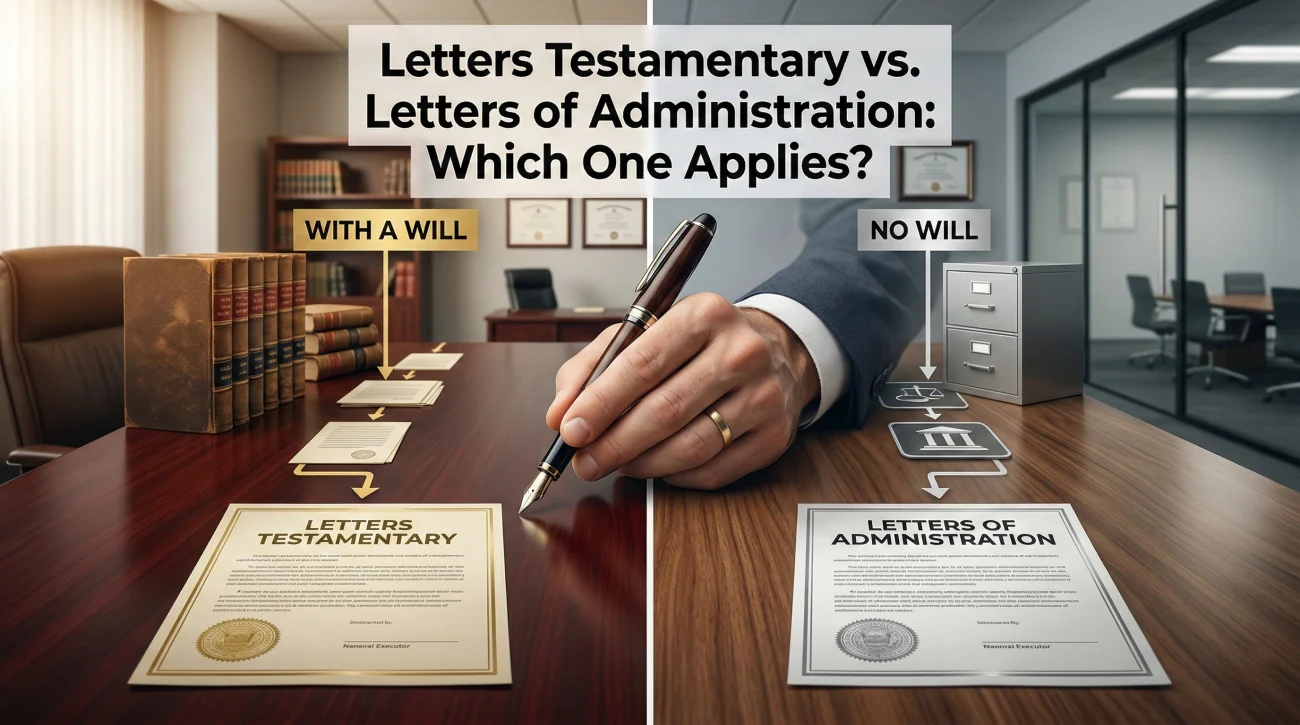
The primary difference is origin: Letters Testamentary are issued when the court validates a will, while Letters of Administration are issued when there is no will or the named executor cannot serve. Administrators usually face a longer, more heavily supervised timeline, often requiring specific court hearings to sell real estate (adding 45 to 90 days … Read more

Probate Without a Will: The Court Appointment Process Before You Can Act

Probate Without A Will

The starting reality: When there is no will, no one has the legal authority to access accounts or manage assets until the court officially appoints an administrator. The first 72 hours: Focus entirely on securing physical property, ordering death certificates, and pausing incoming mail. Your core objective: Gather a clear family tree and a structured … Read more

Letters of Administration: What the Document Proves and How It Gets Used

Letters Of Administration

The core purpose: Letters of administration are the official court document that proves you have the legal authority to manage an estate when there is no will. The main unlock: This single document shifts your status from “family member” to “legal administrator,” forcing banks, insurers, and utilities to speak with you. The exemptions: Not everything … Read more

Letters Testamentary: What They Prove and Why Banks Keep Asking

Letters Testamentary

The permission slip: Letters Testamentary are the official court documents proving a judge has validated the will and granted you legal authority. Why a will is not enough: Financial institutions require court documents to shield themselves from liability before releasing account access or funds. What desk workers verify: Third parties typically check for your exact … Read more