- A small estate affidavit is a sworn document used to claim assets without a full court process, but it requires strict adherence to local limits.
- Eligibility relies on a strict value cap (which usually excludes joint and beneficiary accounts), asset types (real estate is generally excluded), and a mandatory waiting period.
- Different asset types require different approaches; for example, your local DMV may have its own specific form for vehicles.
- Even with a valid form, banks have internal compliance rules. If rejected, ask for the reason in writing and escalate to their centralized estate department.
- Always verify requirements directly on your county court website and build an accurate asset snapshot before signing any sworn statements.
Navigating the Alternative Path: When a Shortcut Actually Works
When I sit down with families who are just beginning to organize an estate, the very first question I usually hear is whether they can skip the court process entirely. Formal probate can feel heavy, paper-intensive, and slow. Naturally, people look for a faster route. In many situations, that alternative route is known as a small estate affidavit.
In my experience helping executors and families track their administrative workflows, the small estate affidavit vs probate decision is one of the most common early hurdles. People often assume that if an estate feels “small” to them, they can automatically use a simplified form. Unfortunately, the administrative reality is much more rigid. The rules regarding when you can avoid probate with a small estate affidavit are set by local jurisdictions, and they leave very little room for interpretation.
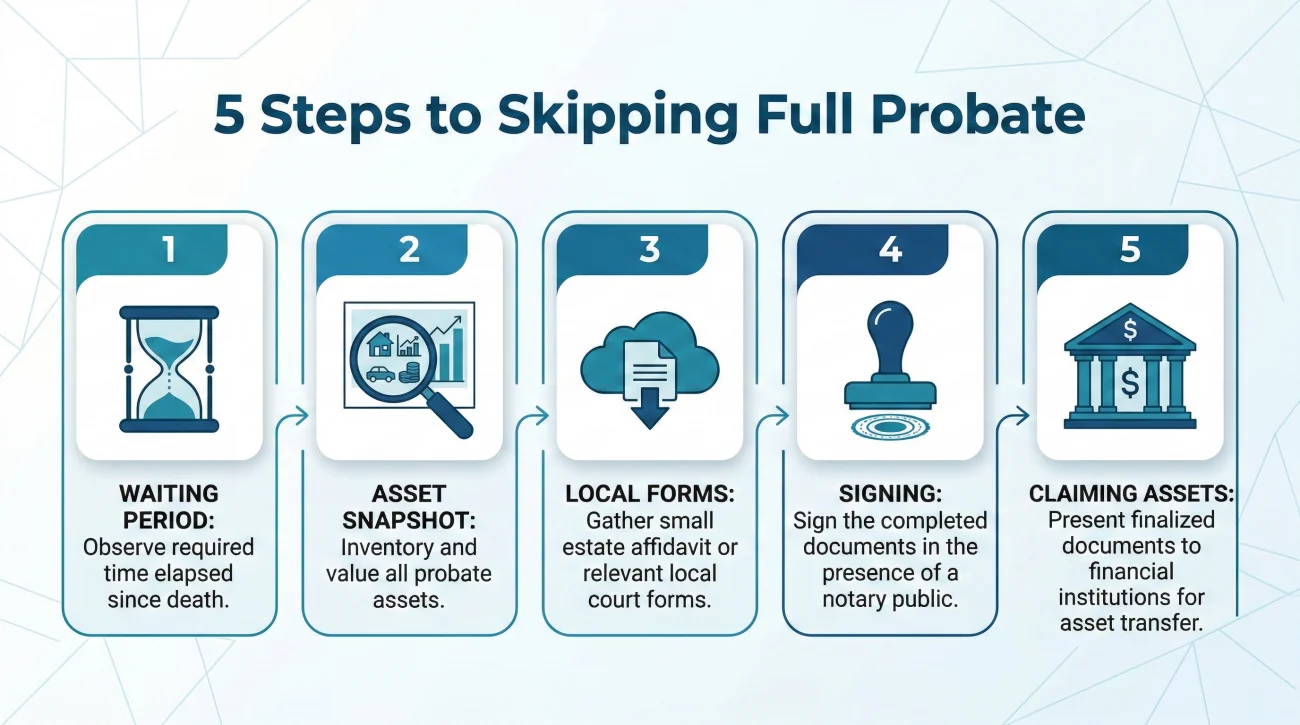
My goal here is to share the operational patterns I see every day. I want to help you understand the boundaries of this document, how institutions actually process it, and what you need to track to keep your paperwork organized. Before we look at the specific requirements, it helps to visualize the standard workflow for this shortcut:
- ⏳ Step 1: Wait for the state-mandated waiting period to pass.
- 📋 Step 2: Build an accurate asset snapshot to confirm the estate is under the value limit.
- 🏛️ Step 3: Download the correct local forms (court or DMV).
- ✍️ Step 4: Sign under oath and notarize (or file with the court, if required locally).
- 🏦 Step 5: Present the sworn document directly to the institution to claim the asset.
What a Small Estate Affidavit Is (And What It Isn’t)
Before gathering any paperwork, it is vital to understand what this document actually represents. A small estate affidavit is not a court order. It is a sworn statement, signed by someone claiming the right to inherit or manage specific assets, stating that the estate meets certain simplified criteria. You are essentially promising, under penalty of perjury, that the estate is small enough and simple enough that it does not require a judge’s oversight.
When a formal probate case is opened, the court issues official documents (like Letters Testamentary or Letters of Administration) that grant broad authority to an executor. A small estate affidavit does not grant you broad authority over everything. Instead, it is usually a targeted tool used to transfer specific, identified assets like a single bank account or a specific vehicle.
You apply to the court, wait for official letters of authority, and use those letters to interact with all banks, creditors, and agencies across the board.
You wait for a mandatory period to pass, sign a sworn statement listing specific assets, and present that statement directly to the institution holding the asset to claim it.
I often remind families that using a small estate affidavit to avoid probate is a privilege, not a guarantee. The institution holding the funds still has to review the document, verify that it meets their internal risk compliance standards, and agree to release the funds based on your sworn word rather than a judge’s order.
Core Eligibility Themes: The Universal Boundaries
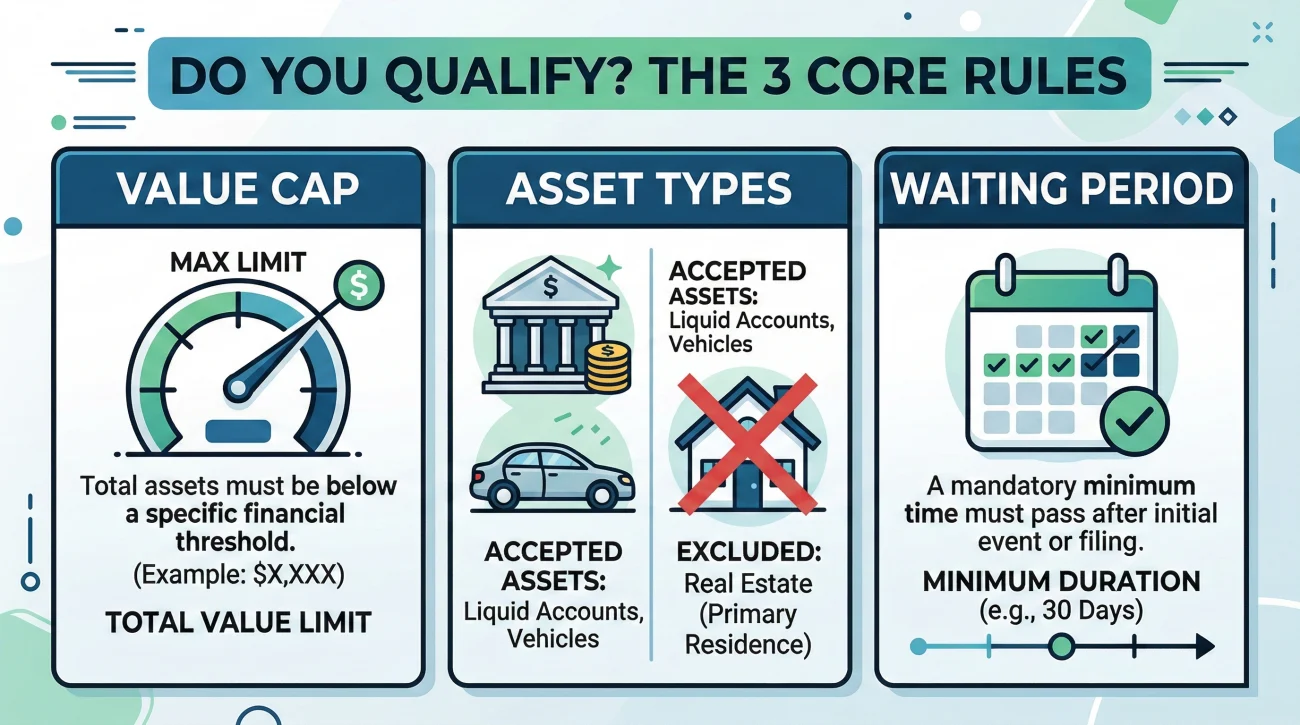
While I cannot give you the exact rules for your county, I can tell you that almost every local jurisdiction uses the same three themes to determine small estate affidavit requirements. If you miss the mark on any one of these three, you will likely be pushed back toward the standard court process.
1. The Overall Value Cap
Every jurisdiction sets a maximum value limit for the estate. If the total value of the deceased person’s assets exceeds this cap, the affidavit cannot be used. The crucial operational detail here is how that value is calculated. Often, jurisdictions look at the gross value of the assets, meaning they do not subtract debts. You must meticulously document your valuation sources so that if an institution questions your math, you have a clear paper trail.
Key Point: Assets that bypass probate automatically do not usually count toward the small estate limit. This includes joint bank accounts with right of survivorship, payable-on-death (POD) accounts, or life insurance with a living beneficiary. This rule often saves families, as it can keep a seemingly large estate well under the local value threshold.
2. The Types of Assets Involved
Not all assets are treated equally. Small estate affidavits are generally designed for personal property, such as bank accounts and personal belongings. Real estate and land present a unique hurdle that almost always disqualifies an estate from using this simple form, which we will explore in the red flags section below.
3. The Mandatory Waiting Period
You almost never can use a small estate affidavit the day after someone passes away. Jurisdictions typically require a mandatory waiting period (commonly ranging from a few weeks to over a month) before the document can be signed or presented. This pause exists to allow time for a will to be found, for creditors to come forward, or for other family members to surface. Attempting to submit an affidavit before this clock runs out is a very common administrative mistake that results in immediate rejection.
The Red Flags: Common Disqualifiers
Even if you meet the value cap and wait the required time, certain complexities will make a small estate affidavit unworkable. In my day-to-day admin work, I encourage families to look for these red flags early. Spotting them saves you from wasting weeks filling out paperwork that will ultimately be rejected.
⚠️ Warning: Do not attempt to hide assets to keep the estate value under the limit. Signing an affidavit is a sworn legal oath. Undervaluing the estate intentionally can lead to severe legal and financial consequences.
The Real Estate Hurdle
Trying to transfer a house deed using a simple sworn statement is usually impossible because title insurance companies require absolute legal certainty. If the deceased owned a home solely in their name, you should generally prepare for a more formal process.
💡 Field Note: The “It’s Just a Small Piece of Land” Pattern
I frequently see families try to use an affidavit because the deceased only owned a tiny, low-value plot of vacant land. The family assumes that because the monetary value is low, it qualifies. But the administrative friction comes from the type of asset, not just the price tag. Title companies and county recorders almost always demand clear court authority to change property ownership, regardless of value.
Family Dynamics: Disputes vs. Agreement
Affidavits only work smoothly when everyone is on the same page. If there is a dispute among family members about who should get what, the informal route collapses. Institutions and courts rely on these documents being undisputed.
However, even when multiple heirs agree perfectly, you still must navigate the logistics. If three siblings inherit equally, who signs the paper? Depending on local rules, all heirs may be required to sign and notarize the document together, or the siblings may need to sign formal waivers allowing one person to act as the primary claimer. Never assume one person can sign for everyone without written consent.
An Already-Open Probate
You cannot use a small estate affidavit if a formal probate case has already been opened or if a personal representative has already been appointed by the court. The affidavit is an alternative to probate; the two processes cannot run simultaneously.
Taking Inventory: The Asset Snapshot and Special Handling
Before you can safely decide if you qualify for this shortcut or approach any banks, you need a highly organized list of what the person owned. Guessing the values is a common mistake that leads to rejected documents. I recommend creating a master “Asset Snapshot” to calculate the total value accurately before making any legal decisions.
| Asset Category | Verification Action Needed | Common Pitfall |
|---|---|---|
| Bank Accounts | Request date-of-death balance statements. | Forgetting to check for safe deposit boxes tied to the account. |
| Joint & POD Accounts | Confirm beneficiary status in writing with the bank. | Accidentally including these balances in the small estate total limit. |
| Physical Property | Log valuable items (jewelry, art, collectibles) conservatively. | Overestimating value without an appraisal, artificially inflating the estate limit. |
| Vehicles | Find the physical title and check standard market value. | Discovering an active lien or a co-owner listed on the title. |
| Digital Accounts | Check platforms like PayPal, Venmo, or crypto exchanges. | Missing funds because no paper statements were mailed. |
Beyond the standard checking account, some assets require a completely different administrative pathway, even if the estate is technically small.
The DMV Route for Vehicles
Transferring a car title is so common that many state Departments of Motor Vehicles (DMVs) do not use the general court affidavit at all. Instead, they provide their own specific, highly simplified vehicle transfer form. This process is usually completely separated from bank accounts. Always check your local DMV website for a “deceased owner title transfer” packet before filling out standard court forms for a car.
Digital Wallets and Payment Apps
Balances sitting in PayPal, Venmo, Cash App, or cryptocurrency wallets are easily overlooked. You cannot walk into a local branch to claim these funds. To use an affidavit for these accounts, you must search the platform’s help center for their specific bereavement or deceased account team. Standard customer service agents are rarely trained to handle these legal documents.
❌ Note: Do not use the deceased person’s passwords or phone to manually transfer funds out of a payment app. This violates the terms of service and can trigger immediate fraud locks. If you do not have the passwords, or if the platform lacks a clear bereavement policy, a simple small estate affidavit might not be enough to compel them to communicate. In those edge cases, you may be forced to obtain formal court orders to recover the digital funds.
The Reality Check: Dealing with Banks and Rejections
One of the most frustrating moments for a family is getting a state-approved affidavit notarized, bringing it to a bank, and having the teller refuse it. Banks, brokerages, and insurance companies are terrified of releasing funds to the wrong person and being sued later. Therefore, they often build their own internal policies.
Sometimes, a bank will refuse the standard state form entirely and demand that you fill out their own proprietary, internally drafted affidavit. To avoid unexpected rejections, I highly recommend calling the institution’s estate department before you finalize any paperwork.
Script: Requesting Institution-Specific Requirements
Hello, I am handling the final affairs for [Name]. The estate is small and we believe it qualifies for a small estate process.
Before I submit any documents, could you please provide your institution’s specific written requirements for processing a small estate claim?
Specifically, do you accept a standard state affidavit, or does your legal department require us to use your own proprietary form? Please send the checklist of accompanying documents to my email at [Email Address] so I can ensure the packet is complete.
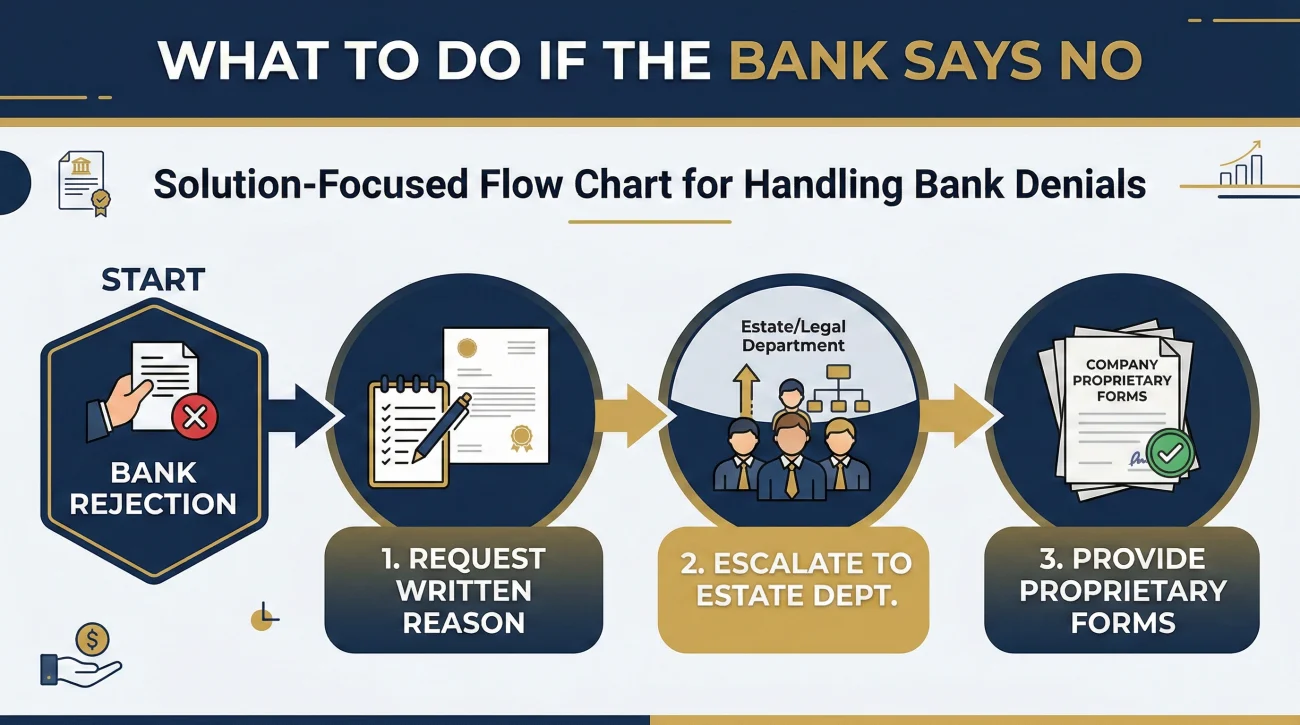
What to Do If the Bank Rejects Your Affidavit
If a bank representative refuses your form, remain calm and treat it as a process issue, not a personal block. Ask for the rejection, and the specific reason, in writing. Next, politely ask to escalate the review to their centralized estate or legal department, as branch tellers often lack the authority to approve alternative documents.
If their legal department formally refuses the document (which happens if their internal risk policies are stricter than state law), you may be forced to open a formal probate case to secure a judge’s order. This is why getting their requirements in writing early is crucial.
How to Verify Local Requirements Without Guessing
Because the rules are fiercely local, your single source of truth must be the probate court or surrogate’s court in the county where the deceased person lived. Do not rely on generic internet articles to tell you the value limit, because the limits change over time due to legislative updates.
When searching online, look for official county or state government websites (URLs ending in .gov or official state court domains). Search for phrases like “[County Name] Probate Court small estate affidavit instructions.” Many courts provide free, downloadable packets that include the blank form and a checklist of required attachments.
Script: Calling the Court Clerk for Clarification
Hello, I am looking for the administrative requirements for filing a small estate affidavit in this county.
Could you tell me exactly where on your website I can download the current checklist and forms? Also, does this county require the affidavit to be filed and stamped by the court first, or do I simply get it notarized and take it directly to the banks?
Thank you for your time.
This is a critical procedural detail: in some places, you just notarize the paper and walk into the bank. In other places, you must file it with the court, pay a small fee, and get a certified stamp before any bank will look at it. Always confirm this workflow step.
Final Thoughts on Skipping Full Probate
The small estate affidavit is a powerful tool, but it requires precision and excellent recordkeeping. By taking the time to build an accurate asset snapshot, respecting the mandatory waiting periods, and confirming requirements in writing with both the court and the financial institutions, you can dramatically reduce the friction in the process.
However, if your situation involves real estate, family tension, or a complicated web of debts, it is often safer to proceed with the standard court process rather than trying to force a shortcut that does not fit. Before you make a final decision, I strongly recommend reviewing the broader picture of what court authority entails. Make sure you understand the baseline requirements by reading our Probate Court Checklist for Executors. Having a clear view of the entire landscape is the best way to choose the right path forward.
❓ FAQ
🗣️ Can you avoid probate with a small estate affidavit?
Yes, in many cases. If the estate falls below your local value limit, contains no real estate, and meets the waiting period requirements, this sworn document can be used to claim assets without going through a formal, lengthy court proceeding.
⏳ How long does a small estate affidavit take to process?
The timeline depends heavily on the mandatory waiting period required by your local jurisdiction, which often ranges from 15 to 45 days after the date of death. Once that period passes and the document is signed, the speed depends on how quickly the specific bank or institution processes the paperwork.
🏦 Will the bank accept a small estate affidavit immediately?
Not always. Banks have their own risk and compliance departments. Even if you have a valid, notarized state form, the bank may require you to fill out their internal version of the affidavit or ask for additional identity verification before releasing funds.
🏠 Can I use a small estate affidavit if there is a house?
Usually, no. In most jurisdictions, the presence of real estate automatically disqualifies the estate from using this simple process. Transferring a property deed generally requires clear, formal court authority to satisfy title insurance requirements.
📝 Do I need to go to court for a small estate affidavit?
It depends entirely on local rules. In some areas, you simply get the form notarized and present it directly to the bank. In other areas, you are required to file the document with the local probate clerk and receive a certified stamp before it becomes valid.
💰 Does life insurance count towards the small estate limit?
Generally, if a life insurance policy has a named, living beneficiary, it passes directly to that person outside of the estate. Because it is not considered an estate asset, it typically does not count toward the overall value limit.
🤷 What happens if I find more money after filing the affidavit?
If you discover additional assets that push the total value of the estate over the legal limit, the affidavit may become invalid. You will likely need to stop using the document and open a formal probate case to handle the newly discovered funds.
🛑 Can a bank refuse a small estate affidavit?
Yes. If the bank suspects fraud, if the paperwork is incomplete, if there is a family dispute, or if the form does not meet their internal legal standards, they can refuse it. Always ask for their specific requirements in writing beforehand.
✍️ Who needs to sign the small estate affidavit?
Usually, the person claiming the assets (such as the closest heir or the named executor in the will) signs the document under oath. Some states require all living heirs to sign, or require the signatures to be notarized to prevent fraudulent claims.
🚙 Can I use this process just to transfer a car title?
Yes, many people use this specifically for vehicles. In fact, many state Departments of Motor Vehicles (DMV) have their own specialized, simplified small estate forms used exclusively for transferring vehicle titles without needing court involvement.
⚠️ Disclosure: I'm not an attorney and nothing on this site is legal or tax advice. The content covers process, organization, and workflow—the operational side of estate administration. For legal interpretation, jurisdiction-specific deadlines, contested situations, or tax matters, please work with a licensed professional in your state.