

- The Bank’s Priority: Banks manage liability. They will not grant access until they can verify your identity, your legal authority, and the specific ownership type of the account.
- Account Type Controls Access: A will does not automatically override how an account is set up. Joint accounts and POD (Payable on Death) accounts typically bypass the estate entirely.
- The Paperwork Packet: Success at the teller window requires a specific, organized set of documents. Handing over loose papers often leads to rejection and repeated trips.
- The Estate Account: Think of an estate bank account as a clean, new bucket for the deceased’s assets. It prevents the dangerous mixing of estate money with your personal funds.
- Preparation is Key: Understanding why an account is frozen and knowing how to communicate with the bank calmly will save you hours of administrative frustration.
Why the Bank Keeps Saying “We Can’t Help You Yet”
I have sat across the table from many families who are exhausted, grieving, and holding a perfectly valid will, only to be turned away by a bank teller. If you are stepping into the role of an executor, the bank is often the very first administrative wall you will hit. You walk in expecting the will to act like a master key. Instead, the bank representative politely but firmly explains that they cannot give you access, cannot tell you the balance, and cannot let you pay the mortgage from the deceased person’s checking account.
This experience is incredibly common. In my daily administrative work, I see this cause more initial frustration than almost any other step in the estate process. The immediate reaction is usually to feel like the bank is being unreasonable or overly difficult. But understanding why the bank operates this way is the first step to navigating the system successfully.
Banks are not trying to be difficult; they are built entirely around risk management. When an account holder dies, the bank’s primary legal obligation is to protect the funds from unauthorized access. If they hand money over to the wrong person, even a well-meaning family member, the bank is liable. Therefore, they default to a frozen state until you can provide a very specific, standardized set of proofs.
This guide is your map through that process. I am going to walk you through exactly what banks are looking for, how different types of accounts completely change the rules of access, and how to build a paperwork packet that actually gets accepted. We will focus strictly on the banking mechanics. If you need to understand the broader court process of being appointed, or the general tasks of an executor, those are separate administrative phases entirely. Here, we are focusing purely on unlocking the financial doors.
Key Point: Do not take a bank’s initial refusal personally. It is a system designed to say “no” until a very specific set of documentation says “yes.” Your job is simply to provide the “yes” in the format they require.
The Three Pillars of Bank Verification
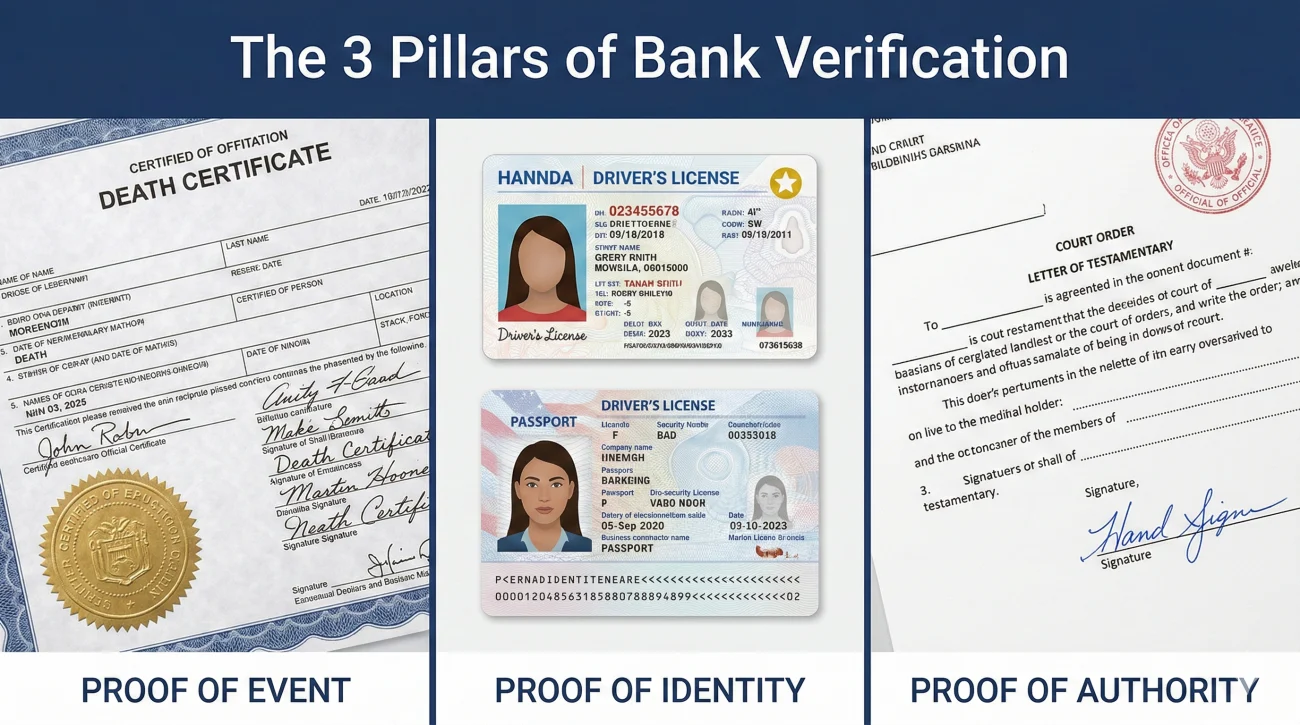
Whenever you interact with a financial institution after a death, the representative on the other side of the desk or phone is mentally checking off three distinct boxes. If any one of these boxes is empty or unclear, the process stops. I always tell people to mentally prepare these three pillars before making a phone call or scheduling a branch visit.
1. Proof of the Event
The bank first needs undeniable, official proof that the account holder has passed away. They cannot act on a phone call, an obituary, or a word-of-mouth notification. They require a government-issued death certificate. Furthermore, they almost always require a certified copy, meaning it has a raised seal or specific official watermark from the vital records office. A simple photocopy from your home printer is rarely sufficient for the initial notification.
2. Proof of Your Identity
The bank needs to know exactly who they are handing information or money to. This means your unexpired, government-issued photo ID. But it goes deeper than just having an ID. The name on your ID must exactly match the name listed on the legal documents granting you authority. If your legal name is “Robert James Smith” on your driver’s license, but the court document names “Bob Smith,” you are going to face delays. Consistency in your identity documentation is crucial.
3. Proof of Your Authority
This is where the biggest misunderstanding happens. A will is a document that states the deceased person’s wishes. However, to a bank, a will is not a document of authority. Only a court can grant authority. The bank needs to see the official court document usually referred to generically as “Letters” that formally appoints you to act on behalf of the estate. Until they see that court stamp, they view you legally as a stranger to the account, regardless of your relationship to the deceased.
Walking into the bank with the will, your ID, and asking to see the account balances so you can start paying bills.
Calling ahead to the bank’s estate department, asking exactly which certified documents they require for an appointment, and arriving with a prepared packet.
How Account Types Change Everything
One of the most important lessons I share with people navigating estate administration is this: the name on the account matters, but the structure of the account matters more. The rules of access change entirely based on how the deceased person set up the account while they were alive. In many cases, the structure of the account completely bypasses the will and the probate process.
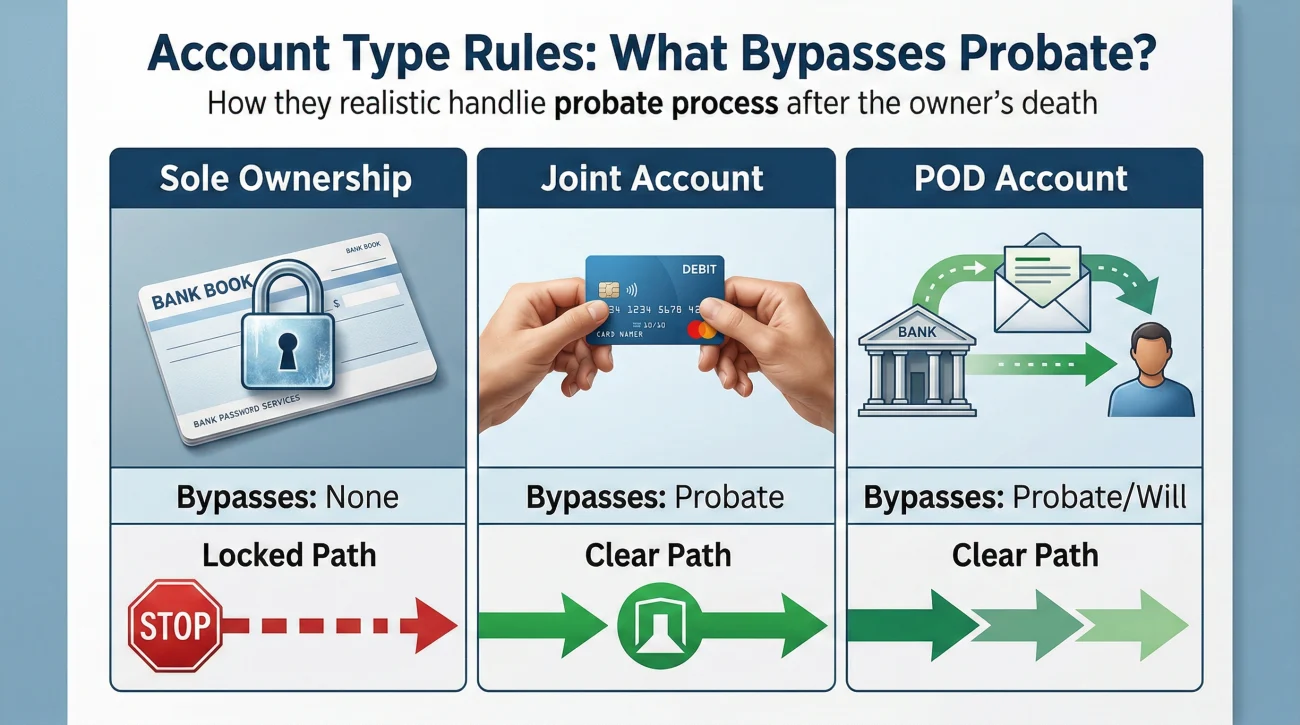
Sole Ownership Accounts
These are accounts owned entirely by the deceased person, with no other names attached and no special beneficiaries designated. When the owner dies, these assets typically become part of the formal estate. These are the accounts that are most strictly locked down by the bank. To access a sole ownership account, you will almost certainly need the formal court appointment documents. The bank will hold these funds frozen until you prove you are the legally appointed executor.
Joint Accounts with Rights of Survivorship
If the account was held jointly, usually with a spouse or a trusted adult child, things operate very differently. In most typical setups, when one joint owner passes away, the surviving owner automatically retains full ownership and access to the account. The account does not enter the estate, and the executor (if it is someone other than the surviving owner) generally has no authority over it.
For joint accounts, the surviving owner usually just needs to present a certified death certificate to the bank to have the deceased person’s name removed. The funds remain accessible to the survivor to pay bills or manage expenses. This is a common point of confusion when an executor expects to take control of an account, only to find out a joint owner already has full rights to it.
Payable on Death (POD) or Transfer on Death (TOD)
These are sole ownership accounts where the owner filled out a specific form with the bank to name a beneficiary. “When I die, pay the balance of this account directly to my sister.” Like joint accounts, POD and TOD accounts generally bypass the estate and the will.
If you are the executor, you typically have no control over a POD account. The named beneficiary simply goes to the bank with their ID and a certified death certificate to claim the funds. If you are both the executor and the named beneficiary, you are claiming the funds in your capacity as a beneficiary, not as the executor.
The Small Estate Pathway (Bypassing Full Probate)
There is a massive exception to the strict “Letters” requirement that many executors miss, and it can save you months of waiting. If the total value of the deceased person’s estate falls below a certain dollar threshold (which varies wildly by state, often sitting anywhere from $25,000 to $150,000), you may not need to go through formal probate at all.
Instead, many states allow you to use a “Small Estate Affidavit.” This is a sworn, notarized document stating the estate is small enough to qualify for simplified procedures. When presented alongside a certified death certificate and your ID, banks will often accept this affidavit in lieu of formal court Letters and release the funds. If you are dealing with a relatively modest estate, always verify your local small estate limits before spending the time and money to get a formal court appointment.
💡 Pro Tip: Before you spend weeks trying to get court authority to access a specific checking account, look at old statements if you have them, or look for beneficiary designation paperwork. Finding out an account is POD can save you a massive amount of administrative effort.
Building the Bank-Facing Document Packet
When you finally have your appointment and are ready to approach the bank, how you present your documents is almost as important as the documents themselves. I cannot stress this enough: do not walk into a bank with a disorganized grocery bag full of loose mail and legal papers. It slows down the representative, increases the chance of them missing something, and often results in you being sent home to find “one more thing.”
You need to build a clean, specific “Bank-Facing Packet.” This is different from your master executor file. The bank does not need to see the funeral receipts, the utility bills, or the appraisal of the house. They only need the documents that prove the three pillars we discussed earlier.
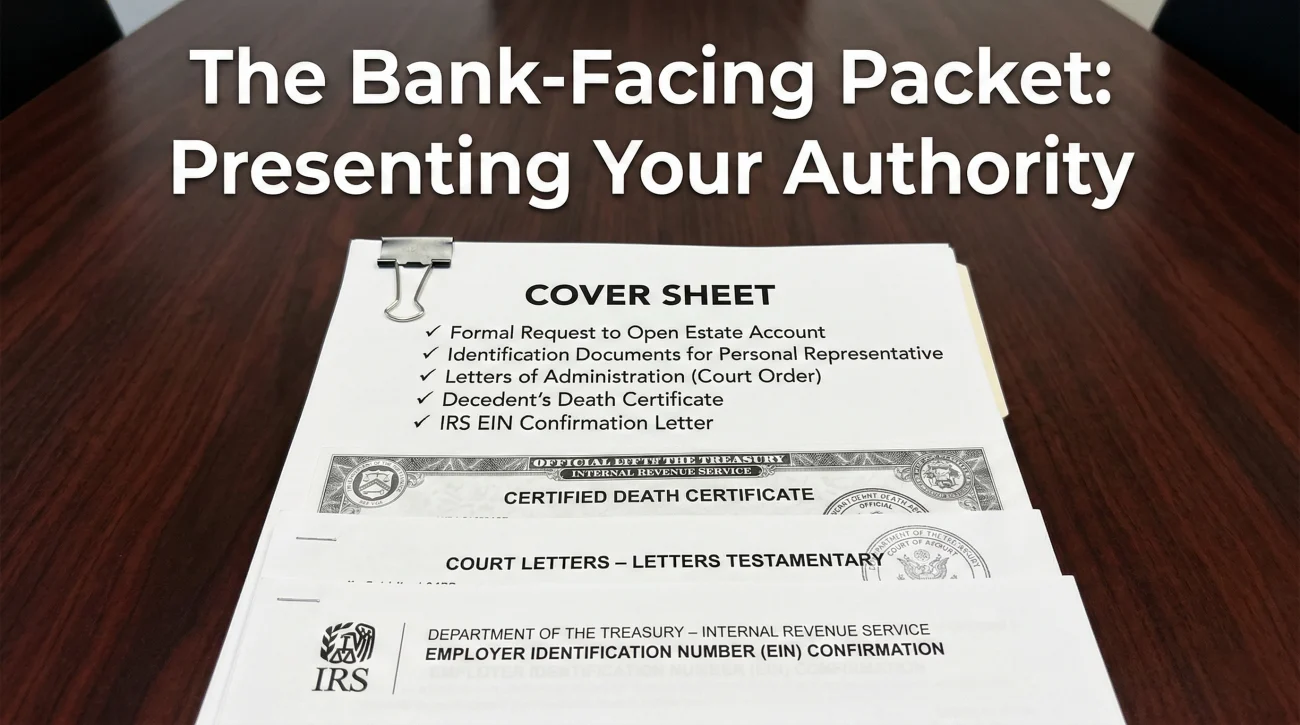
What Typically Goes in the Packet
In my experience, a successful bank packet usually contains the following items, securely clipped together in this order:
- ✅ Cover Sheet: A simple typed page listing the deceased person’s name, their date of death, your name, your contact information, and a bulleted list of the documents you are attaching.
- ✅ Proof of Identity: A clear photocopy of your driver’s license or passport (you will also show them the original).
- ✅ Proof of Death: One certified original death certificate. The bank will typically make their own copy and hand the original back to you, but they must see the raised seal.
- ✅ Proof of Authority: The certified original court document (Letters or Small Estate Affidavit) appointing you. Again, they need to see the seal and the date.
- ✅ Tax Identity: If you are opening an estate account, the official IRS assignment letter showing the new Estate EIN.
- ✅ Account Context: If you have them, a copy of the most recent bank statement or the account numbers. This gives the representative exactly where to look in their system.
By handing over a neat, organized stack with a cover sheet, you immediately signal to the bank representative that you are organized and prepared. It changes the entire tone of the interaction from chaotic to professional.
Sample Packet Cover Sheet Text
Estate of: [Deceased Name]
Date of Death: [Date]
Executor: [Your Name]
Phone: [Your Phone Number]
Documents Included in this Packet:
– Certified Death Certificate (Original to be viewed and returned)
– Certified Court Appointment Document (Original to be viewed and returned)
– Copy of Executor’s Government Issued ID
– Recent Account Statement for Account ending in 1234
The Estate Bank Account: Your Administrative Bucket

Once you have access to the deceased person’s funds, what do you do with them? The standard, safest operational practice is to consolidate the estate’s liquid assets into a specialized checking account known as an Estate Account. This is a temporary account used solely for the duration of the administration process.
I cannot emphasize this strongly enough: never, ever deposit estate funds into your personal bank account. This is called commingling, and it is an administrative nightmare. If a beneficiary questions an expense, or a creditor demands an accounting, untangling estate money from your personal grocery and mortgage payments is incredibly difficult and exposes you to immense personal liability.
The estate account acts as a clean bucket. Every penny that belongs to the estate goes into this bucket. Every legitimate estate expense, such as the funeral, the utility bills for the empty house, and the final taxes, are paid out of this bucket. This creates a perfect, transparent paper trail. When it is time to close the estate, the bank statements from this single account serve as a clear record of exactly what happened to the money.
To open this account, you generally bring your bank-facing packet (Death Certificate, ID, Court Letters) plus one additional critical document: the Estate EIN.
⚠️ Warning: Avoid writing checks to “Cash” from the estate account. Always write checks to specific vendors or service providers to maintain a crystal-clear audit trail of where the funds went.
The Estate EIN: The New Tax Identity
When a person dies, their Social Security Number effectively dies with them for the purposes of new financial business. You cannot open a new bank account, like an Estate Account, using a deceased person’s Social Security Number. The bank needs a valid tax identification number to report any interest earned to the government.
Because the estate is a new, separate legal entity, it needs its own tax ID number. This is called an Employer Identification Number (EIN). Despite the word “Employer,” you do not need to have employees to get one; it is simply the term used for businesses, trusts, and estates. You can apply for this number directly through the IRS.
When I help organize an executor’s paperwork, getting the EIN is usually one of the very first tasks completed after receiving the court appointment. You will print the confirmation letter from the government and add it to your bank-facing packet. When the bank representative asks, “What is the tax ID for this new account?” you hand them the EIN letter. It is a simple administrative step, but an absolutely required one for opening an estate account.
Why Accounts Get Frozen (And What It Means)
Often, an executor will try to use the deceased’s debit card to pay a final utility bill, only to find the card is declined. They call the bank and learn the account has been frozen. Sometimes, the account is frozen before the family has even notified the bank of the death.
This causes immediate panic, but it is a normal part of the process. How does the bank know? Banks subscribe to data feeds, often tied to the Social Security Administration’s death records. When a death is officially recorded, the automated systems flag the associated Social Security Number, and the banks automatically freeze sole-ownership accounts linked to that number.
A freeze is not a punishment or an accusation; it is a hard pause. The bank is hitting the brakes to ensure no automatic withdrawals drain the account inappropriately, and no unauthorized person accesses the funds. The money is safe; it is simply locked in a holding pattern until you arrive with your bank-facing packet to prove you have the authority to manage it.
Paying Bills When You Don’t Have Bank Access Yet
This creates a stressful gap period. The bank account is frozen, but the electric company still wants to be paid so the pipes in the house don’t freeze. You don’t have court authority yet, so you can’t access the estate funds. What do you do?
In many cases, the most practical approach is communication rather than payment. I advise executors to contact the utility companies, mortgage lenders, and other ongoing services immediately. Explain the situation calmly. Let them know the account holder has passed away, that the estate administration is in progress, and that the bank accounts are currently frozen awaiting court documents.
Most utility companies have bereavement policies and will place a temporary hold on the account to prevent shutoffs or late fees while you secure your authority. It requires getting on the phone and keeping detailed notes of who you spoke to and when.
If an expense is absolutely critical (like a small repair to secure the home) and you choose to pay it out of your own pocket, you must keep meticulous receipts. Once the estate account is open, you can usually reimburse yourself from the estate funds, but only if you have a perfect paper trail proving the expense was legitimate and necessary for the estate.
Sample Script: Contacting a Utility Company Before Bank Access
“Hello, I am calling regarding the account for [Deceased Name] at [Property Address]. Sadly, they have passed away. I am in the process of being appointed as the executor, but the bank accounts are currently frozen until the court paperwork is finalized in a few weeks. I am calling to notify you of the death and request that a temporary administrative hold be placed on the account so services are not interrupted while we wait for access to the estate funds. Could you please note this on the account and let me know if you need me to send a copy of the death certificate?”
Recordkeeping That Stops Bank Request Loops
The banking phase involves a lot of phone calls, a lot of documents sent via fax or secure portal, and unfortunately, a lot of lost paperwork. A pattern I see constantly is an executor sending a document, the bank losing it, and the executor having no proof it was sent, causing weeks of delay.
You must adopt a defensive recordkeeping posture. Treat every interaction with a financial institution as if you will need to prove it happened six months from now. Maintain a simple, running log of every bank interaction.
When you call the bank’s estate department, note the date, the time, the name of the representative, and their direct extension or employee ID if they will provide it. Write down exactly what they asked for. When you submit documents, always ask for an email confirmation or keep the fax transmission receipt. If you mail physical documents, use tracked mail.
When you name your digital files before uploading them to a bank portal, be wildly specific. Do not name a file “scan.pdf.” Name it “2024-10-27_DeathCertificate_JohnDoe.pdf”. This makes it infinitely easier for both you and the bank representative to find exactly what is needed without opening ten different files.
💡 Pro Tip: Instead of just sending an email with an attachment, use a clear communication framework: state exactly what document you are providing, use a highly specific file name for clarity, and explicitly ask the bank representative to reply confirming they have successfully received and opened the file.
When the Bank is Wrong (How to Escalate)
Even when you have a perfect bank-facing packet, you might encounter a bank representative who gives you incorrect information, repeatedly loses your files, or incorrectly refuses a legally valid Small Estate Affidavit. I have seen executors stalled for months because a frontline teller misunderstood their own bank’s estate policies.
If you hit an unreasonable wall, stop arguing with the frontline staff. Politely ask to speak directly with the branch manager or request to be transferred to the bank’s specialized “Estate and Bereavement Department.” If the bank still refuses to cooperate or release funds despite you providing correct legal documentation, you have escalation paths. For national banks, you can file a formal complaint with the Office of the Comptroller of the Currency (OCC) or the Consumer Financial Protection Bureau (CFPB). Often, just mentioning that you are preparing to file a CFPB complaint regarding their refusal to honor valid court documents will prompt the institution’s legal department to quickly resolve the issue.
Executor Banking Topic Library
Because banking touches so many different aspects of estate administration, we have broken down specific hurdles into deep-dive guides. Use the table below to find detailed operational steps for the exact banking challenge you are facing right now.
| Topic Guide | What You Will Learn |
|---|---|
| Executor Bank Documents Checklist: The Bank-Facing Packet | Exactly how to build the 3-stack paperwork packet that reduces repeated branch visits. |
| Why the Bank Won’t Talk to You Even If You Have the Will | The difference between stated wishes and court authority, and why banks require the latter. |
| Using Letters for Bank Access: What Banks Typically Verify | How bank representatives scrutinize court documents for names, dates, and certified seals. |
| Can an Executor Access Bank Accounts Before Probate? | The decision map for accessing sole vs. joint accounts, and common small-estate routes. |
| Bank Account Frozen After Death: What It Usually Means | Why freezes happen automatically and the normal triggers that lift them. |
| Do You Need an Estate Bank Account as Executor? | A safe rule-of-thumb guide to deciding if a separate account is necessary to prevent commingling. |
| Opening an Estate Bank Account: What Banks Commonly Ask For | The typical requirements and paperwork stacks needed to establish a new estate checking account. |
| Estate EIN vs. the Deceased Person’s SSN: Why Banks Ask | Understanding the tax identity shift and why the old Social Security number is no longer valid. |
| Check Made Out to “Estate of …”: Why It’s Hard to Deposit | Why personal deposit of estate checks fails and the steps needed to process them correctly. |
| Paying Bills as Executor When You Don’t Have Bank Access Yet | Safe framing for managing immediate expenses without improperly improvising with accounts. |
| Recordkeeping for Bank Requests: The Minimal System | How to track what the bank asked for and what you sent to prevent endless repeat paperwork loops. |
| Closing an Estate Bank Account: What to Expect After Settlement | A high-level overview of the final step: closing the bucket and keeping a clean record of distribution. |
Final Thoughts on Navigating the Banks
Dealing with banks after a loved one passes away tests your patience more than almost any other administrative task. The bureaucracy feels cold and inflexible. But remember, this rigid process is their way of protecting the assets until the proper legal verification is complete.
By shifting your mindset from expecting immediate access to preparing a methodical, well-documented bank-facing packet, you change the dynamic. You move from being a frustrated customer asking for favors to an organized executor providing the exact data points the institution requires. Focus on the three pillars: the Death Event, your Identity, and your Authority. Build your packet carefully, keep meticulous notes of every interaction, and set up your estate account as a clear, centralized ledger for all financial activity. If you approach the banking phase with organization and calm persistence, you will get through the wall.
Sources and Reference Information
To further understand the foundational rules that govern bank accounts and tax identities after a death, you can review these neutral, authoritative resources:
- 📄 Consumer Financial Protection Bureau (CFPB): What happens if I have a joint bank account with someone who died? – Official guidance on how joint accounts and survivorship rights impact account ownership after a death.
- 📄 Internal Revenue Service (IRS): Apply for an Employer Identification Number (EIN) Online – The official IRS portal explaining how to obtain an EIN, which is required before opening an estate checking account.
- 📄 Office of the Comptroller of the Currency (OCC): HelpWithMyBank – The official federal resource and complaint portal for escalating unresolved issues or documentation disputes with national banks.
- 📄 Consumer Financial Protection Bureau (CFPB): Submit a Complaint – The official portal for escalating unresolved issues with national banks regarding estate access and frozen accounts.
❓ FAQ
⏱️ How long does a bank take to release funds after death?
Once you provide the complete bank-facing packet (Death Certificate, Letters, ID), access is often granted within a few days, though large institutions with centralized estate departments may take several weeks to process the paperwork internally.
💳 Can I use the deceased’s debit card to pay their funeral bill?
It is highly recommended not to. Once a person passes, using their card is generally considered unauthorized access. Funeral homes are accustomed to waiting for estate funds or will guide you on how to pay directly from the estate once authorized.
🤝 What happens to a joint bank account when one person dies?
In most standard joint accounts with rights of survivorship, the surviving owner automatically retains full ownership and uninterrupted access to the funds. They typically only need to present a death certificate to have the deceased’s name removed.
🏦 Do I need an EIN to close a bank account?
You generally do not need an EIN to close the deceased’s original account, but you almost always need an EIN to open the new Estate Account where you will deposit those closed funds.
🔍 How do I find all the bank accounts of a deceased person?
Start by monitoring their physical mail for bank statements or tax documents (like 1099s). You can also review past tax returns for interest reported by specific banks, or check their wallet for debit cards.
❄️ Why did the bank freeze the account before I even told them?
Banks use automated systems linked to government death registries (like Social Security). When a death is officially recorded, these systems often automatically freeze sole-ownership accounts to prevent unauthorized withdrawals.
🛑 Can the bank keep the money if there is no will?
No, the bank does not keep the money. If there is no will, the estate is administered according to state intestacy laws. A court will still appoint an administrator, and the bank will release the funds once that administrator provides the proper court paperwork.
📜 What is a letter of testamentary for a bank?
It is the official court document bearing a certified seal that proves to the bank you have been legally appointed as the executor and have the authority to manage the deceased person’s accounts.
📝 Does a POD account go through probate?
Generally, no. A Payable on Death (POD) account transfers directly to the named beneficiary upon the presentation of a death certificate and ID, bypassing the probate process and the executor entirely.
💰 How much does it cost to open an estate account?
Opening the account itself usually doesn’t have an upfront fee, but estate checking accounts may have monthly maintenance fees or minimum balance requirements that vary by bank, similar to standard business checking accounts.
⚠️ Disclosure: I'm not an attorney and nothing on this site is legal or tax advice. The content covers process, organization, and workflow—the operational side of estate administration. For legal interpretation, jurisdiction-specific deadlines, contested situations, or tax matters, please work with a licensed professional in your state.