
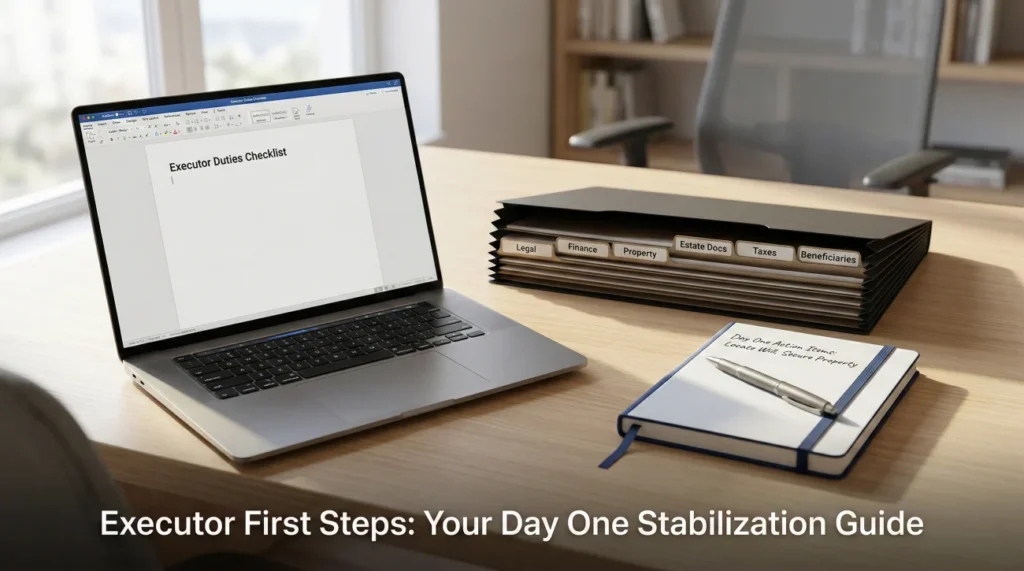
- Secure the immediate environment: Lock the property, care for dependents or pets, and secure physical assets before worrying about any paperwork.
- Freeze financial actions: Do not close bank accounts, transfer funds, or pay off the deceased’s loans immediately. Wait until you have official court authority.
- Build a single tracking system: Start a dedicated folder and a call log spreadsheet on day one. Navigating multiple agencies requires rigorous documentation.
- Locate the core documents: Focus only on finding the original Will, ordering death certificates, and gathering basic identification for now.
- Protect against fraud: Secure the mail and notify major credit bureaus to place a deceased alert and prevent identity theft.
- Secure devices first: Focus on physically securing phones and computers rather than trying to guess passwords or bypass security screens.
The Overwhelm of Day One (And How to Stop It)
When you first realize you are the executor of an estate, the feeling is usually a mix of grief and sudden, heavy responsibility. You are mourning a loss while simultaneously being handed a complex, part-time administrative job that you did not apply for. I have seen this exact moment play out countless times in my work supporting estate administration. You are suddenly handed a massive, disorganized puzzle, and everyone expects you to know exactly how to put it together.
The truth is, nobody is born knowing how to be an executor. The initial days are chaotic because you are stepping into a life that is mid-sentence. Mail is still arriving, subscriptions are still charging, and family members are likely asking you questions you do not have the answers to yet.
Key Point: The biggest mistake I see new executors make is trying to sprint before they know the route. They start calling banks randomly or throwing away paperwork because it looks like junk. Your first job is not to fix everything; your first job is to stabilize the situation.
In this guide, I am going to walk you through the exact executor first steps checklist you need to follow. I will share the operational patterns I see working every day, the scripts to use when you do not know what to say, and the traps that cause massive delays later on. We are going to focus on process, organization, and clear communication.
Your Job in Plain English: What You Do (And What You Do Not Do)
Before we look at a single piece of paper, we need to clarify what your role actually is. Many people assume an executor is a detective, a lawyer, and a financial advisor all rolled into one. You are none of those things.
Your primary role is to act as a project manager. You are the central hub of communication and recordkeeping. You gather information, you protect assets, you pay valid debts using estate funds, and eventually, you distribute what is left according to the Will or local laws.
Here is a practical look at the boundaries I always remind executors to maintain:
You do not pay the deceased person’s debts out of your own pocket. You do not distribute jewelry or cash to family members on day two. You do not guess about legal requirements.
You secure the house keys. You forward the mail. You ask institutions for their requirements in writing. You log every single phone call.
When you understand that your job in the beginning is mostly just asking questions and writing down the answers, the pressure drops significantly. You do not need to be an expert; you just need to be highly organized.
The Three Unlocks: Authority, Documents, and Recordkeeping
In day-to-day admin work, the fastest wins usually come from understanding how institutions view you. Right now, to a bank or a utility company, you are just a stranger on the phone. To get them to speak with you, you need to achieve three “unlocks.”
1. The Authority Unlock
Institutions will not take your word that you are the executor, even if you are holding a Will that names you. They are bound by strict privacy laws. In most cases, true authority only comes when a probate court officially appoints you and issues a document often called “Letters Testamentary” or “Letters of Administration.” Until you have that, expect doors to be closed. Your goal right now is simply to gather the information needed to apply for that authority.
2. The Documents Unlock
Every process requires proof. The death certificate is the ultimate key, but you will also need the original Will, your own government-issued ID, and eventually, statements proving what the deceased owned. Without building a clean, well-labeled document packet early on, you will find yourself constantly searching for the same piece of paper.
3. The Recordkeeping Unlock
This is where I see the most stress. If you rely on your memory, you will fail. An executor might make forty phone calls in the first month. Who did you speak to at the insurance company? Did they say they needed an original death certificate or a copy?
⚠️ Warning: If you do not write down the reference number and the exact name of the form the representative told you to submit, you will likely have to repeat the entire 45-minute phone hold process next week. Poor recordkeeping is the number one cause of estate delays.
The First 48 Hours: Stabilize and Protect
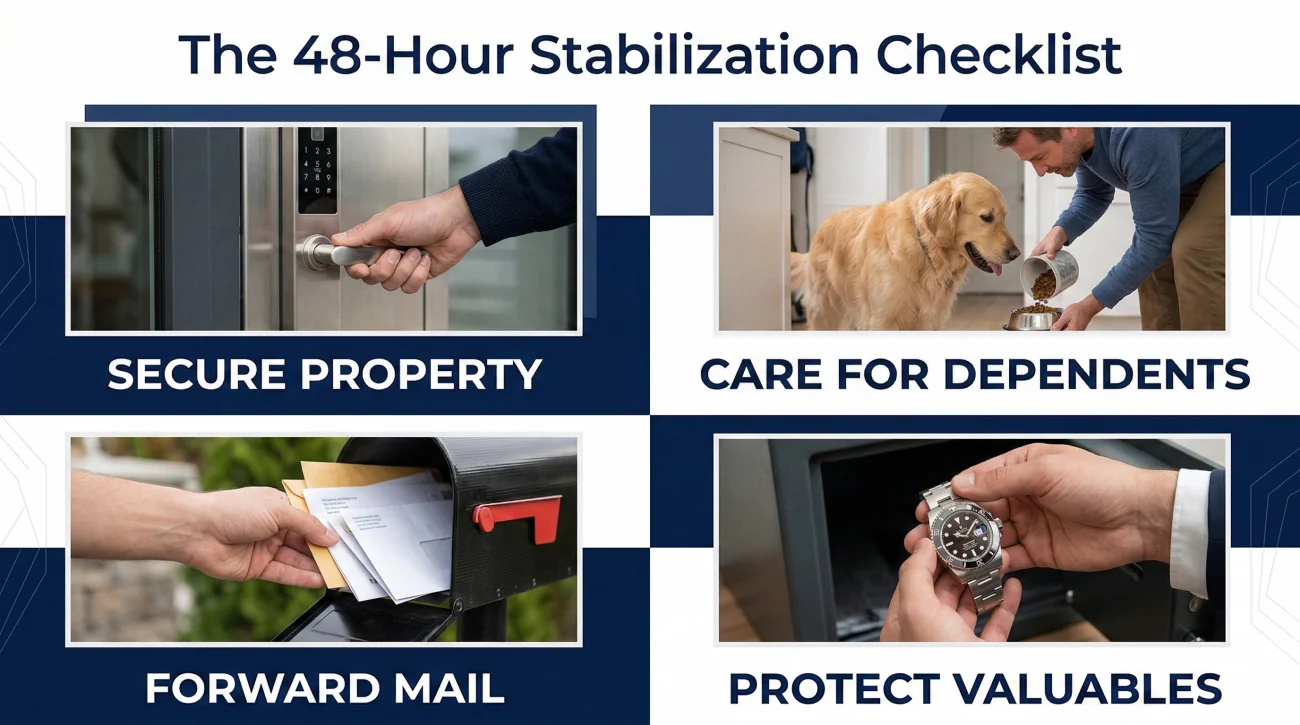
In the immediate aftermath of a death, paperwork can wait. The first 48 hours are purely about stabilization. I refer to this as the “physical protection phase.”
- ✅ Secure dependents and pets: Ensure any children, elderly dependents, or animals are safely relocated and cared for.
- ✅ Lock the property: Secure the deceased person’s home. Lock all doors and windows. If they had roommates or caregivers with keys, consider asking for the keys back or changing the locks to protect the estate’s assets.
- ✅ Remove immediate valuables: If there is visible cash, expensive jewelry, or highly portable valuables, move them to a secure location (like a safe) and document exactly what you moved, where you moved it, and when.
- ✅ Check the fridge and trash: This sounds trivial, but taking out the garbage and clearing perishable food prevents a massive, terrible cleanup job weeks later.
At this stage, do not let anyone, even close family members, start taking items from the house as “keepsakes.” Explain calmly that as the executor, you are responsible for keeping everything intact until official procedures allow for distribution.
“I understand Dad promised you his watch, but right now I have to keep everything exactly where it is until we have official clearance. I will make a note that it goes to you.”
Handling Immediate Funeral Costs
Because bank accounts freeze almost immediately upon death, you will likely not have access to estate funds to pay for the funeral right away. This is a massive point of stress for families. Often, a family member pays these expenses upfront. If you or someone else does this, keep every single receipt. Funeral costs are legally considered a top-priority estate expense, meaning whoever pays is first in line to be reimbursed once the official estate account is open. Before anyone pays out of pocket, check their desk or safe to see if they purchased a pre-paid funeral plan or a life insurance policy designed to cover these specific costs.
Week 1: Do These Before Chasing Paperwork
Once the immediate physical environment is secure, it is time to build your operating system. Often, executors start making phone calls without a plan, leading to scattered notes on sticky pads. Stop, sit down, and set up your workspace.
Create Your Single Source of Truth
I highly recommend getting a physical accordion folder and setting up a dedicated digital folder on your computer. Keep them fiercely organized. In day-to-day admin work, the fastest way to lose momentum is losing a document you know you already found.
Set up a naming convention for digital files right away. A common pattern I see causing trouble is saving files as “scan1.pdf” or “mom_document.jpg.”
YYYY-MM-DD – Institution Name – Document Type
Example: 2023-11-05 – Bank of America – October Statement.pdf
Start the Call Log
Every time you pick up the phone to handle estate business, open your call log. You need to record the date, time, phone number, representative’s name, reference number, and exactly what the next step is. If a representative tells you they mailed a form, write down the date they said they mailed it, and set a reminder to check in a week.
Once your folders are set up and your log is open, you need to populate them. Here is exactly what goes into your initial file.
The Starter Documents Packet
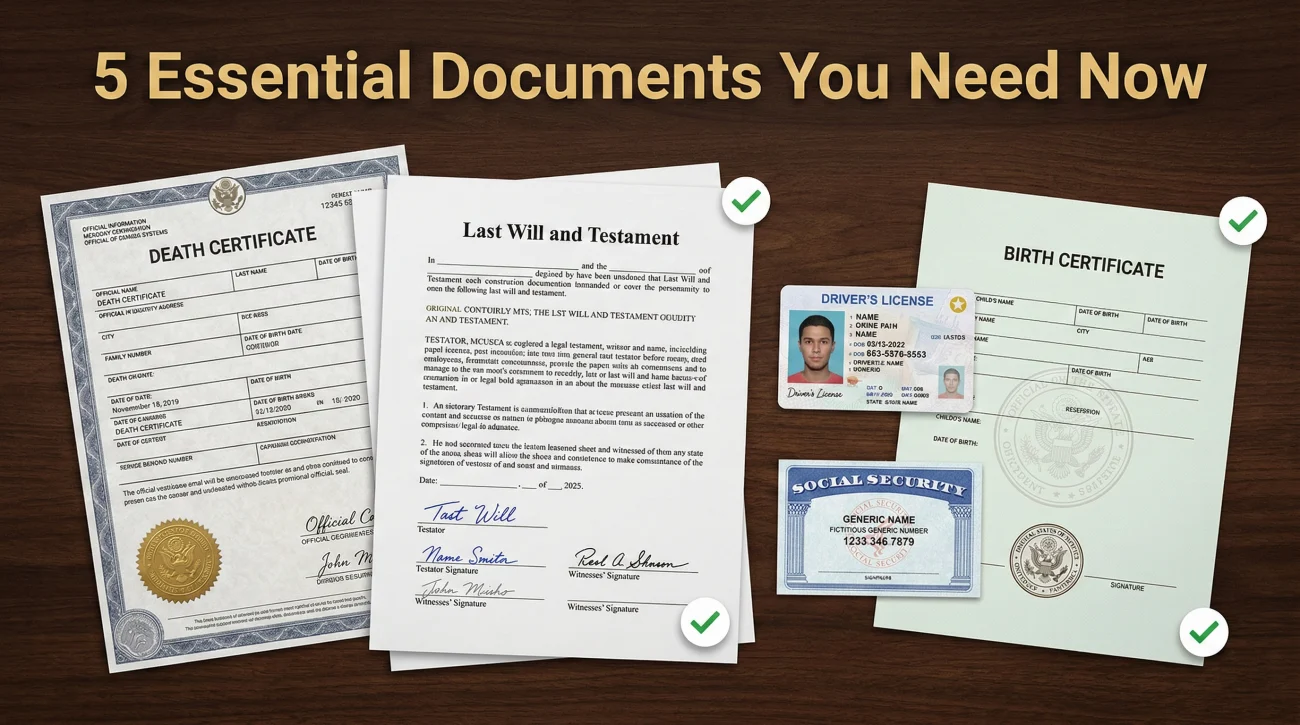
In the first few weeks, you are going to be asked for the same pieces of information repeatedly. Instead of hunting them down every time, build a “Starter Packet.” This is a core set of documents you will keep in your main folder.
- 📄 Death Certificates: You will need multiple certified copies. A practical rule of thumb is to start with 5 to 10 copies, depending on how many different banks or properties the deceased had.
- 📄 The Original Will: If one exists, find it and keep it extremely safe. Do not remove staples or alter it in any way.
- 📄 Your Identification: Have crisp, clear scans and physical copies of your own driver’s license or passport.
- 📄 Social Security Card: Locate the deceased’s original card if possible, or at least have the number written down securely.
- 📄 Basic Financial Statements: Gather the most recent bank statements, mortgage statements, and utility bills. You do not need years of history right now, just the most recent month to establish account numbers.
💡 Pro Tip: Never mail the original Will unless explicitly instructed to do so by a probate court or your attorney, and always send it via certified mail with a tracking number.
Will Discovery and What to Log
Finding the Will can sometimes feel like a treasure hunt. If the deceased did not leave clear instructions on where it is located, you have to start searching methodically.
I always tell people to look in the obvious places first: desk drawers, filing cabinets, and home safes. But over the years, I have seen important documents hidden in incredibly strange places, like taped under desk drawers, sealed in freezer bags, or slipped inside old books. Be thorough, but be careful not to destroy anything.
What If You Only Find a Copy?
If you find a photocopy of a Will but not the original with wet-ink signatures, do not panic, but do recognize that this complicates things. Courts heavily prefer the original. If you only have a copy, look for the name of the attorney or law firm that drafted it (usually printed on the cover page or the bottom of the pages). Call them. They often keep the original in their fireproof vaults.
Script: Asking a Law Firm for the Will
Hello, I am the child of [Name], who recently passed away. I found a copy of a Will drafted by your firm dated [Date]. Could you please check your records to see if your office holds the original document? If so, could you provide me with the written requirements for how I can securely retrieve it?
Field Note: The Missing Original. I once worked with a family who spent three weeks tearing apart a house looking for a Will, only finding a blurry photocopy in a shoebox. Instead of continuing the search, they finally called the law firm listed on the watermark. The attorney had the original safe in a vault and the family saved themselves months of potential probate delays. Always follow the paper trail first.
What If There Is No Will At All?
It is very common for people to pass away without a Will, a situation known as dying “intestate.” If you have thoroughly searched and confirmed with their attorney and family members that no Will exists, the state laws where the deceased lived will dictate who inherits the assets and who has the right to serve as the administrator of the estate. Your first steps remain exactly the same: secure the property, gather documents, and build your list of accounts. You will just apply to the court as an “Administrator” rather than an “Executor.”
Document every place you searched and every person you called regarding the Will. If you ultimately cannot find it, this log will prove to the court that you made a diligent effort.
Property, Mail, and Fraud Protection
An empty house and an overflowing mailbox are giant billboards to scammers and thieves. Protecting the estate from fraud is a massive part of an executor’s first steps.
Securing the Mail
Do not let mail pile up. Not only does it invite theft, but mail is also your best investigative tool for finding out what assets and debts the deceased had. Go to the post office and request that the mail be forwarded to your address. Be prepared to show a copy of the death certificate and your ID.
Leaving mail on the kitchen counter of the deceased’s home and checking it once a week.
Forwarding all mail to the executor’s home, opening it daily, and logging every bill or statement into an inventory spreadsheet.
Stopping Identity Theft
Sadly, identity theft of deceased individuals is common. Scammers monitor obituaries and use the information to open credit cards. You must act quickly to lock down their credit.
You should notify the three major credit reporting agencies (Equifax, Experian, and TransUnion) to place a “Deceased Alert” on the file. This prevents any new credit from being issued in their name. If you suspect fraud has already occurred, you will need to take further steps. The Federal Trade Commission (FTC) provides a comprehensive resource on managing this through their official portal at IdentityTheft.gov, which can guide you on reporting misuse of a deceased person’s information.
Who to Notify Overview (And the SSA)
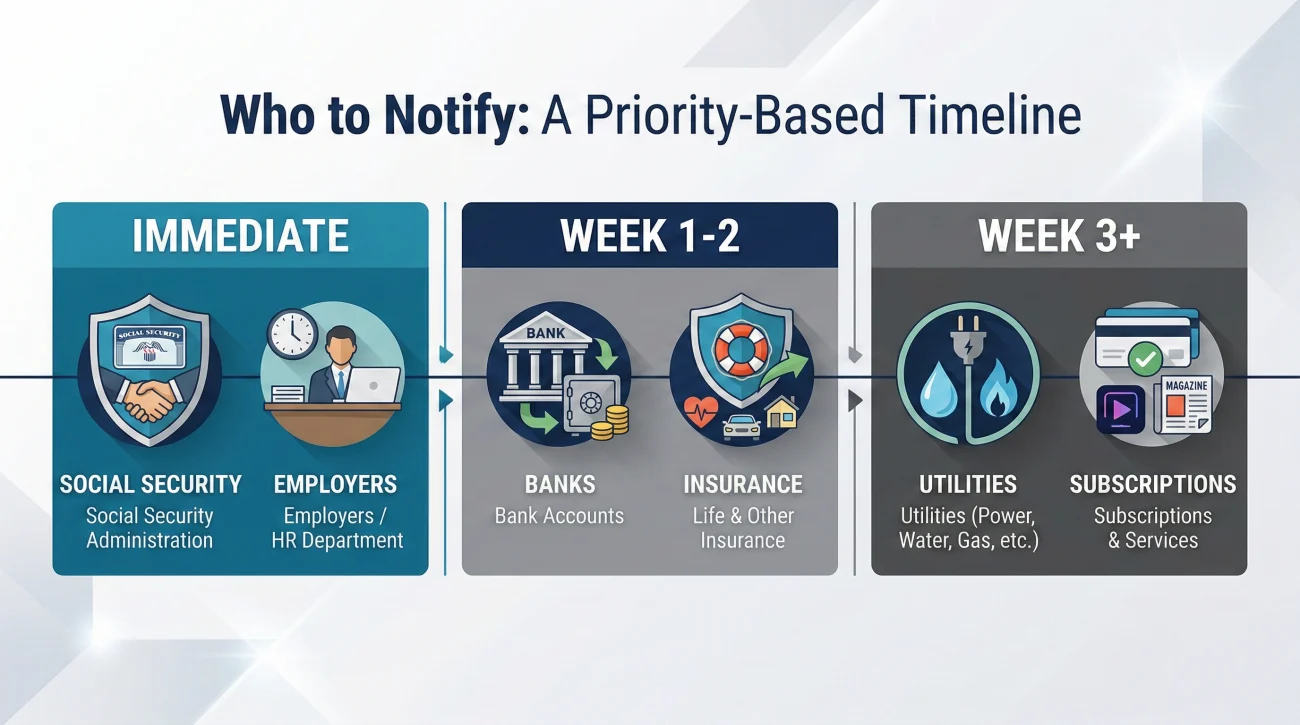
You cannot notify everyone on day one, nor should you try. Prioritize the notifications that stop financial bleeding or prevent fraud.
| Priority Level | Who to Notify | Purpose |
|---|---|---|
| Immediate (Days 1-3) | Employer, Social Security Administration, Credit Bureaus | Stop paychecks/benefits to avoid having to repay them; prevent identity theft. |
| High (Week 1-2) | Banks, Mortgage Company, Home/Auto Insurance | Freeze accounts to prevent unauthorized withdrawals; ensure property remains insured. |
| Medium (Weeks 3+) | Credit Cards, Subscriptions, Utilities, Cell Phone Providers | Close accounts, stop recurring fees, transition utilities to the estate if needed. |
Notifying Banks Early
You might not have court authority yet, but you still need to protect the money. Call the banks to inform them of the death so they can freeze the accounts. This stops automatic withdrawals and prevents fraud, even if it does not grant you immediate access to the funds.
Script: Calling a Bank Without Court Documents
Hello, I am calling to notify you of the passing of [Name], who held an account with your bank. I am the named executor, but I am still in the process of obtaining court documents. I want to formally report the death to secure the account. Can you please place a freeze on the account and send me a written list of the documents you will require from me once I have court approval?
The Social Security Administration
Often, the funeral home will report the death to the Social Security Administration (SSA) on your behalf. However, it is your responsibility to confirm this happened. If Social Security continues to direct deposit funds into the deceased’s account after their death, those funds will eventually be clawed back, which creates a massive accounting headache for you.
Do not spend any Social Security money received in the month of death until you confirm it is valid. You can find their official guidelines on reporting and survivor benefits at SSA.gov/benefits/survivors. Call them, log the representative’s name, and get a confirmation number for the death report.
Modern Blockers: Phones, Email, and 2FA
This is the most modern and frustrating hurdle for today’s executors. Fifteen years ago, you could find everything in a filing cabinet. Today, the bank statements, the bills, and the contact lists are locked behind a passcode on an iPhone and protected by Two-Factor Authentication (2FA).
❌ Note: Do not use the deceased person’s thumbprint, face ID, or known passwords to log into their banking apps or email accounts. While tempting, this violates terms of service and can trigger fraud alerts that lock the accounts permanently, making your job much harder when you try to access them officially later.
Instead, your goal is to preserve the devices. Keep the phone charged. Keep it connected to Wi-Fi. If you have the passcode, you may look through the device to identify which banks they use or to read emails to find out where they hold accounts, but do not initiate transactions.
Eventually, you will need to use official channels (like Apple’s Digital Legacy program or Google’s Inactive Account Manager) or provide court orders to gain legal access to these digital assets. For now, simply map out what devices exist, what email addresses they used, and write it all down.
Working with Co-Executors Without Chaos
If you were appointed alongside a sibling or a trusted friend as a co-executor, you need rules of engagement immediately. When two people are calling the same bank, submitting different forms, and not communicating, the estate administration grinds to a halt.
I always advise co-executors to divide the labor clearly and establish one single point of contact for external institutions.
- 🤝 Person A: Handles all phone calls, bank interactions, and mail sorting.
- 🤝 Person B: Handles all physical property cleanup, securing assets, and organizing the physical files.
Handling Disagreements and Creating an Audit Trail
What happens when you and your co-executor disagree on a decision, like whether to sell a vehicle immediately or wait? This is where your tracking system becomes a shield. Set up a weekly check-in call to sync your notes. Most importantly, use a shared digital folder (like Google Drive or Dropbox) where both of you can view the call log, the document scans, and a “Decision Log.”
Every major decision should be noted in that shared document with a short explanation of why it was made. Transparency prevents resentment, avoids duplicated efforts, and provides a clear audit trail if a beneficiary ever questions your actions.
Tools to Keep You Organized
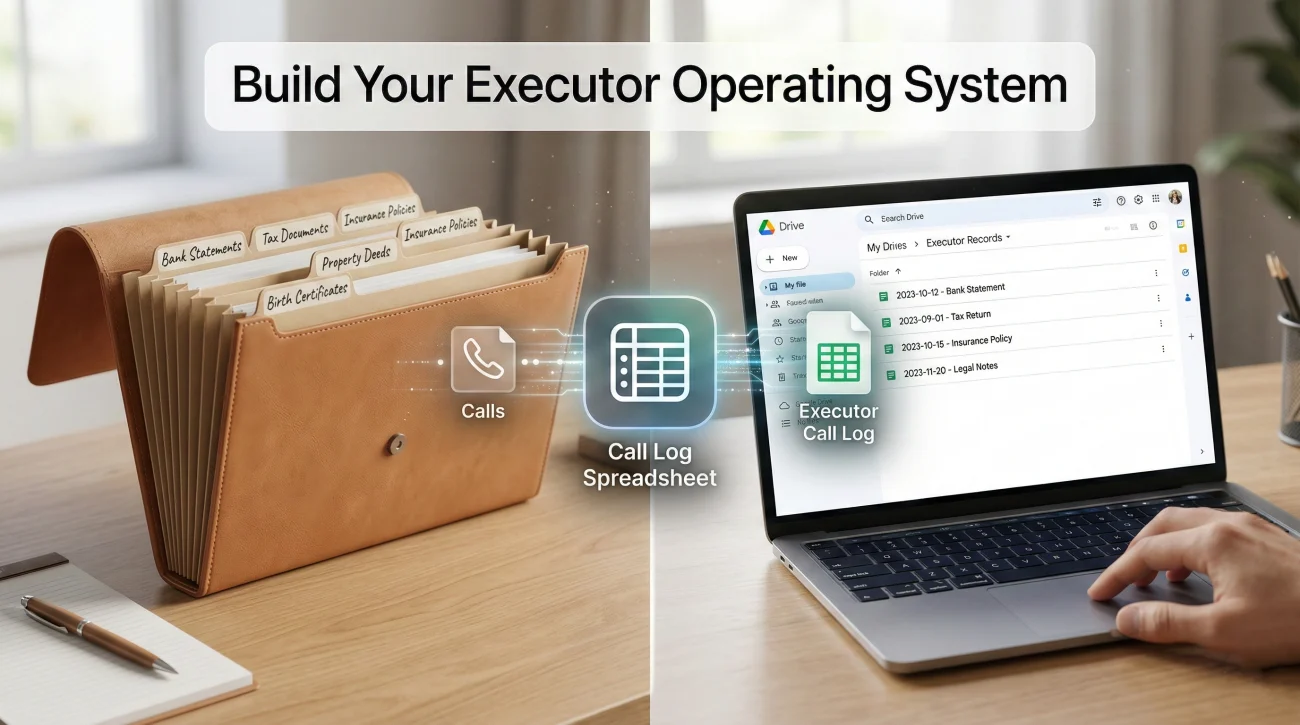
You do not have to build your tracking systems from scratch. In fact, trying to invent a system while grieving is a recipe for burnout. I strongly recommend setting up these three specific tools before you make your first official phone call.
1. The Physical Accordion System
Buy a hard plastic accordion folder with multiple tabs. Label the sections logically: Death Certificates, Court Documents, Real Estate, Banking, Taxes, and Receipts. When you receive an original document in the mail, it goes directly into its tab. Never leave papers scattered on a desk.
2. The Digital Folder Structure
Create a secure cloud folder (like Google Drive or OneDrive) so you have a backup of everything in case of a fire or loss. Set up sub-folders matching your physical accordion. Every time a paper document arrives, scan it immediately using your phone, name the file clearly using the YYYY-MM-DD naming convention discussed earlier, and drop it into the cloud.
3. The Executor Call Log Spreadsheet
A simple notebook is risky because you cannot search it easily. A basic spreadsheet is your best defense against bureaucracy. Create columns for: Date, Institution, Phone Number, Representative Name, Reference Number, Notes, and Next Action Date.
If you want a structured foundation rather than building this yourself, you can learn more about establishing your initial workflow and accessing templates by reading our comprehensive overview on how to manage your first steps.
Final Thoughts on Starting Strong
The first few weeks of being an executor are undeniably stressful, but the stress is manageable if you rely on systems rather than memory. Focus on securing the property, gathering the foundational documents, and establishing a rigorous log of every conversation.
Do not let banks, creditors, or impatient family members rush you into making financial decisions or paying bills before you have officially secured the proper authority. Take a breath, set up your folders, and tackle the process one step, and one call, at a time. You can do this, provided you stay calm, practical, and heavily documented.
Deep Dive Guides for Your First Month
Because there are so many moving parts in the early days, we have broken down specific workflows into detailed checklists. Once you have secured the house and set up your folders, use the table below to find the exact guide you need for the hurdle you are currently facing.
| Guide Title | What You Will Learn |
|---|---|
| Executor First Week Checklist: 7 Moves That Prevent Delays | Immediate week-one actions to reduce confusion and repeated requests. |
| Executor Week One Mistakes: 11 Things That Create Delays Later | A practical list of common missteps and how to avoid back-and-forth. |
| Executor Timeline First Month: A Week-by-Week Sequence | A deep-dive action map outlining what can wait and what cannot. |
| Executor Documents Checklist: The Starter Packet | A clean list of commonly requested documents organized for quick responses. |
| How Many Death Certificates Do You Need: A Practical Rule | A method to estimate copies without wasting money or under-ordering. |
| Find the Will After Death: Where Executors Actually Look First | A realistic search path and safe next questions for finding the original. |
| No Original Will Found: What Executors Can Do Next | Safe steps and documentation methods when the original is missing. |
| Secure the Property After Death: House, Mail, and Identity Theft | Immediate protection steps to reduce theft, fraud, and confusion. |
| Who to Notify After Death: Executor Notification Checklist | A practical notification list organized by priority and timing. |
| Social Security Death Notification Checklist | What to confirm about SSA reporting without overly detailed sequences. |
| Digital Access After Death: First Steps for Phones and Email | How to preserve devices and map digital accounts officially. |
| Co-Executor First Steps Checklist: How to Stay Aligned | An operating system to avoid mixed messaging and missed decisions. |
| Executor Checklist Template: Printable, PDF, and Spreadsheet Versions | Downloadable checklist formats for immediate use, reusable across the whole estate process. |
| Executor Call Log Template: Excel and Google Sheets | A simple call log to track every conversation with banks and agencies so nothing is lost and requests do not repeat. |
Sources and Reference Information
To ensure you have access to official, neutral information regarding federal procedures, taxes, and fraud prevention, please refer to the following resources used to inform this guide:
- Federal Trade Commission (FTC) Identity Theft Portal: IdentityTheft.gov
- Social Security Administration (SSA) Survivor Benefits: SSA.gov/benefits/survivors
- Internal Revenue Service (IRS) Deceased Taxpayers Information: IRS.gov Deceased Taxpayers
❓ FAQ
🕒 How soon do I need to start my executor duties?
Immediate steps like securing the property, arranging care for dependents, and securing pets should happen within the first 48 hours. However, formal legal and financial duties usually wait until after the funeral and after you have obtained copies of the death certificate.
🛑 Can I clean out the house before I am officially appointed?
You can remove trash and perishable food to prevent damage, but you should not distribute belongings, sell furniture, or allow family members to take keepsakes until you have official authority and a clear inventory is made.
🏛️ Do I need to hire a lawyer to be an executor?
Requirements vary greatly depending on local rules and the complexity of the estate. While small, simple estates are sometimes managed without one, hiring a probate attorney is commonly recommended to avoid personal liability and navigate court procedures.
🏦 How do I notify banks if I don’t have court documents yet?
You can often call a bank to notify them of the death so they can freeze the account to prevent fraud. However, they will usually not give you access to the funds or detailed information until you provide a death certificate and official Letters Testamentary.
📄 What is the very first document I need to find?
Your top priority is locating the original Will (if one exists), as this dictates who should be acting as executor. Finding pre-planned funeral arrangements is also critical in the first few days.
⚰️ Who pays for the funeral if the estate accounts are frozen?
Often, a family member pays upfront and gets reimbursed by the estate later once accounts are accessible. Sometimes, funeral homes will wait for payment from life insurance policies. Check if the deceased had a pre-paid funeral plan before making payments.
✉️ How do I stop the deceased person’s mail from piling up?
You should go to the local post office to request a mail forwarding service to your own address. You will typically need to bring a copy of the death certificate and your own identification to process this request.
💻 How do I access their email if I do not have the password?
Do not try to guess passwords or bypass security screens. Major providers like Google and Apple have official “inactive account” or digital legacy processes. You will need to submit a death certificate and court documents to request access legally.
🤝 What if the family disagrees with the decisions I am making?
Keep your communications strictly documented, transparent, and neutral. Share the written requirements you receive from institutions and courts. If conflicts escalate, consulting an estate attorney is the safest next step.
📋 Do institutions need the original death certificate or just a copy?
Major institutions handling large assets (life insurance companies, real estate transfers, big banks) almost always require an original, certified copy with a raised seal. Smaller entities like utility companies or subscriptions will often accept a clear photocopy.
⚠️ Disclosure: I'm not an attorney and nothing on this site is legal or tax advice. The content covers process, organization, and workflow—the operational side of estate administration. For legal interpretation, jurisdiction-specific deadlines, contested situations, or tax matters, please work with a licensed professional in your state.