
- Stop panicking: It is very common to only find a photocopy or no will at all in the first few days. Take a breath and do not assume the worst.
- Follow the paper trail: Contact the attorney listed on any drafts, check for safe deposit boxes, and reach out to the deceased’s financial advisors.
- Document the dead ends: Keep a concrete written log of exactly where you looked and who you asked. This log will be your shield later.
- Preserve copies carefully: If you find a photocopy or multiple old drafts, store them flat and do not alter them in any way.
- Shift from searching to asking: Once you exhaust the physical search, you will use your gathered evidence to seek specific local administrative guidance.
The Stomach Drop of a Missing Original Document
In my day-to-day estate administration support work, I regularly talk to families who are completely frozen in their tracks. They have spent hours sorting through boxes, desk drawers, and home safes, only to realize a hard truth: no original will found. Sometimes they find an old, faded photocopy. Sometimes they find a draft with “COPY” stamped across it in red ink. Often, they find absolutely nothing.
The immediate reaction is usually a mix of panic and frustration. You might feel like you cannot take a single step forward, or you might worry that the entire estate process is about to become a chaotic battle. I want to ask you to take a deep breath. Missing the original document with the wet ink signatures is an incredibly common hurdle.
Your job right now is not to magically produce a document that might not exist. Your job is to switch from a frantic scavenger hunt into a structured, documented search process. When courts or professionals ask about the will later, they will want to know exactly what efforts you made to find it. This is where your organizational skills come into play.
Before you start pulling up floorboards or calling every law firm in the city, you need a baseline. If you have not yet secured the home or set up a basic file system, pause and review the core executor first steps checklist. Once your basic foundation is stable, you can dedicate your focus to tracking down the estate documents in a methodical, trackable way.
Confirming the Search: The Places People Usually Forget
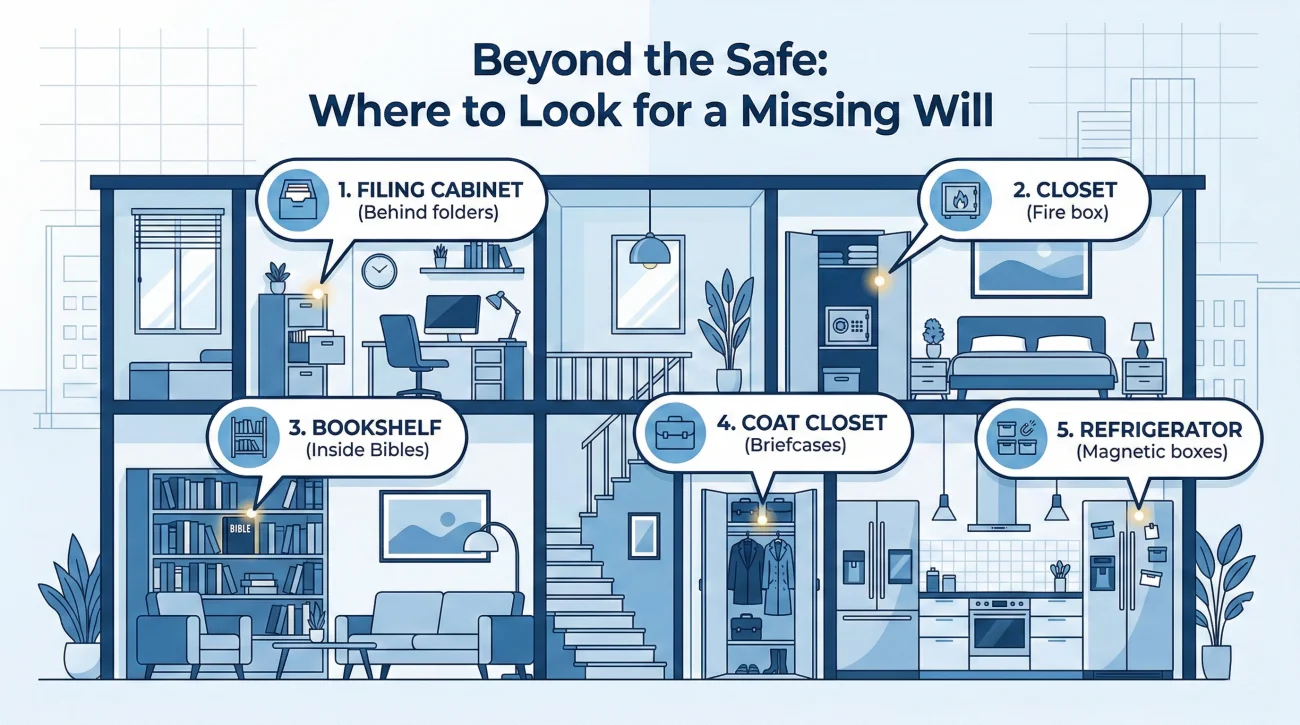
When someone tells me they “looked everywhere,” my first question is always about the hidden-in-plain-sight locations. Families naturally check the home safe, the office desk, and the filing cabinets. But paper has a funny way of migrating over the years, especially as people age or move.
To confidently say the original will is missing, you need to expand your search radius slightly. Often, important documents are tucked away to protect them from damage, which ironically makes them harder for executors to find. You do not need to tear the house apart, but you do need to be thorough in a few specific zones.
| Search Location | Why It Gets Overlooked |
|---|---|
| Behind other files | Original wills are often kept in thick, oversized envelopes that slip down behind the hanging folders in standard filing cabinets. |
| The “Go Bag” or Fire Box | People often pack a portable fireproof box or a heavy zipper bag with passports and birth certificates, storing it under a bed or high in a closet. |
| Books and Bibles | Older generations commonly pressed important single-page documents or envelopes between the pages of heavy books or family bibles. |
| Old Briefcases | An old leather portfolio or briefcase sitting in the back of a coat closet is a very common resting place for estate planning documents. |
| The Refrigerator Top | Surprisingly common. Many people place emergency medical directives and wills in magnetic clips or boxes on top of the fridge for emergency responders. |
Take one afternoon to systematically check these areas. Bring a notepad with you. Do not throw any paperwork away right now, even if it looks like junk mail from a bank. It might hold clues to advisors or safe deposit boxes.
Handling the Search from Out of State
If you do not live near the deceased’s home, the search process becomes significantly harder. Do not rely on neighbors or distant relatives to do a thorough legal search for you. The risk of documents getting thrown away or misplaced by well-meaning helpers is too high. Instead, secure the property remotely first by hiring a service to rekey the locks and forward the mail. Then, either plan a dedicated trip to conduct the search yourself, or hire a bonded local estate organizer to do a supervised, documented search on your behalf.
Building Proof of Efforts: What Your Search Log Should Look Like
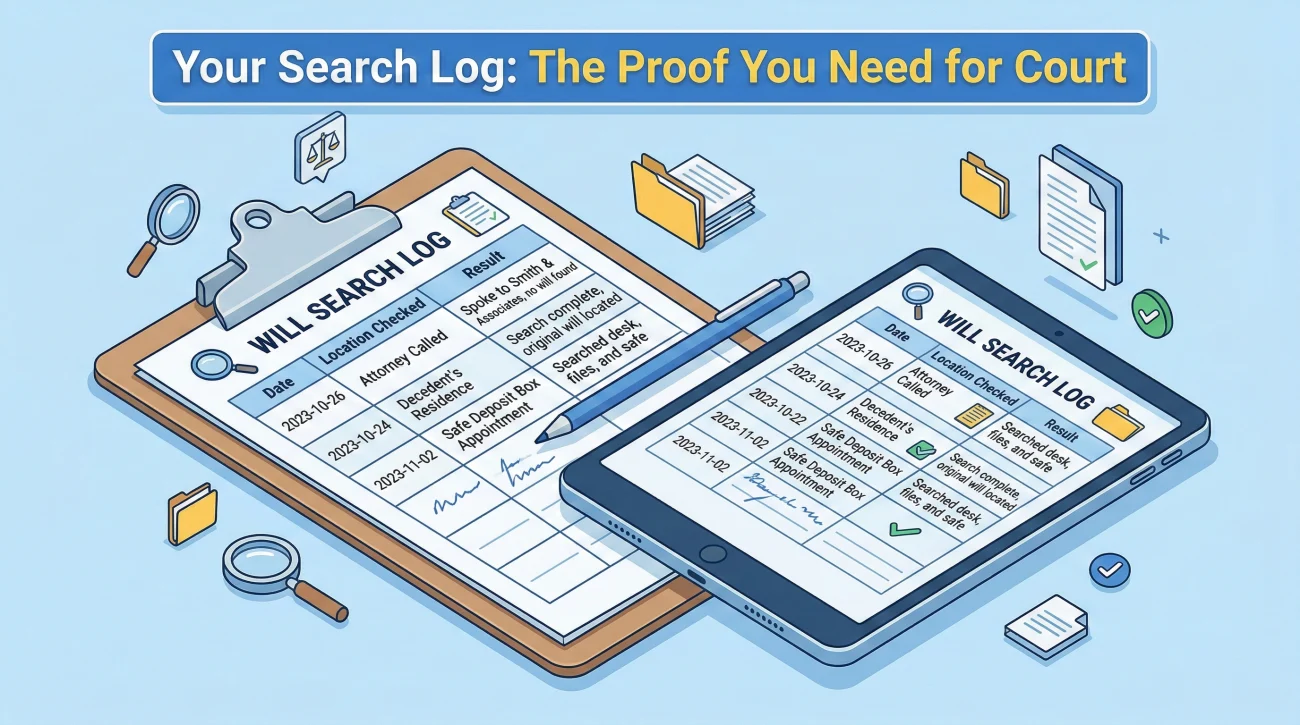
This is where many first-time executors make a critical mistake. They spend a week making phone calls and digging through closets, but they write nothing down. In my experience, simply saying “I tried my best” does not hold much weight in administrative or legal settings. A simple, written log carries tremendous value because it shows diligence and exact dates.
You need a tangible record. If you end up having to proceed without a will, this log proves to authorities and family members that you did not ignore the deceased’s wishes. You do not need complex software. A standard piece of paper or a basic spreadsheet works perfectly.
Here is exactly what your Will Search Log should look like:
| Date | Location Checked / Contact Made | Action Taken | Result & Next Steps |
|---|---|---|---|
| Oct 12 | Home Office | Searched filing cabinet and desk drawers. | Found unsigned 2015 draft. No original. |
| Oct 13 | Attorney Sarah Jenkins | Called office number listed on the draft. | Firm closed in 2020. Left message with forwarding number. |
| Oct 14 | First National Bank | Checked for safe deposit box under deceased’s name. | Branch manager confirmed a box exists. Appointment set for Friday. |
If you reach a dead end, that dead end is valuable data. Log it. If a family member tells you they “think they saw it five years ago,” log that conversation.
Key Point: A documented failed search is infinitely more useful than an undocumented failed search. Your log is your proof of action.
Tracing the Paper: Who Else Might Hold the Original?
People rarely draft wills entirely in secret. There is usually a paper trail of invoices, business cards, or correspondence that points to the original document’s location. If the original is not in the home, you need to trace their professional relationships.
The Attorney of Record
Many estate planning attorneys retain the original will in their firm’s fireproof safe, giving the client only copies. If you find a lawyer’s name on old bank statements or printed on the protective jacket of a photocopy, call them immediately. Be prepared to provide a copy of the death certificate, as they cannot release information without proof of passing.
“Hi, I think my dad used your firm. Do you have his will? I need it today.”
“Hello, I am calling regarding the estate of [Name]. I am trying to locate his original will. Can you confirm if your firm holds his original estate documents in your vault, and if so, what your written requirements are to release them?”
The Safe Deposit Box Protocol
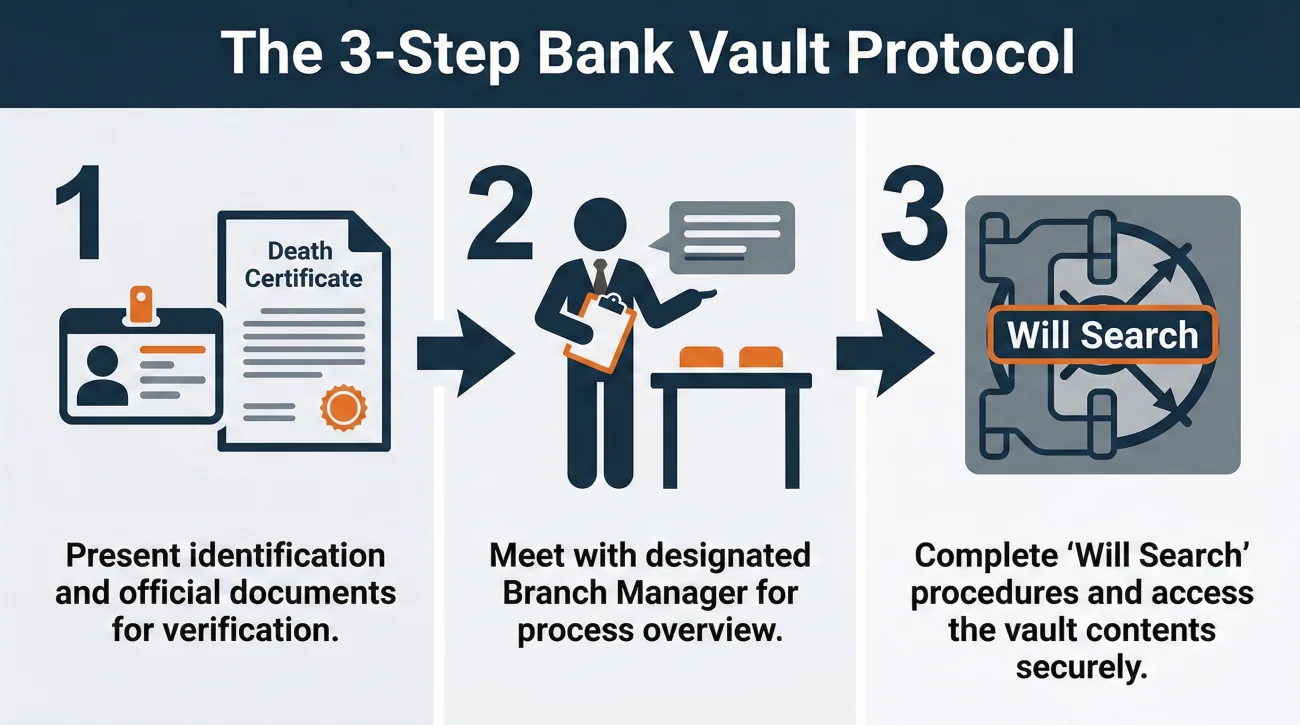
This is a classic operational catch. Often, the original will is locked inside a bank safe deposit box. However, banks want to see the authorizing document before granting access to the box. It feels like an impossible loop, but there is a standard workaround.
Do not just walk into the bank and demand access. Follow this specific protocol:
- ✅ Step 1: Gather your proofs. You will absolutely need the original death certificate, your government-issued photo ID, and the safe deposit box key if you have it.
- ✅ Step 2: Ask for the Branch Manager. Tellers usually cannot authorize this process.
- ✅ Step 3: Request a “Will Search.” State clearly: “I am not asking to empty the box. I am requesting a standard will search under supervision.”
Many institutions have a procedure where two bank employees will open the box in your presence solely to look for a will or burial instructions. They will hand over the will if found, but they will not let you touch jewelry or cash until you have official court authority.
Digital Traces: E-Wills and Online Platforms
Increasingly, the “paper trail” is actually an email trail. Many people now use online document services or digital legal vaults. If you cannot find physical paper, you need to scan for digital footprints.
I must be very clear here: you should not guess passwords or bypass two-factor authentication to log into the deceased’s computer. Doing so can trigger security lockouts or violate terms of service. Instead, look for external clues on their recent credit card statements or bank feeds for recurring charges from legal services like LegalZoom, Rocket Lawyer, or Trust&Will.
If you suspect an e-will exists on one of these platforms, follow this recovery protocol:
- ✅ Step 1: Identify the platform. Use your legitimate access to their email or physical mail to find billing receipts or account renewal notifications, rather than trying to hunt down passwords.
- ✅ Step 2: Check the survivor protocol. Major platforms have dedicated survivor portals. Do not try to log in as the deceased. Navigate to the site’s “report a death” section.
- ✅ Step 3: Submit the proofs. You will typically need to upload a scan of the death certificate and your ID directly to the platform’s support team to unlock the authenticated digital file.
What If You Find Multiple Wills?
Sometimes the problem is not finding zero documents, but finding too many. You might open a drawer and find a drafted will from 2005, a signed copy from 2012, and an un-notarized handwritten note from last year. This causes immense confusion.
As the person organizing the estate, your rule is simple: collect them all, but judge none of them. It is generally true that a newer valid will supersedes an older one, but determining validity is a legal conclusion, not an administrative task.
Place every version you find into a separate folder. Do not staple them together. Use a sticky note on the outside of the folder to label where and when you found it (e.g., “Found in bedroom desk, dated 2012”). Keep all versions safe until a professional can review them. Never throw away an old will just because you found a newer copy.
The Mid-Process Pivot: A Newer Will Surfaces Later
Finding multiple old drafts in a desk is one thing. But what happens if you start the estate process using an older will, and three weeks later, a relative suddenly finds a newer original document? In my experience, this is one of the most stressful scenarios an executor can face.
If this happens, you must immediately hit the brakes. Pause all asset distributions, stop selling property, and do not write any more checks from the estate account. A valid newer will generally revokes the older ones, meaning your current operating instructions might be entirely wrong. Continuing to act on the old document once you know a newer one exists can expose you to personal liability. Log the exact date and time the new document was discovered, secure it flat in your folder, and immediately notify the professionals guiding your administration so the new document can be formally evaluated.
Communication Hygiene: Reaching Out for Help
As you track down these physical and digital leads, you will inevitably need to send emails and make phone calls to people who might hold the documents. If you are emailing a professional (accountant, former lawyer, or financial advisor) to ask about the will, use a clean, structured format. You want to make it easy for them to check their records and reply quickly.
Subject: Estate Inquiry: [Full Name of Deceased] – Request for Document Records
Dear [Professional’s Name],
I am writing to you regarding the estate of [Full Name of Deceased], who passed away on [Date]. I am currently organizing their affairs and trying to locate their original estate planning documents.
Could you please check your records to see if your office holds the original will, or if you have any notes indicating which law firm may have drafted it?
If you do hold the original documents, please reply with a list of the written requirements and forms you need from me to authorize their release.
Thank you for your time and assistance during this process.
Best regards,
[Your Name]
[Your Contact Information]
When a Relative Claims They Have the Original
Occasionally, you will face a situation where a family member claims they have the original will, but they refuse to hand it over. This is highly stressful. The worst thing you can do is send an angry text message demanding the paperwork.
Keep the emotions out of it and shift to a process-oriented response. Send a polite, written request (email or text) that creates a record of your attempt to move forward.
“Hi [Name], I am compiling all the required documents so we can handle the estate properly. Since you mentioned you have the original will, could you let me know what day next week works best for us to meet at [neutral location / lawyer’s office] so we can submit it into the official records?”
This puts the ball in their court politely while reminding them that the document must eventually enter official channels.
What to Do When You Only Have a Photocopy
Let us say you have searched everywhere, checked the safe deposit box, called the lawyer, and you are still empty-handed regarding the original. However, you do have a clean photocopy of the signed will. First, having a copy is vastly better than having nothing at all.
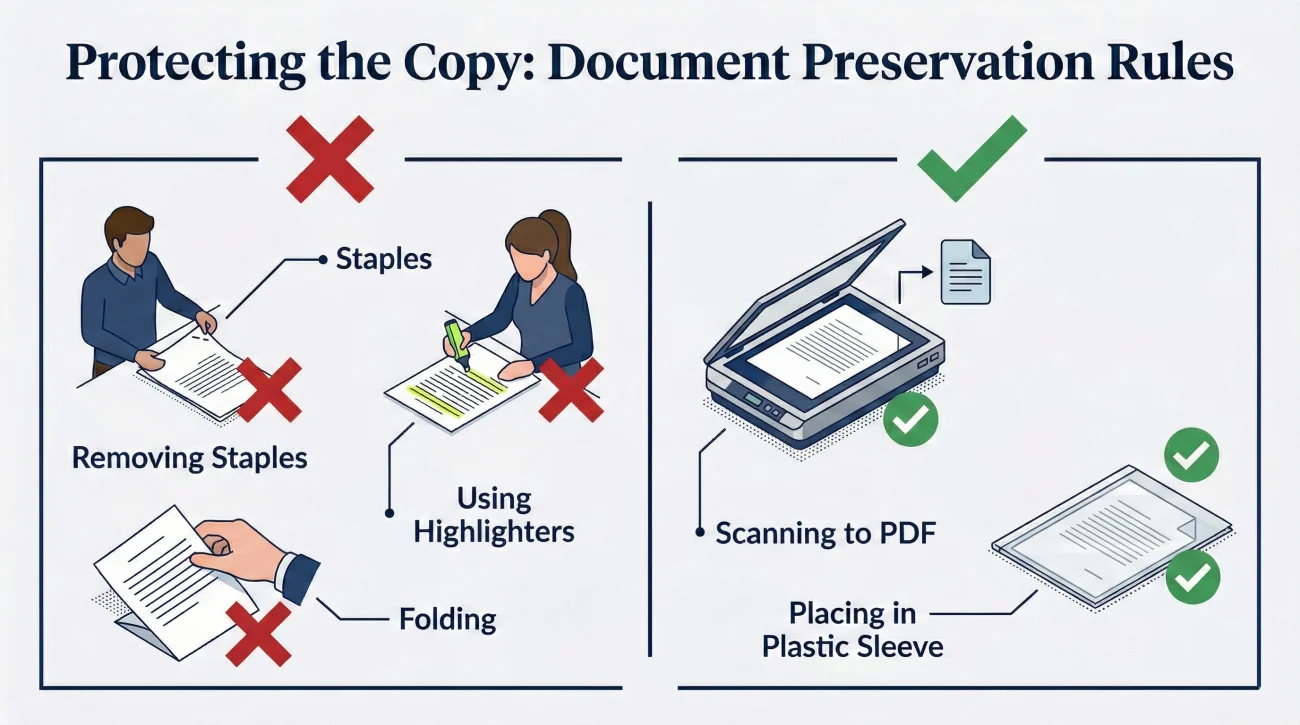
The condition of that photocopy is now extremely important. In many administrative situations, a copy can provide a roadmap for your next steps. Therefore, you must treat the copy as if it were a fragile artifact.
⚠️ Warning: Never alter the photocopy. Do not write notes in the margins, do not use a highlighter on it, and do not fold it if it is currently stored flat.
If the photocopy is stapled, do not remove the staples. In the paperwork world, removing a staple leaves two extra holes in the paper. Those extra holes can raise questions about whether pages were removed or replaced. Leave the staple exactly where it is.
Instead of handling the single copy every time you need to reference it, carefully scan it into your computer as a PDF file. Name the file clearly, such as [Deceased Last Name] - Will Copy - DO NOT ALTER.pdf. Print a few working copies from your computer to use for your own notes and planning. Put the “original photocopy” in a plastic sleeve inside your secure executor folder.
Common Mistakes When the Original is Missing
Even if you carefully preserve a photocopy and log your calls, the anxiety of a missing original document can lead to rushed decisions. By knowing these unforced errors in advance, you can keep the process moving smoothly.
Mistake 1: Stopping all other work.
Executors sometimes halt all activity because they cannot find the will. While you cannot distribute money or sell a house without authority, you absolutely can (and should) continue to secure the property, collect mail, cancel subscriptions, and notify credit bureaus. Do not let the house fall into disrepair simply because a piece of paper is missing.
Mistake 2: Making promises to family members based on a draft.
If you find an unsigned draft or an old copy of a will, do not call relatives to tell them what they are “supposed” to inherit. An unsigned draft might not be valid, and setting expectations early almost always leads to conflict later. Keep your findings private.
Mistake 3: Throwing away the envelopes.
If you find a copy of a will or a draft in a mailing envelope, keep the envelope attached to it. The postmark date, the return address of a law firm, and even the handwriting on the outside can be vital pieces of evidence to prove a timeline or locate a drafting attorney.
Final Steps: The Handoff
There comes a point where you have exhausted every logical search location. You have checked the house, visited the bank, traced the digital footprints, and your search log is completely filled out. If you still have no original will, the search phase is officially over.
It is time for the handoff. You have done the heavy lifting by gathering facts and documenting your efforts. Your goal now is to take your complete file and hand it to someone who understands the local rulebook.
Every county handles missing wills or photocopies differently. In some jurisdictions, a clean photocopy is readily accepted if accompanied by a strong search log. In others, proceeding without the original means following strict default rules. Take your complete, documented file to the local county clerk’s office or schedule a consultation with an estate professional. Presenting a clear, organized record of your search efforts will allow them to instantly bypass the guesswork and give you the exact administrative roadmap for your specific area.
❓ FAQ
📄 Will the court accept a photocopy of the will?
In many areas, courts can accept a photocopy if you can provide sufficient proof that the original was lost and not intentionally destroyed by the deceased. This is exactly why maintaining a detailed search log is so critical.
🏦 Can I empty a bank account with just a copy of the will?
No. Banks rarely act on the will itself, whether original or a copy. They generally require the official authorizing documents issued by the local court or administrative office after the will (or copy) has been formally processed.
⏳ Is there a deadline to find the original will?
Yes, many states have a statutory deadline (often ranging from 30 days to a few months) to file the will after the date of death or after you discover the document. Always check your local county clerk’s website for specific time limits.
🗣️ What if they verbally told me their wishes, but there is no paper?
Verbal promises are generally incredibly difficult to enforce in estate administration. If absolutely no written document exists, the estate typically follows local intestate rules based on family relationships, which dictate who inherits by default.
⚖️ Do law firms charge a fee to release the original will?
Typically, there is no fee simply to hand over the original document to the named executor, provided you show the proper identification and the death certificate. However, always ask the firm about their specific policy.
💻 What if the will was electronically signed (an e-will)?
Electronic wills are becoming more common, but their validity depends entirely on local laws. If you locate an e-will, download the secure file and contact the service provider to ensure you have the full, authenticated version.
💳 Should I pause paying the deceased’s bills while searching?
You should secure the property and cancel unnecessary subscriptions, but avoid using your own money to pay the deceased’s general debts (like credit cards) while searching. Wait until you have official authority and a clear view of the estate’s finances.
🏢 If the estate is tiny, do I still need to find the original?
Even for very small estates that qualify for simplified processes (like a small estate affidavit), authorities often still want to see the original will if it exists. Make a good-faith search regardless of the estate’s size.
🛑 Can a family member be penalized for hiding the original will?
In many jurisdictions, intentionally concealing or destroying a will is a serious offense. If you have evidence someone is withholding the document, keep a strict written record of your requests, as this issue may need to be escalated through formal legal channels.
📝 I found a draft, but it is not notarized. Is it useless?
Not necessarily. While a notary seal speeds up the validation process, many unwitnessed, handwritten wills (holographic wills) or un-notarized documents can still be valid. Keep the document safe in your main file, as courts often accept these depending on the specific state laws where the deceased lived.
⚠️ Disclosure: I'm not an attorney and nothing on this site is legal or tax advice. The content covers process, organization, and workflow—the operational side of estate administration. For legal interpretation, jurisdiction-specific deadlines, contested situations, or tax matters, please work with a licensed professional in your state.