- The Core Problem: The mistakes you make in the first seven days as an executor rarely cause immediate explosions. Instead, they create massive administrative headaches, delayed approvals, and missing paperwork loops three to six months down the line.
- Money & Property: Mixing your personal money with estate funds, paying the deceased’s bills too quickly, or leaving physical property unsecured are the most common early traps.
- Communication & Records: Calling institutions without logging reference numbers or saving files without clear names guarantees you will have to do the same work twice.
- The Goal: Stop rushing to cross things off a list. Focus on building a pristine, trackable system. Secure the property, separate the money, and document every single interaction.
The Chaos of the First Seven Days
When you step into the role of an executor, the first week feels like standing in front of a firehose. Relatives are asking questions, the mail keeps piling up, and you likely have a stack of paperwork sitting on your kitchen table that you are afraid to throw away. Having guided over 300 families through this exact phase, I can tell you that the urge to “just start getting things done” is incredibly strong.
But acting too fast is usually where the trouble begins. In my experience, the executor mistakes first week activities produce do not show up immediately. You will not get an error message on day three. Instead, you will find out six months later that you cannot close a bank account because you threw away a crucial statement, or you will spend weeks fighting a pension provider because you did not write down a reference number during a five-minute phone call.
As someone who helps executors build functional, stress-free workflows, I want to walk you through the 11 specific things that create delays later. If you can avoid these pitfalls, you will save yourself dozens of hours of frustrating phone calls and emails. Let’s look at where things usually go wrong and how you can protect your time and your sanity.
Mistakes with Documents and Proof
Every bank, agency, and institution will require proof of identity, proof of death, and proof of your authority. If your document system is messy in week one, your life will be miserable in month four. In fact, I often notice that probate cases with early document organization errors take on average 6 to 8 weeks longer to close simply due to missing paperwork loops.
Mistake 1: Treating original paperwork like scrap paper
I often see executors open the deceased’s mail, pull out a life insurance premium notice, use the back of it to write down a grocery list, and then lose it in their car. In the first week, every piece of financial mail, every tax document, and every institutional letter is a puzzle piece. Losing an original document means you will have to request a duplicate later, which requires proving your authority all over again.
❌ Note: Do not throw away any financial statements, utility bills, or tax documents you find in the first week, even if they look like junk mail. Put them in a single, dedicated physical inbox.
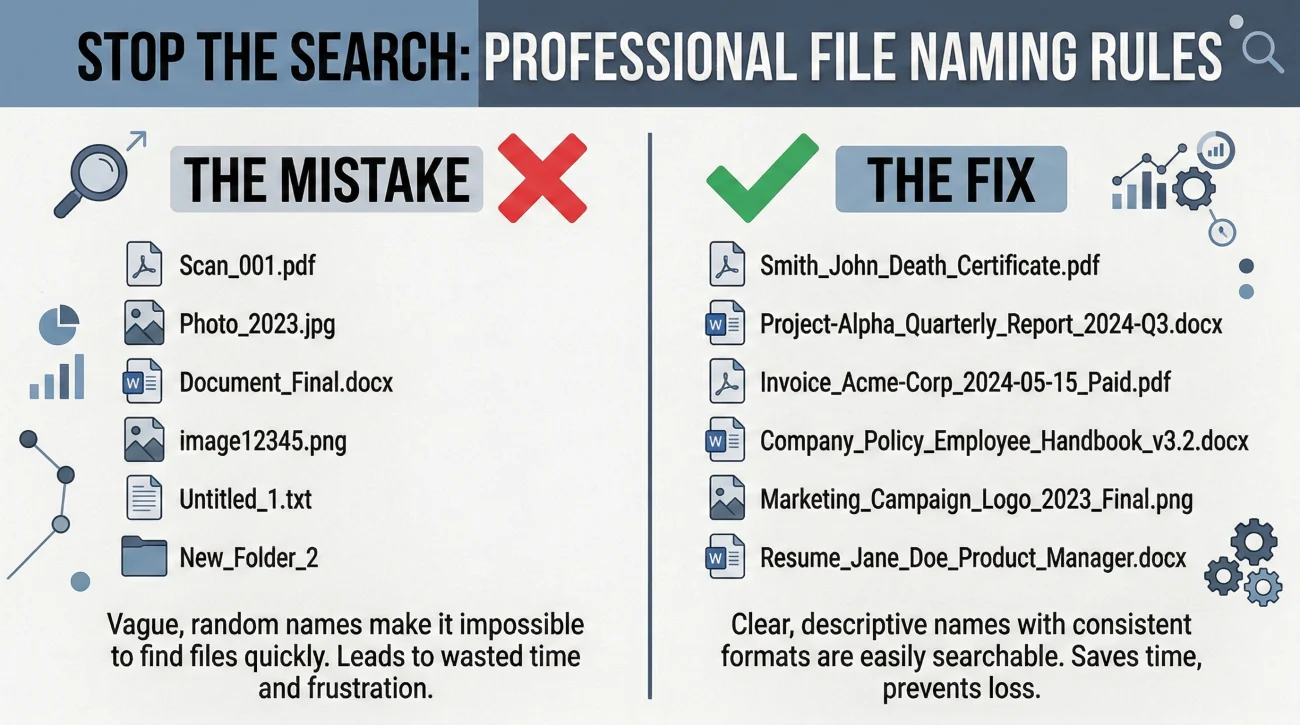
Mistake 2: Scanning files without naming them
Eventually, you will need to email a death certificate or a court document to a bank. A massive mistake is scanning these files into your computer and leaving them named as “Scan_20231014_001.pdf”. When a financial institution asks for four different documents, and you attach four files with random numbers, the clerk on the other end is highly likely to reject your submission because they cannot quickly identify what they are looking at.
Scan_00912.pdf
Smith_John_Death_Certificate_Copy.pdf
Mistake 3: Only keeping digital copies of the Will
If you locate the original Will, keep it incredibly safe. A very common week one mistake is finding the Will, taking a picture of it on a smartphone, and then misplacing the original document. Courts and attorneys almost always require the physical, original Will to begin formal proceedings. A photo or a basic photocopy often triggers a complex, expensive legal process to prove the original was not intentionally destroyed.
Mistakes with Money and Expenses
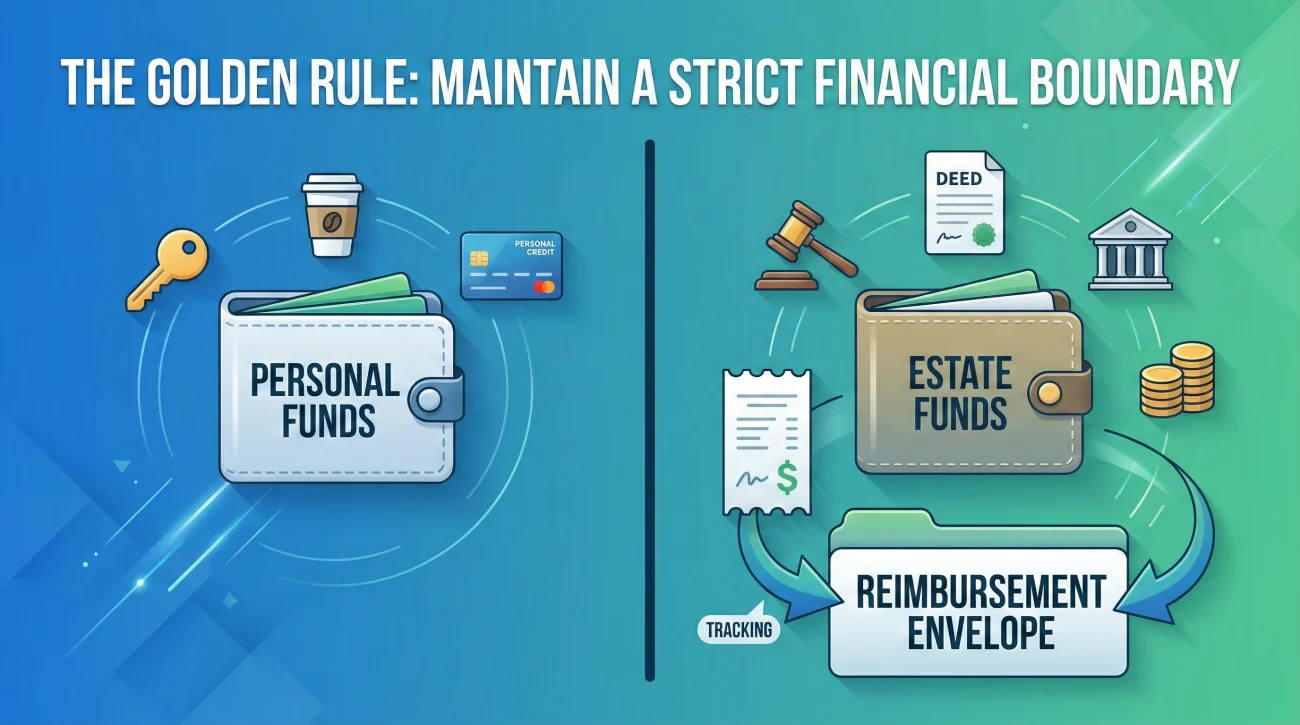
Once your paperwork is secure, the next trap is financial. Money is where emotions run high and where family disputes usually start. The golden rule of being an executor is maintaining a pristine boundary between your personal finances and the deceased’s estate.
Mistake 4: Mixing funds and ignoring receipts
It happens all the time: the executor needs to pay a quick utility bill to keep the lights on at the deceased’s house, so they just use their own personal checking account. Then they pay for a plumber. Then a locksmith. Suddenly, their personal money is tangled up in the estate’s liabilities, and they forgot to get receipts for half of the transactions. When it comes time to distribute the estate, the other beneficiaries may question why you are reimbursing yourself $800. Without strict tracking and receipts, you have no proof.
Key Point: If you must use your own money for an urgent estate expense in the first week, you must treat yourself like a vendor. Keep the physical receipt, note exactly what it was for, and log it immediately in a spreadsheet.
Mistake 5: Paying unsecured debts too quickly
I completely understand the instinct to be responsible. You see a credit card bill for $400 on the counter, and you want to pay it immediately so it does not incur late fees. Do not do this. As an executor, you are not generally supposed to pay unsecured debts out of order, and certainly not before you have a full picture of the estate’s assets.
This is a high-stakes error. I once saw an executor held personally liable for an $8,000 shortfall because they aggressively paid off credit cards in week one, leaving the estate without enough cash to settle the deceased’s final tax obligations. Always review a proper executor creditor checklist before writing any checks.
Mistake 6: Triggering digital lockouts
Digital assets are a modern minefield. A huge mistake executors make in the first 48 hours is trying to guess the deceased’s passwords to log into their email or online banking. After three failed attempts, the account locks. An even worse mistake is canceling the deceased’s cell phone service to save a few dollars. The moment you cancel that phone, you lose the ability to receive two-factor authentication (2FA) text messages, permanently locking you out of cloud storage, email accounts, and digital wallets.
⚠️ Warning: Keep the cell phone active and plugged in. Do not attempt to guess passwords. Focus entirely on securing devices and gathering a list of accounts rather than trying to force access.
Mistakes with Communication and Tracking
Financial missteps cost money, but communication missteps cost time. You are going to make a lot of phone calls to the Social Security Administration, pension providers, and utility companies. Treat every one of these interactions like a business transaction.
Mistake 7: Having phone calls without taking notes
Calling a bank, waiting on hold for 40 minutes, getting instructions on how to close an account, hanging up, and realizing you forgot what form they told you to download is a painful experience. Worse, when you call back the next day, you will speak to a different representative who might give you entirely different advice.
💡 Pro Tip: Never make an executor phone call without a pen and paper. Always ask for the representative’s name, an interaction reference number, and exactly what the next steps are.
Mistake 8: Sending vague, open-ended emails
When you email an institution or a service provider, do not send a paragraph of emotional backstory. It is a harsh reality, but the clerk processing your request only cares about the facts. Vague emails lead to vague replies, which leads to a missing document loop.
Subject: Estate of [Name] – Request for Required Document List
Hello,
I am the executor for the estate of [Name], who passed away on [Date]. I need to begin the process of closing account number ending in [Last 4 Digits].
Please reply with a written, itemized list of every document you require from me to process this request. Do not close the account until I have submitted these documents.
Thank you,
[Your Name]
Mistakes with Property and Mail
While you are managing calls and files, do not forget the physical reality of the estate. Physical assets are vulnerable in the first week, whether from well-meaning neighbors, distant relatives wanting a keepsake, or the general risk of a vacant house.
Mistake 9: Leaving the house unsecured
One of the biggest week one mistakes is leaving the deceased’s home exactly as it was. People know the person has passed away. If the house is empty, it is a target. Go to the house, lock every door and window, remove obvious valuables like cash or jewelry for safekeeping, and make sure the home looks maintained. Do not start throwing away furniture or deeply sorting items in week one, but absolutely ensure the perimeter is secure.
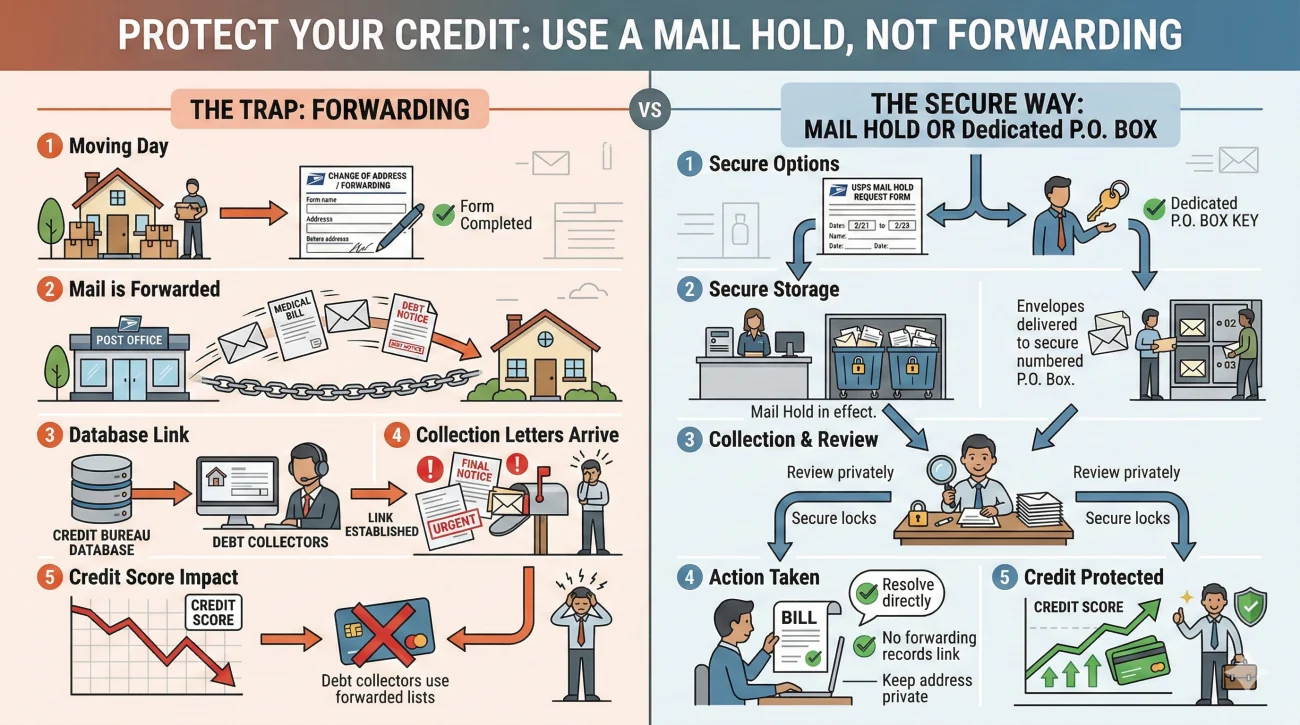
Mistake 10: Forwarding the mail too early
This is a subtle but critical mistake. If you immediately go to the post office and forward all of the deceased’s mail to your personal home address, the postal database updates. Often, debt collectors and credit card companies will purchase this data and start associating your personal address with the deceased’s debts. I worked with one executor who forwarded mail in week one and spent four months fighting to untangle the deceased’s debts from her own credit profile.
❌ Note: Instead of forwarding the mail to your house, request a 30-day “Mail Hold” at the post office. This keeps the mail safe while you set up a dedicated P.O. Box for the estate.
Mistakes with the Timeline
Even if you handle property, money, and documents perfectly, you can still burn out rapidly if you do things in the wrong order.
Mistake 11: Operating without a Priority Matrix
In the first week, many executors feel a frantic urge to cancel a $15 streaming subscription while ignoring the fact that the property insurance on the deceased’s vacant house is about to lapse. This happens when you do not filter your tasks.
You need a simple Priority Matrix. High-Stakes & Urgent items include securing the physical property, finding the original Will, and keeping the cell phone active. Low-Stakes items include canceling Netflix, sorting through old clothes, or paying the cable bill. Focus exclusively on actions that stabilize the estate and unlock the next phase of administration. If you are feeling lost on the correct sequence, review our comprehensive executor first steps checklist to map out your real priorities.
Fixes: What to Do Instead

To keep things actionable, here is a quick reference table showing the common mistakes and the immediate operational fixes you should implement today.
| Common First Week Mistake | The Operational Fix |
|---|---|
| Losing loose paperwork | Buy one physical accordion folder today. Everything goes inside. |
| Vague digital file names | Adopt a strict naming rule: Lastname_Firstname_DocumentType. |
| Mixing funds and losing receipts | Keep a dedicated envelope for estate receipts and log them immediately. |
| Paying bills too fast | Freeze payments. Just collect the bills and log the amounts for now. |
| Canceling the cell phone | Keep the phone active and charged to receive critical 2FA codes. |
| Un-tracked phone calls | Print a simple call log. Demand a reference number for every call. |
| Forwarding mail to your house | Use a USPS Mail Hold for the first 30 days instead of forwarding. |
Final Thoughts on Week One
The estate administration process is a marathon, not a sprint. The institutions you will deal with are slow by nature, and rushing your side of the work usually just leads to errors that take months to unravel.
If you build a solid foundation of organized records and clear communication now, the rest of the executor process will be significantly smoother. To help you stay on track, consider downloading a printable executor checklist to physically cross off these high-priority items and keep your workflow visible.
❓ FAQ
🛑 What is the absolute first thing an executor should not do?
Do not start paying the deceased person’s credit cards or personal debts. You must fully assess all assets, liabilities, and strict legal payment hierarchies before writing any checks.
⚖️ Do I need to hire an attorney in the very first week?
Not always immediately. The first week is usually about securing property, gathering documents, and planning the funeral. However, if the estate is complex, businesses are involved, or family conflict is present, consulting a probate attorney early is a smart protective step.
🏠 Can I start cleaning out the house right away?
It is generally a mistake to give away items, host an estate sale, or throw away paperwork in week one. Secure the perimeter, remove perishables, lock up valuables, but leave the deep sorting for later.
💸 What happens if I accidentally mixed my money with the estate?
Stop doing it immediately, and document the past expenses perfectly. Write down the exact amount, date, and vendor, and attach the receipt to your ledger so you can be formally reimbursed when the estate account opens.
📬 Is forwarding mail to my home address really that bad?
It can be. Data brokers often pick up on change-of-address requests, which can inadvertently link the deceased’s debt profiles to your personal credit file. A USPS Mail Hold or a P.O. Box is much safer.
🏦 Is it a mistake to tell the bank immediately?
Once you notify a bank of a death, they will freeze the accounts. Ensure there are no critical automatic payments (like a mortgage or property insurance) that will bounce before you initiate the freeze.
📄 Do I need to keep the original copy of every bill I find?
Yes. While you should scan them to create a digital backup, retain the physical copies in a safe folder until the estate is completely settled, as courts or auditors may request the originals.
🗣️ Should I announce to the whole family that I am the executor?
Let the key stakeholders know, but set firm boundaries. Making a grand announcement in week one often leads to everyone asking you for timeline updates before you have even secured the foundational documents.
📝 How exactly should I track executor expenses?
Use a simple spreadsheet alongside a physical envelope. Log the date, the vendor, the exact amount, the reason for the expense, and note clearly whether it was paid out of your pocket or from an existing estate fund.
⏱️ What happens if I miss a deadline in the first seven days?
There are very few hard legal probate deadlines in the first week other than prioritizing the funeral and securing the home. Most formal legal timelines start ticking only after you file the initial paperwork with the probate court.
⚠️ Disclosure: I'm not an attorney and nothing on this site is legal or tax advice. The content covers process, organization, and workflow—the operational side of estate administration. For legal interpretation, jurisdiction-specific deadlines, contested situations, or tax matters, please work with a licensed professional in your state.