
- Stop duplicating work: Two people calling the same institution often triggers security freezes. Designate one “voice” for all official outreach.
- Divide by function, not by 50/50 split: Assign a Primary Contact, a Document Lead, and a Finance Tracker based on individual strengths.
- Create a single source of truth: Set up one shared folder with strict naming conventions so nobody is guessing which document is the most recent.
- Log decisions clearly: Agree in writing on what requires mutual sign-off versus what is simply a “heads-up” notification.
- Handle the silence properly: If a co-executor stops responding, build a documented paper trail of your outreach efforts before escalating.
The Reality of Managing an Estate Together
When two or more people are named to handle an estate, it often sounds like a relief. Sharing the burden should make things easier. But in my experience watching families navigate this process, having multiple people in charge can quickly turn into an administrative tangle if you do not establish a operating system on day one.
I frequently see co-executors accidentally trip each other up simply because they are trying to be helpful. One person calls a bank on Tuesday, the other calls the exact same bank on Thursday to ask a slightly different question, and the bank’s system automatically flags the account for suspicious activity. I have seen this happen with three different families at two separate major banks, and resolving the resulting security freeze takes weeks.
You do not need to do every task side-by-side. Building a reliable co executor checklist early on provides a framework for everyone involved. It ensures no critical deadlines fall through the cracks because one person assumed the other was handling it.
The First 72 Hours: Immediate Co-Executor Tasks
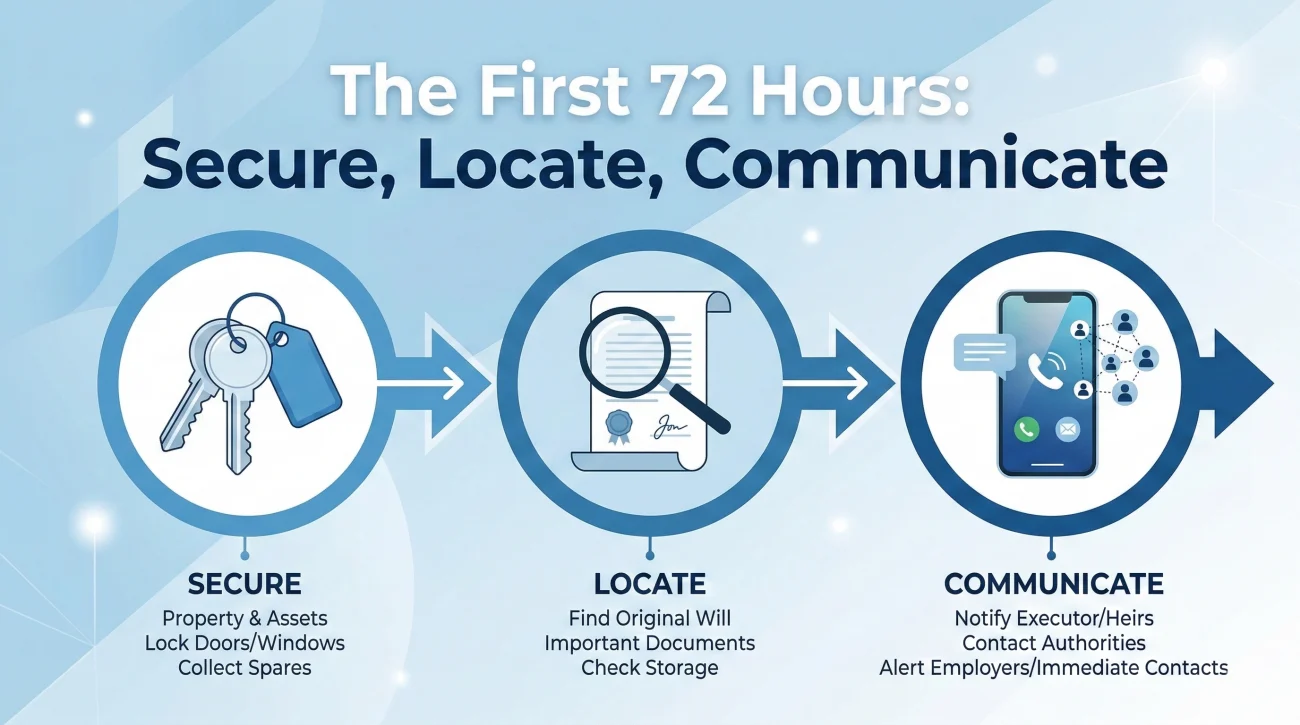
Before you build your long-term spreadsheets, there is an immediate stabilization phase. In the first few days, confusion is at its peak, and both executors often scramble to do the same tasks simultaneously.
During the first 72 hours, sit down together (or get on a video call) and focus only on these three critical items:
- 🏠 Secure the physical property: Agree on who holds the keys, who is checking the house, and ensure no family members are removing items from the home.
- 📄 Locate the original documents: Decide who is searching the home desk and who is calling the estate attorney to find the original will.
- 📱 Pick a communication channel: Agree immediately on how you will talk about the estate moving forward. Do not mix estate discussions into the family group text.
Step 1: Set Clear Roles and Divide Functions
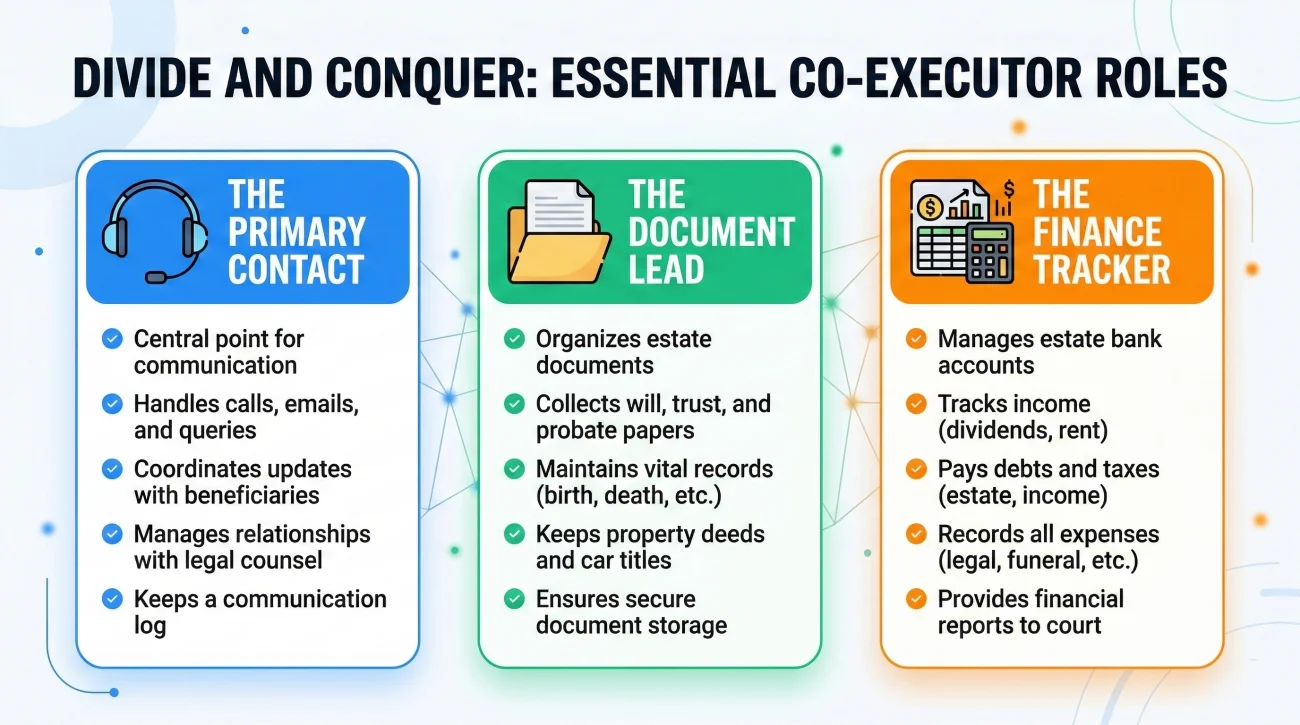
A common mistake is trying to split the workload evenly by taking turns. Saying “You do the first bank, I will do the second” usually leads to inconsistent recordkeeping. When everyone knows their specific lane, the whole process moves faster.
The Primary Contact
This person is the voice of the estate. They handle the phone calls to institutions, wait on hold, and speak with customer service representatives. Having one dedicated caller gives institutions a consistent point of contact.
The Document Lead
The Document Lead is responsible for the paper trail. They scan the physical mail, download statements, organize the digital folders, and ensure every file is named correctly. If the Primary Contact needs a copy of a utility bill to email an agency, they request it from the Document Lead.
The Finance Tracker
This role focuses on logging. They track the incoming bills, log the estate expenses, and update the master spreadsheet. They maintain the visibility of where the money is going.
Key Point: Dividing roles does not mean dividing legal responsibility. You are still working as a unified team. If the Finance Tracker misses a final tax deadline, both of you are held accountable. This is why total visibility is just as important as the division of labor.
Step 2: Build a Single Source of Truth
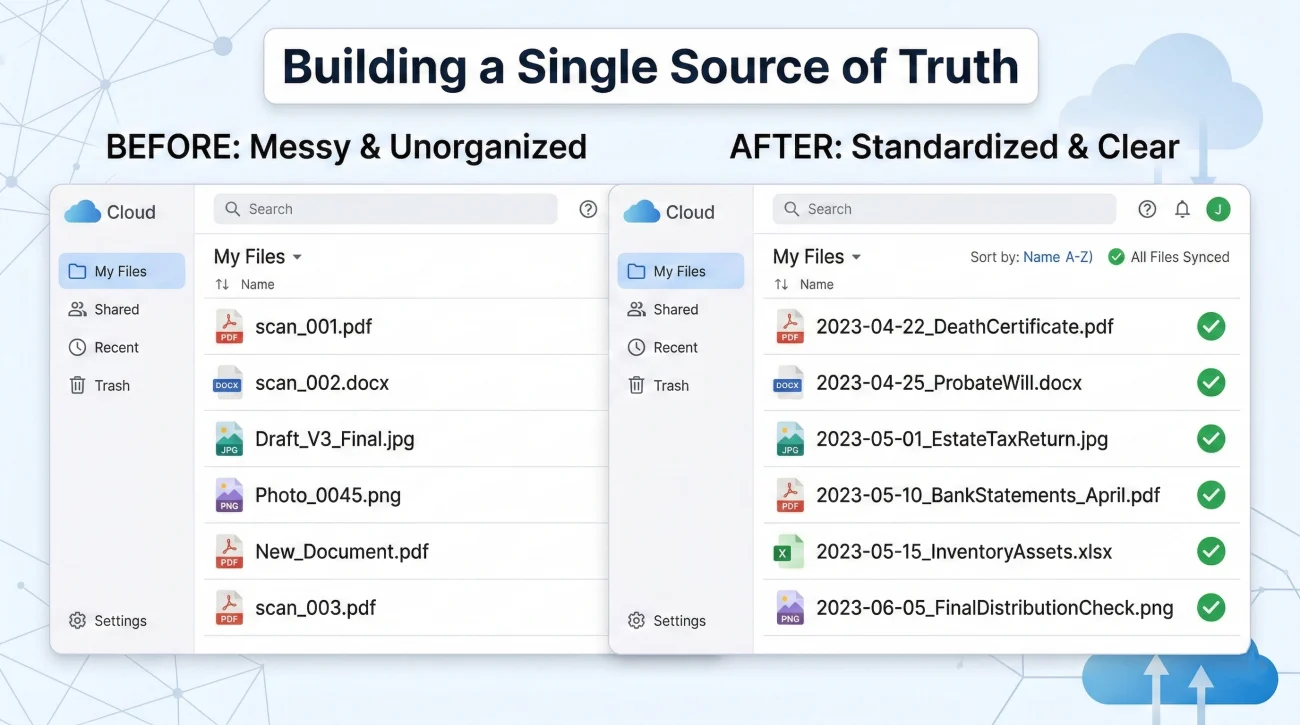
If you are emailing PDF attachments back and forth, you will eventually lose track of the most updated version. I have seen estates stall because one executor was analyzing a bank statement from March while the other was looking at an updated version from April.
You need a central, shared location for all estate documents. This can be a secure cloud folder or a shared drive. The tool matters less than the discipline of using it.
Once you have a shared space, you must agree on how to name files. A folder filled with files named “Document_1_Final” and “Scan_004” is practically useless when you are trying to find a specific life insurance policy months later.
“bank statement.pdf”
“dad house bill.jpg”
“scan_0991.pdf”
“2023-04-15_BankName_Checking_Statement.pdf”
“2023-04-20_UtilityCompany_WaterBill.pdf”
“2023-04-22_DeathCertificate_Copy.pdf”
💡 Pro Tip: Always start your file names with the year, month, and day (YYYY-MM-DD). This forces your computer to automatically sort every document in perfect chronological order.
Step 3: Define Agreement vs. Notification
Not every action requires a formal discussion. If you schedule a meeting for every $40 utility bill, the estate administration will grind to a halt. You must establish ground rules on what requires mutual sign-off and what simply requires a “heads-up” notification.
Selling a vehicle or authorizing a major repair on the estate property requires an agreement. Conversely, canceling a $12 monthly streaming subscription or forwarding the mail only requires a notification. One person does it and logs it.
Here is a script you can use to set these boundaries early on:
Subject: Setting up our decision rules for the estate
Hi [Name],
To keep things moving smoothly, I thought we could agree on how we handle daily tasks versus bigger decisions.
How about this: For basic administrative tasks (like canceling subscriptions, ordering death certificates, or updating mailing addresses), one of us can just handle it and add a note to our shared tracker.
For anything involving spending estate funds over $100, selling physical assets, or signing official forms, we will review it together before moving forward.
Let me know if this framework makes sense to you.
Step 4: Establish a Communication Cadence
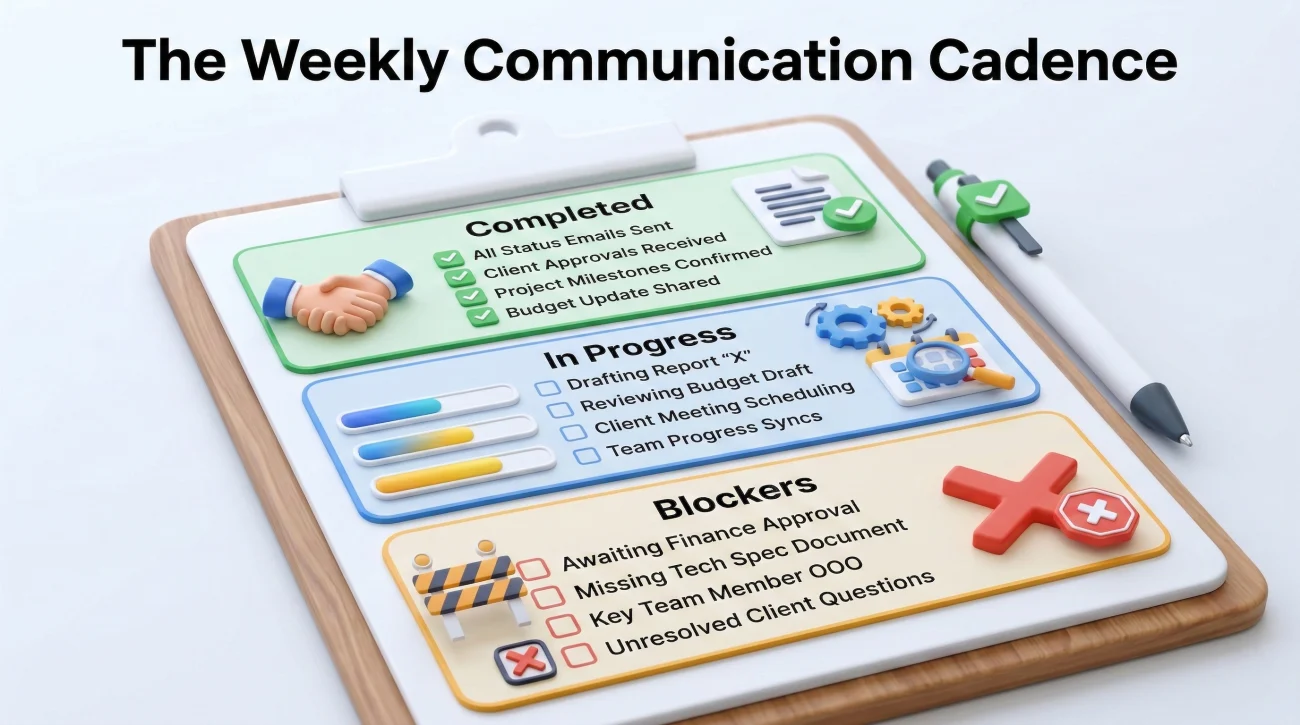
When communication breaks down, ad-hoc texting is usually the culprit. Sending a text message at 9:00 PM on a Tuesday about a confusing tax form creates unnecessary stress and guarantees that the information will be hard to find later.
Rely on a scheduled weekly check-in via email or a planned phone call. This allows both of you to gather your thoughts, compile your updates, and address everything systematically.
Keep the weekly update format simple and predictable:
- ✅ Completed this week: (e.g., Forwarded mail, ordered death certificates)
- 🚧 In progress: (e.g., Waiting on hold times to reach the pension provider)
- 🛑 Blockers/Decisions needed: (e.g., Need your review on the property tax bill before paying)
Step 5: Consolidate Outreach and Share Roadmaps
When you designate one person to handle the phone calls, the other person naturally feels disconnected from the progress. The only way to bridge that gap is through rigorous, accessible note-taking.
Whenever the Primary Contact speaks to a bank, creditor, or agency, they must write down the specifics. This protects both of you and provides a clear record if an institution later claims they never received your instructions. A simple Call Log table in your shared folder works best.
| Date | Institution | Representative Name | Reference # | Outcome / Next Steps |
|---|---|---|---|---|
| Oct 12 | Chase Bank | Michael R. | #88492-A | Notified of death. Faxing death cert tomorrow. Account frozen. |
| Oct 15 | State Farm | Sarah L. | #11099 | Home policy is active until Dec. Need to send court letters to change named insured. |
Before making these calls, both of you should understand the overall roadmap. I highly recommend sitting down and reviewing the complete Executor First Steps Checklist together. Having a shared understanding of the broader timeline prevents one person from rushing ahead to step ten when you have not finished step two.
Step 6: Maintain a Shared Decision Log
Human memory is fragile, especially under grief. Six months from now, neither of you will remember exactly why you decided to list the house in May instead of waiting until July. A written decision log removes the guesswork and prevents arguments over “who said what.”
A simple table in a shared document is all it takes to keep a permanent record of major agreements.
| Date | Decision Topic | Agreed Action | Who is Responsible |
|---|---|---|---|
| Oct 12 | House maintenance | Hire local service to winterize pipes, cap at $300. | Sarah (scheduling) |
| Oct 15 | Credit cards | Close all three known accounts. Do not pay balances until full debt picture is clear. | David (calling) |
❌ Note: Never rely on verbal agreements for anything involving estate funds or the sale of assets. Always log it in writing to protect your legal standing.
Step 7: Master the Handoff
Because you are dividing tasks, there will constantly be handoffs. Handoffs usually fail because the sender assumes the receiver has all the background context. If you simply forward an email from the probate attorney with the note “Please handle,” the other person has to spend twenty minutes reading the thread just to figure out what “handle” means.
A good rule of thumb is the formula below for any internal request:
[Clear Request] + [Location of Context] + [Deadline]
Instead of a vague message, a clean handoff looks like this:
“I just uploaded the home insurance renewal notice to the ‘Property Bills’ folder. They are asking for a copy of our court letters by the 15th. Can you review it and mail the packet out by Friday?”
This leaves no room for ambiguity. The recipient knows exactly what the document is, where to find it, what physical action is required, and when it is due.
Step 8: What to Do When a Co-Executor Goes Silent
Even with a clean system in place, the process can stall for a reason that has nothing to do with paperwork. One of the most stressful scenarios is when a co-executor simply stops responding to emails or calls. Progress halts, and deadlines loom.
If this happens, your first move is to build a documented paper trail. Do not bombard them with angry texts. Send clear, factual emails outlining what decisions are pending. If emails fail, send a certified letter outlining the specific actions required to prevent harm to the estate (such as an upcoming tax deadline or a property foreclosure risk).
If the unresponsiveness threatens the estate, you may eventually need to speak with an attorney about petitioning the court to remove them or allow you to act independently. The court will want to see proof that you tried to collaborate, which is why your polite, documented outreach is so critical.
Handling Mid-Stream Changes
While an unresponsive co-executor is a frustrating roadblock, sometimes a co-executor’s departure is voluntary. A co-executor might realize the work is too much and decide to step down, or an unexpected health issue prevents them from continuing. If a co-executor resigns, do not just take their word for it and carry on alone.
They usually need to sign a formal renunciation or resignation document to file with the court. Once they are officially removed, check the will to see if a successor was named to take their place. If someone new is stepping in, you will use your shared folder, Decision Log, and Call Log to instantly get them up to speed. Beyond just handing over the files, you need to brief them specifically on the current estate bank balance, any upcoming tax or creditor deadlines that are pending, and exactly which institutions have already been formally notified.
The True Goal of Co-Managing an Estate
The ultimate goal of a co-executor system is not just to close the estate efficiently. It is also to preserve your relationship with the other person once the paperwork is done. Decades of family history can be severely strained by twelve months of disorganized administrative work, resentments, and missing files.
Institutions and creditors only care about the forms they receive. They do not see the internal effort it takes to gather them. Build your shared folders today, divide your roles clearly, and over-communicate in writing. The peace of mind, and the preservation of your family bonds, is well worth the upfront effort.
❓ FAQ
🗣️ Do co-executors have to agree on everything?
In many cases, major decisions like selling real estate, distributing funds, or paying large debts require mutual agreement. However, minor administrative tasks like forwarding mail or gathering records can often be handled individually, provided you communicate your actions clearly to the other person.
📞 Can just one executor call the bank?
Yes, and it is usually preferred. Having one designated point of contact reduces confusion. However, the bank may require both of your signatures on initial paperwork or official forms to recognize your authority before they will speak to either of you over the phone.
💻 How should we share sensitive estate documents?
Use a secure cloud storage service like Google Drive, Dropbox, or OneDrive where you can restrict access. Avoid sending documents with full account numbers or social security numbers directly through standard email attachments, as email is generally less secure.
🤝 What if a co-executor lives out of state?
Distance is common and highly manageable if you use the right tools. Here is how it usually works in practice:
- Physical tasks: The local person acts as the Document Lead, securing the property and scanning the mail.
- Digital tasks: The out-of-state person manages the master spreadsheets and handles phone calls to national institutions.
- Signatures: Gathering dual signatures requires a specific workflow involving overnight mail or e-signatures (see the signature question below for exact details).
🏦 Do we both need to be present to open an estate bank account?
Many banks require all named executors to sign the account opening documents. Some institutions allow you to sign paperwork separately at different branch locations or via secure mail, but you must ask the specific bank for their exact logistical requirements.
⚖️ What happens if we cannot agree on a decision?
If you reach a true deadlock on a major issue (like whether to sell an asset), progress stops. If informal mediation between yourselves fails, do not immediately rush to court. A highly effective middle step is to hire a family mediator or consult a neutral probate attorney to review the issue objectively. If all else fails, you may eventually have to ask the court to intervene and provide direction, which takes time and costs money.
📂 Who keeps the original death certificates?
The person acting as the Document Lead or whoever handles physical mail should keep the originals in a secure file box. Whenever a copy is needed, they can mail it out. Always log how many certified copies you have left so you know when to order more.
🛑 Can one executor act alone without telling the other?
Acting entirely independently on major estate moves is highly risky and a primary cause of conflict. Even if local rules allow independent action on minor items, best practice is to always provide a written “heads-up” notification to maintain transparency and trust.
📝 How do we sign estate documents together?
For physical forms requiring wet signatures, you may need to use overnight couriers to pass the original document back and forth sequentially. However, for many modern institutions, secure e-signature platforms like DocuSign are now accepted. Always confirm in writing with the receiving agency if they accept digital signatures before paying for overnight shipping.
📬 Should mail be forwarded to both of us?
The post office will only forward mail to a single address. You must choose one person to receive the physical mail. That person should act as the Document Lead, opening the mail, scanning the important documents, and uploading them to your shared digital folder.
⚠️ Disclosure: I'm not an attorney and nothing on this site is legal or tax advice. The content covers process, organization, and workflow—the operational side of estate administration. For legal interpretation, jurisdiction-specific deadlines, contested situations, or tax matters, please work with a licensed professional in your state.