
- The Core Issue: A will alone does not give you power. You must obtain formal court authority before institutions will let you access or manage estate assets.
- The Three Paths: Your route depends entirely on the facts: whether you have an original will, if there is no will at all, or if the estate qualifies for a local small-estate shortcut.
- The Timeline Reality: Gaining authority is not a weekend project. In most jurisdictions, expect a 1 to 3-month gap between your initial filing and receiving your official documents.
- The Question Bank: Never assume court procedures. We provide a 12-question template to ask your local clerk to ensure your first filing is accepted without delay.
- Knowing Your Limits: DIY administration works for straightforward cases, but specific red flags (like hostile family dynamics or interstate real estate) mean you should immediately consult an attorney.
The Wall of Silence at the Local Branch
I have lost count of how many times I have spoken with an overwhelmed family member who walked into a local bank branch, death certificate and original will in hand, fully expecting to access an account to pay the deceased person’s utility bills or funeral costs. They slide the paperwork across the desk. The teller looks at it, offers their condolences, and then says the phrase that stops everything in its tracks.
“I am sorry, but we cannot help you until you bring us your court documents.”
This is the exact moment when the reality of estate administration sets in. It is incredibly frustrating, and it feels entirely counterintuitive. You have the will. The will clearly says you are the executor. It has your name printed right there in black and white. Why is that not enough?
In day-to-day admin work, this is the most common, and most jarring, early hurdle. Early in my career, I watched a family nearly lose a pending house sale because they assumed “reading the will” was the official start of the process, only to realize the title company required court orders they hadn’t even applied for yet. The truth is that a will is essentially just a piece of paper with a wish list until a judge looks at it, validates it, and officially appoints you to the role. That appointment is what unlocks the doors. Without it, you are legally a stranger to the estate.
My goal here is to help you build a reliable probate court checklist for executors. I want to map out how you go from holding a piece of paper to holding the actual legal authority that makes institutions listen to you. We are not going to dive into state-specific legal advice, tax codes, or litigation strategy here. Instead, I am going to share the practical, universal workflow steps that keep files moving, reduce administrative friction, and help you understand exactly what the court system is trying to accomplish before they hand you the keys.
The Three Common Paths to Authority
Your probate court checklist for executors will always start by identifying which path you are on. In almost all cases, your situation will fall into one of three broad categories. You do not get to pick the path based on preference or convenience. The undeniable facts of the estate dictate the route.
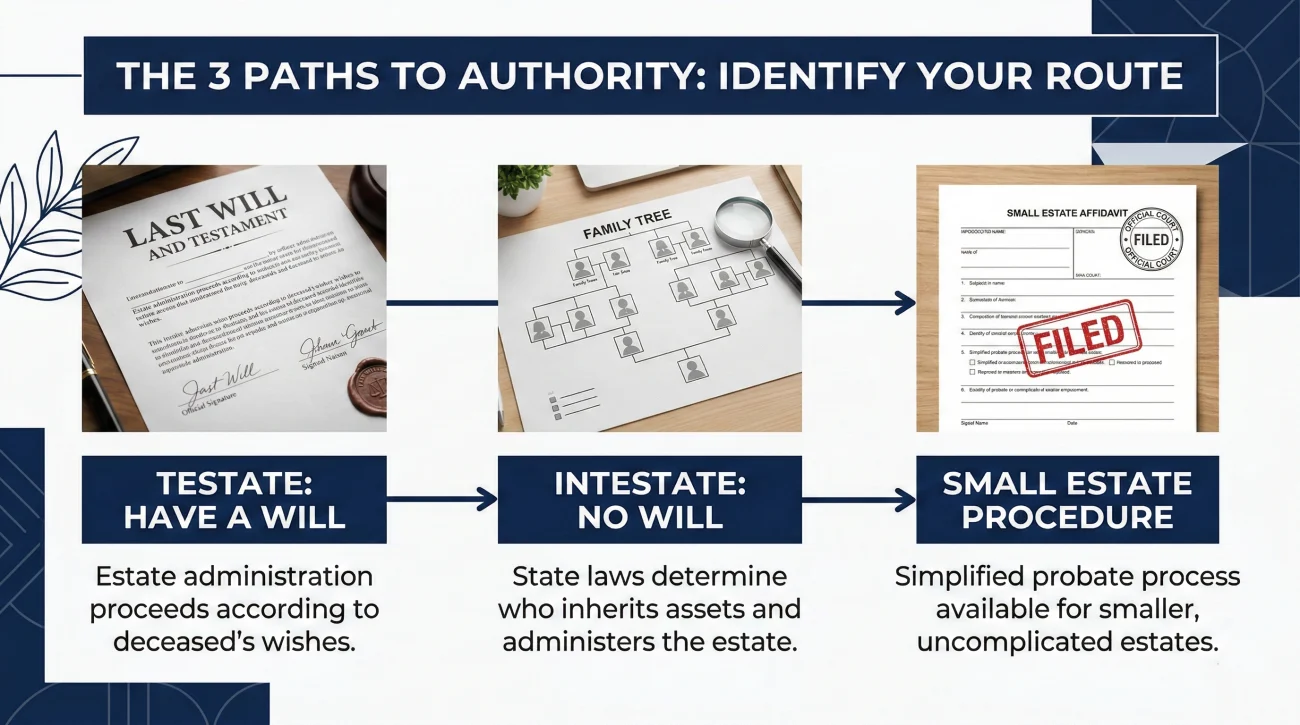
Path 1: The Will Exists (Testate)
If you have a valid, original will that names you as the executor, you are on the standard path. Your objective is to present this document to the court to prove it is the final, authentic wish of the deceased person. In practice, this means physically securing the original document, gathering the names of all beneficiaries listed, and preparing to formally ask the court to validate it. The court will review it, ensure it meets basic local formatting rules (like having the correct number of witness signatures), and then officially grant you the power to act.
Path 2: No Will Exists (Intestate)
If there is no will, or if the original cannot be found anywhere, the estate is considered “intestate”. Someone still has to handle the assets, but the court does not have a written guide from the deceased person telling them who that should be. Instead, the court relies on local default laws to determine who has priority to step up (usually a surviving spouse, followed by adult children). Your operational steps here shift heavily toward proving your relationship to the deceased and documenting the family tree so the court knows who needs to be notified.
Path 3: The Small Estate Shortcut
Many people assume that every single estate must go through a long, formal court process. Families are often relieved to discover that many jurisdictions offer a simplified path if the estate is relatively small or simple. This is commonly called a small estate affidavit or a summary administration. If the total value of the assets falls below a certain cap (which varies wildly depending on your state), you might be able to submit a sworn statement to the court or directly to the bank to gain authority much faster. However, this path is highly conditional.
Regardless of which path you are required to take, the destination is the same: obtaining the official court document that proves your status to the outside world.
Handling Your “Letters”: The Golden Ticket
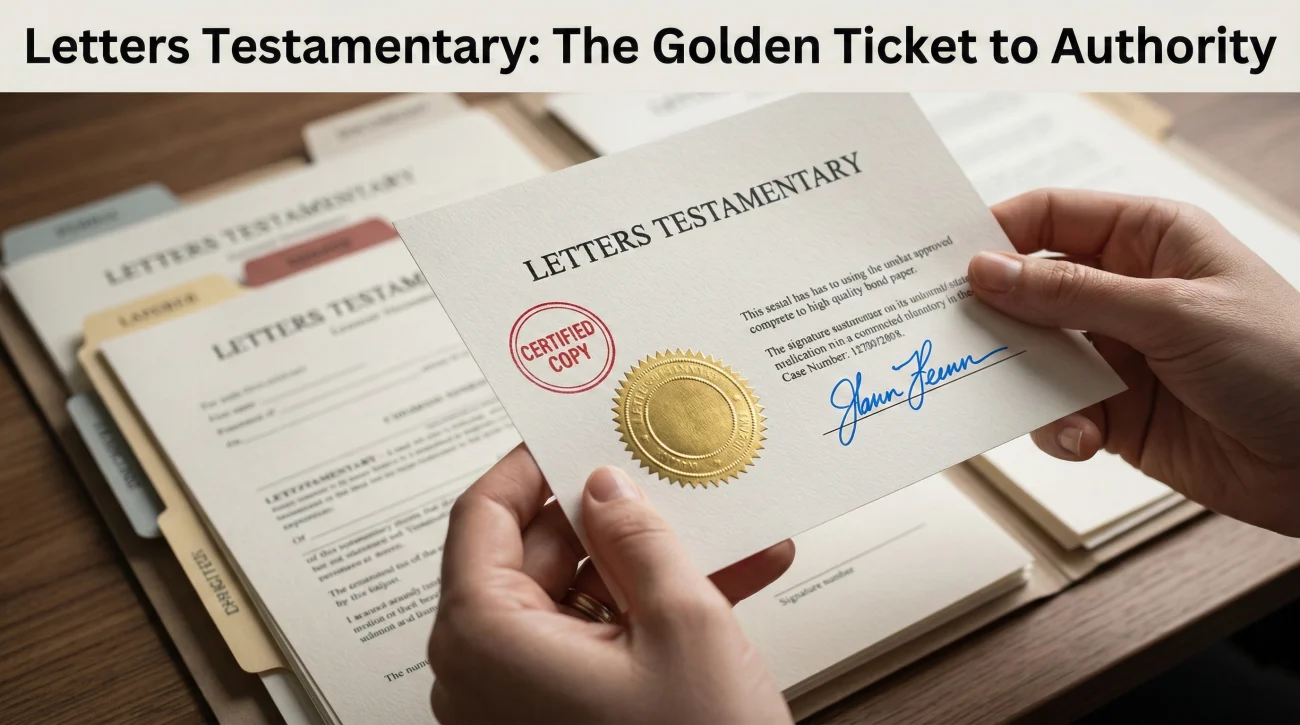
When you complete the initial court phase, the output you receive is a surprisingly simple-looking piece of paper. If there is a will, they are called Letters Testamentary. If there is no will, they are called Letters of Administration. Functionally, they do the exact same thing.
The most important operational shift once you receive your Letters is understanding how to handle them. A regular photocopy from your home printer is rarely accepted by major institutions. Third parties want proof that your authority is current and authentic.
💡 Pro Tip: You will frequently need to provide “certified copies” of these Letters. A certified copy has a raised, embossed seal or a specific colored stamp from the clerk proving it is an authentic duplicate. Always ask the clerk how to order 5 to 10 certified copies right on the day your authority is granted.
Additionally, understand that Letters can sometimes “go stale” in the eyes of a bank. Even if the court does not officially expire them, a risk-averse financial institution might refuse a certified copy that is older than 60 or 90 days. Keep your originals pristine in a fireproof folder, hand out certified copies only when strictly required, and track exactly who you sent them to in case you need to request updated versions later.
What Courts Commonly Want to See First
Before the court will issue your authority, they need a baseline understanding of the situation. Every local jurisdiction has its own specific forms, but the core data they ask for is remarkably consistent nationwide. When building your probate court checklist for executors, you should prepare a master folder that contains these foundational facts.
- 📄 The Original Will: The court almost always demands the original document, not a scan. Keep it in a safe folder and absolutely do not remove the staples.
- 📄 The Death Certificate: You will typically need a certified copy to prove the person has passed away.
- 📄 Basic Biographical Data: Full legal names, previous addresses, and dates of birth for the deceased person.
- 📄 A List of Interested Parties: The names, addresses, and relationship statuses of anyone named in the will, plus the closest living relatives (who must usually be listed even if they were intentionally left out of the will).
- 📄 A High-Level Asset Snapshot: Many courts want a rough estimate of what the estate is worth right at the beginning. You usually do not need exact, to-the-penny appraisals on day one, but you need to know if the estate is worth $50,000 or $5,000,000, as this often determines the filing fees and bond requirements.
Having this data organized before you make your first phone call to the court will dramatically smooth out the application process. However, even with the right data, administrative traps are everywhere.
Avoidable Delays That Trap First-Time Executors
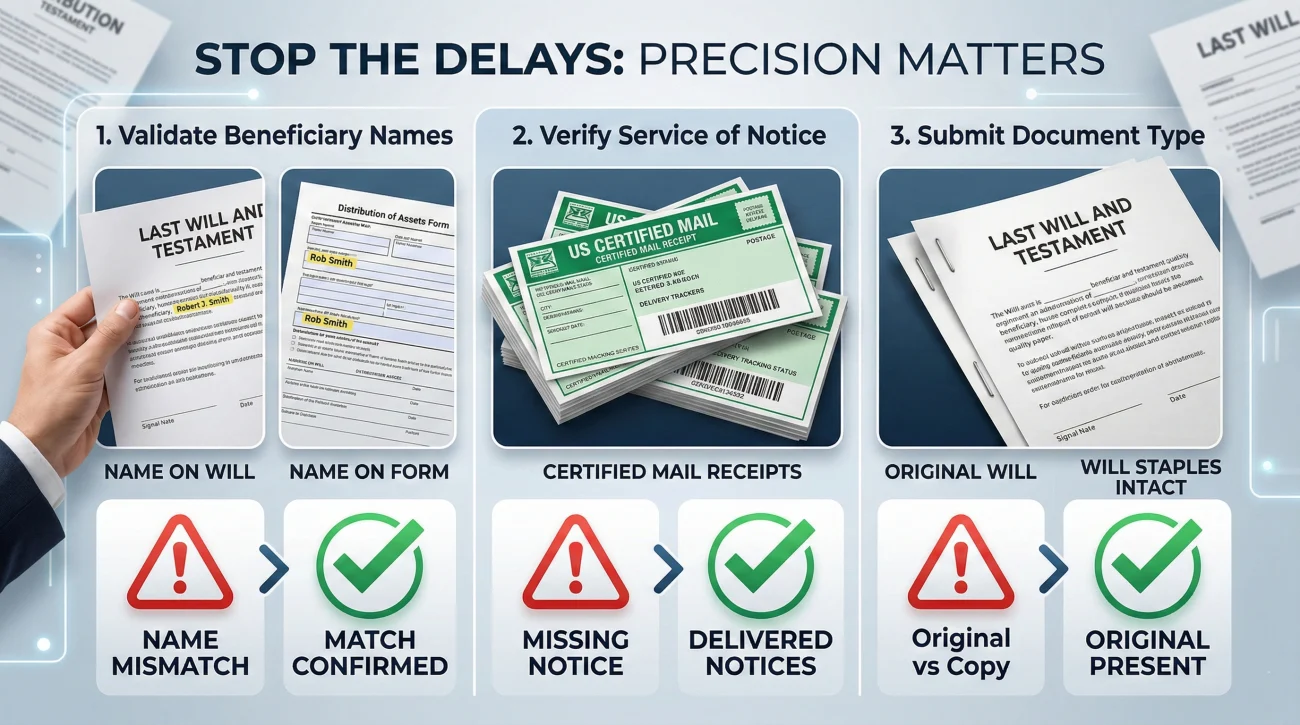
The court process moves at its own pace, but I frequently see executors accidentally slow things down themselves. The initial filing phase is highly procedural. If a box is left unchecked, the clerk will simply kick the file to the back of the line.
I once consulted on a case where a family lost three entire months because the executor’s middle initial was listed on the application, but not on the original will. The clerk flagged the mismatch, returned the packet via standard mail, and required a sworn affidavit to prove identity. By the time the paperwork was corrected and re-entered the queue, the estate had incurred late fees on property taxes. Precision matters.
Here are the three most common avoidable delays, and the specific mini-checklists to solve them:
Delay 1: Incomplete Notice to Heirs
Courts are obsessed with transparency. They usually require you to formally notify everyone involved that you are stepping up to take control. If you forget to mail notice to an estranged sibling, the court will halt the process.
- ✅ Compile a complete family tree, including addresses for estranged relatives.
- ✅ Ask the clerk exactly which “Notice of Application” form is required.
- ✅ Send all notices via Certified Mail with Return Receipt Requested.
- ✅ File the green return receipts with the court as proof of mailing.
Delay 2: The Bond Requirement
A probate bond is essentially an insurance policy that protects the estate from an executor making a terrible financial mistake. Sometimes the will explicitly waives this. If it does not, you may be required to arrange and pay for a bond before the letters are issued.
- ✅ Read the will specifically looking for the phrase “serve without bond.”
- ✅ If a bond is required, ask the clerk for a list of locally approved surety companies.
- ✅ Prepare to provide your own personal credit score, as bond approval is based on your financial history.
Delay 3: Photocopy Confusion
Bringing a photocopy of the will to the initial meeting when the court strictly requires the original is a classic error. Courts presume a missing original was intentionally destroyed by the deceased.
- ✅ Search safe deposit boxes, home safes, and contact the drafting attorney before settling for a copy.
- ✅ If only a copy exists, prepare to file an “Affidavit of Lost Will” (or local equivalent).
- ✅ Expect a formal hearing where you must explain to a judge why the original is missing.
Mailing the initial packet through standard post, assuming the clerk will fix any minor typos, and passively waiting for a month without tracking it.
Sending the packet via Certified Mail, logging the delivery date, calling the clerk on Day 14 for a status check, and confirming exact next steps based on their feedback.
The Realistic Timeline: Managing Expectations
A major source of anxiety for first-time executors is not knowing how long this administrative limbo will last. While exact timelines vary heavily by county population and court backlog, you should generally view the process of getting legal authority in three distinct phases.
Phase 1: Preparation and Filing (1 to 3 Weeks)
This is entirely in your control. This phase involves hunting down the original will, waiting for the funeral home to provide the certified death certificates, gathering family addresses, and filling out the initial application. The clock does not start until this packet is physically received by the court.
Phase 2: Court Review and Notice Period (2 to 8 Weeks)
Once filed, the court clerks must review your documents for procedural accuracy. In many states, this phase also includes a mandatory waiting period where a notice is published in a local newspaper, or heirs are given 14 to 30 days to object to your appointment. You cannot speed this up.
Phase 3: Hearing and Issuance (1 to 4 Weeks)
Depending on local rules, you may need a brief zoom or in-person hearing with a judge. Once approved, the clerk’s office processes the paperwork, stamps the seal, and issues your certified Letters.
⚠️ Warning: When family members ask when you will distribute money, point to this timeline. Set the expectation early that it often takes 1 to 3 months just to get the legal authority to start the real work, let alone finish it.
The Executor Tracking System
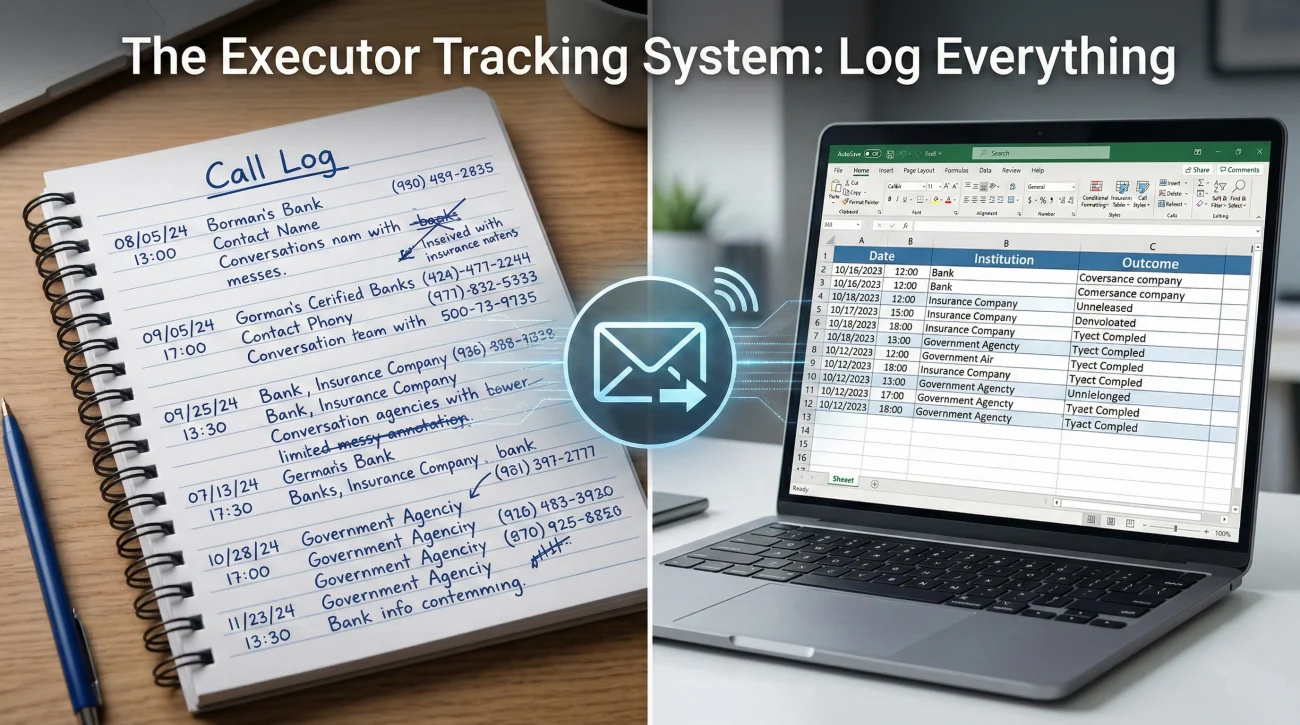
If there is one piece of operational advice I can give you, it is this: start tracking everything immediately. You will be dealing with multiple clerks, bank representatives, and vendors over several months. You will not remember who told you what on a random Tuesday afternoon.
A solid tracking system is your best defense against missing document loops. A simple spreadsheet or a dedicated spiral notebook works perfectly. You need three specific logs:
1. The Master Call Log
Every time you speak to an institution or the court, document it. Memories fade, and call center representatives change. When an institution claims they never received your paperwork, your call log gives you the exact date, time, and name of the person who confirmed receipt.
Date: October 14
Time: 10:15 AM
Institution: County Probate Intake Desk
Representative: Clerk at Window 4 (Did not catch name, asked for initial)
Notes: Asked if they accept digital signatures on the heir waiver form. Clerk confirmed they require wet ink signatures mailed to the main PO Box. Need to overnight the packet tomorrow.
2. The Document Tracker
Keep a running list of every form you mail out. Note the date you sent it, the tracking number if you used certified mail, and the date you received a confirmation of receipt. Never send an original document without a tracking number.
3. The Family Communication Log
Family friction arises simply because people feel out of the loop. If you make a significant administrative step, log it and proactively share a quick status update. A simple Friday email saying, “The initial paperwork was successfully submitted to the court this week, the clerk stated the current processing time is roughly 4 weeks” goes a long way toward keeping the peace.
Red Flag Checklist: When to Hire an Attorney
Many executors successfully navigate the initial court filing on their own, especially for simple estates. However, part of being a responsible administrator is recognizing when a situation exceeds a DIY approach. Understanding your limits as an executor is critical to protecting both the estate and your own personal liability.
If you encounter any of the following red flags during your initial prep phase, you should pause and consult an estate attorney immediately:
- 🚩 Hostile Dynamics: You hear rumors that a sibling intends to contest the will or challenge your appointment.
- 🚩 Missing Originals: The original will is completely missing and you only have an unsigned copy.
- 🚩 Insolvent Estate: It appears the deceased owed significantly more money in debts than they owned in assets.
- 🚩 Interstate Property: The deceased owned physical real estate in multiple different states (requiring complex “ancillary” probate).
- 🚩 Active Business: The deceased was the sole owner of an operating business with active payroll and employees.
- 🚩 Blended Families: There is no will, and the deceased leaves behind a second spouse and children from a previous marriage.
In these scenarios, legal advice is not an optional luxury; it is a necessary shield.
The Local Court Question Bank
Because every county operates slightly differently, the most important part of your probate court checklist for executors is verifying the local rules. To find the correct local court website to start your research, the National Center for State Courts (NCSC) acts as the official central hub for locating state and county judicial branch websites across the country.
When you call the local office, do not ask for legal advice. Keep your questions strictly focused on process. Here is a 12-question bank you can pull from to build your script:
1. Do you require the original will to be mailed, or do you have an in-person drop-off system?
2. Are there any specific local county forms required beyond the standard state application?
3. Do you accept digital signatures from heirs, or must all waivers have wet-ink signatures?
4. Are there specific requirements for how the death certificate is presented (e.g., long-form vs. short-form)?Financial & Fees:
5. What is the current accepted method for paying filing fees (check, money order, online portal)?
6. Is the filing fee a flat rate, or is it based on the estimated value of the estate?
7. Can I request certified copies of the Letters at the time of initial filing, and what is the cost per copy?
8. If a bond is required, do you provide a list of approved surety companies?Timeline & Process:
9. What is your current estimated processing time from the day you receive an application to the day Letters are issued?
10. Will the court automatically publish the required notice to creditors, or is the executor responsible for contacting the newspaper?
11. Do you require an in-person hearing for an uncontested application, or is it handled entirely via paperwork?
12. How will I be notified if my application is deficient—by mail, email, or phone?
Always follow up complex answers by asking the clerk if there is a written procedural guide or a specific link on their website where you can confirm these details.
The Complete Authority Routing Map
Getting your initial authority is just the first step. I have mapped out the deep dive guides below. Use this table as your routing system to find the exact, practical steps for the specific hurdle you are facing right now.
| Topic / Deep Dive Guide | What It Covers in Practice |
|---|---|
| Letters Testamentary: What They Prove and Why Banks Keep Asking | A practical breakdown of the ultimate authority document, what third parties verify, and how to use it safely. |
| Letters of Administration: What the Document Proves and How It Gets Used | The core guide for the “no will” scenario, explaining what this document authorizes in the real world. |
| Probate Without a Will: The Court Appointment Process Before You Can Act | A process map for the chaotic period before anyone has authority, focusing on how families can prep data. |
| Letters Testamentary vs Letters of Administration: Which One Applies and What Changes | A side by side workflow comparison showing how your interactions with banks and insurers shift based on the document type. |
| What to Bring to Probate Court: A Practical Executor Checklist | A granular prep list for your first interaction with the clerk, focusing on document organization and identity proof. |
| Executor Bond and Probate Bond Checklist: When It Comes Up and What to Expect | A plain English guide to the insurance policy courts sometimes demand, and how it impacts your timeline. |
| Small Estate Affidavit: When It Can Replace Full Probate and When It Can’t | Themes and red flags to help you determine if the estate might qualify for the faster, simplified shortcut. |
| Informal vs. Formal Probate: What’s Different and Why It Matters to Executors | An overview of how your paperwork load and reporting requirements change depending on the oversight level. |
| Renouncing as Executor: What Happens Next and What to Document | A clean handoff checklist for those who are named in a will but cannot take on the responsibility. |
| Contested Will in Probate: What Changes, What to Pause, and What to Track | A calm, procedural guide on what tasks to pause and what records to lock down if family disputes arise. |
| How Long Does It Take to Get Letters Testamentary: A Practical Timeline | Realistic ranges, the most common delay factors, and what safe actions you can take while you wait. |
| What to Do After You Receive Letters Testamentary: The First 10 Actions | The critical bridge post: the exact organizational steps to take the day the court hands you your authority. |
| How Many Certified Copies of Letters Do You Need: A Practical Rule of Thumb | An estimator method based on asset categories to help you order the right amount of copies without wasting money. |
| Letters Reissue or Renewal: When You Need Updated Letters and What to Ask For | How to handle it when a stubborn bank claims your letters are “too old” and demands fresh court stamps. |
Final Thoughts on the Court Phase
Entering the court system is inherently intimidating. The terminology feels ancient and the timeline often feels completely out of your control. But when you strip away the legal jargon, the initial phase is simply a highly rigid data-gathering exercise. The court just wants to verify the facts, protect the assets from fraud, and ensure the correct person takes the wheel.
By focusing your energy on building a solid probate court checklist for executors, maintaining an obsessive tracking system, and asking clear procedural questions locally, you take back a measure of control. Do the prep work methodically. Track your mailings. When you finally walk back into that local bank branch, slide those officially stamped, certified Letters across the desk, and watch the teller’s demeanor change—you will know the administrative foundation you built was worth the effort.
Sources
- 📄 American Bar Association (ABA): The Probate Process Overview
- 📄 National Center for State Courts (NCSC): Official State Court Resources
❓ FAQ
🎤 Can I empty the deceased’s fridge and clean the house before getting authority?
Yes, securing the property, throwing away perishable food, and locking the doors are considered basic preservation acts and can usually be done safely before court appointment.
📬 Will the court automatically mail the letters to me once approved?
Not always. Some jurisdictions require you to pick them up in person, while others will mail them if you provided a self-addressed stamped envelope. Always ask the clerk their specific delivery method.
🏦 Can I use my own money to pay for the probate bond or filing fees?
Yes, executors frequently pay initial court fees out of pocket because estate accounts are locked. Keep a pristine receipt; these expenses are generally reimbursable from the estate later.
📅 Do Letters Testamentary automatically expire after a year?
Usually no, the court order remains valid until the estate is closed. However, banks often arbitrarily refuse to accept certified copies that were printed more than 60 days ago, forcing you to order fresh copies.
✍️ What color ink does the probate court usually require on forms?
In many counties, clerks strictly require blue or black ink. Blue is often preferred for original signatures so they can easily distinguish the wet-ink original from a black-and-white photocopy.
🏷️ Do I need to list personal items like clothes on the initial court application?
Typically, no. The initial application usually only requires a broad, high-level estimate of major assets (real estate, bank accounts) to determine filing fees, not a granular inventory of household goods.
🚗 Can I sell the deceased’s car if I have the will but no letters yet?
No. The DMV will require the official court Letters (or a specific small estate affidavit for vehicles) before they will allow you to transfer the title or sell the vehicle.
💸 Who pays the mortgage while I wait 2 months for court authority?
This is a common friction point. If the estate has no joint accounts to draw from, family members sometimes pay the mortgage out of pocket to prevent default, keeping receipts for future estate reimbursement.
👥 Do I have to notify estranged family members I haven’t spoken to in years?
Yes. If they are legally considered next-of-kin under state law, the court requires you to make a diligent effort to notify them of the probate proceedings, regardless of personal relationships.
📑 What if the court asks for an original will but the lawyer only has a copy?
You must file an explanation (often an Affidavit of Lost Will) and go before a judge to prove the deceased didn’t intentionally destroy the original to revoke it. This significantly delays the process.
⚠️ Disclosure: I'm not an attorney and nothing on this site is legal or tax advice. The content covers process, organization, and workflow—the operational side of estate administration. For legal interpretation, jurisdiction-specific deadlines, contested situations, or tax matters, please work with a licensed professional in your state.