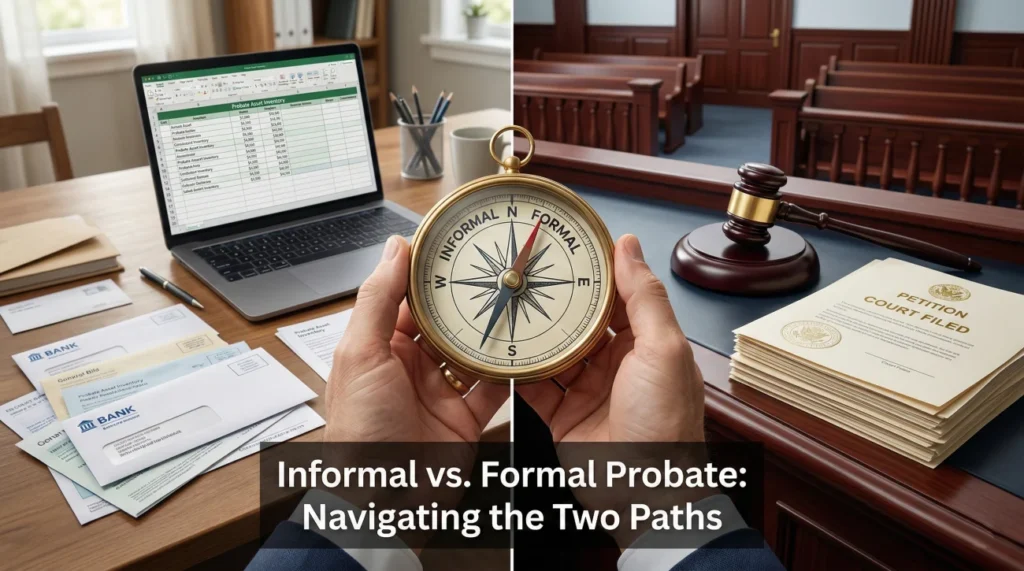
- The core difference: Informal probate relies on paperwork and mail, while formal probate involves direct court supervision, hearings, and mandatory approvals before you can take action.
- Your workload changes: Formal processes require meticulous tracking. You must prove every penny spent and request permission before selling assets.
- Communication is key: The path you take directly affects your timeline. Managing family expectations early prevents frustration down the line.
- The golden rule: Maintaining a single, hyper-organized timeline log and document tracker is your best defense against administrative delays.
Decoding the Jargon: How Your Daily Workload Will Actually Change

When you step into the role of an executor, you are immediately hit with a wave of unfamiliar terminology. Among the most common and stressful are the terms “informal” and “formal” administration. If you are sitting at your kitchen table staring at a stack of documents and wondering what these words mean for your next six months, take a deep breath. You are not alone in feeling overwhelmed.
In my work helping executors organize their administrative chaos, I see this exact moment of panic almost daily. People assume that “formal” means a highly combative courtroom drama, while “informal” means you can just do whatever you want. The reality is much more practical. These terms simply describe the level of oversight the court will apply to your work and how much paperwork you must generate.
I always tell first-time executors to look at this not as a legal puzzle, but as a project management challenge. Whether the path is supervised or unsupervised, your job is to gather information, protect assets, pay valid debts, and distribute what is left. The difference lies in how many times you have to raise your hand and ask the court for permission along the way.
What “Informal” Probate Looks Like on Your Desk
If the circumstances allow for an informal process, it means the court trusts you to handle the administration with minimal intervention. This is usually available when there is a valid will, the heirs are in agreement, and there are no glaring red flags like impending foreclosures or complex business assets.
From an administrative standpoint, informal administration is heavily reliant on paperwork rather than physical appearances. You still submit applications, inventories, and final accountings, but clerks process these through the mail or an electronic portal. You are not standing in front of a judge explaining why you paid a specific utility bill.
Handling Daily Tasks Without Waiting for a Judge
The biggest relief for executors in an unsupervised setting is the ability to maintain momentum. For example, if you need to sell the deceased person’s car to pay for estate expenses, an informal setup allows you to find a buyer, sign the title as the authorized representative, and deposit the funds into the estate account without asking the court for a special order first.
💡 Pro Tip: Even with the freedom of an informal process, I strongly advise executors to act as if they are being audited. Just because you do not submit every receipt to a judge immediately does not mean the beneficiaries will bypass asking to see them later.
Where Things Go Wrong Without Supervision
The biggest trap of the informal route is complacency. Because no judge is actively scheduling hearings or breathing down your neck, it is entirely up to you to maintain momentum. I have seen many executors lose months of progress simply because they put the file away and forgot to follow up on a life insurance claim.
Furthermore, autonomy brings the risk of unforced errors. It is tempting to write a check for a credit card bill simply because the statement arrived in the mail, completely forgetting that funeral expenses and taxes have legal priority. Without a judge reviewing your work before you distribute funds, mistakes like paying the wrong creditor are entirely on your shoulders.
What “Formal” (Supervised) Probate Means for Your Workflow
When an estate requires formal administration, the court effectively puts a leash on the process. This does not mean you have done something wrong, nor does it guarantee the family is fighting. Formal oversight is required automatically in many places if the original will cannot be found, a beneficiary is a minor, or the local jurisdiction mandates it for large estates.
For your day-to-day workload, a formal path demands a “hurry up and wait” mindset. You gather information, but before you can act on it, you must petition the court, notify all interested parties, wait for a mandatory objection period to pass, and finally receive a signed order.
The Burden of Extreme Documentation
In a supervised setting, your documentation must be flawless. If you spend estate funds on property maintenance, you cannot just log it in a spreadsheet and move on. You must preserve the original invoice, the proof of payment, and a written justification for why the expense was necessary to preserve the asset.
You write a check from the estate account to clear out a storage unit and keep the receipt in your folder.
You submit a written request to the court explaining why clearing the storage unit is beneficial, wait for a judge’s signature, and only then write the check, filing the receipt with your mandatory accounting report.
This friction can be incredibly frustrating. However, this supervision actually protects you. If the court pre-approves a real estate sale, it becomes nearly impossible for a disgruntled family member to sue you later claiming you sold the house for too little.
What Actually Happens at a Probate Hearing
Unlike the paperwork-driven informal route, formal processes require physical or virtual appearances. If you have never been to a probate hearing, it is rarely like television. You and your professional representative will sit in a courtroom waiting for your case to be called.
When the judge addresses you, they are not looking for a long story; they are looking for numbers and facts. They might ask exactly why a house sold for under market value or why a specific medical debt remains unpaid. If you have your decision log and communication tracker open in front of you, answering these rapid-fire questions becomes a simple matter of reading your notes. If you rely on your memory, you will stumble, and the judge may delay your approvals.
Side-by-Side: How Your Habits Must Adapt
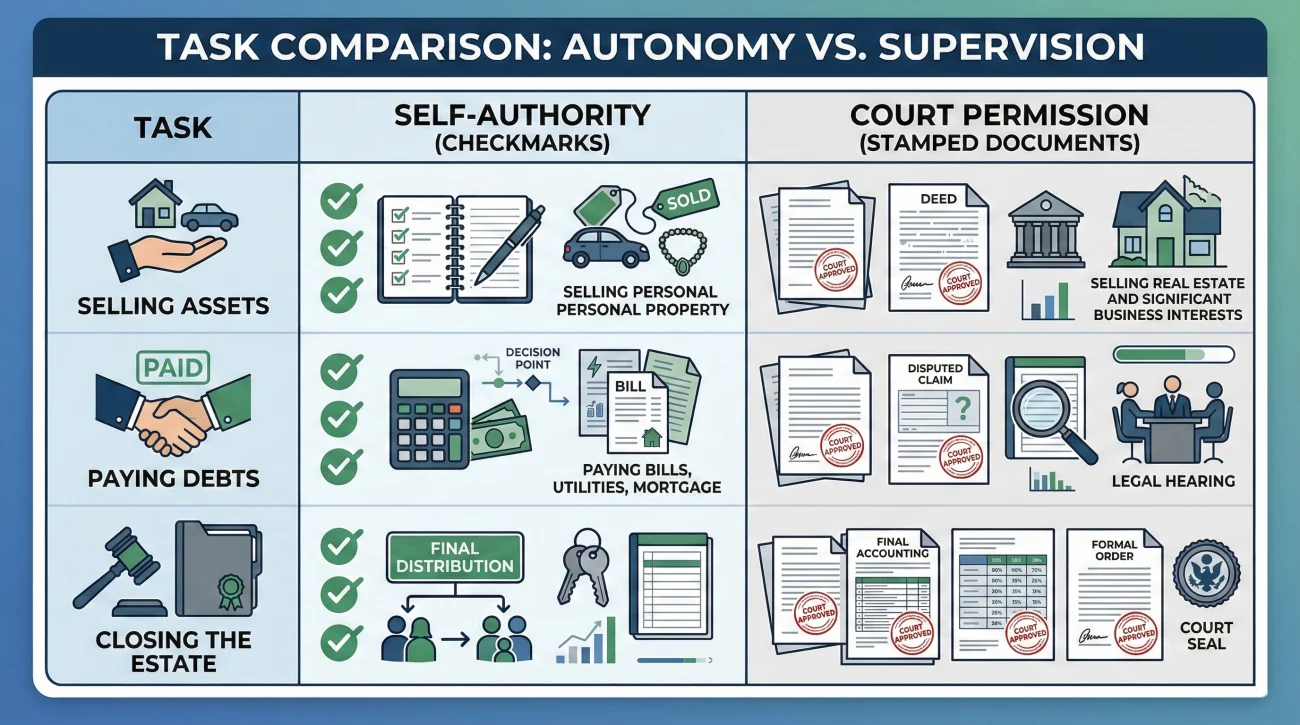
To make this abstract legal concept more concrete, let us look at how typical administrative tasks change depending on the level of oversight. Understanding these shifts helps you build the right filing system from day one.
| Administrative Task | Informal / Unsupervised Path | Formal / Supervised Path |
|---|---|---|
| Selling Real Estate | Done with standard executor authority. You sign the deed and log the proceeds. | Requires a court petition, an approved appraisal, and an order authorizing the sale. |
| Paying Debts | You verify the debt and pay it directly from the estate account in the proper priority. | You submit a schedule of claims to the court for approval before releasing funds. |
| Communicating with Family | Requires voluntary updates. You decide how often to share progress reports. | Requires mandatory, formalized legal notices at specific milestones via certified mail. |
| Closing the Estate | Accomplished by filing a simple closing statement asserting all tasks are done. | Requires a final, highly detailed accounting reviewed and approved by a judge. |
Signals That Your Case Might Require More Supervision
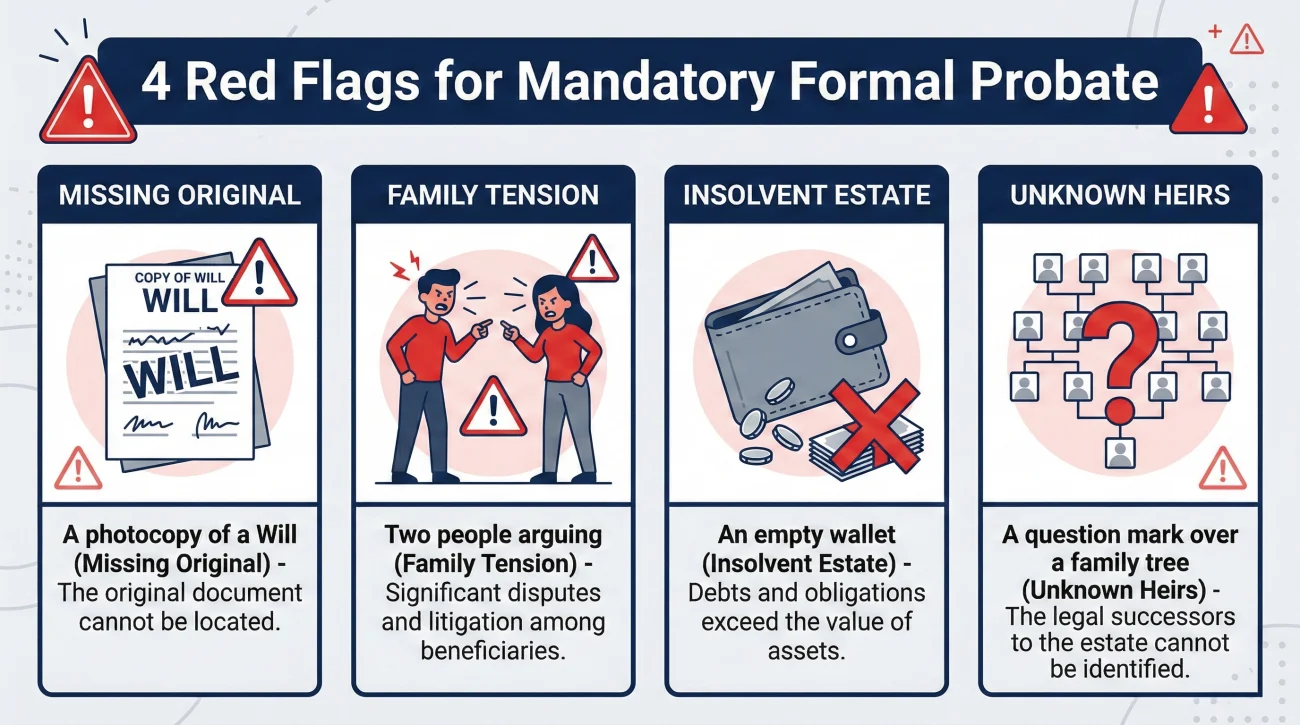
Many executors start their journey hoping for the fastest, quietest route possible. However, certain factors make it highly likely that a court will mandate a supervised process. Knowing these red flags early helps you mentally prepare for the extra administrative load.
- ✅ Missing Original Documents: If you only have a photocopy of the will, courts require a formal hearing to prove the original was not intentionally destroyed by the deceased.
- ✅ Family Tension: If beneficiaries are arguing over personal property before the funeral is even over, courts and careful executors prefer a formal process to ensure every decision is legally shielded.
- ✅ Insolvent Estates: If the deceased owed more money than they had, paying the right creditors in the exact order required by law becomes highly sensitive. Supervision ensures the executor does not accidentally pay the wrong party.
- ✅ Unknown Heirs: If there is a possibility of children from a previous relationship who cannot be easily located, the court will require formal notices and waiting periods to protect those potential heirs.
⚠️ Warning: Do not try to hide family friction from the court just to get the faster, informal route. In many cases, an informal setup can be quickly converted to a formal one if a beneficiary files an objection. It is always better to start with the correct level of oversight than to have your process derailed halfway through.
Communication Hygiene: Explaining the Path to the Family
One of the most challenging parts of an executor’s job is managing the expectations of people who are grieving. When beneficiaries hear the estate is going through a “formal” process, they panic, assuming money is being wasted or hidden. When they hear “informal,” they assume they will get their inheritance next week.
I have learned through trial and error that sending a calm, neutralizing message early on is the best way to prevent your phone from ringing every single day. You need to explain the timeline without making rigid promises.
Formula: [Acknowledge the chosen process] + [Explain the practical delay factor] + [Commit to a future update date]
Script: Setting Expectations for an Informal Process
If you have been granted unsupervised authority, use this framework to explain that “informal” still takes time.
Subject: Update on [Name]’s Estate – Next Steps
Hello everyone,
I wanted to share a brief update. The court has granted me authority to begin the administrative work for the estate. We are proceeding under what is called an “informal” process.
While this is good news because it reduces the number of mandatory court hearings we have to attend, it does not mean the process happens overnight. I am currently focused on gathering all financial records, notifying creditors, and completing the asset inventory.
I will not have a clear timeline for distributions until all debts and taxes are fully resolved. I plan to send another update by [Month/Date], but please feel free to reach out if you have specific questions before then.
Best regards,
[Your Name]
Script: Explaining Delays in a Formal Process
If your case requires court supervision, use this variation to shift the blame for delays away from yourself and onto the structural requirements of the court.
Subject: Status Update on [Name]’s Estate Administration
Hello everyone,
I want to keep you all informed about our progress. Because of [brief, neutral reason, e.g., the types of assets involved / local court procedures], the administration is proceeding as a “formal” or supervised process.
Practically, this means I must submit formal requests and wait for a judge’s approval before taking major actions, like selling property or paying certain expenses. This naturally adds mandatory waiting periods to our timeline.
I am currently preparing the next batch of paperwork. Because we are dependent on the court’s calendar, things will move slower than we might prefer, but this ensures everything is done perfectly by the book.
I will reach out again once the court issues our next order.
Thank you for your patience,
[Your Name]
The “One Folder” Rule: Your Ultimate Defense System
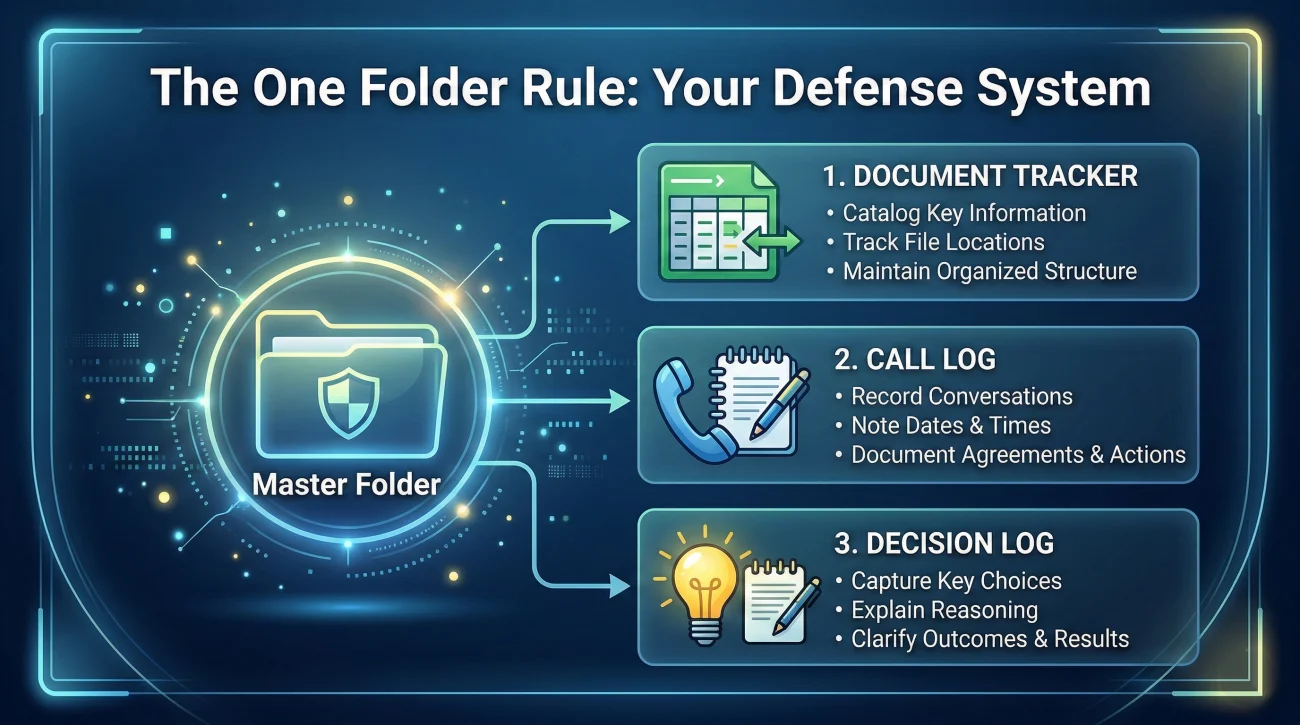
Whether you are sending an annual report to a judge or just answering a quick question from your sister, your internal organization must be identical. The fastest way to create a disaster is to think, “This is informal, so I don’t need a paper trail.”
In my experience, the single most effective tool for an executor is a strict “One Folder” policy. Every piece of paper, every decision, and every communication goes into one centralized system. Do not keep some notes on your phone, some receipts in your car console, and some emails in your work inbox.
Three Logs You Must Maintain
To survive either level of oversight, you should immediately start three specific tracking logs. These three lists are the actionable solution to almost every administrative headache you will face.
- 📄 The Document Tracker: A simple spreadsheet showing what documents you have requested (like death certificates or bank statements), when you asked for them, and when they arrived.
- 📄 The Call Log: Every time you speak to a bank, an insurer, or a clerk, record the date, the time, the name of the representative, and the specific outcome. “Called Bank X, spoke to Sarah, she said to mail the letters to the PO Box.”
- 📄 The Decision Log: A brief note explaining why you made a specific choice. “Chose to pay for emergency roof repair on Oct 12th to prevent interior water damage to the estate’s primary asset.”
If you can master these tracking habits early on, the difference between formal and informal administration just becomes a matter of who you are mailing the copies to. A judge will eventually ask to see your work in a formal setting, but a well-prepared executor with a solid paper trail has nothing to fear.
Final
Navigating the early days of estate administration is rarely straightforward. At the end of the day, the fundamental difference between an informal and formal process is where you draw your stamina from. In an informal setting, you are managing your own momentum against the temptation to procrastinate. In a formal setting, you are managing your patience against the rigid calendar of the court system.
Regardless of the path chosen, your success comes down to your operational habits. If you can build a solid foundation of logs and clear communication early, the court’s level of oversight simply becomes a procedural background noise rather than a daily crisis. If you are unsure of where your authority begins or what exactly the court expects from you on day one, review our complete Probate Court Checklist for Executors to map out the broader landscape.
❓ FAQ
🎙️ What is the difference between informal and formal probate?
The main difference is the level of court supervision. Informal probate allows the executor to handle tasks mostly through paperwork and mail with minimal interference, while formal probate requires court hearings and judge approvals before major actions can be taken.
⏳ How long does informal probate take compared to formal?
While formal is strictly bound by the court’s calendar and mandatory objection periods, an informal timeline depends entirely on the executor’s personal momentum. Informal can be wrapped up in a few months if you push hard, whereas formal almost always stretches closer to a year or more due to scheduling bottlenecks.
🏛️ Do I have to go to court for informal probate?
In many cases, no. Informal administration is often handled entirely through mail, email, or a clerk’s filing portal. You typically only step into a courtroom if a dispute arises or if the status gets changed to formal.
📝 What paperwork changes if the probate is formal?
Formal probate requires you to submit highly detailed petitions for permission to act, send certified notices to all parties, and provide a strict, line-by-line financial accounting to the judge at the end of the process.
🛑 Can an informal probate turn into a formal one?
Yes. If a beneficiary files an objection, if a complex creditor dispute arises, or if the executor fails to fulfill their duties properly, the court can intervene and convert an unsupervised case into a supervised, formal process.
👨⚖️ Does formal probate mean someone is suing the estate?
Not necessarily. While a lawsuit or contested will guarantees formal oversight, some estates are required to go through formal channels simply because of local rules regarding the estate’s value, the lack of an original will, or the presence of minor heirs.
💸 Is formal probate more expensive?
Because formal administration requires more complex document preparation, mandatory mailings, and physical appearances at hearings, the administrative costs and professional fees generally increase compared to the paperwork-only informal route.
📁 How do I know if I qualify for informal probate?
Eligibility usually depends on having a valid, original will, no disputes among family members, and an estate that is solvent (more assets than debts). You must always verify the specific eligibility requirements with your local court clerk.
🤝 Do I need the family’s permission for informal probate?
In many jurisdictions, opening an informal process requires all interested parties (heirs and beneficiaries) to sign a waiver or consent form agreeing to let the executor proceed without strict court supervision.
📬 What do I tell beneficiaries if they complain about formal probate delays?
Instead of just agreeing that the court is slow, point to the legal protections. Remind them that formal supervision ensures every penny is accounted for and completely prevents any one person from making unauthorized decisions with their inheritance. Frame the delay as a benefit to them, not a punishment.
⚠️ Disclosure: I'm not an attorney and nothing on this site is legal or tax advice. The content covers process, organization, and workflow—the operational side of estate administration. For legal interpretation, jurisdiction-specific deadlines, contested situations, or tax matters, please work with a licensed professional in your state.