- Processing times vary wildly: Depending on the local docket, receiving your letters can take anywhere from a few weeks to a few months. It is rarely immediate.
- Delays are often avoidable: The most common reasons for a stalled timeline are missing original documents, incomplete notifications to heirs, and unsigned forms.
- Use the waiting period wisely: While you cannot touch financial accounts yet, you can use this time to build your tracking logs, secure physical property, and map out the digital assets.
- Protect yourself from liability: Acting before the court officially appoints you, even just paying an estate bill from your own pocket, can create massive accounting messes and personal liability.
The Waiting Game: Setting Realistic Expectations for Court Authority
If you have recently submitted a will and an application to the court, you are likely checking your mailbox every single day. The period between filing the initial paperwork and actually holding the legal document that grants you authority is notoriously stressful. Family members are asking when things will be sorted out, bills might be piling up, and you feel stuck because banks refuse to speak with you.
In my experience helping families organize estate administration workflows, I have seen this exact waiting period cause more panic than the actual court filings. For example, I worked with a family in 2022 where the entire file sat in a pending queue for five weeks simply because a middle initial was missing on page three of the application. The system does not care about your urgency; it cares about exactness.
The number one question people ask at this stage is: how long does it take to get letters testamentary?
I wish I could give you a universal, exact number of days. The reality is that the timeline depends entirely on the current workload of the local clerk’s office, the complexity of the paperwork submitted, and the specific procedures of that venue. When you are appointed as an executor, your instinct is to start fixing things immediately. But without that specific piece of paper, your hands are tied.
This guide is designed to help you understand what is happening behind the scenes, how to identify factors that might be slowing down your timeline, and, most importantly, what practical, safe steps you can take to stay organized while you wait.
Behind the Scenes: What the Court is Doing Before Issuing Letters
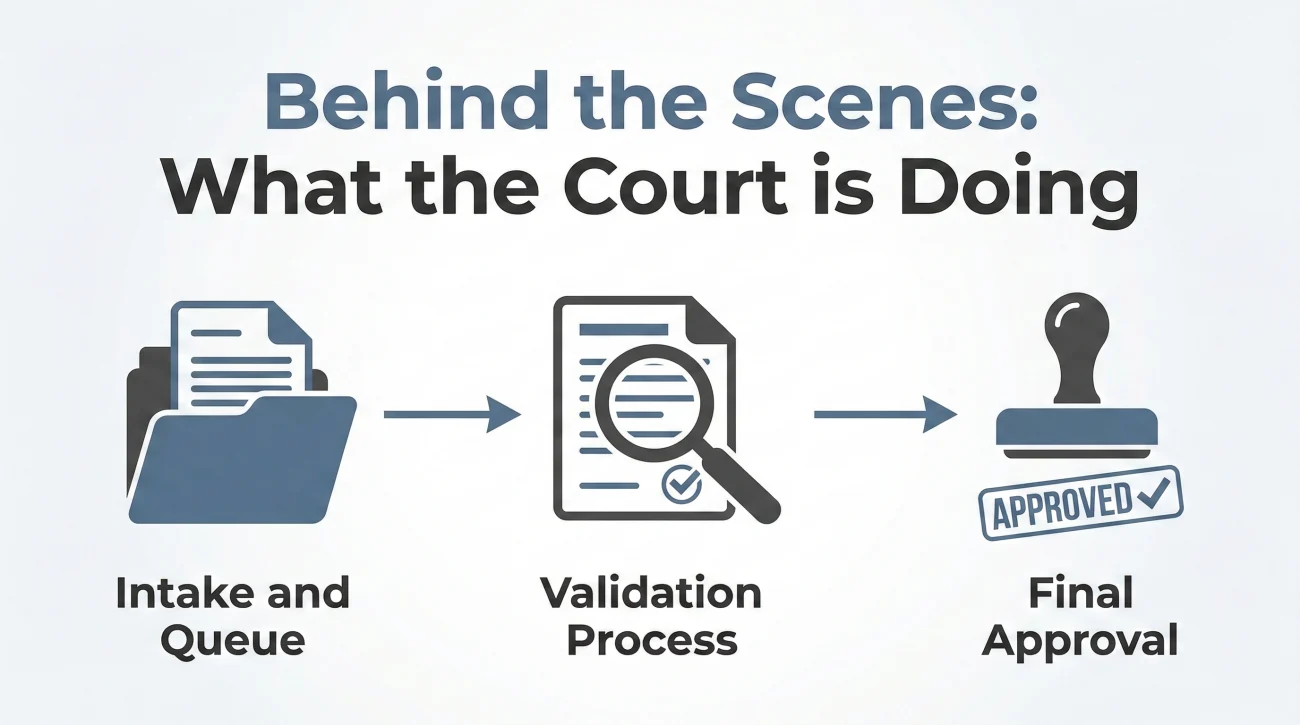
When you drop off your application, it does not just go straight to a printer. The process of issuing letters testamentary is a manual, layered workflow designed to prevent fraud.
The Intake and Queue
When an application arrives, it goes into an intake queue. Depending on the size of the jurisdiction, there may be hundreds of other applications ahead of yours. The staff must manually log the submission, create a file, and assign it for review. During peak times, simply getting the physical file from the mailroom to a reviewer’s desk can take days.
The Validation Process
Next comes the review phase. Someone must carefully look through the submitted packet to ensure that everything aligns. They are checking to see if the will appears valid on its face, whether the person applying is actually the person named in the document, and if all mandatory fields are filled out correctly.
Key Point: The court clerk is acting as a gatekeeper, not a rubber stamp. Their priority is preventing unauthorized access, which means they are required to halt your file for weeks over a single mismatched address.
The Timeline: Best, Average, and Delayed Scenarios
While I cannot give you state-specific deadlines, here is a practical framework I use to help families set their expectations:
- ✅ The Best-Case Scenario (2 to 4 weeks): The county is fully staffed, your application is flawless, all family members have signed waivers agreeing to your appointment, and the original will is intact.
- ⏳ The Average Scenario (4 to 8 weeks): The court is experiencing normal seasonal backlogs. There may be a mandatory waiting period built into the local rules to allow creditors or heirs to object before the court officially hands you the keys.
- 🛑 The Delayed Scenario (8+ weeks): You submitted a photocopy of the will, a family member is hard to locate for a signature, or the court decided you need to secure an insurance bond before proceeding.
Common Delay Factors: Why Timelines Slip
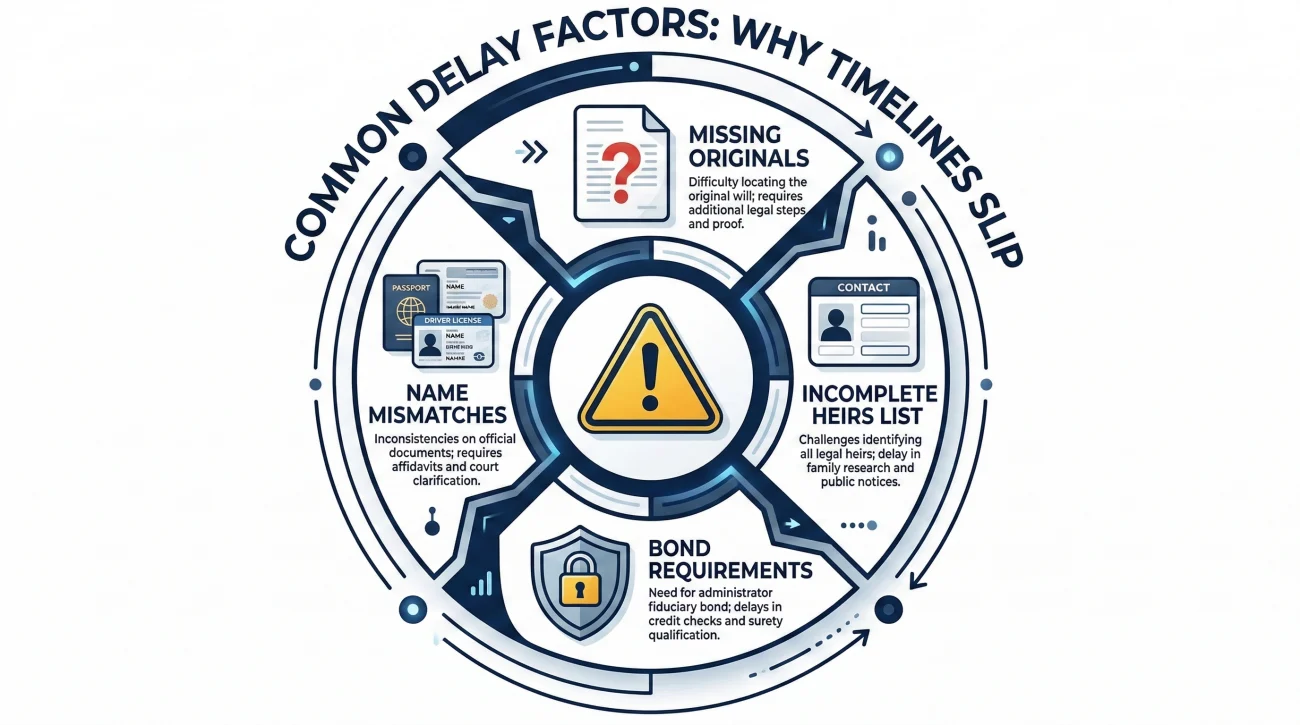
While you cannot control the clerk’s backlog, you can control the quality of the packet that gets submitted. In day-to-day admin work, I frequently see timelines derail due to simple administrative oversights.
Missing Original Documents
One of the most frequent roadblocks is submitting a photocopy of the will instead of the original document. Courts are incredibly strict about original signatures. If an application is submitted with a copy, the review process often comes to a grinding halt until the original is produced, or until a much more complex explanation is provided.
Incomplete Heirs List or Notifications
When you apply for letters, you are typically required to list surviving family members or individuals named in the document. If an address is missing, or if a required notification was not sent, the staff cannot move the file forward.
📌 Note: A common pattern I see is a file sitting dormant for three weeks because the applicant forgot to include the zip code for one of the beneficiaries on the contact sheet.
The Unexpected Bond Requirement
Sometimes, the court requires the executor to secure a bond (a type of insurance policy protecting the estate) before they will issue the letters. If you hit this roadblock, do not just wait. Immediately contact a commercial insurance broker that specializes in probate or surety bonds. They will walk you through a separate financial underwriting process, which often adds another week or two to your timeline.
Name Mismatches and Typos
Administrative exactness matters. If the deceased person’s name on the death certificate is “Robert J. Smith,” but the will says “Bob Smith,” and the application says “Robert James Smith,” this inconsistency can trigger a pause. The reviewer may require an affidavit to clarify that all these names refer to the exact same person.
📌 Note: I once saw a file stalled for a full month simply because the property deed listed “William” but the will said “Bill.” We had to hunt down decades-old supporting documents to prove identity before the court would proceed.
How to Reduce Delays Through Organization
The best way to ensure you get your letters as quickly as possible is to make the reviewer’s job easy. A clean, organized, and perfectly complete packet moves through the system much faster than a disorganized stack of papers.
Pre-Solve the Common Roadblocks
Do not wait for the court to discover a problem. If you know you only have a photocopy of the will, do not just submit it and hope no one notices. Proactively include a written explanation or affidavit detailing why the original is missing. If you anticipate a name mismatch between the death certificate and the will, provide an ‘Also Known As’ explanation upfront. Addressing these known issues before they are flagged saves weeks of back-and-forth mail.
Use a Clear Cover Sheet
Whenever you submit something, include a simple cover sheet. List exactly what is in the packet. This serves as a checklist for the clerk and shows that you are organized.
Sliding a stack of unclipped, folded papers across the counter and hoping it’s all there.
Providing a neatly clipped packet with a cover page that reads: “Enclosed: 1. Original Will, 2. Certified Death Certificate, 3. Completed Application Form, 4. Filing Fee Check.”
How to Follow Up Politely
If you have been waiting significantly longer than the average timeframe you were initially given, it is entirely reasonable to ask for a status update. The key is to be polite, factual, and concise. Court staff are overworked, and a frustrated, demanding phone call will not speed up your file.
Here is a safe, professional script for following up on the status of your letters:
Hello,
I am writing to politely request a status update on the application for the Estate of [Name of Deceased], which was submitted on [Date].
Could you please let me know if the file is still under standard review, or if there is any additional information, missing signatures, or further documentation you need from me to proceed?
Thank you for your time and assistance.
Best regards,
[Your Name]
[Your Phone Number]
By asking if you missed something, you change the dynamic. You are not accusing them of being slow; you are offering to fix any potential problems.
Safe Tasks: What to Do While You Wait for Letters
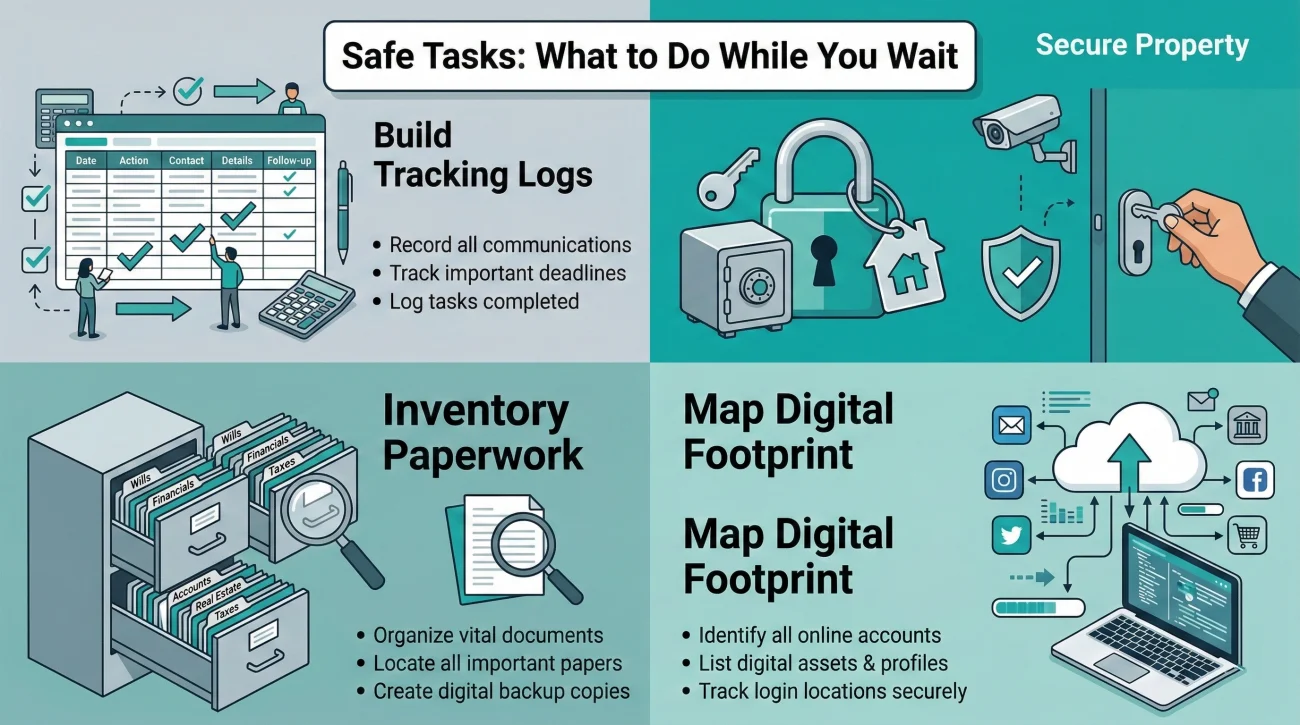
Once your packet is in the queue, the real work of the waiting period begins. Even with a perfect submission, you will still have to wait. But that downtime is incredibly valuable if you use it right. When the letters finally arrive, the administrative floodgates will open. If you are prepared, you will handle it easily.
Before you take any action, I highly recommend reviewing a complete executor first steps checklist to ground yourself in the broader workflow. But for right now, here are the safest, most productive tasks you can tackle without official authority.
Build Your Tracking Architecture
Do not wait until you make your first phone call to a bank to realize you need a notebook. Start your logs today. You need a dedicated, physical binder or a secure digital folder structure.
- 📄 The Contact Log: A spreadsheet is best. Create specific columns for Date, Time, Institution, Representative Name, Call Reference Number, and Next Action. Do not rely on loose sticky notes.
- ✅ The Document Tracker: Set up a physical accordion folder with tabs. For digital files, start a habit of naming them systematically right now (e.g.,
2024-05-12_BankName_Statement.pdf). - 📄 The Mail Log: Start collecting the deceased’s mail. Do not throw anything away, even if it looks like junk. Sort it into piles: Bills, Financial Statements, Subscriptions, and Unknown.
Secure Physical Property
You do not need court letters to lock a door. One of your primary duties is preserving the estate. Ensure that the deceased’s home is secure. Lock all doors and windows, remove any perishable food, and park vehicles safely.
If you are an out-of-state executor, this step is critical. Since you cannot be there daily, ask a trusted neighbor to check the perimeter, or consider hiring a local property management service to winterize the house and do weekly drive-bys. Securing assets requires common sense, not a court order.
“In day-to-day operations, I often see the most immediate risk not in complex financial portfolios, but in a vacant house where the thermostat was left off during winter. Water damage from a burst pipe will drain an estate far faster than a credit card bill.”
Gather and Inventory Paperwork
Without letters, you cannot call a financial institution and ask them to close an account. However, you can absolutely look through filing cabinets to build a list of where accounts are held. Note the institution name, the type of account, and the account numbers.
Once you have this raw list, stop. Group this list by asset type (real estate, liquid cash, vehicles). The goal is that on the day your letters arrive, you know exactly which five institutions you need to tackle first, rather than sorting through a box of receipts.
Map Out the Digital Footprint
You cannot legally log into their email or social media accounts right now. But you can look at their phone screen notifications or physical credit card bills to note which services they used (Netflix, Amazon, Gmail). Start a list of digital subscriptions that will eventually need to be shut down so you do not miss ongoing charges later.
The Danger Zone: What Not to Do While Waiting
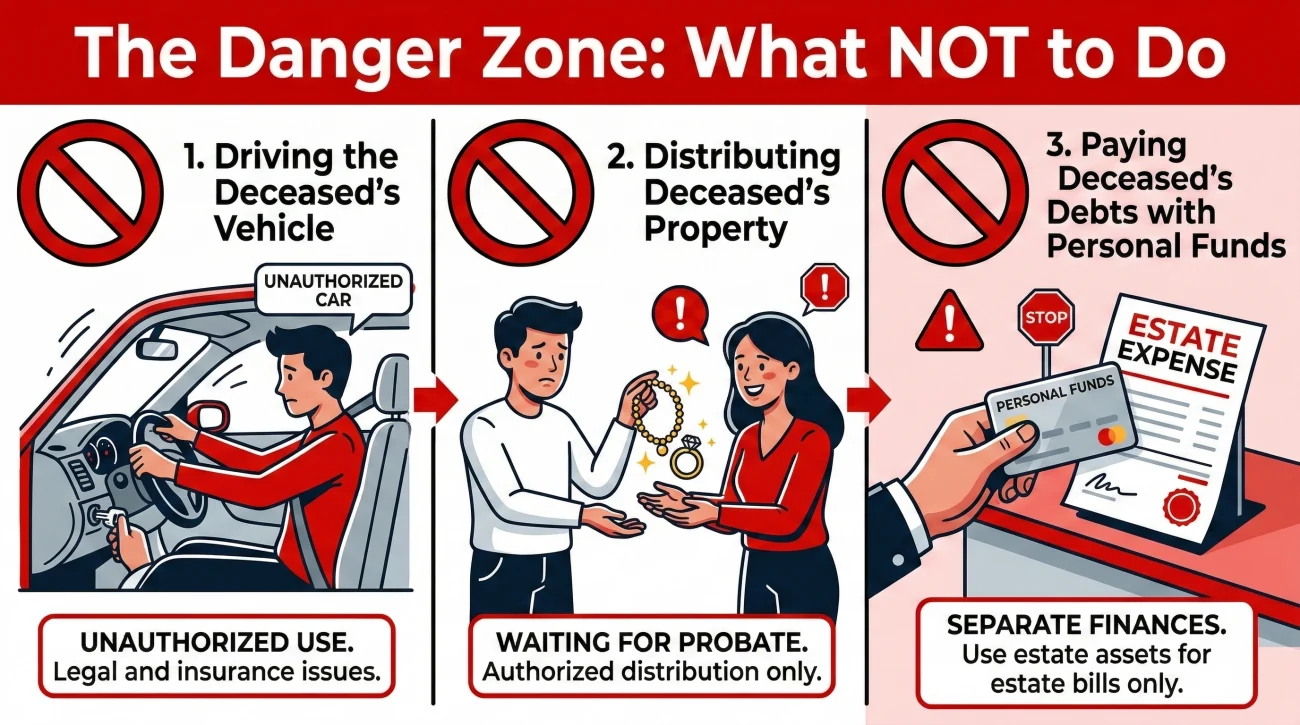
Patience is difficult, especially when family members are pushing for answers or when you see an impending due date on a utility bill. However, acting before you have official authority is one of the most dangerous things you can do.
To fully understand the boundaries of your role and what exactly the court expects of you, you should study a comprehensive probate court checklist for executors. But as a strict rule of thumb, avoid the following actions completely until your letters arrive.
| Do Not Do This | Why It is Dangerous |
|---|---|
| Distribute personal property | Family members often want to take “small keepsakes” immediately. If you allow this before an inventory is done and without authority, you are personally responsible if those items are later needed to pay estate debts. |
| Pay estate bills from your own pocket | If you pay the deceased’s credit card bill with your own money, there is no guarantee the estate will have enough liquid cash to reimburse you later. Wait until an estate account is opened. |
| Drive the deceased’s vehicle | Insurance coverage often lapses or changes status upon death. If you get into an accident while driving the car without official authority to manage it, the liability could be disastrous. |
| Make promises to creditors | Do not tell a debt collector, “I will pay you next week.” You do not know the full financial picture yet. Inform them of the death, tell them the estate is in the queue for appointment, and hang up. |
⚠️ Warning: Even if you are the surviving spouse and know all the passwords, logging into the deceased’s individual bank account post-death to pay for the funeral is a massive red flag. Banks track IP addresses and login times, and unauthorized access can cause the bank’s fraud department to freeze the account entirely, creating months of legal headaches.
Managing Family Expectations
Often, the pressure to act comes from beneficiaries. They want to know when they will receive their inheritance, or they want access to the house. Your job during this waiting period is communication hygiene. Keep them informed, but set firm boundaries.
Here is a script for managing impatient beneficiaries:
Hi everyone,
I want to give you a quick update on the estate administration. All the necessary paperwork has been filed with the court, and we are currently in their processing queue.
Until the court formally issues the letters of authority, all accounts are frozen by law, and I am not legally permitted to distribute any property, pay debts, or access funds.
I am checking the status regularly. As soon as the court issues the documents and I can officially begin the financial work, I will send another update.
Thank you for your patience during this waiting period.
This script removes the blame from you and places it correctly on the legal process. It teaches the family exactly why you are pausing, preventing future arguments.
Final Thoughts
Waiting to get your letters testamentary is a test of patience, but it is also a gift of time. Do not waste these weeks refreshing the court’s online portal or arguing with bank tellers who are legally forbidden from helping you yet.
Use this gap to build an unshakeable organizational foundation. Set up your files, start logging the mail, secure the property, and draft your future correspondence. Once that official envelope is finally in your hands, the real work begins. Your very next move should be understanding exactly what to do after you receive your letters so you can unlock the estate’s accounts safely and efficiently.
❓ FAQ
🧭 How long does probate take to start?
Probate does not automatically start when someone passes away. If the estate requires a complex search for a missing original will or if estranged heirs refuse to sign waivers, simply getting to the “starting line” of official appointment can be delayed for several months before the clock even begins.
⏳ When will the court issue letters testamentary?
Typically, letters are issued only after a mandatory “notice period” has expired. This delay is intentionally built into the system to give creditors and estranged family members a specific window to contest your appointment before you are handed any real financial power.
📞 Can I call the court to speed up my letters testamentary?
No phone call will move your file to the front of the line. However, checking in politely after a few weeks can be useful to ensure your file is not sitting in a “suspended” state due to a missing signature or an unpaid administrative fee.
🏦 Will the bank wait for me to get letters of administration?
Yes, and they have no other choice. Banks operate under strict compliance rules. Once they are notified of a death, they freeze the account and will wait indefinitely until someone presents the correct court-issued document proving legal access.
🛑 What if a bill is due before I get the letters testamentary?
Contact the billing department immediately, inform them of the death, and explain the estate is pending court appointment. Do not pay it yourself. Most utility and credit companies will place an administrative hold on the account to pause late fees.
✉️ Do I get the letters testamentary in the mail?
Many courts do mail the certified copies directly to the executor or the estate attorney. However, some counties require you to pick them up in person and pay for each certified copy at the clerk’s window. Always confirm their specific delivery method.
📑 How long to get letters of administration if there is no will?
The intestate process (no will) often takes longer. The court usually requires deeper background verification to establish the legal heirs, and they are much more likely to require an insurance bond before they let anyone touch the assets.
🚗 Can I sell the car before the letters testamentary arrive?
Absolutely not. The DMV will not process a title transfer without seeing your letters. Trying to sell estate property before you have authority is a serious breach of duty and can result in your appointment being denied.
🏠 Who pays the mortgage while waiting for letters testamentary?
The estate is responsible for the mortgage. If a family member chooses to pay it to avoid foreclosure during the waiting period, they are taking a personal risk; the estate can only reimburse them later if there is enough liquid cash available to do so.
👥 How do I tell family members the letters are delayed?
Keep it entirely factual and in writing. Explain that the application is in the court’s normal queue, remind them that the law freezes all assets in the meantime, and assure them you will send another update the moment the court issues the document.
⚠️ Disclosure: I'm not an attorney and nothing on this site is legal or tax advice. The content covers process, organization, and workflow—the operational side of estate administration. For legal interpretation, jurisdiction-specific deadlines, contested situations, or tax matters, please work with a licensed professional in your state.