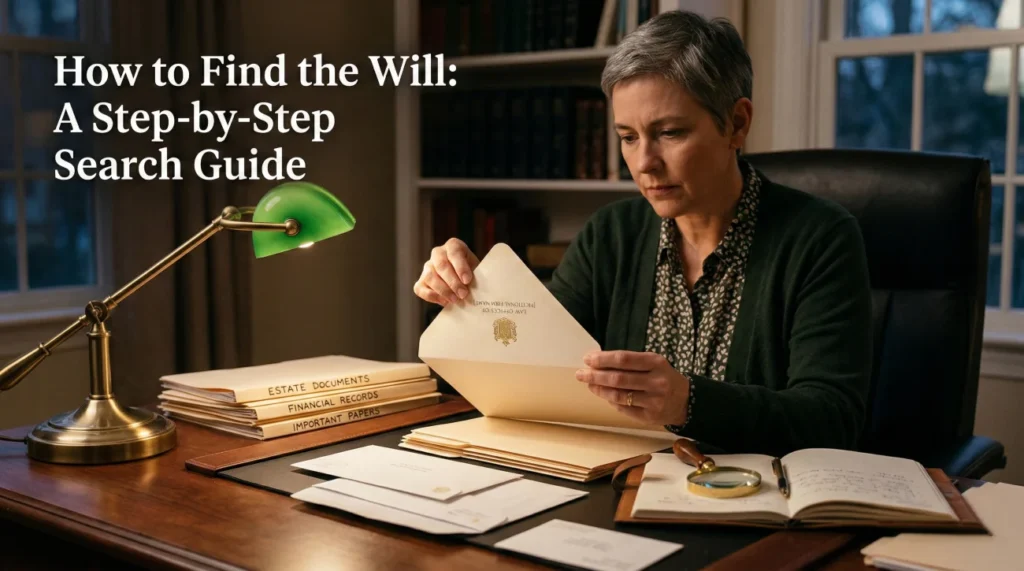
- Start the physical home search by looking for distinctive law firm envelopes, checking hidden fireboxes, and scanning old mail for attorney retainer receipts.
- Do not bypass digital passwords or force open locked safes. Focus on gathering physical clues, checking cloud storage structures, and documenting what you find.
- Maintain a single “Will Search Log” to prove to courts and family members that you made a reasonable, organized effort.
- If you locate multiple versions or only a photocopy, secure all of them chronologically. They provide crucial clues like witness names and drafting law firms.
The Reality of Searching for the Original Document
One of the most stressful moments in the early days of estate administration is simply trying to figure out how to find a will after death. I have seen executors spend three full days tearing apart a home office, convinced they missed a hidden floorboard compartment, only to find the document sitting in plain sight at a local lawyer’s office a week later. You are likely dealing with grief, fielding impatient questions from family members, and feeling the pressure to take immediate action.
People rarely leave a giant, neon sign pointing to their estate documents. If you are standing in a living room right now wondering where to even begin, take a deep breath. You do not need to locate it in the next five minutes. What you need is a methodical, calm approach.
I always tell first-time executors that finding the document is a process of elimination. You are essentially acting as an investigator, looking for paper trails, business cards, and clues that will lead you to the right place. Locating this document is just one part of your broader executor first steps checklist. Today, we are going to focus solely on the search path, where executors actually look first, and the exact steps to take when the obvious locations turn up empty.
Phase One: The Physical Home Search
Because people frequently keep their most vital records close to where they live, the original document or a very clear photocopy is often stored somewhere inside the primary residence. Therefore, before you start making phone calls or driving to banks, you should begin your physical search right at home. However, be prepared to dig deeper than the main desk drawer, as people hide things in strange places because they want to keep them safe from burglaries or natural disasters.
The Obvious Locations
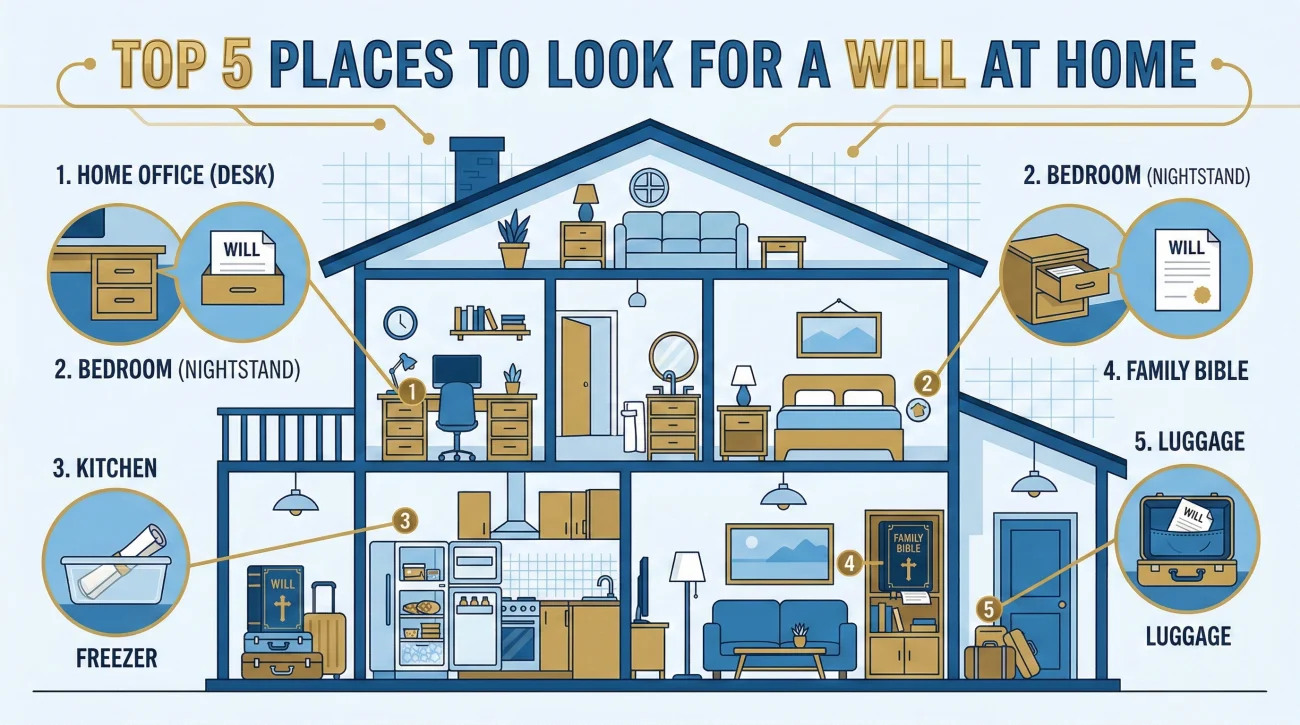
Start with the places that make the most logical sense. You are looking for a thick, premium-paper envelope. Law firms often use distinctive, heavy-stock folders with their firm name embossed on the front. Look through the main desk in the home office, any filing cabinets, and the primary bedroom nightstands.
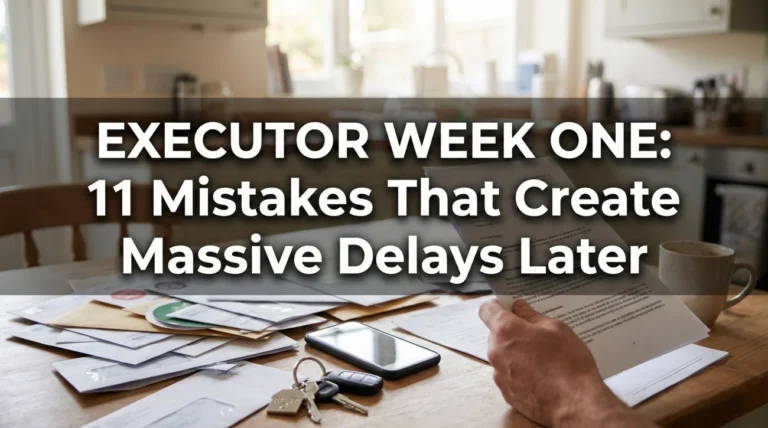
I remember working with a family who almost threw out a messy stack of old utility bills and junk mail. Tucked right in the middle was a routine letter from an attorney regarding a completely unrelated real estate matter. That single piece of paper gave us the contact information of the law firm that drafted the estate documents, saving them weeks of searching.
Throwing away “junk mail” and old letters to clear space quickly.
Setting aside every single piece of mail with a law firm’s name, bank logo, or financial advisor’s letterhead into a single “clues” folder.
The Unconventional Hiding Spots
If the obvious places turn up empty, you have to start thinking creatively. In day-to-day admin work, I have heard stories of documents being found in locations that defy logic. When you are doing your physical sweep, check these areas:
- 🔎 Inside the freezer (often placed in sealed plastic bags to protect from house fires).
- 🔎 Taped to the bottom of heavy desk drawers.
- 🔎 Tucked inside the pages of a family Bible, dictionary, or heavy encyclopedia.
- 🔎 Inside old luggage stored in the attic or top of a closet.
- 🔎 Underneath the mattress or inside hollow bed frames.
⚠️ Warning: If you find a locked fireproof box or a safe in the house, do not attempt to pry it open or hire a locksmith immediately. Document its location. In many cases, you will find the key or the combination written down somewhere else in the house during your broader search. Destroying a safe can sometimes damage the very papers you are trying to retrieve.
Phase Two: Asking the Likely People
If the house does not hold the answers, your next step is to tap into the deceased person’s professional network. This is where your communication hygiene becomes incredibly important. You want to ask questions without sounding demanding, and you want to keep a record of every person you speak to.

Contacting the Attorney
If you found an attorney’s business card, letterhead, or an old bill, this is your strongest lead. Many attorneys keep the original documents in their own fireproof vaults for safekeeping, or at least retain a stamped, official copy and a record of where the original went.
When you reach out, remember that the attorney has a professional obligation to protect their client’s confidentiality, even after death. They will likely need to see a death certificate and proof of your identity before they can hand anything over or even confirm details.
Subject: Estate Document Inquiry – [Deceased’s Full Name]
Hello [Attorney Name],
My name is [Your Name]. I am writing regarding the late [Deceased’s Full Name], who passed away on [Date]. I am currently trying to locate their original estate documents.
I found your contact information among their personal files. Could you please check your records to see if your office drafted a will for them, or if you are currently holding the original documents in your vault?
If so, please let me know what documentation you require from me (such as a death certificate or identification) to proceed.
Thank you for your time and assistance.
Financial Advisors and Accountants
If there is no obvious attorney, look for a financial advisor, CPA, or tax preparer. These professionals almost always ask their clients about estate planning during their annual reviews. Even if the CPA does not have the document, their file notes might say, “Client completed estate planning with John Smith Esq. in 2018.”
Once you have that name, do not stop there. Look up that specific attorney to see if they are still practicing. If they are, send the standard inquiry email. If they are not, you will need to take an extra step to locate where their files went.
What If the Drafting Attorney Retired or Passed Away?
It is incredibly frustrating to finally find the name of the lawyer, only to discover their phone number is disconnected. When lawyers retire or close their practice, they do not just throw their clients’ estate documents in the trash. They usually transfer their custodial files to another active attorney or a continuing law firm. Contact your state or local bar association. They maintain records of where a retired or deceased attorney’s files were transferred, giving you the name of the new firm holding the documents.
Phase Three: Institutional Places and Safe Deposit Boxes
This is where things can get slightly bureaucratic, and it is a common point where files go missing or timelines slip. Many people mistakenly believe the best place to keep their most vital papers is in a bank safe deposit box. While it is secure, it creates a massive hurdle for the person left behind.
The Safe Deposit Box Catch-22
I often see executors hit a wall here. You need the document to prove you have the authority to act, but the bank will not let you open the safe deposit box without proof of your authority. It is an anxiety-inducing loop.
If you find a safe deposit box key (often a small, flat metal key with a number stamped on it but no bank name) or a billing statement for a box, contact the bank branch manager. Explain the situation calmly. Do not demand access. Instead, ask for their specific requirements in writing. In many cases, banks have a specific, restricted procedure where a bank employee will open the box in your presence solely to look for estate documents or life insurance policies, without letting you remove any financial assets.
Registries and Court Vaults
In some jurisdictions, individuals can file their original documents with the local probate court or a specialized registry while they are still alive for safekeeping. While this practice is not available in every state, inquiring with the local probate clerk about a pre-death filing registry is a prudent step, especially if the deceased was highly organized but kept a minimalist home.
Phase Four: Digital Traces and Expanded Clues
If the physical locations and institutional vaults turn up empty, your next step is to look for the digital breadcrumbs that lead to the physical document. Searching for digital clues is essential, but it requires extreme caution to avoid crossing legal boundaries.

What Not To Do
It is very tempting to try and guess passwords or use the deceased person’s phone to bypass two-factor authentication (2FA). I strongly advise against this. Bypassing access controls can trigger fraud alerts and lock accounts permanently. More importantly, it can lock you out of official recovery processes, such as Apple’s Legacy Contact or Google’s Inactive Account Manager, which are designed to give you lawful access to the data.
Safe Digital Searching
If a computer or tablet is already unlocked and accessible, or if you are looking at shared family accounts, you can safely look for digital traces. Do not just search the email inbox for the word “will.” People rarely email the final document back and forth with that exact subject line.
💡 Pro Tip: Search the email inbox for terms like “draft,” “estate,” “notary,” “retainer,” “invoice,” “planning,” and “executed.” You are looking for an email from a law firm confirming an appointment or sending an invoice for services rendered.
Because the current generation of retirees is increasingly tech-savvy, you should also check these digital locations if you have authorized access:
- 📄 Cloud Storage (Google Drive, Dropbox, iCloud): Look for folders named “Important Documents” or “Estate.” You might find a PDF scan of the signed document.
- 📄 Digital Password Managers: Apps like 1Password or LastPass often have a “Secure Notes” section. Many people type out instructions here, such as “Original will is located in Bank of America box #402.”
- 📄 Phone Scanning Apps: Check apps like Adobe Scan, CamScanner, or the native Apple Notes app. People often scan legal documents right after signing them before putting the original away.
What If You Find Something Unexpected?
The search rarely results in finding one perfect, cleanly labeled folder. You are more likely to uncover partial documents, old drafts, or copies. Knowing how to handle these unexpected finds is critical.
If You Only Find a Photocopy
A very common pattern I see is a family turning the house upside down and finding a photocopy, but not the original. Panic usually sets in immediately, as people worry a copy is useless.
While the original is always the primary goal, a copy is an incredibly valuable investigative tool. Look past the main text and examine the margins, the footer, or the cover page to identify the drafting attorney. Furthermore, a copy names the specific witnesses and the notary public who were present at the signing. Tracking down the witnesses named on the copy can sometimes lead to answers about what the deceased intended to do with the original paper.
If You Find Multiple Versions
People frequently update their estate plans after major life events like marriages, divorces, or the birth of grandchildren. If you find three different folders dated 2010, 2015, and 2022, do not assume the 2022 version is automatically the valid one just because it is the newest. It must be properly signed and witnessed to be legally binding.
Key Point: Do not throw away the older versions. Gather all of them. The probate court or your local attorney will need to see the chronological progression to determine which document legally revokes the previous ones.
The Search Log: Creating Your Paper Trail
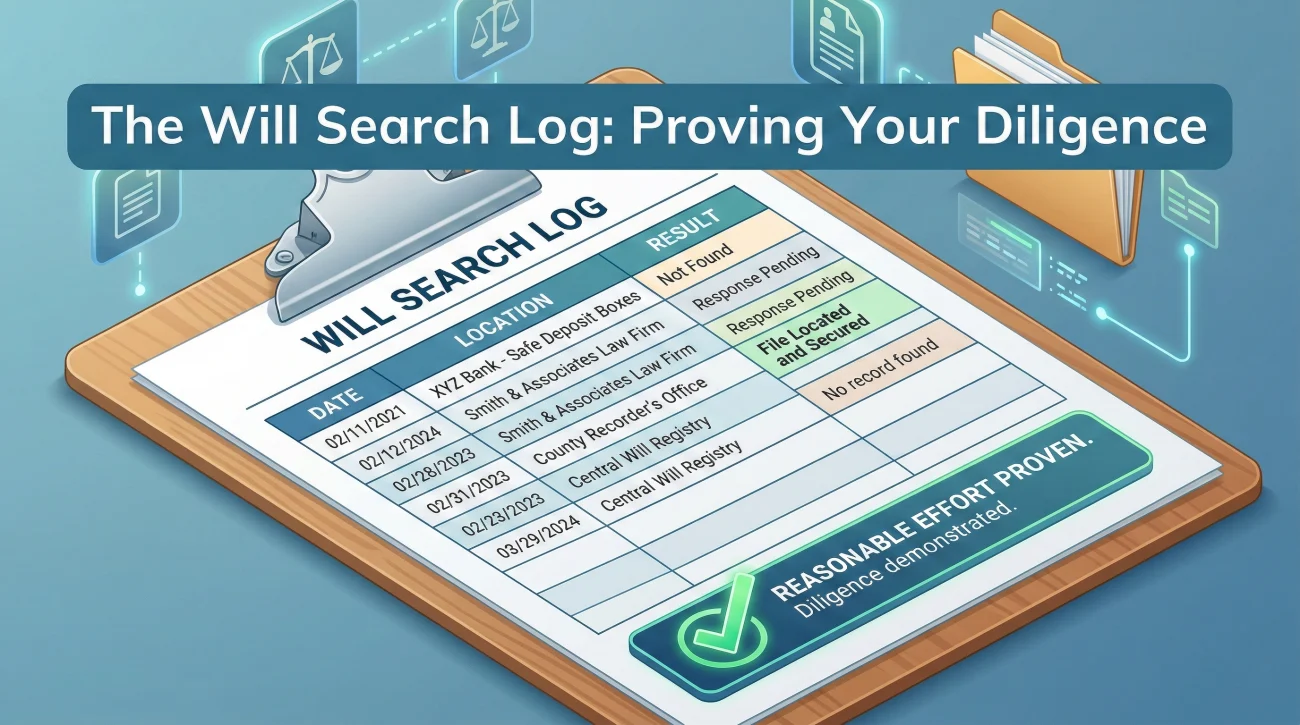
One of the biggest mistakes executors make in the first week is doing a lot of work but keeping no records. You might spend ten hours searching the house, calling three attorneys, and visiting two banks. If you do not write that down, you have nothing to show for your effort when someone asks, “Are you sure you looked everywhere?”
I highly recommend creating a simple Will Search Log. The goal is to prove that your search was systematic, exhaustive, and reasonable. You can build this yourself in Excel, or adapt a printable tracking sheet if you prefer working with pen and paper.
Here is a basic structure of what your log should capture:
| Date | Location / Person Contacted | Action Taken | Result / Next Step |
|---|---|---|---|
| Oct 12 | Home Office Desk | Searched all drawers and file boxes. | Found life insurance policy, no estate documents. |
| Oct 13 | Smith & Associates Law Firm | Called and spoke with receptionist Mary. | Firm has no record of deceased as a client. |
| Oct 14 | First National Bank | Inquired about safe deposit box via phone. | Box exists. Requested written procedure for access. |
| Oct 15 | Basement Firebox | Opened using key found in kitchen. | Found 2015 copy of document. Attorney listed: Jane Doe. |
What Happens If the Document Is Genuinely Lost?
Sometimes, despite your most thorough efforts and a completely filled-out search log, the result is zero. The document is simply not there, or the deceased never actually formalized one.
If you reach the end of your search path with no document, the estate is generally considered “intestate” (dying without a will). This is not a failure on your part, and it does not mean the estate is frozen forever. It simply means the local probate court will step in to appoint an estate administrator, and the assets will be distributed according to your state’s default family hierarchy. You will submit your search log to show you made a thorough effort, which clears the way for the court to formally start the intestate process.
Final Thoughts Before You Stop Searching
Calling an end to the search phase is often a relief, as it allows you to finally transition from an investigator to an active manager. Whether you found the original paper, located only a photocopy, or confirmed that nothing exists at all, making a definitive call means you can stop digging and start moving forward.
Once you close this chapter, you have the clarity you need to confidently approach the probate court and begin the real work. You can transition your energy toward unlocking accounts, notifying creditors, and handling the practical administration of the estate with a clear roadmap ahead of you.
❓ FAQ
🗣️ How to find out if someone had a will without asking family?
Review their credit card statements and checking account history for the past year. You are looking for recurring safe deposit box fees or a one-time substantial payment to a law firm, which often indicates estate planning was recently completed.
🔎 Is there a national registry where all wills are kept?
No, there is no centralized national database for estate documents in the United States. They are typically held in private custody by the individual, their drafting attorney, or occasionally lodged with a local county probate court.
🏛️ Can an executor from an older, revoked draft help me?
Yes. If you find an old, clearly outdated version naming a different executor, contact that person. The deceased may have discussed their intention to update their plans with them, giving you a lead on which new attorney they might have hired.
⚖️ Can I use a photocopy if the original was destroyed in a house fire?
Courts have specific procedures for proving a lost or destroyed document. You will usually need to provide the copy and gather testimony from the original witnesses to prove to the judge that the document was accidentally destroyed, rather than intentionally revoked by the deceased.
🔐 Do I need Letters Testamentary to look inside the safe deposit box?
Usually no. While you need full court authority to remove money or jewelry, many states allow a limited search procedure where a bank officer supervises the opening of the box specifically to extract burial instructions and estate documents before the court process officially begins.
⏱️ How long do I have to find a will after someone dies?
While you should locate it promptly to secure assets, it is perfectly normal for the search to take several weeks. Many jurisdictions suggest filing it within 30 days of death, but you should always verify the specific timeline requirements with your local probate court.
📄 Will the probate court accept a digital scan on a USB drive?
A digital scan is treated exactly like a photocopy. While it is highly informative, you still have the burden of explaining to the court what happened to the original wet-ink paper document before they will consider admitting the digital version to probate.
📹 Is a video recording of their wishes legally binding?
In almost all cases, no. A video can help demonstrate the person’s intent or mental capacity if the estate is challenged, but it does not replace the requirement for a written, signed, and formally witnessed paper document.
🏦 Will a bank tell me over the phone if they have the document?
Banks do not keep estate documents on file in their general computer system. They only know if the deceased rented a safe deposit box. They cannot tell you what is physically inside the box until you initiate the formal, in-person search procedure.
💰 Does a law firm charge a fee to release the original to me?
Generally, no. If the firm is simply holding the document in their vault for safekeeping, they should release it to the named executor upon verifying the death and your identity, without charging a release fee.
⚠️ Disclosure: I'm not an attorney and nothing on this site is legal or tax advice. The content covers process, organization, and workflow—the operational side of estate administration. For legal interpretation, jurisdiction-specific deadlines, contested situations, or tax matters, please work with a licensed professional in your state.