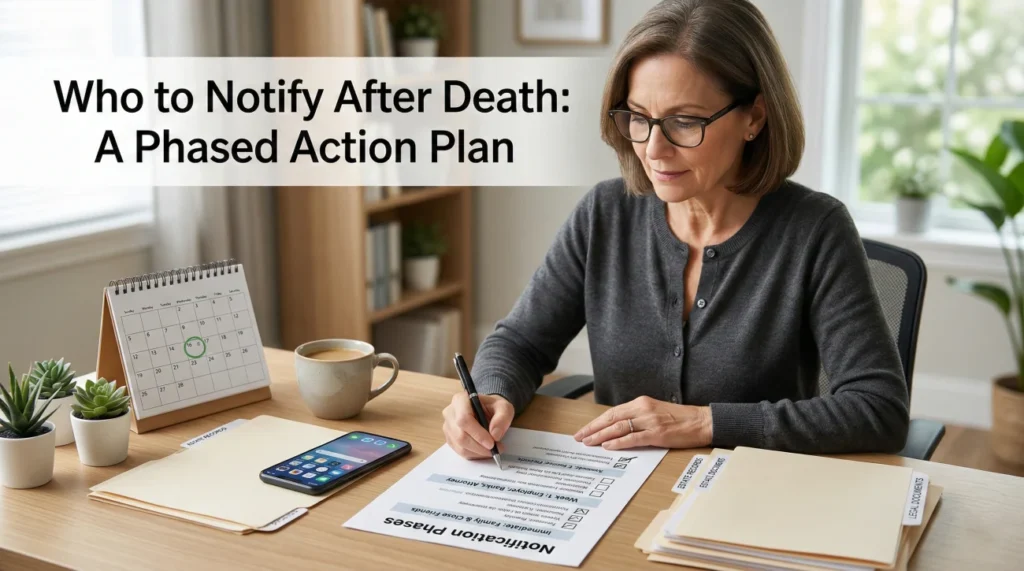
- Pace yourself: You do not need to call every institution on the first day. A phased approach prevents burnout and limits duplicate requests.
- Get the master list: Use our categorized checklist below to see exactly who needs to be contacted across government, financial, and digital sectors.
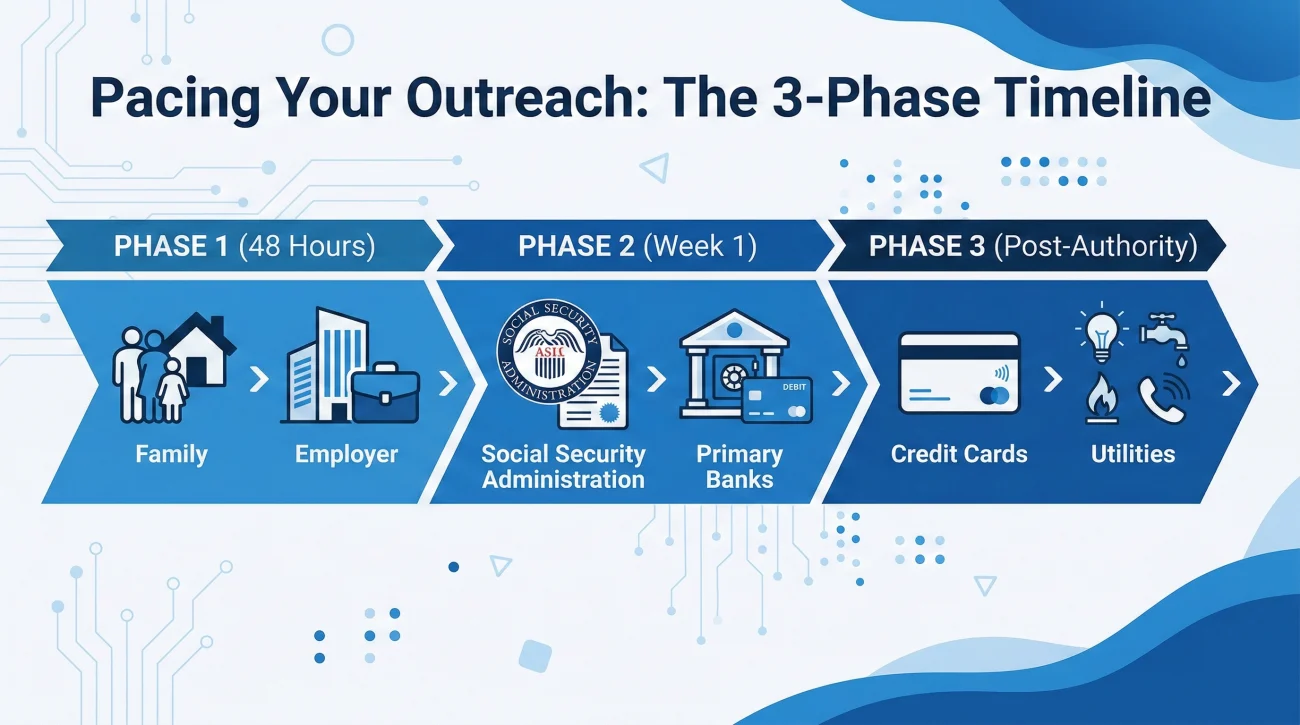
- Phase 1 (48 Hours): Focus strictly on immediate family, the current employer, and securing physical property.
- Phase 2 (Week 1): Notify Social Security, Veterans Affairs, primary banks, life insurance, and lock down the credit files to stop identity theft.
- Phase 3 (Post-Authority): Wait until you have official court documents before tackling credit cards, taxes, mail forwarding, and subscriptions.
The Overwhelming Wave of Notifications (And How to Manage It)
When you step into the role of managing an estate, one of the most immediate pressures you will feel is the urge to pick up the phone and tell everyone what happened. Friends, family, utility companies, banks, the mortgage lender, the post office. It feels like an endless list of entities waiting for an update. I have seen many first-time executors sit at their kitchen tables with a smartphone and a stack of mail, dialing customer service numbers for six hours straight.
In my experience, this “call everyone immediately” approach almost always backfires. Without a structured who to notify after someone dies checklist, you end up repeating yourself and forgetting who you spoke to. Even worse, you might trigger account freezes before you actually have the legal authority or the right documents to unlock them.
If you are feeling lost in the chaos of the first few days, I highly suggest pausing to review the Executor First Steps Checklist to ensure your foundation is solid. Once you have your baseline priorities straight, you can tackle notifications systematically. My goal here is to help you pace these calls. We will break this down into a timeline.
| Timeline Phase | Focus Area | Key Actions |
|---|---|---|
| Phase 1: First 48 Hours | Immediate Stabilization | Family, current employer, property managers, hospice or authorities. |
| Phase 2: Week 1 | Stopping Automated Systems | SSA, VA benefits, primary banks, life insurance, credit bureaus. |
| Phase 3: Post-Authority | Closing and Settling | Credit cards, IRS, USPS mail forwarding, digital accounts, utilities. |
The Master Notification Checklist
Before we dive into the step-by-step phases, here is the complete bird’s-eye view of the organizations you will likely need to contact. Use this as your master reference list.
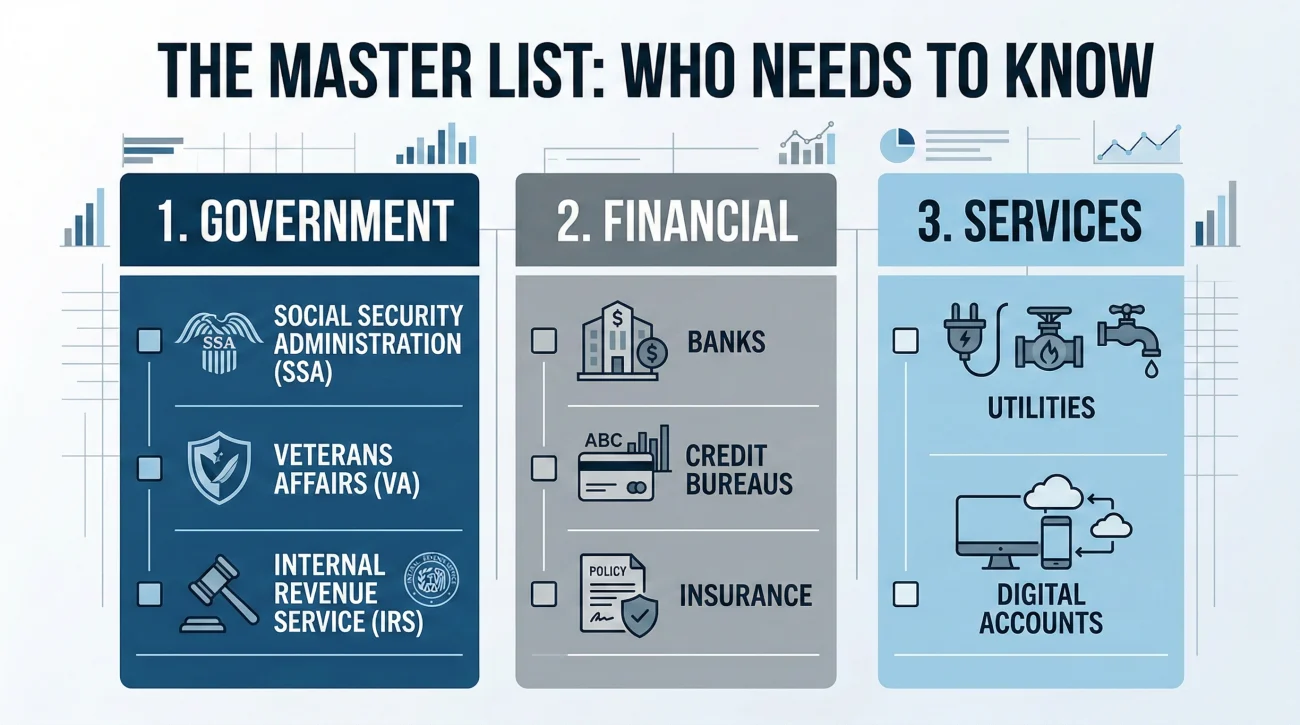
Government and Benefits
- ✅ Social Security Administration (SSA)
- ✅ Veterans Affairs (VA), if applicable
- ✅ Medicare or Medicaid offices
- ✅ Department of Motor Vehicles (DMV)
- ✅ Internal Revenue Service (IRS)
- ✅ United States Postal Service (USPS)
Financial and Legal
- ✅ Primary banks and credit unions
- ✅ The three major credit bureaus (Equifax, Experian, TransUnion)
- ✅ Credit card issuers
- ✅ Mortgage lenders or landlords
- ✅ Pension administrators and retirement accounts (401k, IRA)
- ✅ Life insurance companies
Property, Services, and Digital
- ✅ Homeowner’s and auto insurance providers
- ✅ Utility companies (water, power, gas, internet)
- ✅ Cell phone carriers
- ✅ Social media platforms (Facebook, LinkedIn)
- ✅ Cloud storage and digital ecosystems (Apple ID, Google)
Phase 1: The Immediate Essentials (48 Hours)
In the first two days, your focus should remain extremely narrow. You are only contacting the people and organizations required to stabilize the immediate situation. Do not worry about credit cards or cell phone bills right now. Those can wait.
Family and Close Contacts
This is the most emotionally taxing part of the process. I always advise writing down a short list of the primary contacts. Instead of calling everyone individually, consider calling a few key individuals and asking them to cascade the information to extended family and social circles. This protects your energy.
The Current Employer
If the person was actively employed, notifying their employer is a high priority. The HR department needs to stop payroll, process final paychecks, and initiate any death-in-service benefits. When you make this call, keep it brief and focused on the administrative handoff.
Script: Notifying an Employer (Phone or Email)
Hello, my name is [Your Name]. I am calling to inform you that [Name of Deceased], an employee in your [Department Name] department, passed away on [Date]. I am handling their affairs. Could you please provide me with a written list of the steps required to process their final payroll and any company-provided benefits? I will also need to know where to send the death certificate once it is available.
Immediate Property Managers
If the deceased lived in a rented apartment, an assisted living facility, or a home with a homeowner’s association, notify the property manager. The goal here is security. You want to ensure that maintenance staff or unauthorized individuals cannot freely access the unit now that it is unoccupied.
Phase 2: High-Priority Financials and Benefits (Week 1)
Once you move into the first full week, your notification checklist shifts to stopping automated systems and preventing overpayments. If you delay these notifications, government agencies will continue depositing money, which they will inevitably claw back later.
Social Security Administration (SSA)
In many cases, the funeral director will notify the Social Security Administration automatically. However, one pattern I commonly see is executors assuming this happened when it did not. I strongly advise confirming this directly. If you must report it yourself, you will need to call your local SSA office or the national 800 number. They will not allow you to report a death online.
Veterans Affairs (VA) and Military Benefits
In my experience with military families, the VA has a very specific and strict workflow. If the deceased was receiving military retirement pay or disability compensation, you must notify the Defense Finance and Accounting Service (DFAS) and the VA immediately. Overpayments from these entities are notoriously difficult to untangle and can cause severe accounting headaches for the estate. Call their survivor assistance lines and request written instructions for stopping benefits.
Primary Banks and Mortgage Companies
Notifying the primary bank is a delicate step. Once the bank is officially notified of the death, they will typically freeze the accounts solely in the deceased’s name. This is necessary, but it means auto-pays for things like electricity or the mortgage will bounce. Before you notify the bank, identify which critical bills are tied to that account.
Calling the bank, telling them the person passed away, and getting frustrated when they freeze the account and refuse to give you the balance over the phone.
Calling the bank, stating you are reporting a passing, and politely asking: “Can you please mail me your specific checklist of requirements for estate accounts and the mailing address for the legal documents?”
Life Insurance Companies
I always advise executors to notify life insurance companies during the first week. While you will not get a payout immediately, many policies have a claims submission window, so contacting them early is essential. Call their claims department to report the passing and ask them to mail the exact claims packet to your address. They will tell you exactly what documentation the beneficiaries need to provide to move forward.
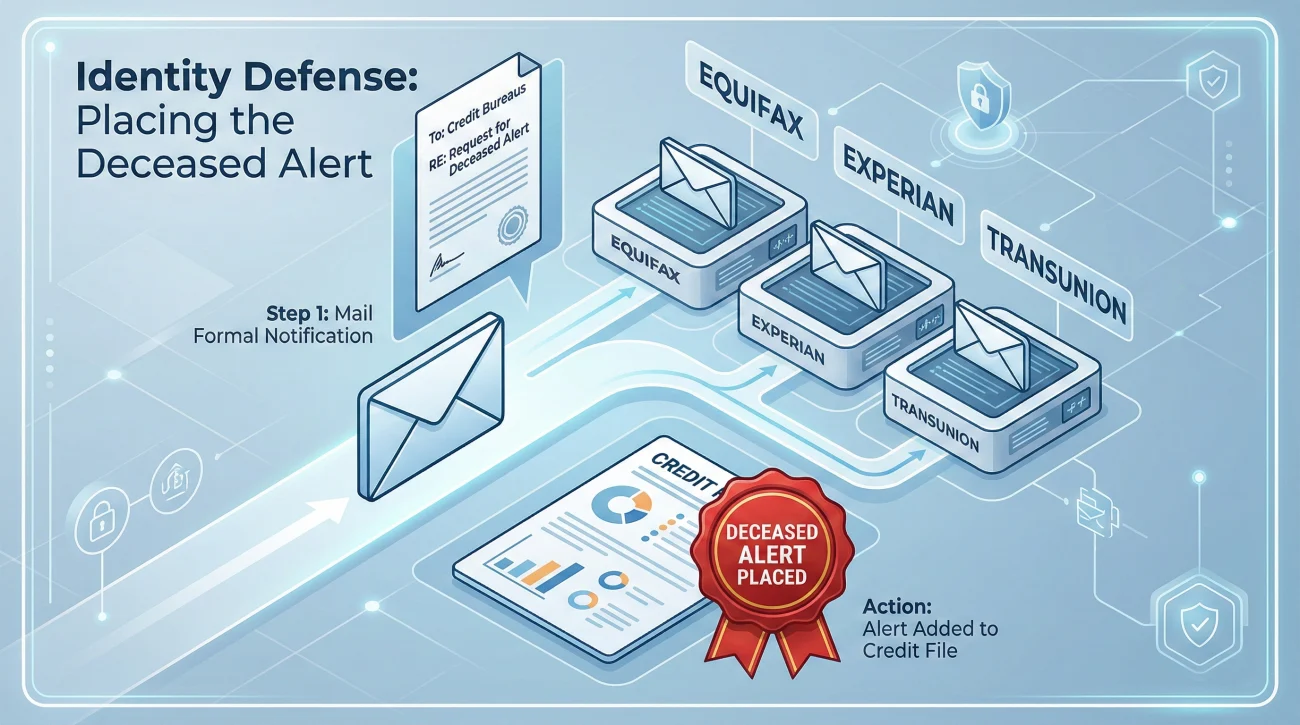
Stopping Identity Theft Early
One of the most unfortunate realities of estate administration is the high risk of identity theft. Scammers actively monitor obituaries to open fraudulent accounts. This step should happen as soon as you have the first physical copies of the death certificate.
You must notify the three major credit reporting bureaus (Equifax, Experian, and TransUnion) to place a “Deceased Alert” on the credit file. Typically, you must send this notification in writing via certified mail. Here is a standard template you can use for your mailings.
[Date]
[Credit Bureau Name]
[Credit Bureau Address]
Subject: Deceased Alert Request for [Deceased Name]
To Whom It May Concern,
I am writing to notify you of the passing of [Deceased Name], whose Social Security Number is [SSN] and date of birth is [DOB]. They passed away on [Date of Death]. Their last known address was [Address].
Please place a “Deceased – Do Not Issue Credit” alert on this file immediately to prevent identity theft.
Enclosed please find a copy of the death certificate, proof of my legal authority to act on behalf of the estate, and a copy of my own government-issued ID.
Sincerely,
[Your Name]
[Your Contact Number]
[Your Mailing Address]
⚠️ Warning: Even if you are told that notifying one bureau will automatically update the other two, I strongly advise sending letters to all three independently. Relying on automated systems often leaves dangerous gaps.
The Operational Secret: Using a Notification Tracker
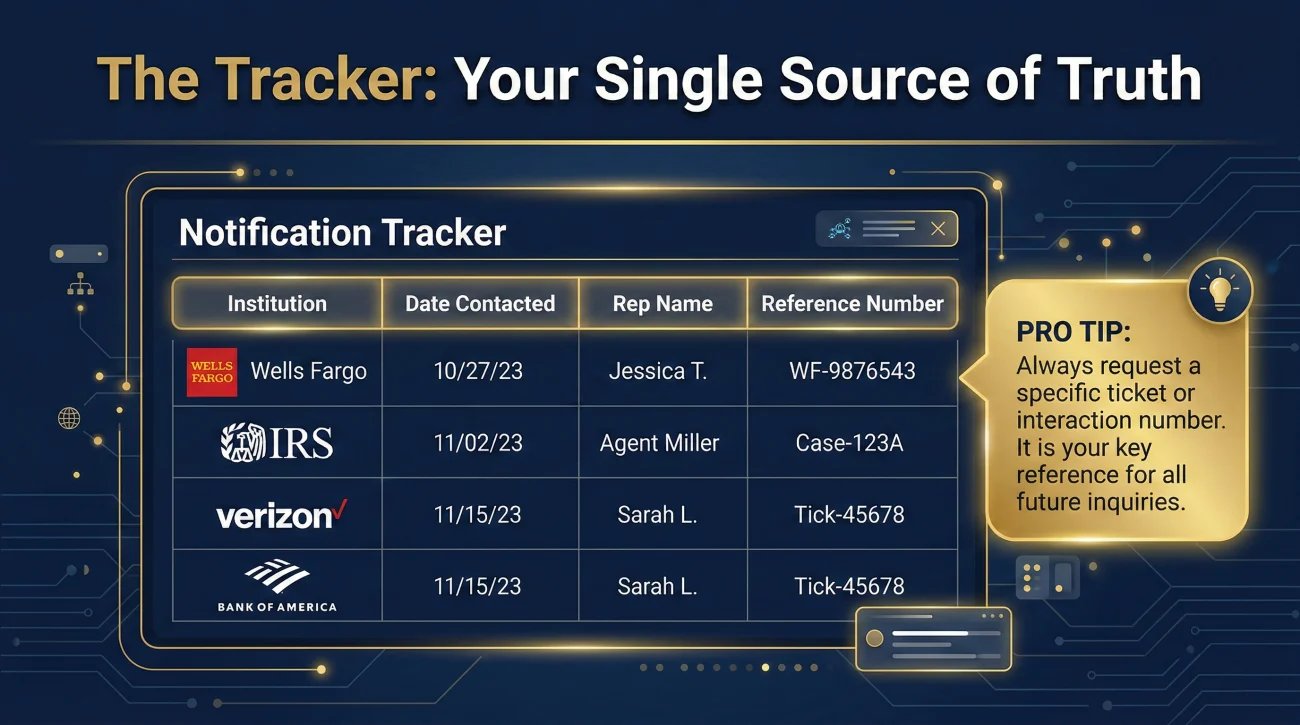
In day-to-day admin work, the fastest wins usually come from simple tracking. You will make dozens of calls. You will not remember if the representative from the water company told you to mail or fax the certificate. You must build a single source of truth for your communications.
Here is a basic structure for a notification tracker. You can build this in a spreadsheet or simply draw lines in a dedicated notebook.
| Institution Name | Date Contacted | Rep Name & ID | Reference Number | Next Action Required |
|---|---|---|---|---|
| State Bank (Checking) | Oct 12 | Sarah M. (ID: 4492) | #REQ-88321 | Mail copy of cert to P.O. Box 123 |
| National Auto Insurance | Oct 14 | David T. | Claim #992-B | Wait for packet in mail (expected Oct 20) |
| Mega Credit Card | Oct 15 | Automated System | #TC-4412 | Need to call back with court docs |
Use that formula for every interaction. Take the action (make the call), ask for their requirements in writing, and always log the confirmation reference number.
💡 Pro Tip: If an agent says “I have updated the file,” politely reply: “Thank you. Can I please get the reference number or ticket number for that update so I have it for my legal records?” This one habit will save you hours of repeated work.
Final Thoughts
Working through a notification checklist is not just about crossing names off a page. It is about systematically transferring the administrative burden of a life from the deceased to the estate, piece by piece. Treat every phone call and every certified letter as a formal business transaction. By pacing your outreach, securing the essentials first, and refusing to rely on your memory for the details, you protect the estate from fraud and protect yourself from burnout.
❓ FAQ
📞 Who is the first person to call when someone dies at home?
If the passing was expected and under medical care (like hospice), call the hospice nurse. If it was unexpected, you must call 911 so the proper authorities can officially pronounce the passing.
🏦 How do you notify a bank that an account holder has died?
Call the bank’s main customer service line and ask for the bereavement or estate services department. Request their specific requirements for closing an account, which usually involves mailing a death certificate and proof of your authority.
🇺🇸 What specific information does Social Security need when you report a passing?
When you call the SSA, you must be prepared to provide the deceased person’s Social Security number, exact date of birth, date of death, and their final home address.
💳 How long do I have to notify credit card companies after a death?
There is no strict legal countdown of days, but you should notify them as soon as you have the death certificate and official authority documents. This stops interest accumulation and prevents fraudulent charges.
🛡️ Can I notify the credit bureaus by phone?
It is highly recommended not to do this by phone. To establish a legally tracked paper trail and ensure the “Deceased Alert” is applied correctly, you should send the request via certified mail with a return receipt.
🏥 Does notifying Social Security automatically stop Medicare billing?
In most cases yes, but always monitor the account directly to confirm. When the SSA updates its system with the death record, that information flows to Medicare to stop premium deductions.
🚗 Do you have to notify the DMV when someone dies?
Yes, eventually. You will need to contact the local Department of Motor Vehicles to cancel the driver’s license (to prevent fraud) and to find out their specific process for transferring vehicle titles.
📱 How do I cancel cell phone service for a deceased person?
Call the carrier’s customer service and state you are handling the estate. Be prepared to provide the account PIN (if known) and email or upload a copy of the death certificate to process the closure without early termination fees.
⚠️ What happens if you forget to notify a creditor of a death?
The debt does not disappear. The creditor may continue to add late fees and eventually send the account to collections. It is always better to notify them promptly so they can pause the account and communicate directly with the estate.
📨 Do I need to send a certified death certificate to every single company?
Not always. Banks, life insurers, and credit bureaus almost always require an original certified copy. Minor subscriptions or local gyms may only require a phone call or a forwarded digital copy. Always ask for their requirements first.
⚠️ Disclosure: I'm not an attorney and nothing on this site is legal or tax advice. The content covers process, organization, and workflow—the operational side of estate administration. For legal interpretation, jurisdiction-specific deadlines, contested situations, or tax matters, please work with a licensed professional in your state.