- The Core Rule: Treat family-paid funeral costs as formal creditor claims against the estate. Do not issue reimbursements based on verbal memories or side agreements.
- The Evidence Standard: A clean reimbursement file requires an exact match between an itemized vendor invoice and absolute proof of payment (like a cleared bank statement), even for digital transfers like Venmo or Zelle.
- The Timeline Reality: Funeral reimbursements are high-priority, but they are not paid on day one. Executors must confirm the estate has enough cash to cover strict legal priorities before writing any checks.
- The Dispute Buffer: Relying on a standardized, written document request protects you from family friction when navigating highly emotional, grief-driven spending.
The Heavy Burden of Upfront Funeral Costs
The timeline for making funeral arrangements is incredibly compressed. In those first few agonizing days, the estate account does not exist yet. There are no official executor letters, no estate tax ID, and no centralized pool of money to draw from. Yet, funeral homes, cemeteries, and florists typically require payment upfront.
This creates immediate financial pressure on the family. A spouse might put the casket on a credit card. A sibling might write a personal check for the church fee. A child might pay the catering deposit in cash. Suddenly, multiple people are acting as ad-hoc creditors to the estate, and everyone understandably expects to be made whole.
As the person stepping into the executor role, untangling this web is one of your earliest tests. Handling a funeral expenses reimbursement as an executor requires a delicate balance: you must be deeply empathetic to grieving family members who fronted their own money, while remaining firmly organized about how you document and process their payouts. If you simply write checks from the estate account based on memory, you open the door to accounting headaches, beneficiary disputes, and potential personal liability.
Key Point: Do not treat funeral reimbursements as informal family favors. Treat them as formal, documented expenses of the estate administration. Clear paperwork protects both the person who paid and the executor who reimburses them.
Bridging the “Assumption Gap” During Grief
Reimbursing funeral costs often triggers family friction because of a fundamental misunderstanding of what an estate is actually allowed to pay for. When I review early estate records, I commonly see a pattern I call “the assumption gap.” A relative assumes that because they loved the deceased, any expense they incurred around the time of death is a valid estate expense.
They might submit a list of expenses that includes the primary funeral home invoice, but also a $600 flight for their spouse, a $200 hotel room, and $150 worth of groceries for the family gathering. You have a duty to preserve estate assets for all beneficiaries, which means you typically cannot reimburse personal travel, even if it feels morally justified to the family member. Having to say “no” or “I need a receipt for that” to a grieving sibling is incredibly difficult.
A secondary issue arises when family members disagree on what constitutes a “reasonable” expense. If one sibling books an extravagant $5,000 catered repast without consulting anyone, and another sibling formally objects to the estate paying for it, the executor is caught in the middle. In these scenarios, how much the estate can actually pay depends on its total financial picture, which is covered in the workflow below.
The safest way to remove the emotion from this process is to rely entirely on a standardized, neutral documentation system. When the requirement for paperwork comes from “the estate process” rather than from you personally, it lowers the temperature of the conversation.
Building the Funeral Expense Packet (What to Collect)
To safely reimburse family funeral expenses as an executor, you need to build an audit-proof paper trail. A vague line item on a spreadsheet is not enough. You need to assemble a complete packet for every individual seeking reimbursement.
Before you accept any out-of-pocket claims, always verify if the deceased had a pre-paid funeral plan or burial insurance policy. Those funds must be applied to the vendor balance first, before any family member seeks reimbursement from the general estate pool.
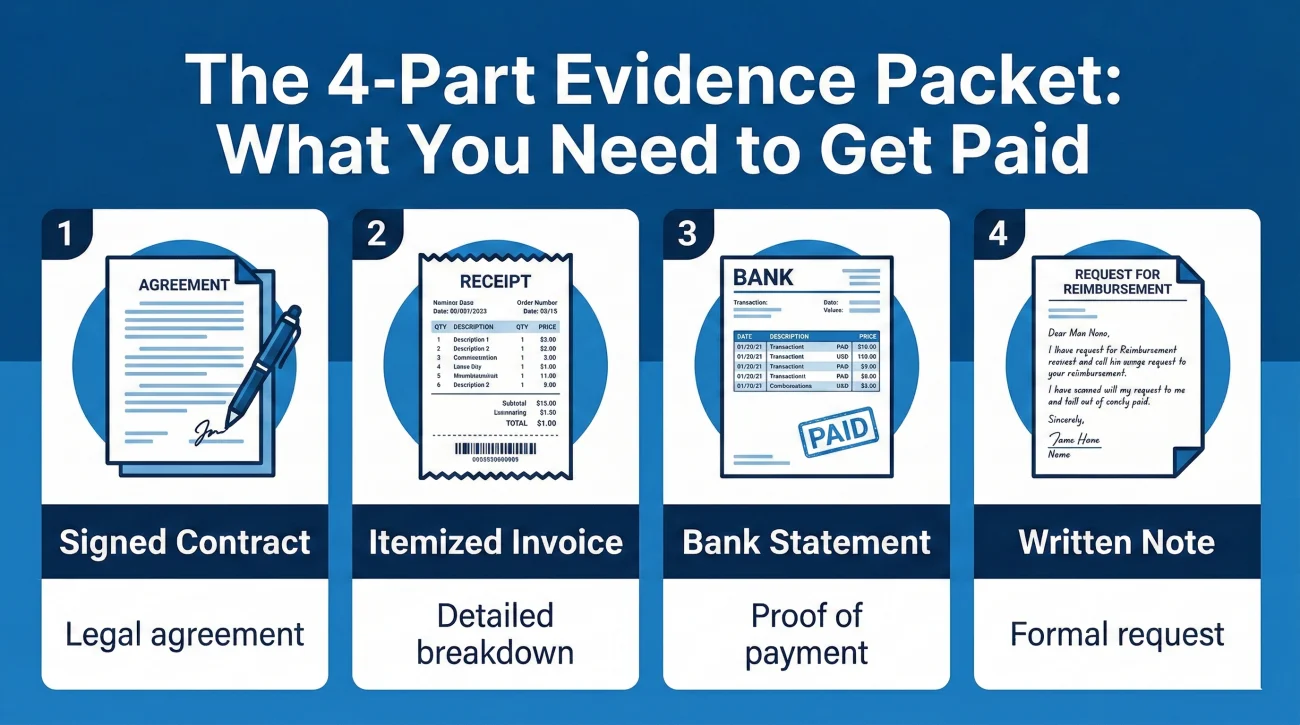
Once you confirm an out-of-pocket reimbursement is necessary, a complete expense packet typically requires four distinct pieces of evidence:
- 📄 The Initial Contract: This is the agreement signed with the funeral home or service provider. It shows exactly what was agreed upon and who signed as the responsible party.
- 📄 The Itemized Invoice: A single line reading “Funeral Services – $8,000” is insufficient. The invoice should break down the costs: casket, transportation, professional services, facility fees, etc.
- ✅ Proof of Payment (The Crucial Step): An invoice only proves a debt exists; it does not prove who paid it. You need a cleared check copy, a bank statement, or a credit card statement matching the exact amount and showing the payer’s name.
- ✅ The Reimbursement Request Note: A simple, written statement from the family member stating what they paid, confirming they are seeking reimbursement from the estate, and providing their mailing address.
💡 Pro Tip: Modern digital payments require the same rigor. If a child used Venmo or Zelle to pay a florist, a screenshot of the app is rarely enough on its own. You still need the matching itemized florist invoice and the underlying bank statement showing the app transfer cleared.
Be extremely careful with “split payments” among relatives. If three siblings agreed to split a $9,000 funeral bill, but only one sibling actually put it on their credit card, the estate only reimburses the cardholder. Do not write three $3,000 checks based on their private side agreements. Reimburse the exact name on the proof of payment.
How to Document Who Paid What (The Tracking Method)
Keeping a stack of loose receipts in a folder is a recipe for duplicate payments or lost records. You need a centralized tracking log: one you update the moment each receipt arrives, not when you are ready to write checks. This log becomes the single source of truth when beneficiaries eventually ask to see the estate accounting.
Here is an example of the fields you should be capturing to maintain a clear trail of funds:
| Date of Expense | Paid By (Claimant) | Vendor / Provider | Description of Expense | Amount | Proof Provided? | Reimbursement Status |
|---|---|---|---|---|---|---|
| Oct 12, 2023 | David Smith (Son) | Oakwood Funeral Home | Main funeral service & casket | $6,450.00 | Yes (CC Statement + Invoice) | Pending Estate Funding |
| Oct 14, 2023 | Sarah Jones (Daughter) | City Floral Shop | Casket spray and standing wreaths | $425.00 | Yes (Cleared Check image) | Pending Estate Funding |
| Oct 15, 2023 | David Smith (Son) | Main Street Deli | Catering for post-service reception | $380.00 | Missing (Requested 11/02) | Hold – Awaiting Receipt |
Notice the third entry. By logging it immediately and marking it “Missing,” you create a clear to-do list for yourself. You know exactly who to follow up with and what is holding up their specific reimbursement. This level of granular tracking is what protects you if someone later questions why David was paid a certain amount.
Where Funeral Costs Sit in the Estate Workflow
A common operational mistake is assuming that because you have the receipts and the estate account has a little cash, you should immediately write reimbursement checks. The timing of when you pay is just as important as what you pay.
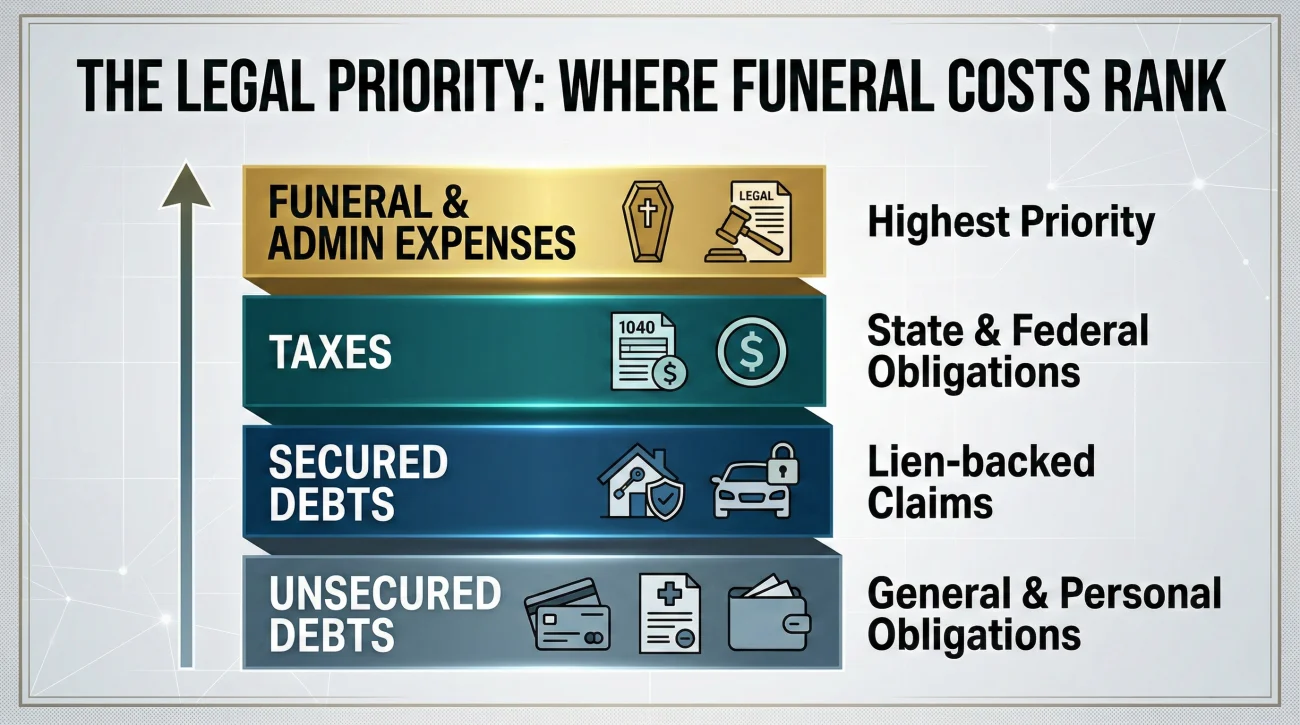
To understand the timeline, you must understand the mechanism of an “insolvent estate.” If an estate is insolvent (meaning total debts exceed total assets), state law dictates a strict priority ladder. Funeral and administration expenses usually sit near the top of this ladder. However, if there is only $5,000 in the bank and a $10,000 funeral bill, the estate cannot pay credit card companies or distribute inheritances at all. If you distribute money out of order, or pay one sibling in full while another gets nothing, you can be held personally liable for the shortfall.
Therefore, your operational workflow should follow this conservative sequence:
- ✅ Step 1: Build the complete documentation packet (Contract, Invoice, Proof of Payment) for all known funeral costs during the first month.
- ✅ Step 2: Sweep initial liquid assets into the newly opened estate account to determine your baseline cash pool.
- ✅ Step 3: Run the insolvency check. Map out all known debts, taxes, and claims against the estate. Compare your cash pool against the highest priority items.
- ✅ Step 4: Determine the payment timeline. If the estate is clearly solvent (plenty of money to pay everyone), reimbursements can often be processed in Month 2 or Month 3. If funds are tight, reimbursements must be paused until all creditor claims are evaluated.
- ✅ Step 5: Issue reimbursement checks directly from the estate account, tying them specifically to the tracking log.
To safely navigate this phase without misstep, I highly recommend reviewing our comprehensive Executor Creditor and Debt Checklist. It provides the essential map for identifying what to pay, what to pause, and how to track the overall debt landscape before moving money.
Common Reimbursement Recordkeeping Mistakes
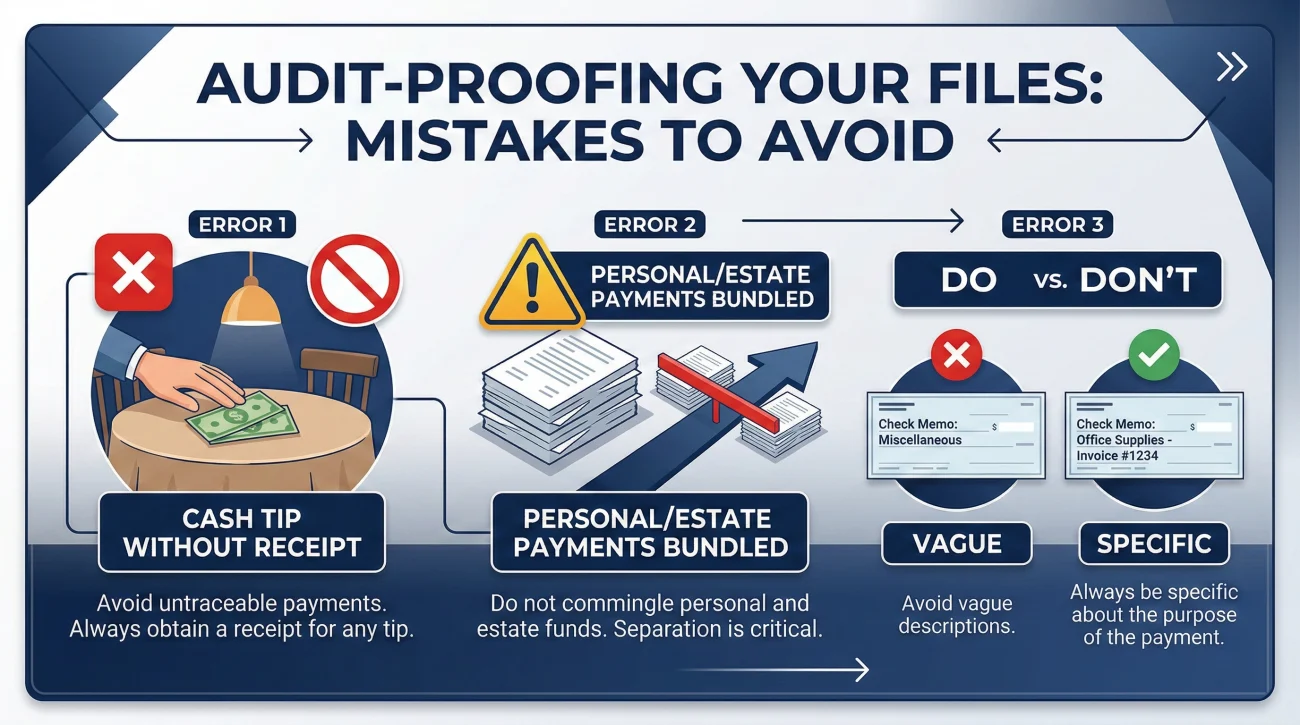
When you are managing the executor workflow, the smallest documentation errors can snowball into major headaches during the final accounting phase. It is much easier to establish strict rules early on than to try and recreate paper trails months later.
These mistakes share a common thread: they all blur the line between what was actually paid and who specifically paid it.
One of the most frequent patterns I observe is the “bundled payment” problem. A family member might write a single check from their personal account to cover the funeral home, a personal credit card bill they owed the deceased, and a cash withdrawal to tip the pallbearers. Disentangling that single bank line item into estate-approved expenses and personal expenses is a nightmare.
⚠️ Warning: Be incredibly wary of cash payments without receipts. It is common for family to hand cash to officiants, musicians, or catering staff at the service. If a relative asks for a $500 reimbursement for “cash tips handed out at the church,” you are in a tough spot. Without a receipt or a signed acknowledgment from the recipient, reimbursing cash outlays carries high risk.
Another common point of failure is vague labeling. When you eventually write the reimbursement check from the estate account, the memo line matters. It is the final link in your documentation chain.
Writing an estate check to a sibling with the memo “For Dad’s stuff” or “Reimbursement.” If an auditor or beneficiary reviews this a year later, it means nothing.
Writing the estate check with the memo “Reimb: Oakwood Funeral Home Inv #1234.” This instantly ties the payment back to the specific, approved documentation in your file.
How to Ask Family Members for Proper Documentation
The hardest part of this process isn’t the paperwork; it’s the people. Asking a grieving sister or an exhausted uncle to go dig up a credit card statement feels deeply uncomfortable. You might worry they will think you don’t trust them.
The key to maintaining communication hygiene here is to place the “blame” entirely on the administrative process. Frame your requests around what the estate requires to keep everyone legally safe, rather than what you personally want. Keep your tone calm, neutral, and highly structured.
If you have a relative who keeps mentioning how much they spent but hasn’t provided any paperwork, you need to transition the conversation from verbal to written. Here is a practical, copy-paste safe script you can use to request the packet:
Hi [Name],
Thank you again for stepping in and covering the [florist/catering/funeral home] costs last month. I know that was a heavy burden, and I want to make sure the estate reimburses you correctly.
To process this through the estate account, the recordkeeping rules require me to build a formal file for the expense. Could you please send me the following when you have a moment?
1. A copy of the itemized receipt or invoice from the vendor.
2. A copy of the bank or credit card statement showing the charge clearing your account (you can black out your account numbers and other personal purchases).
Once I have those for the estate records, I can log it as an official administration expense and give you an update on when the reimbursement can be issued.
Thank you for helping me keep the paperwork organized.
[Your Name]
This script works because it follows a reliable formula:
[Acknowledge the help] + [State the estate's requirement for documentation] + [Provide a clear list of needs]
It removes emotion and establishes that you are simply doing the job properly.
Final Thoughts Before Processing Claims
As you gather these files, it helps to mentally separate “funeral expenses” (the immediate, one-time costs of laying the person to rest, like the casket, service, and headstone) from general “estate administration expenses” (the ongoing operational costs of managing the estate, like probate filing fees, lock changes, or property maintenance).
Both categories are incredibly high-priority when it comes to the order of operations, but they are logged in different categories for the final accounting. Keeping them separate from day one reduces confusion later.
Remember that you are acting in a fiduciary capacity. Every dollar that leaves the estate account must have a clear, documented reason, tied back to a legitimate estate expense. By taking the time to build a solid funeral expense packet, using a centralized tracking log, and communicating neutrally with your family, you strip away the risk of future disputes.
❓ FAQ
⚰️ Who pays funeral expenses out of pocket initially?
In most cases, a spouse, adult child, or close relative pays the funeral home upfront using their personal funds or a credit card, because the estate bank account cannot be opened quickly enough to cover the immediate costs.
🧾 What happens if a family member lost the funeral receipt?
If the physical receipt is lost, the executor should ask the family member to contact the funeral home or vendor to request a duplicate itemized invoice, and pair that with their personal bank statement showing the cleared transaction.
✈️ Are flights to the funeral considered a reimbursable estate expense?
Typically, no. Personal travel costs, hotel stays, and family meals surrounding the funeral are generally considered personal expenses of the attendees, not official administration expenses of the estate itself.
🍽️ Can the estate pay for the funeral reception or repast?
This often depends on local guidelines and the size of the estate. While basic, reasonable reception costs are sometimes allowed as part of the funeral expense, extravagant catering might be challenged by other beneficiaries. Always document these costs thoroughly.
💳 What if the funeral was put on a shared credit card?
If a joint account holder or authorized user placed the funeral cost on a card shared with the deceased, the executor must carefully separate that specific funeral charge from the deceased’s general debt balance, ensuring the surviving account holder is correctly reimbursed or credited.
⏱️ How long does it take for the estate to reimburse funeral costs?
Reimbursement can take anywhere from a few weeks to several months. A common timeline is gathering receipts in Weeks 2-4, funding the estate account in Months 2-3, and processing reimbursements in Months 3-4, assuming the estate is clearly solvent.
🏦 Can the bank pay the funeral home directly from the deceased’s account?
In many cases, yes. If the executor presents a valid death certificate and the official funeral home invoice, some banks will issue a cashier’s check directly to the funeral home from the deceased’s frozen account, avoiding the need for family to pay out of pocket.
🪦 Are headstones and grave markers included in funeral expenses?
Yes, reasonable costs for a headstone, grave marker, or cemetery plot are commonly classified alongside funeral expenses as necessary estate administration costs, provided they are properly documented with invoices.
📝 Do I need to show the family the funeral invoices?
Executors are required to provide an accounting to the residuary beneficiaries before closing the estate. This accounting will list the total funeral expenses, and beneficiaries generally have the right to request the supporting invoices if they question the amounts.
🛑 What if the estate doesn’t have enough money to reimburse everyone?
If the estate is insolvent (more debts than assets), funeral expenses usually have high priority for payment. However, if funds run out entirely, the family members who paid out of pocket may only receive partial reimbursement based on a prorated scale, or none at all.
⚠️ Disclosure: I'm not an attorney and nothing on this site is legal or tax advice. The content covers process, organization, and workflow—the operational side of estate administration. For legal interpretation, jurisdiction-specific deadlines, contested situations, or tax matters, please work with a licensed professional in your state.