- Sorting over paying: Medical bills after death are a sorting problem first. The immediate goal is building an accurate, documented packet.
- The insurance lag: Hospital billing cycles often take weeks or months to process. Paying early usually leads to duplicate payments that are difficult to recover.
- The verification step: Never accept a medical invoice at face value. Always cross-reference the provider’s bill with the official Explanation of Benefits (EOB).
- Communication boundaries: Keep providers informed with a standard written notice to pause collections, but avoid making personal promises to pay.
The Medical Bill Avalanche: Taking Control of the Mailbox
When I sit down to help families organize estate files, the medical folder is almost always the thickest. Within weeks of a person passing, the mailbox can quickly turn into an overwhelming avalanche of envelopes. You might see statements from the hospital facility, the emergency room physician group, the radiologist who read a scan, the laboratory, and the ambulance service.
It feels chaotic, and for an executor trying to do the right thing, the pressure to start writing checks from the estate account immediately is intense. In my day-to-day admin work, I see this anxiety drive people to act on the very first invoice they open. The problem is that medical billing is notoriously slow and fragmented. If you pay an incomplete bill today, you are almost guaranteeing a tangled administrative mess next month.
By treating the incoming mail strictly as a data-gathering exercise rather than an immediate financial emergency, you protect the estate from overpayment and protect yourself from unnecessary liability.
Why Deceased Medical Debt Arrives in Confusing Waves
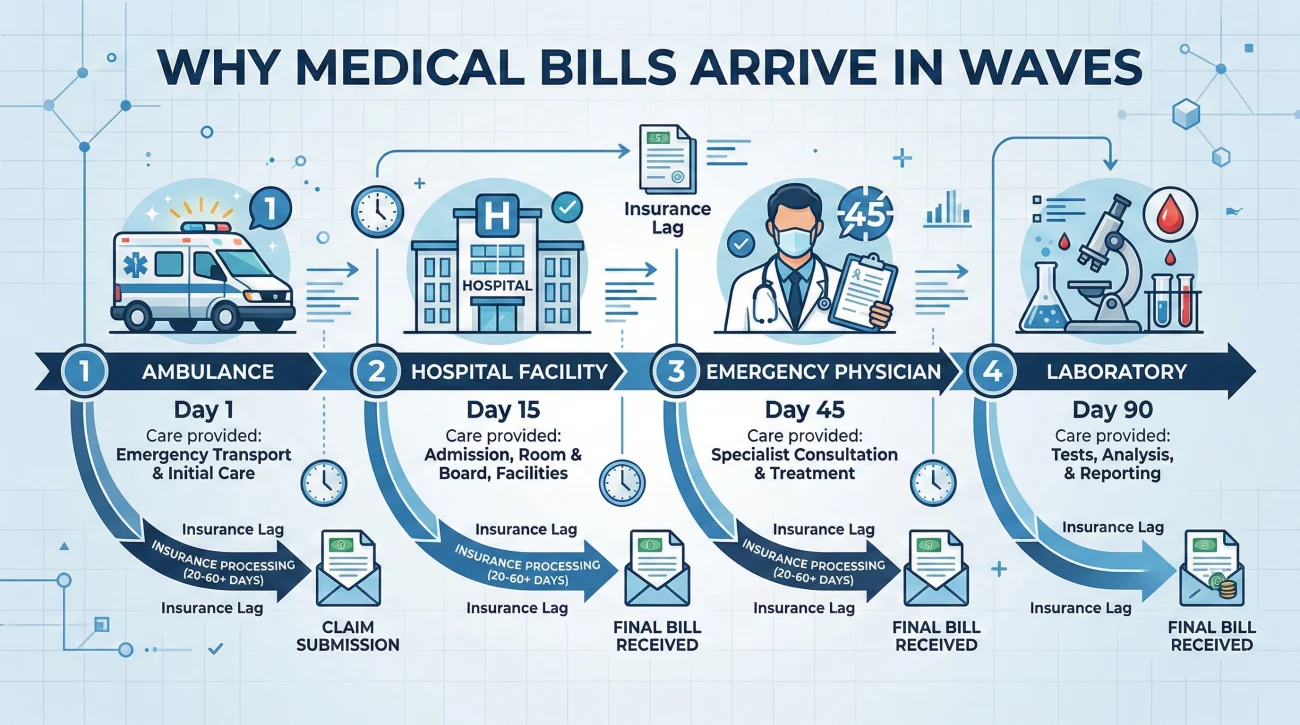
To keep these records organized, it helps to understand why the paperwork looks so disorganized when it arrives. Medical care operates on a fragmented system where different providers submit separate claims to the insurance company on completely different timelines.
Let’s look at a very common scenario. Imagine a three-day hospital stay before passing. The facility sends a bill for the room, the emergency doctor bills separately through their private group, the pharmacy bills for medications, and the outside lab bills for bloodwork. Some of these providers process their insurance claims in a matter of days. Others might take 60 to 90 days to even submit the initial paperwork.
Key Point: Your primary job right now is not to clear the balances. Your job is to collect the data, verify the amounts against insurance records, and build a clean, trackable packet of final illness expenses for the estate.
Because of this lag, you will receive bills that cross in the mail with insurance payments. You will see duplicate statements for the same date of service. You might even receive a letter from a debt collection agency out of nowhere. Sometimes, if a hospital’s automated system does not know the patient has passed away, they will automatically sell an unpaid 60-day-old balance to a third-party collector. If that happens, do not panic. It is just a byproduct of this fragmented system catching up to reality.
This is exactly why rushing is dangerous. If you pay a $2,000 ambulance bill on Tuesday, and the insurance adjustment arrives on Thursday showing the patient responsibility was only $150, trying to get a $1,850 refund check issued back to the estate is a frustrating process.
The Verification Checklist: Matching Bills to Reality
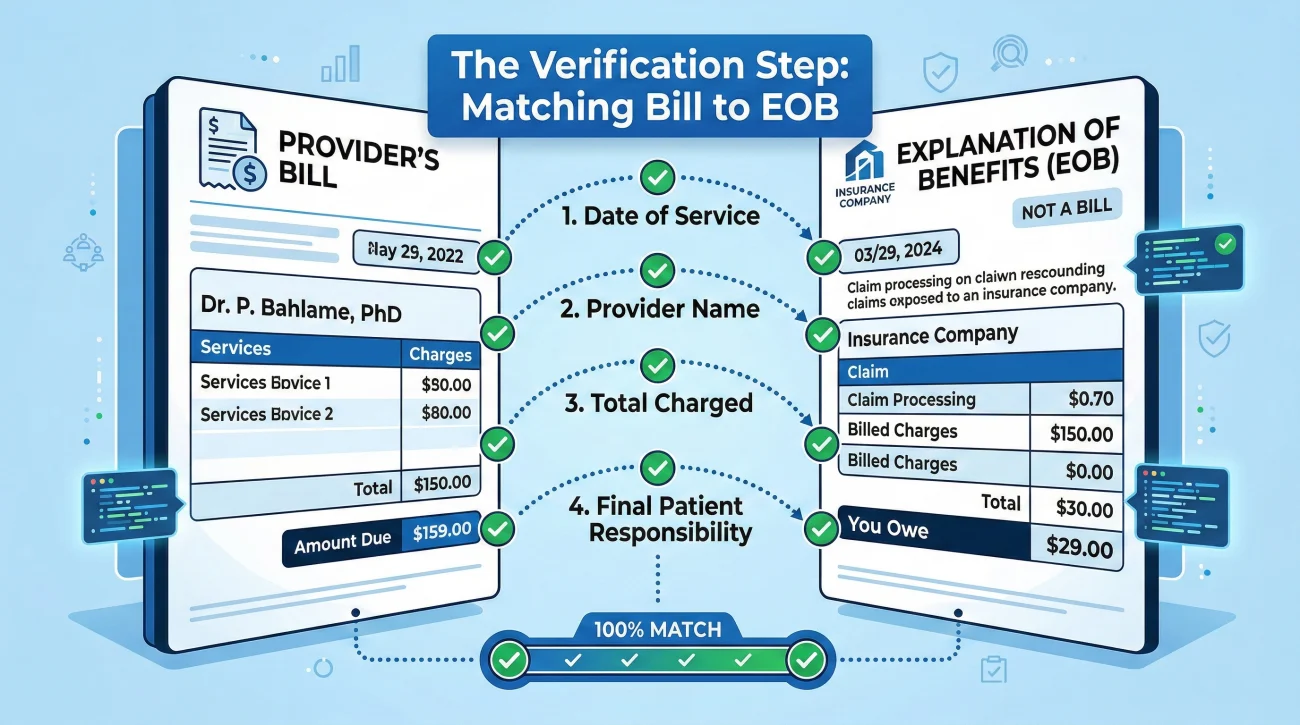
Before any medical invoice is considered a valid claim against the estate, it must pass a basic verification check. I always advise setting up a physical “holding zone” on your desk. Nothing moves from this holding zone to the “approved” folder until it has been matched against an official record.
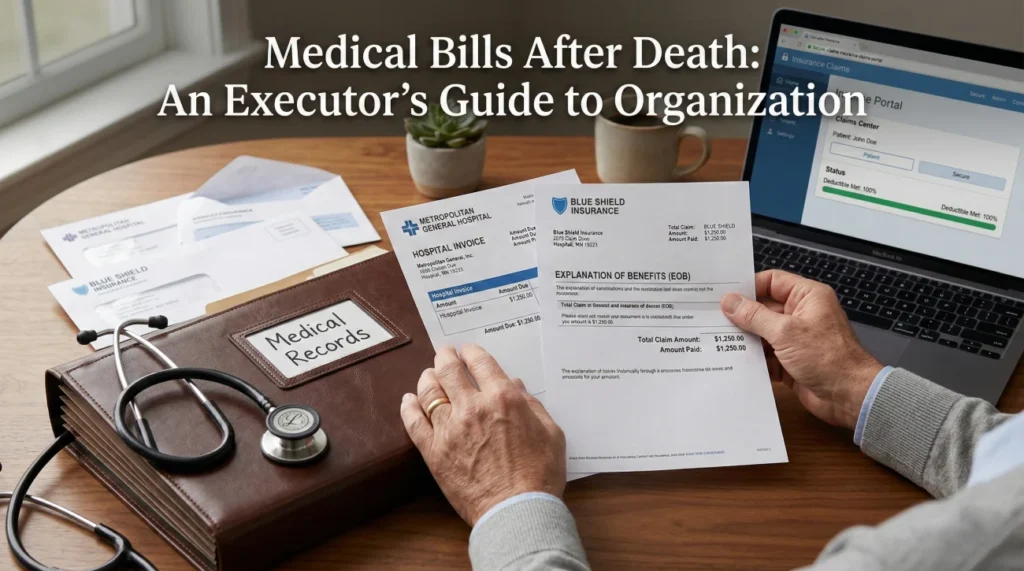
The single most important document in this phase is the Explanation of Benefits (EOB). This is the statement sent by Medicare or the private health insurance company. It is the insurance company’s official math showing what the provider charged, what the insurance company agreed to pay, and the exact amount the patient is legally responsible for.
❌ Note: A common mistake is receiving an initial hospital statement that says “Amount Due” and assuming insurance has already been applied. Often, this is just a preliminary notice of charges.
| What You Are Looking For | Why It Matters for the Estate |
|---|---|
| Date of Service | Does the date on the bill match the date on the EOB? This prevents paying for the same visit twice. |
| Provider Name | Medical groups often use obscure corporate names. Verify the name matches the service received. |
| Patient Responsibility | This is the critical number. The bill from the doctor MUST match the “Patient Responsibility” line on the EOB. |
| Pending Flags | If the bill says “Pending Insurance” or “Claim Submitted,” place it back in the holding zone. |
If an invoice arrives and you do not have the matching EOB, simply log its arrival and wait. In many cases, executors receive three increasingly urgent letters from a provider, only for the fourth to show a zero balance because the insurance finally processed the claim. While a clean match means you can confidently file the bill in your approved packet, you must also be prepared for the times when the paperwork does not align perfectly.
Handling Denied Claims and Insurance Nuances
In a perfect world, every EOB matches the invoice perfectly. In reality, you will likely encounter denied claims or complex insurance structures that require special attention.
If an EOB arrives and the claim is denied entirely, the estate might suddenly be responsible for a massive balance. As an executor, your immediate step is to document the denial code. Do not automatically assume the estate has to pay it. Often, claims are denied simply because the provider used the wrong billing code. You can contact the provider and request that they resubmit the claim with the corrected codes.
The Medicare vs Medicaid Distinction
It is also crucial to understand the difference in coverage types. Standard Medicare and Medicare Advantage plans process claims like traditional insurance. However, if the deceased was receiving Medicaid (which is state-administered), the rules change significantly.
⚠️ Warning: Medicaid programs often have an “Estate Recovery” provision. This means the state can file a formal claim against the estate to recover the costs of care provided, particularly for nursing home stays. If you see Medicaid involvement, this is a major signal to pause and seek local professional guidance before distributing any estate assets.
Building a Clean Final Illness Expenses Packet
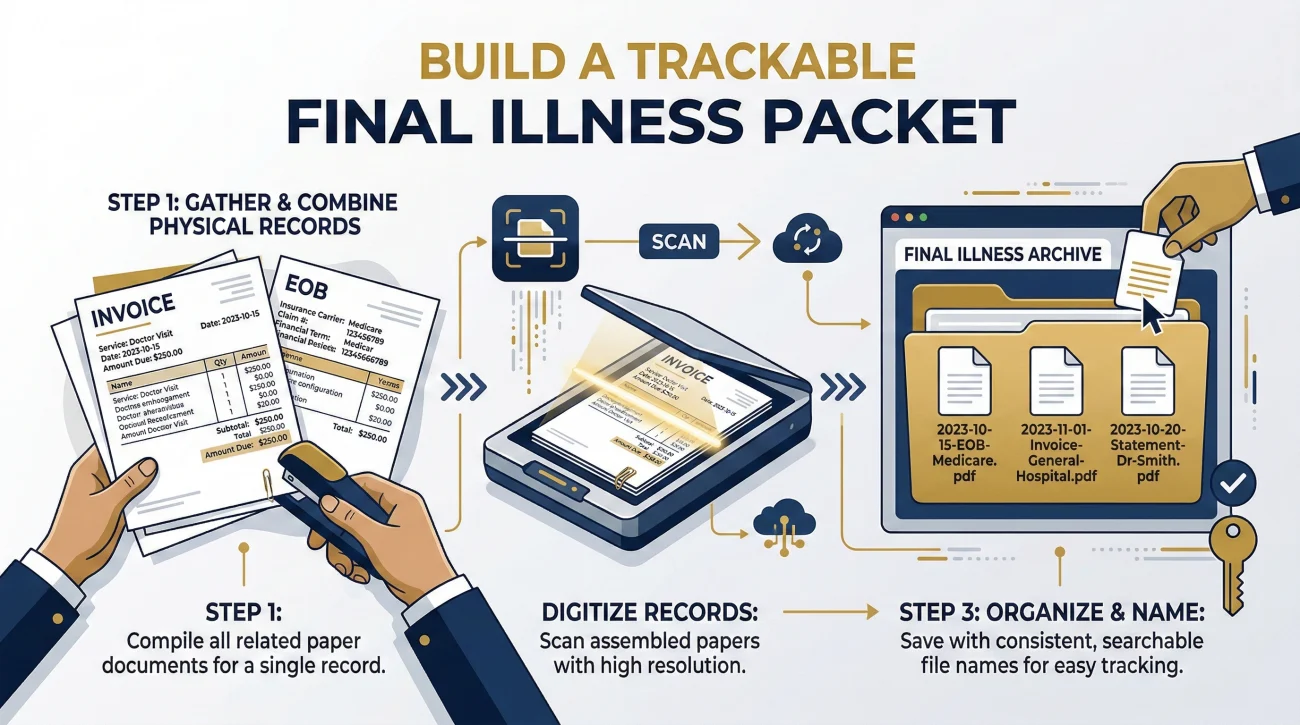
Once you begin verifying these bills, you need a system to store them. Scattered paper across a dining room table is the enemy of a smooth estate administration. You are building a trackable record potentially for beneficiaries, the probate court, or an accountant down the line.
I rely heavily on a physical-to-digital workflow. When a medical bill is verified, staple the provider’s invoice directly to the matching EOB. This creates a complete story for that specific charge. If anyone ever questions why a particular amount was approved, the proof is attached directly to the bill.
Digital File Naming Habits
If you are scanning documents (which I highly recommend), the file names you choose will either save you hours or cause massive frustration later. Avoid generic file names so you can spot duplicates instantly.
scan004.pdf
hospital_bill.pdf
medicare_letter.pdf
2023-10-15-EOB-Medicare-Cardiology.pdf
2023-10-15-Invoice-CityHospital-ER.pdf
2023-11-02-Invoice-MainStRadiology.pdf
Once your files are named clearly and securely stored, you will be in a much stronger, more confident position to actually speak with the people sending these bills.
Communicating with Medical Billing Departments
When you contact hospitals, clinics, or collection agencies, your goal is strict neutrality. You are gathering information and establishing a paper trail. You are not negotiating lump-sum settlements on the spot or taking on personal responsibility for the deceased medical debt estate obligations.
If a bill is missing details, or if you need to buy time while the estate is formally opened, a written request is always best. This applies whether the letter comes from the hospital itself or a third-party collection agency.
Script: Requesting a Pause and Itemization
Here is a safe, polite way to respond to an incoming medical bill while you are still sorting the estate. This can be sent via mail or modified for an email if the provider uses a secure portal.
To the Billing Department:
I am writing to formally notify you of the passing of [Patient Name], who died on [Date].
I am in the process of gathering records to handle the estate administration. Regarding account #[Number], please place a 90-day administrative hold on this account while insurance claims are finalized and the estate inventory is compiled.
In the meantime, please provide a complete, itemized statement for this account, including all dates of service, billing codes, and any insurance adjustments or payments applied to date.
Please send all future correspondence regarding this account in writing to my address below.
Thank you,
[Your Name]
[Your Mailing Address]
While written communication is always preferred to establish a paper trail, you may occasionally need to call a billing department directly to check on a claim’s status. If you do find yourself on the phone, keep the conversation strictly factual and use a script like this:
“Hello, I am calling regarding the account for John Doe. He recently passed away. Can you confirm if all pending claims have been fully processed through his primary insurance before I log this balance?”
💡 Pro Tip: If a debt collector pressures you by asking how you plan to pay the balance today, simply state: “I am currently organizing all claims for the formal estate administration process. I will keep your office updated via mail.” Keep it brief and do not argue.
Where Medical Bills Sit in the Order of Operations
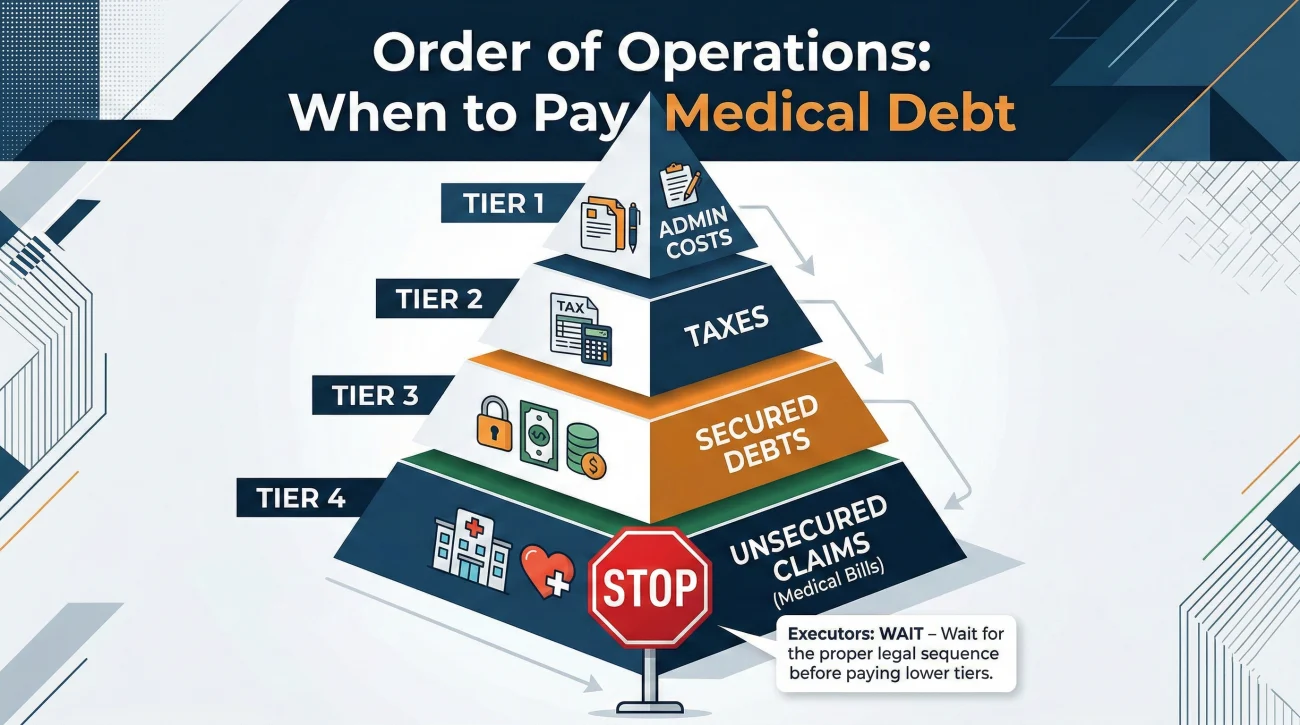
Organizing medical bills is only half the job. The other half is knowing when it is safe to pay them. Estates have a specific legal hierarchy for paying expenses, meaning some creditors legally stand in line ahead of others.
While local rules vary, the general workflow usually looks like this:
- ✅ Stage 1: Administration Costs (Court fees, legal help, property protection)
- ✅ Stage 2: Taxes (Final income tax, estate tax)
- ✅ Stage 3: Secured Debts (Mortgages, car loans tied to an asset)
- ✅ Stage 4: Unsecured Claims (General medical bills, credit cards)
As you can see, general hospital bills typically fall near the end of the line. If you pay a large hospital bill today and discover next month that the estate does not have enough money left to cover the deceased’s final taxes, you have created a serious liability issue for yourself.
What if the Estate is Insolvent?
If you look at the total assets and realize there simply is not enough money to cover all the bills after Stage 1 and Stage 2 are handled, the estate is considered insolvent. When an estate is insolvent, state laws dictate exactly who gets paid and who receives partial payments (prorated amounts). You cannot simply choose to pay the hospital and ignore the credit cards, or vice versa. If you suspect insolvency, this is a critical time to pause all payments and seek professional guidance.
To safely navigate this overall hierarchy, I strongly recommend keeping our executor creditor and debt checklist open as your master blueprint.
Creating Your Medical Expense Log (Template)
To pull all of this together without losing your mind, you need a central tracking log. Relying on memory is a recipe for missed details. Below is the exact format I use to build a master spreadsheet. You can copy these column headers directly into Excel or Google Sheets.
Column B: Provider / Facility Name
Column C: Original Charge Amount
Column D: EOB Received? (Yes/No/Pending)
Column E: Insurance Adjustment / Payment
Column F: Final Estate Responsibility (The actual owed amount)
Column G: Current Status (Hold / Disputed / Approved for Payment)
By keeping this log updated weekly, you remove the emotion from the process. When it is time to review the estate’s overall financial health, you will have a clear, objective spreadsheet to reference instead of a messy pile of envelopes.
Finding Relief in the Process
Handling the paperwork generated by a final illness is exhausting, both mentally and emotionally. It is completely normal to feel a spike in anxiety every time you open the mailbox and see another piece of medical mail.
However, the moment you shift your mindset from “I need to pay this right now” to “I just need to log this and file it,” the burden lightens significantly. The hospital billing machines will keep churning out statements, but you do not have to operate on their timeline. By leaning on a solid verification process, building clear tracking logs, and respecting the estate’s order of operations, you transform a chaotic situation into a predictable, manageable workflow.
❓ FAQ
🏥 Do I have to pay my deceased parent’s hospital bills out of my own pocket?
In most cases, no. Medical debts belong to the estate of the deceased person, not to the children or the executor personally. The debts are typically paid using the funds available within the estate.
⏱️ How long do hospitals have to bill an estate?
Hospitals are generally bound by the formal creditor claim windows established when an estate is opened. However, billing delays are common, which is why executors often wait several months to ensure all final invoices have surfaced before closing the accounting.
🛑 How do I stop medical bill collectors from calling after a death?
Send a written notification of the death to the billing department, along with your contact information as the executor. Request that all future communication be done in writing and ask them to place an administrative hold on the account.
💸 Should I use my own money to pay a final medical bill just to get it out of the way?
It is generally best to avoid this. Mixing personal funds with estate obligations can create confusion and complicate the accounting process. It is safer to wait until the official estate bank account is operational to settle verified debts.
🚑 Why did I get an ambulance bill months after they passed away?
Medical providers, particularly specialized services like emergency transport or external laboratories, often have separate, slower billing cycles than the main hospital facility. It is completely normal for some bills to arrive three to four months later.
❌ What happens if the estate doesn’t have enough money for medical bills?
The estate is considered insolvent, meaning state laws dictate exactly who gets paid and who receives partial payments. Do not pay bills randomly; instead, refer to the Order of Operations section above for guidance on how to proceed.
🔄 Can an executor negotiate a hospital bill for a deceased person?
While some providers may offer hardship programs or settlements, your first step is always verification. Ensure all insurance has been applied correctly before considering any discussions about the remaining balance. Once the estate’s overall financial picture is clear, verified balances can be addressed.
✉️ Who do I mail the death certificate to for medical debt?
Do not mail copies of the death certificate to every single lab or provider automatically. Wait until you have verified the debt and established contact with the main billing department, and only send a copy if they explicitly require it to update their system.
🕵️♀️ What if I receive a medical bill for a service I don’t recognize?
Never pay an unrecognized bill. Contact the provider in writing, request a fully itemized statement with billing codes, and wait for the matching insurance paperwork to confirm the service was actually rendered to the deceased.
🏛️ Does Medicare cover everything automatically after death?
No. Medicare processes final claims just as they would for a living patient, meaning there will still be copays, deductibles, or non-covered services that become the estate’s responsibility. Always wait for the final Medicare summary notice before confirming balances.
⚠️ Disclosure: I'm not an attorney and nothing on this site is legal or tax advice. The content covers process, organization, and workflow—the operational side of estate administration. For legal interpretation, jurisdiction-specific deadlines, contested situations, or tax matters, please work with a licensed professional in your state.