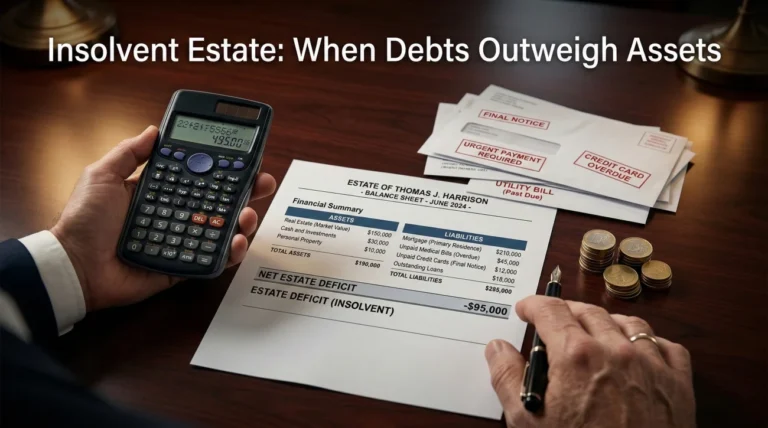

- Estate administration expenses are the necessary “operating costs” required to safely manage, protect, and settle the deceased person’s affairs.
- There is a strict line between maintaining an asset (like fixing a leaking pipe) and improving it (like upgrading a bathroom). Estates pay for maintenance, not improvements.
- A practical expense log needs more than just amounts. It requires a specific purpose note, a clear category, and proof of payment for every single transaction.
- Executors often confuse expense reimbursement (getting your own money back) with executor compensation (taxable income for your time). They must be tracked separately.
- When a beneficiary questions a cost, the fastest way to resolve it is by providing a clean, defensible log entry rather than getting defensive.
The Operating Costs of Settling an Estate
When you step into the role of executor, you quickly realize that closing out a person’s life is not free. There are documents to mail, properties to secure, professionals to consult, and files to organize. All of these necessary actions cost money. In the world of probate and estate settlement, these are known as estate administration expenses.
In my daily support work helping people navigate estate paperwork, I often see executors paralyze their own progress because they are terrified of doing the wrong thing. I recently spoke with someone who was paying for the estate’s certified mail out of their own pocket and hesitating to document it, simply because they were unsure if it was “allowed.” Others delay changing the locks on a vacant house, worrying the family will accuse them of wasting money. They end up frustrated, out of pocket, and resentful.
The goal of this guide is to give you a calm, practical framework. We will walk through exactly what typically counts as an administration cost, how to build a log that stops family disputes before they start, and how to identify the “gray areas” where you need to pause.
Five Common Categories of Estate Administration Expenses
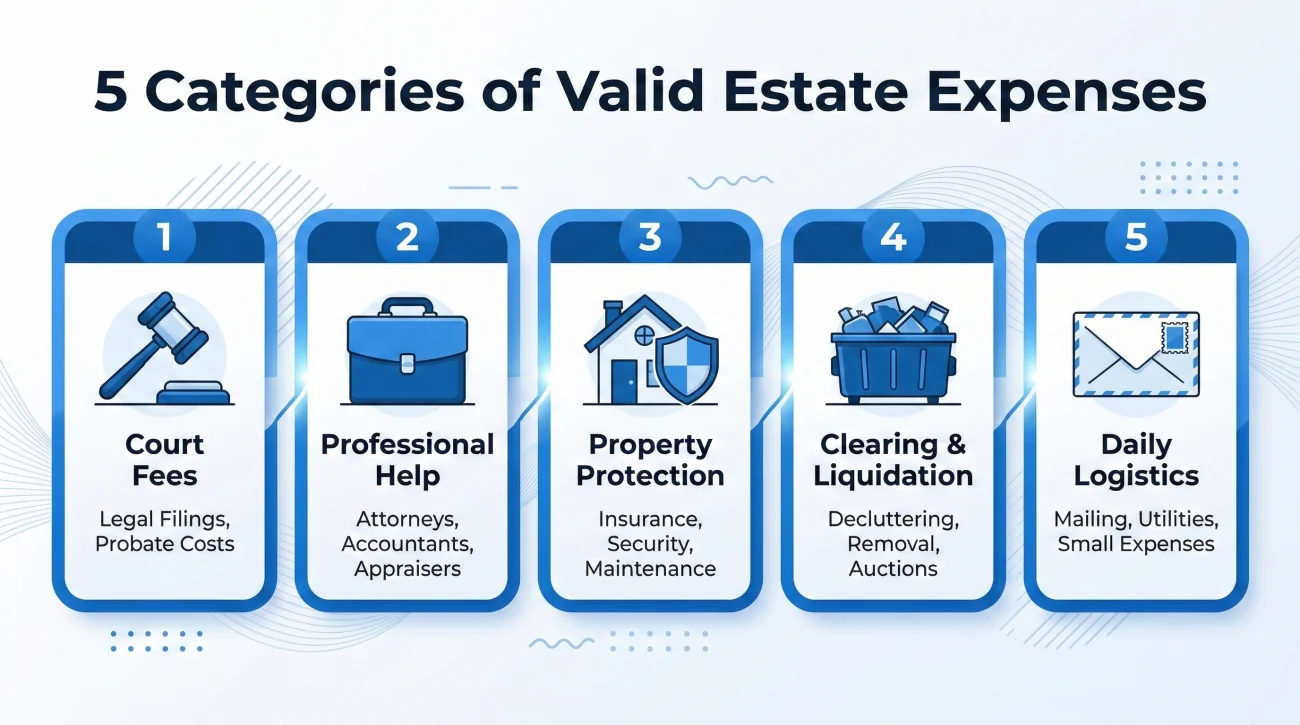
When you are standing in a hardware store holding a receipt, you need a fast way to know if it belongs to the estate or your personal budget. Every valid administration expense generally falls into one of these five operational categories.
1. Court and Filing Fees
You cannot settle an estate without interacting with the local court or county clerk systems. Typical expenses here usually include the initial filing fees to open the estate, the cost of obtaining multiple certified copies of the death certificate, and fees for publishing required public notices.
I often see complications arise when the deceased owned property in multiple states. In these cases, you might face ancillary filing fees in a completely different county. These are unavoidable costs required to keep the legal process moving.
2. Professional Help and Guidance
Executors are not expected to be legal or financial experts. Hiring professionals to handle specialized tasks is a standard, protective part of administration. This commonly includes estate attorneys to guide the legal process, CPAs or tax professionals to handle final tax returns, and certified appraisers to value real estate or unique personal property.
3. Property Protection (Maintenance vs. Improvement)
If the estate includes physical property, such as a vacant house, your immediate job is to protect that asset from losing value. Common costs include changing locks, paying for basic utilities to prevent pipe freezes, maintaining property insurance premiums, and basic lawn care to avoid municipal code violations.
A frequent trap I see involves upgrading the asset. There is a rigid line here. Fixing a leaking pipe under the sink is a valid maintenance expense. Rerouting the plumbing and installing a new vanity to get a better sale price is an improvement. Replacing a shattered window is maintenance. Painting the entire exterior of the house is an improvement. The estate pays to preserve the asset, not to flip it.
4. Valuation, Clearing, and Liquidation
Before an estate can be closed, physical items must be cleared, valued, or liquidated. This phase routinely catches executors off guard. I once worked with an executor who spent three exhausting weekends hauling old furniture and trash to the dump in his personal truck to “save the estate money.” He not only risked physical injury but also accidentally threw away unmarked boxes containing seven years of old tax returns, triggering a frantic search later.
He should have hired a professional cleanout crew and a secure document shredding service. Valid estate expenses in this category include junk removal fees, dumpster rentals, estate sale commissions, and professional shredding. Because cleanout prices vary wildly, your documentation here must be bulletproof: always keep written quotes from two different companies in your file to prove to beneficiaries that you secured a fair market price.
5. Daily Logistics and Communication
You will need supplies specifically dedicated to the administrative work. Reimbursable logistics usually include postage (especially certified mail with return receipts), copying and printing costs, and purchasing dedicated file folders. If you are working with a co-executor in another state, the cost of securely shipping original documents back and forth also falls into this category.
Key Point: Just because a task takes your time does not mean the tools to do it are automatically estate expenses. Buying a new laptop to “manage the estate spreadsheet” is a personal asset purchase. Buying a $20 lockbox to hold the original will is a valid estate expense.
Building a Clean Expense Log (With Template)

Knowing what to pay is only half the battle. In estate administration, an expense only exists if you can prove it with a clean paper trail. I often tell the executors I work with that a receipt is just a piece of paper; what makes it a valid estate record is the context you attach to it.
Tossing thermal receipts into a shoebox is a recipe for disaster. Six months later, the ink will fade, and no one will remember what the hardware store run was actually for. You need a dedicated tracking system from day one.
Here is the format I recommend for a highly defensible expense log. You can build this in a spreadsheet or write it in a physical ledger. Update it weekly.
| Date | Vendor | Amount | Payment Method | Receipt Logged? | Purpose Note (The “Why”) |
|---|---|---|---|---|---|
| Oct 12 | USPS | $24.50 | Executor Personal Card | Yes (Photo saved) | Certified mail to 3 known creditors for balance verification. |
| Oct 15 | County Court | $45.00 | Estate Checking | Yes (File #2) | Ordered 5 official short certificates for bank access. |
| Oct 18 | Smith Locksmith | $185.00 | Executor Cash | Yes (Invoice saved) | Re-keyed front and back doors of vacant Elm St property. |
💡 Pro Tip: Thermal ink fades rapidly. The moment you walk out of a store, place the receipt on your steering wheel, snap a clear photo with your phone, and type the “Purpose Note” into your phone’s notes app. Transfer it to your main log on the weekend.
To see how logging these daily administrative costs fits into the larger picture of settling the deceased’s outstanding accounts, I highly recommend reading our executor creditor and debt checklist. It acts as a safe map for prioritizing all types of payments.
The “Gray Area” Expenses: When to Pause and Ask
Not every expense fits neatly into a clear category. Sometimes, an action feels necessary to you, but might look questionable to a court or a beneficiary. When you hit a gray area, the safest move is to pause, write down why you think the estate needs it, and ask your estate attorney before opening your wallet.
Here is a practical checklist of signals that indicate you are in a gray area:
- 🛑 The Dual Benefit: Does this expense benefit you personally while also helping the estate? (Example: You buy a plane ticket to clear out the house, but you also stay an extra week to visit friends).
- 🛑 The Missing Paper Trail: Is the vendor demanding cash and refusing to provide a formal, itemized invoice with their business name on it?
- 🛑 The High Dollar Threshold: Is the single expense unexpectedly large? (While $50 for lawn care is standard, authorizing a $5,000 tree removal service requires professional validation).
- 🛑 The “Improvement” Risk: Are you changing the condition of an asset rather than just stabilizing it?
Defensible Labeling: How to Describe Costs Without Creating Friction
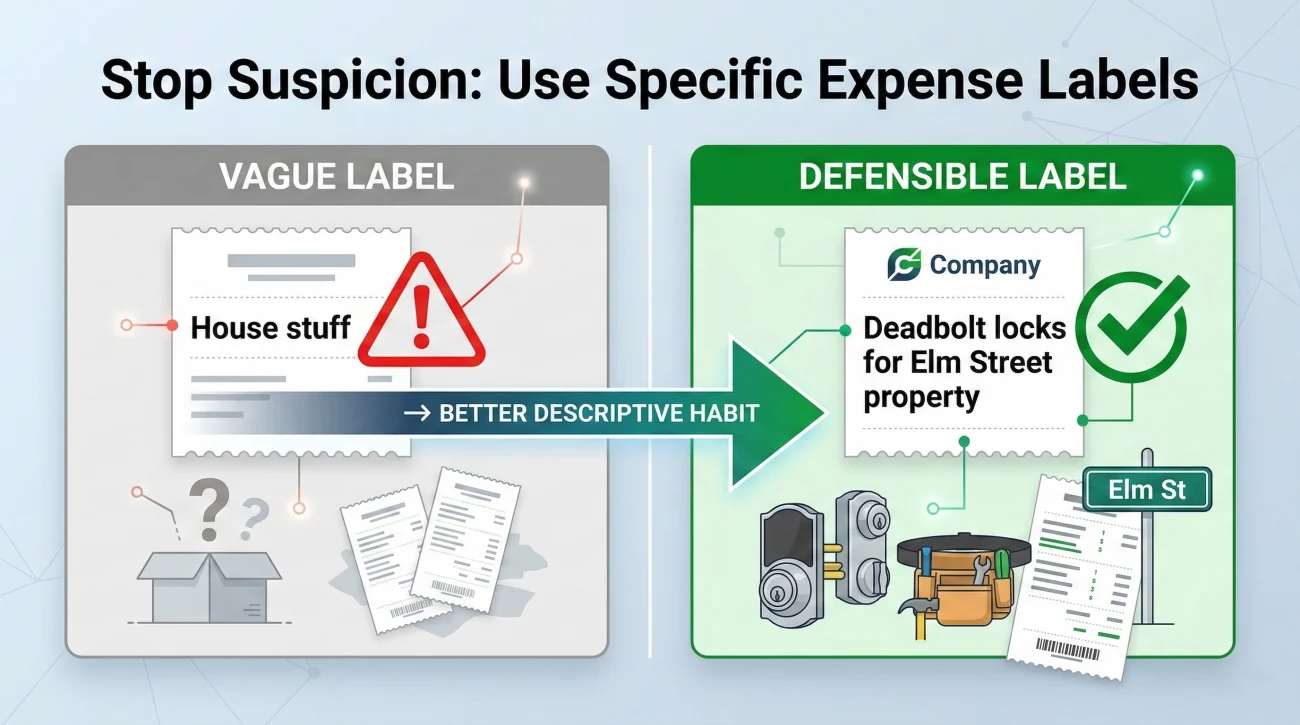
Beneficiaries do not read expense logs with an open mind; they read them looking for mistakes. When someone sees money leaving a pot they are waiting to inherit, vague descriptions instantly trigger suspicion.
If you write “Misc. Supplies” or “House stuff” on a $200 line item, you are practically inviting a family dispute. You must use specific, clinical language that permanently anchors the cost to a legitimate estate need.
Hardware store – $85.00 – House stuff.
Hardware store – $85.00 – Purchased and installed two deadbolt locks to secure the vacant property on Elm Street.
Let’s look at how to translate common loose terms into solid, professional administration log entries.
| Vague Label (Avoid) | Defensible Label (Use This Instead) |
|---|---|
| Cleanout stuff | Supplies: Heavy duty trash bags and boxes for sorting home office files. |
| House cleaning | Cleaning service: Post-estate sale deep clean required prior to property listing. |
| Storage fees | Storage unit: 1 month rental to securely hold estate financial records during house clearing. |
| Travel costs | Mileage: 40 miles round trip to county courthouse to file original will and petition. |
Red Flags That Guarantee Scrutiny
In my experience, disputes over administration expenses rarely start over large, obvious bills like the attorney’s retainer. Instead, trust usually breaks down over small, poorly documented lifestyle choices. Avoid these two massive red flags.
Red Flag 1: Mixed Personal and Estate Receipts
This is a classic, avoidable trap. You are at the big box store picking up cleaning supplies for the estate house. At the last minute, you toss a case of your favorite sparkling water and a magazine into the cart for yourself. You pay for it all in one transaction, figuring you will just subtract your items from the total later.
When a beneficiary looks at that receipt, they do not see your mental math; they see estate funds being used for personal groceries. It shatters the illusion of strict separation.
❌ Note: Never mix personal items and estate items on the same receipt. Always ask the cashier to ring up estate items in a completely separate transaction so the paper trail is 100% clean.
Red Flag 2: The “Cash Handshake”
You hire a local neighborhood crew to haul away a massive pile of debris from the garage. They offer you a discount if you pay in cash. You hand them the money, and they drive away without giving you an invoice or a receipt. As far as the official record is concerned, that estate money simply vanished.
Always demand a written invoice for every service, no matter how informal the arrangement seems. If a vendor refuses, find someone else.
Sample Vendor Request Script:
“Hello. I am managing this cleanout for an estate, which means I have to keep strict accounting records. Before we start, I just need to confirm that you will be able to provide a formal, itemized invoice and a receipt upon payment. Will that be possible?”
Handling Disagreements with Beneficiaries
Even with perfect records, someone might question your spending. In my day-to-day work, I notice that beneficiary questions usually start as mild curiosity. They might send an email asking, “Why did we pay $400 to a landscaping company in November?”
The biggest mistake an executor can make here is taking the question personally and getting defensive. Anger escalates the situation. If you have followed the documentation habits above, you do not need to argue. You simply provide the data.
Respond neutrally by attaching the exact line from your expense log and a photo of the invoice showing the town required the overgrown brush to be cleared to avoid a municipal fine. If a beneficiary continues to argue after you have provided the complete paper trail, do not keep trying to explain yourself. That is the point where you pause and let the estate attorney handle the communication.
Executor Compensation vs. Expense Reimbursement
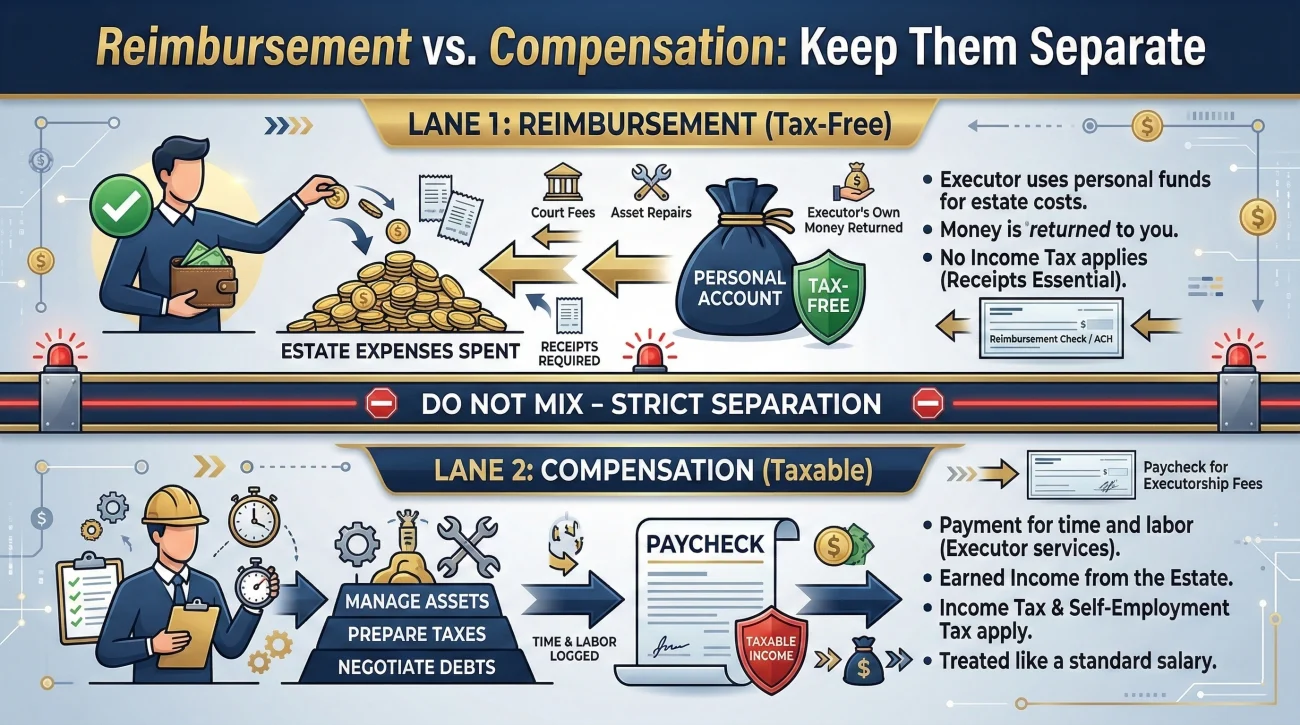
I frequently see executors conflate two entirely different financial concepts: getting reimbursed and getting paid.
Expense Reimbursement: This is simply getting your own money back. If you used your personal credit card to pay the $45 court filing fee because the estate account wasn’t open yet, the estate owes you $45. This is not income. It is just replacing the funds you fronted.
Executor Compensation (Fee): This is money the estate pays you for the time and labor you spent acting as the executor. In most jurisdictions, an executor fee is considered taxable income. You must claim it on your personal taxes.
⚠️ Warning: Never lump your executor fee and your out-of-pocket reimbursements into the same check or the same log entry. They must be tracked, reported, and documented as two completely separate lanes.
Final Thoughts on Estate Expenses
At its core, managing administration expenses is about eliminating ambiguity. You do not need an accounting degree to get this right. You simply need the discipline to treat every receipt as evidence, keep your personal wallet completely separate, and label your logs for a skeptical audience. Do that, and you will close the estate without giving anyone a reason to question your integrity.
❓ FAQ
🗂️ What exactly are estate administration expenses?
They are the necessary operating costs incurred by an executor to manage, protect, and settle the estate. This commonly includes court fees, professional services (like attorneys and accountants), property maintenance, and logistics like postage and document copying.
🚗 Can I claim my driving mileage as an expense?
In many cases, reasonable mileage directly related to estate duties (like driving to the courthouse or the deceased’s bank) is considered a valid expense. You must maintain a strict log detailing the date, destination, miles driven, and the exact estate purpose for every trip.
🍔 Are my meals covered while I clean out the house?
Routine daily meals are usually considered personal living expenses, not estate expenses, even if you are working on the house. Claiming meals often raises red flags with beneficiaries unless there are highly specific, unusual travel circumstances involved.
🧾 What if I lost a receipt for an estate expense?
A missing receipt breaks the paper trail. Often, you can contact the vendor to request a duplicate copy or use a matching bank or credit card statement alongside a written sworn statement of the purchase. However, without an itemized receipt, beneficiaries may challenge the cost.
✈️ Is a flight to the estate considered an administration cost?
If your physical presence is absolutely mandatory to secure assets or sign documents and you live far away, a modest flight may be considered a valid expense. However, out-of-state travel is heavily scrutinized, so always verify with your legal team before booking.
📦 Does the cost of renting a storage unit count?
Yes, typically, if the storage unit is used temporarily to secure the deceased’s physical property, valuables, or important paperwork while the main house is being cleared or sold, it is viewed as a valid property protection expense.
🧹 Can I hire a cleaning service for the property?
Hiring a cleaning service to prepare a property for sale or to make it safe for clearing out is commonly accepted. Just ensure you get a detailed invoice specifying the property address and the nature of the deep clean.
💸 Do I need to pay these costs out of my own pocket first?
Often, executors pay initial costs (like early court fees or postage) out of pocket before they have access to an official estate bank account. Once the estate account is open and funded, executors can typically reimburse themselves, provided they have perfect receipt documentation.
👕 Can I use estate funds to buy a suit for the funeral?
No. Personal clothing, even if purchased specifically to attend the deceased person’s funeral or a court hearing, is considered a personal living expense and is not a valid estate administration cost.
⚖️ Will beneficiaries audit my administration expenses?
Beneficiaries generally have the right to review the estate’s accounting before final distribution. If your expense logs are vague, missing receipts, or appear to mix personal items, they can raise formal questions or challenge the accounting in court.
⚠️ Disclosure: I'm not an attorney and nothing on this site is legal or tax advice. The content covers process, organization, and workflow—the operational side of estate administration. For legal interpretation, jurisdiction-specific deadlines, contested situations, or tax matters, please work with a licensed professional in your state.