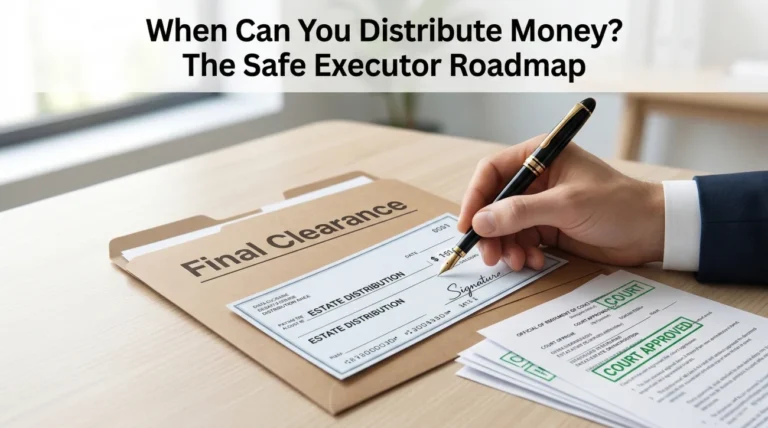
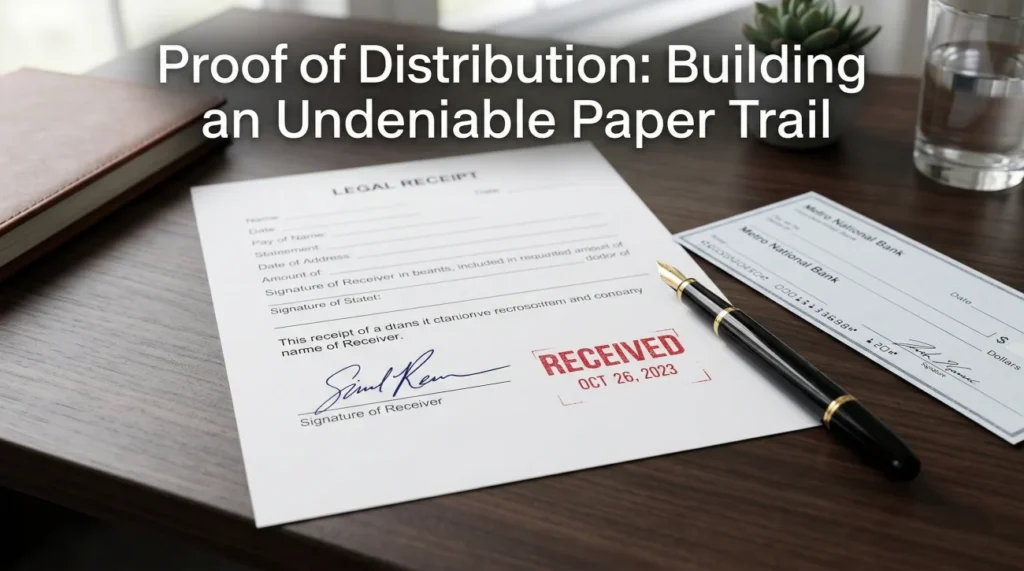
- If a distribution cannot be proven with a clear paper trail, it is highly vulnerable to future disputes or accounting questions.
- A complete proof of distribution executor file usually contains three layers: the bank record, the delivery confirmation, and the signed beneficiary acknowledgement.
- Never rely on cash distributions or vague bank memos. Every payment must map exactly to a line item in your final accounting.
- Keeping organized, cleanly labeled folders for each beneficiary will save you hours of stress when it is time to close the estate.
Why “I Sent It” Is Never Enough in Estate Administration
I often see executors breathe a massive sigh of relief when they finally click “transfer” on a bank portal or drop a certified check in the mail. After months of sorting through paperwork, dealing with creditors, and organizing assets, paying the beneficiaries feels like crossing the absolute finish line. But in my experience tracking executor workflows, the job is not actually done when the money leaves the account. It is only done when you have undeniable, organized proof that the right person received the right amount.
When you are acting as an executor, memory is your enemy. You might perfectly recall handing a specific sentimental item to a sibling, or mailing a check to a nephew. However, six months later, when questions arise or when you need to finalize your reports, relying on memory simply does not work. Beneficiaries forget. Papers get lost in the mail. Bank statements can be notoriously vague. This is why establishing a rigorous proof of distribution executor system is one of the most practical things you can do to protect yourself.
In day-to-day admin work, the fastest wins usually come from setting up a documentation habit early. You want to reach a point where every single item that leaves the estate, whether it is a wire transfer or a box of old photographs, has a matching receipt. If you are currently mapping out how to close the estate safely, you can see exactly where this proof-gathering phase fits into the broader picture by reviewing our complete estate distribution checklist.
Today, I want to walk you through how to build a paper trail that leaves zero room for doubt. We are not talking about complex legal theories here. We are talking about file naming, communication hygiene, and simple habits that keep everyone on the same page and keep the estate moving toward closure.
The Three Core Types of Distribution Proof
When we talk about proof of inheritance payment, we are usually looking to build a layered defense. A single piece of evidence is good, but overlapping evidence is what truly prevents misunderstandings. Let us look at the three types of records you need to be capturing for every major distribution.
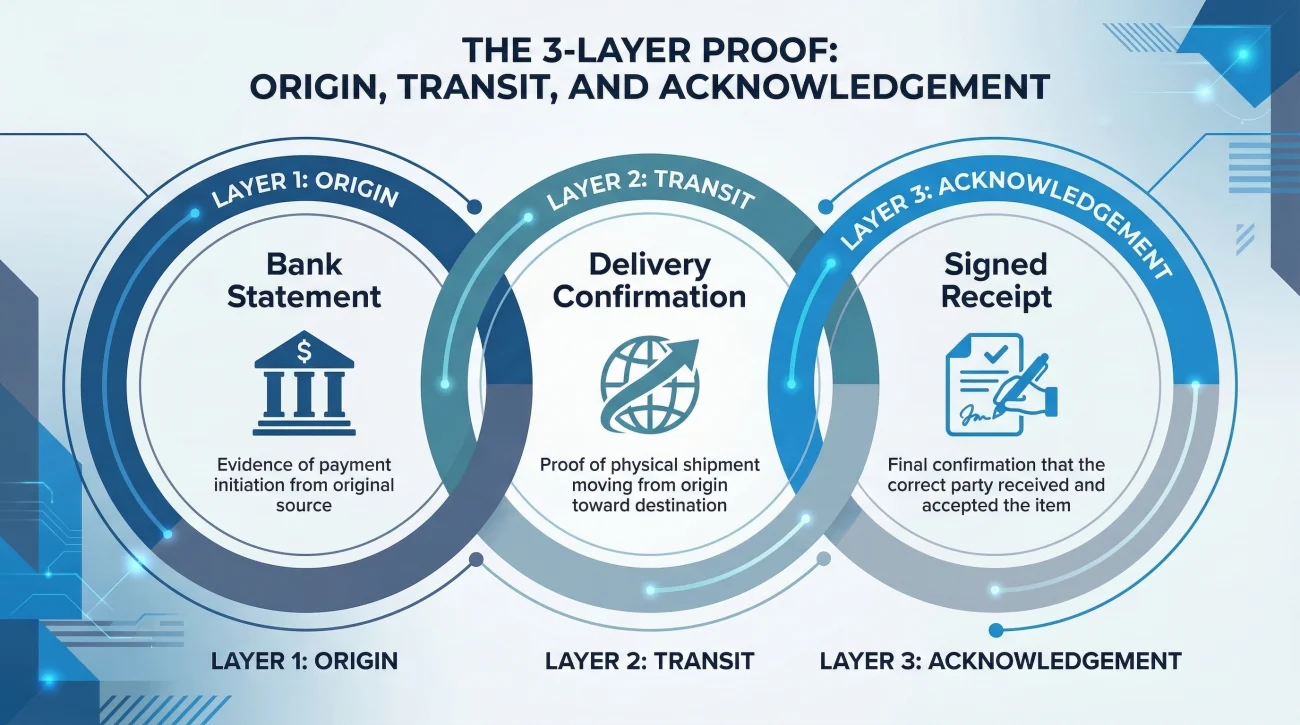
1. The Origin Record (Bank or Financial Statements)
This is where the distribution starts. If you are moving money, the estate bank account statement is your baseline proof. However, a bank statement alone is often insufficient if it just says “Withdrawal” or “Check 104.” You need the origin record to be highly specific. If you are writing a check, the memo line must state exactly what the payment is for. If you are sending a wire, the transfer notes must be meticulously filled out.
A bank memo that simply says “For Mom’s estate” or “First payment.”
A bank memo that says “John Doe – Partial Distribution 1 of 2 – Estate of Jane Doe.”
2. The Transit Record (Delivery Confirmation)
How did the asset get from the estate to the beneficiary? If you mailed a check, you should ideally use certified mail with a tracking number. If you hired a freight company to move a grand piano across the country, you need the bill of lading and the delivery signature from the driver. The transit record proves that the item or the funds actually reached the destination, not just that they left your hands.
3. The Acknowledgement Record (Signed Receipts)
This is the gold standard. A signed document explicitly stating what was received and when is the most powerful tool in your distribution confirmation estate folder. We often refer to these conceptually as distribution receipts. If you are drafting your own basic receipt for the file, make sure it includes these five fields at minimum: the estate name, the beneficiary’s name, the exact amount or item description, the date received, and their signature.
Key Point: A cleared bank check only proves the bank processed the paper. You still need a signed receipt to prove the beneficiary formally accepted that payment as their official distribution share.
How to Label Distributions to Match Your Accounting
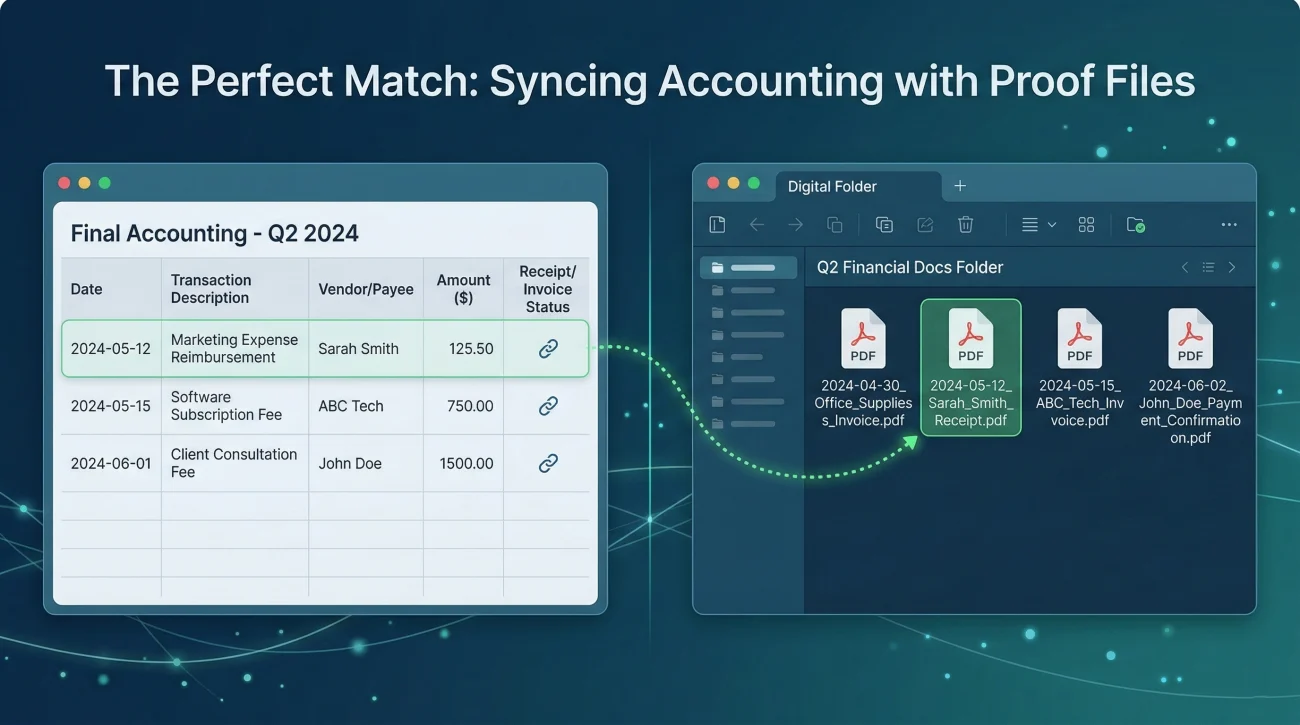
One of the most common places where executors get stuck is at the very end of the process, trying to reconcile a pile of distribution receipts with the final estate accounting. I have seen many people spend days flipping through printed emails and bank statements, trying to figure out if “Check 108” matches “Beneficiary Share A.”
To avoid this headache, your proof of distribution must map exactly to your accounting document. If your accounting has a line item, your physical or digital folder must have a matching piece of proof with the exact same name.
💡 Pro Tip: Create a dedicated folder on your computer for each beneficiary. Inside that folder, name the files starting with the date, followed by the accounting line item name. This creates an automatic, chronological paper trail that is incredibly easy to review.
| Final Accounting Line Item | Matching Proof File Name in Your Folder |
|---|---|
| Distribution: Sarah Smith (Interim) | 2024-05-12_Sarah_Smith_Interim_Cleared_Check.pdf |
| Distribution: David Smith (Final) | 2024-11-04_David_Smith_Final_Wire_Receipt.pdf |
| In-Kind: 2018 Honda Accord (Value $15k) | 2024-03-20_Vehicle_Title_Transfer_Acknowledgement.pdf |
When you keep your records this tight, answering questions becomes trivial. If a beneficiary asks why their final amount looks a certain way, you do not have to guess. You simply open their folder, look at the cleanly labeled documents, and provide the exact dates and amounts.
The Danger Zones: Where Proof Usually Falls Apart
A pristine folder structure works perfectly for standard bank transfers, but the reality of estate distribution is rarely that neat. Impatient family members, unusual assets, and mixed roles can easily wreck your paper trail. Here are the specific scenarios where I see documentation systems break down most often, and how you can navigate them safely.
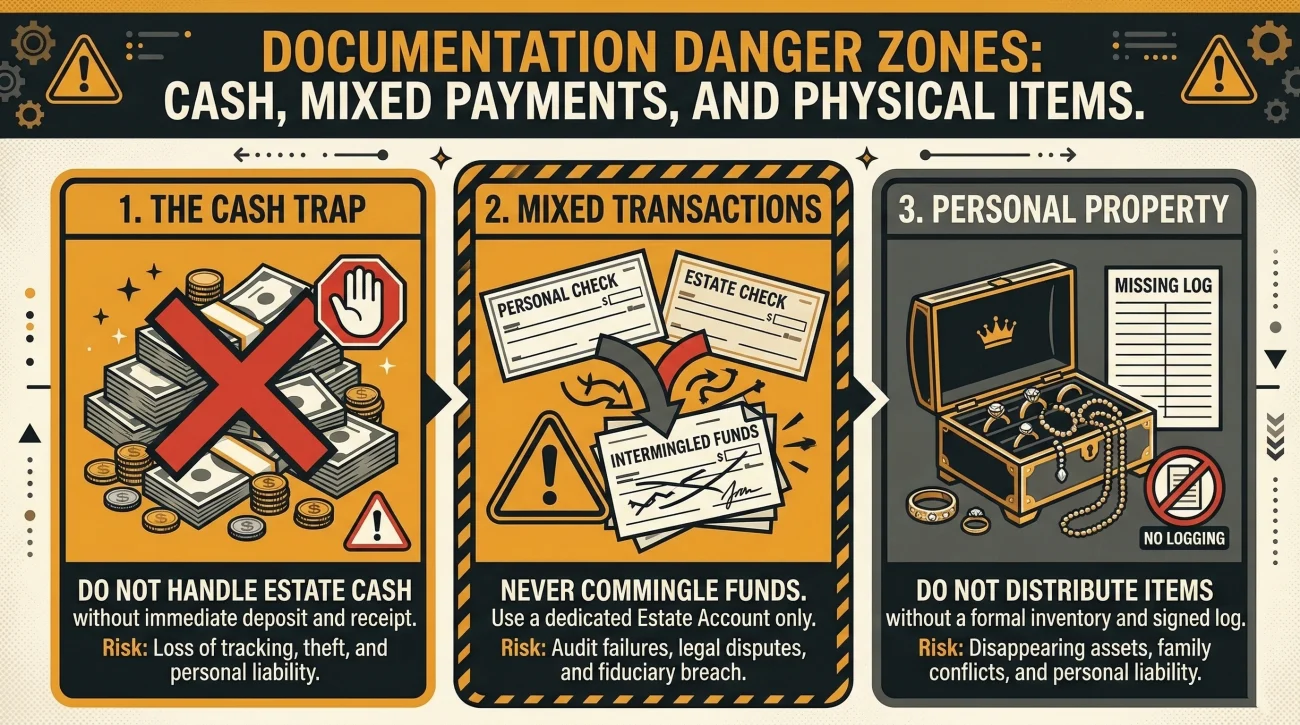
The Cash Trap
Distributing inheritance in physical cash is almost always a bad idea. Cash leaves no native paper trail. If you hand a beneficiary three thousand dollars in cash from a safe you found in the house, and they later deny receiving it, it is simply your word against theirs. This creates an impossible situation for your final accounting.
❌ Note: If you find physical cash in the estate, the standard practice is to deposit it into the official estate bank account, log it in your inventory, and then distribute it via check or wire so the banking system tracks the movement.
Mixed Transactions (When the Executor is a Beneficiary)
It can be very tempting to pay yourself back for out-of-pocket expenses at the exact same time you take your distribution share, lumping it all into one big check. I have personally had to help untangle files where an executor wrote themselves one single check covering both a funeral reimbursement and their inheritance share. It creates an accounting nightmare.
Always keep the lanes separate. Write one check for the exact expense reimbursement (and attach the hardware store receipts). Write a completely separate check for the distribution share (and attach the distribution receipt). Clarity is always better than convenience.
Personal Property and Sentimental Items
Executors are often great at tracking money but terrible at tracking physical items. If the will states that your sister gets the antique dining set, you cannot just let her load it into a truck and drive away without a paper trail. Tangible items hold value, and their distribution must be proven just like a bank wire.
Before any furniture, jewelry, or artwork leaves the property, have a simple written log ready. A basic document listing the item description, the date taken, and a signature line prevents “Where did the silver go?” arguments later. I strongly recommend taking a quick photo of the beneficiary holding the item or loading it into their car, and dropping that photo directly into their digital folder alongside the signed log.
Communication Hygiene: How to Ask for Proof Without Causing Friction
Nobody likes signing legal-looking documents, especially when tensions are already high. While getting a receipt should be a simple administrative step, beneficiaries often drag their feet or view the request with suspicion. The tone you use when requesting these confirmations matters immensely. You want to sound organized, neutral, and process-focused.
I find that framing the request as a routine administrative step for the estate’s files works best. Here is a formula I commonly see used effectively in daily admin work, mapped out in a real email template:
[The Context] + [The Action Required] + [The Benefit to the Process]
Script: Sending a Distribution and Requesting a Receipt
If you are mailing a check or initiating a wire, you want to send a communication simultaneously so they know what to look out for and what you need back.
Subject: Estate of [Name] – Distribution Transfer and Receipt Confirmation
Hello [Name],
[The Context]
I wanted to let you know that a [check/wire] for your [interim/final] distribution in the amount of [Amount] has been initiated today. Please let me know as soon as you see this clear your account.
[The Action Required]
For the estate’s mandatory closing records, I need to keep a signed receipt for every distribution on file. I have attached a simple receipt document to this email. Once you have received the funds, could you please sign the attached document and return it to me? You can just scan it or take a clear photo of the signed page and email it back.
[The Benefit]
Getting this filed helps us stay on track to wrap everything up smoothly without delays.
Thank you for your help,
[Your Name]
Executor
⚠️ Warning: If a beneficiary ignores your request for a receipt, do not escalate to anger. Wait a week, send a polite follow-up, and ensure you have saved the bank’s cleared check image and the certified mail delivery slip to your files. In many cases, the bank proof plus proof of your repeated requests will have to serve as your documentation if they simply refuse to sign.
A Working Example of a Perfect Proof Loop
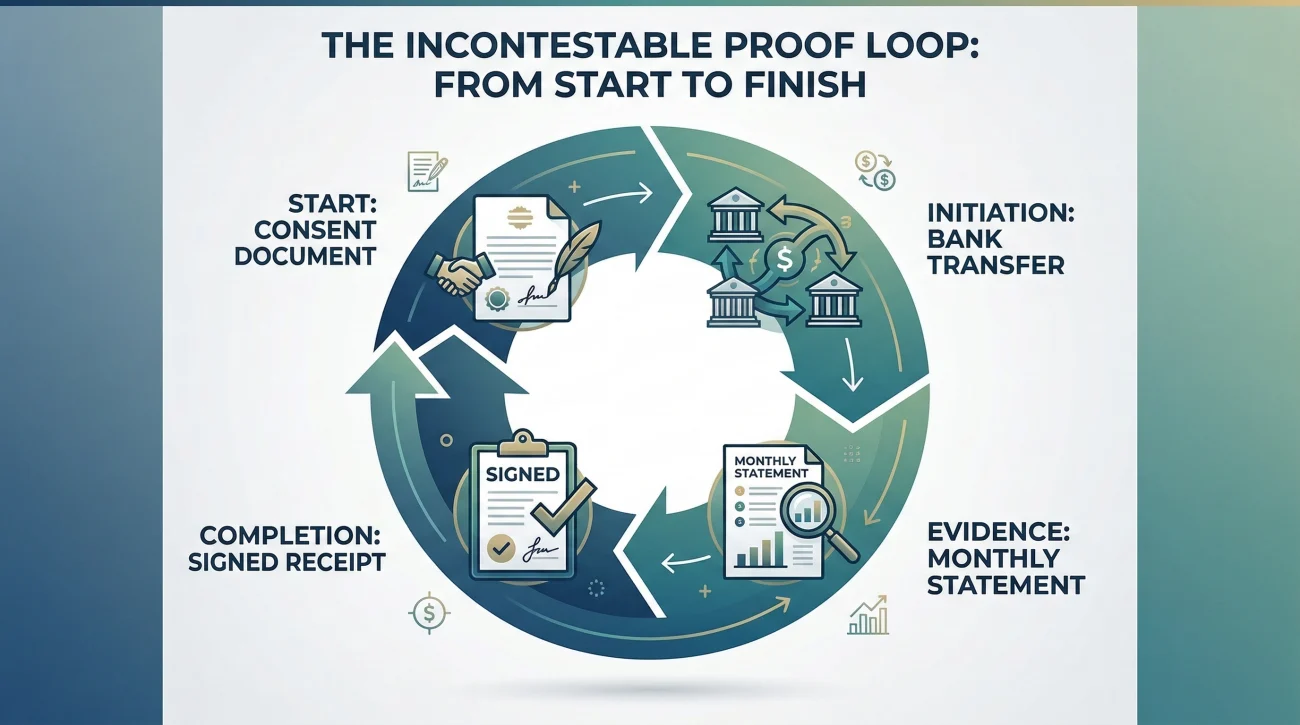
Theory is helpful, but seeing a complete paper trail in action makes the abstract rules concrete. Let us look at what an incontestable proof loop actually looks like for a single payment. Imagine you are reviewing the estate’s final accounting before distributing the closing packets to the family. You are looking at a single line item for your brother, Michael.
The Accounting Line:
October 12, 2024 – Distribution – Michael Thomas – $10,000.00
If anyone ever questions this payment, here is the exact trail you pull from your files to prove it happened correctly:
- 📄 Item 1: The Consent/Readiness Document. A file dated October 1st where Michael replied “Looks good to me” to the proposed distribution math.
- 📄 Item 2: The Bank Initiation. A PDF save of the online banking screen showing the wire transfer of $10,000 to Michael’s verified account ending in 1234, dated October 12th.
- 📄 Item 3: The Bank Confirmation. The monthly estate bank statement from October showing the $10,000 deduction clearly labeled as a transfer to Michael.
- ✅ Item 4: The Acknowledgement. The signed receipt from Michael, dated October 14th, acknowledging receipt of the $10,000 as his partial distribution.
When you build this kind of file structure for every single movement of assets, the paper trail answers any future questions immediately. You are no longer guessing or hoping.
The Final Proof Mini-Checklist
Instead of just hoping you have enough documentation, I recommend running every major distribution through a quick verification filter before you consider that specific payment “done.” Before moving on to the next task, confirm these four steps:
- ✅ 1. Did the money or asset leave the estate with a clear, specific memo or log?
- ✅ 2. Do I have the physical transit tracking number or digital wire confirmation saved?
- ✅ 3. Is the signed receipt scanned, named correctly, and placed in the beneficiary’s folder?
- ✅ 4. Does the total amount match the final accounting line perfectly?
If you can check all four boxes, you have done your job properly. You can proceed with closing the estate knowing that if a question is ever asked, your files hold the undeniable answer.
❓ FAQ
🕵️♂️ How do I prove I paid a beneficiary?
The standard way to prove payment is to maintain a three-part file: a specific bank statement showing the cleared funds, a delivery tracking receipt (like certified mail), and a signed acknowledgement form from the beneficiary confirming they received their share.
🏦 Is a cleared bank check enough proof of distribution?
While a cleared check proves the bank transferred the money, it is often not enough on its own. You typically want a signed receipt as well, because the receipt confirms the beneficiary accepts those funds as their inheritance, rather than a loan repayment or a gift.
✍️ What if a beneficiary refuses to sign a receipt?
If someone ghosted you or refuses to sign, keep the proof of the cleared bank transaction, keep the delivery confirmation, and save logs of your polite emails requesting the signature. A strong paper trail of the payment and your attempts to get the receipt is your best fallback.
💵 Can an executor distribute inheritance in cash?
Avoid it whenever possible. Cash lacks a verifiable transit trail, making it extremely difficult to prove delivery to a court or other heirs later. Using checks or bank transfers ensures an automatic, neutral record exists.
📦 How do you prove you gave someone physical property?
You use a physical item log. Create a simple document listing the item (e.g., “oak dining table”), the date of pickup, and have the beneficiary sign and date the document before they load the item into their vehicle.
⏳ How long should an executor keep distribution receipts?
As a general principle, executors keep the complete closing packet, including all final accounting documents, bank statements, and distribution receipts, safely filed away for years after the estate closes to protect against any late-arriving questions or audits.
📱 Does a Venmo or Zelle receipt count for an estate?
Peer-to-peer payment apps are often problematic for estates because the memos can be vague and they lack the formal tracking of a wire or bank check. It is typically much safer to use traditional bank transfers to ensure the paper trail is robust and easily readable.
🧾 Do I need proof for partial distributions too?
Yes. Every time money or property leaves the estate, whether it is an interim partial payment or the final closing check, you must gather and save the exact same level of proof to ensure the final accounting balances perfectly.
🤝 What if siblings divide things themselves without me?
Even if beneficiaries amicably divide household items among themselves, the executor is still responsible for the record. You should have them draft a simple agreement stating who took what, sign it together, and give you a copy for the official estate file.
📑 How do I match my bank statements to the final accounting?
Use exact naming conventions. Ensure every check you write or wire you send has a specific memo (like “Jane Doe Final Share”). When you save the digital PDF of that statement, name the file to identically match the line item on your accounting spreadsheet.
⚠️ Disclosure: I'm not an attorney and nothing on this site is legal or tax advice. The content covers process, organization, and workflow—the operational side of estate administration. For legal interpretation, jurisdiction-specific deadlines, contested situations, or tax matters, please work with a licensed professional in your state.