
- Success in distributing personal property relies on shifting family focus from subjective memories to an objective, documented process.
- Using established selection pathways prevents the executor from becoming the target of bias accusations.
- Remote beneficiaries and third-party claims require specific communication guardrails to keep the timeline on track.
- Securing written confirmations for every distributed item is the only reliable way to safely close this phase of the estate.
Where Memories Collide With Estate Paperwork
In my experience supporting estate administration workflows, dividing bank accounts is usually just a math problem. Distributing personal property as executor, however, is where the paperwork collides with deep emotional history. A dining room table is rarely just a piece of wood; to a beneficiary, it represents decades of holiday dinners and family memories.
Because the emotional stakes are so high, this is the exact phase where communication tends to break down. Executors often feel pressured to just “let people take what they want” to get it over with. But moving too fast without a documented process is a common trap. When items disappear from the house without a written record, it almost always leads to accusations of unfairness weeks or months later.
I always tell the people I work with: your job here is not to play referee or judge family history. Your role is to establish a calm, predictable process, document the decisions the family makes, and keep the estate moving forward. In this guide, I will share the operational steps I see work best for dividing household items after death, keeping the drama low and the paper trail strong.
The Classic Bottleneck: Three Siblings, One Watch
To understand why process matters, look at the most common scenario executors face: multiple beneficiaries requesting the exact same sentimental item. Let us say there is a vintage grandfather clock in the hallway, and three different siblings have emailed you claiming they were promised it years ago.
When an executor tries to solve this by deciding who “deserves” it the most, they immediately step out of their administrative role and become a target for anger. If you hand the clock to sibling A based on a verbal conversation you remember, siblings B and C will likely challenge your impartiality for the remainder of the estate process.
This is why having a standardized approach to executor distribute personal items is vital. Instead of making a unilateral choice, an experienced operator relies on a neutral system. You present the options for how the group can decide, you give them a deadline to reach a consensus, and you document whatever they choose. If they cannot choose, you rely on the fallback methods outlined in your core estate documents or local guidelines. In cases where I see families use neutral systems like rotation selection, disputes over those specific items almost never resurface.
To avoid this trap, you have to move the family out of the realm of subjective memory and into reality. That shift begins before anyone is allowed to claim a single item.
Step One: Building a Visual Item List
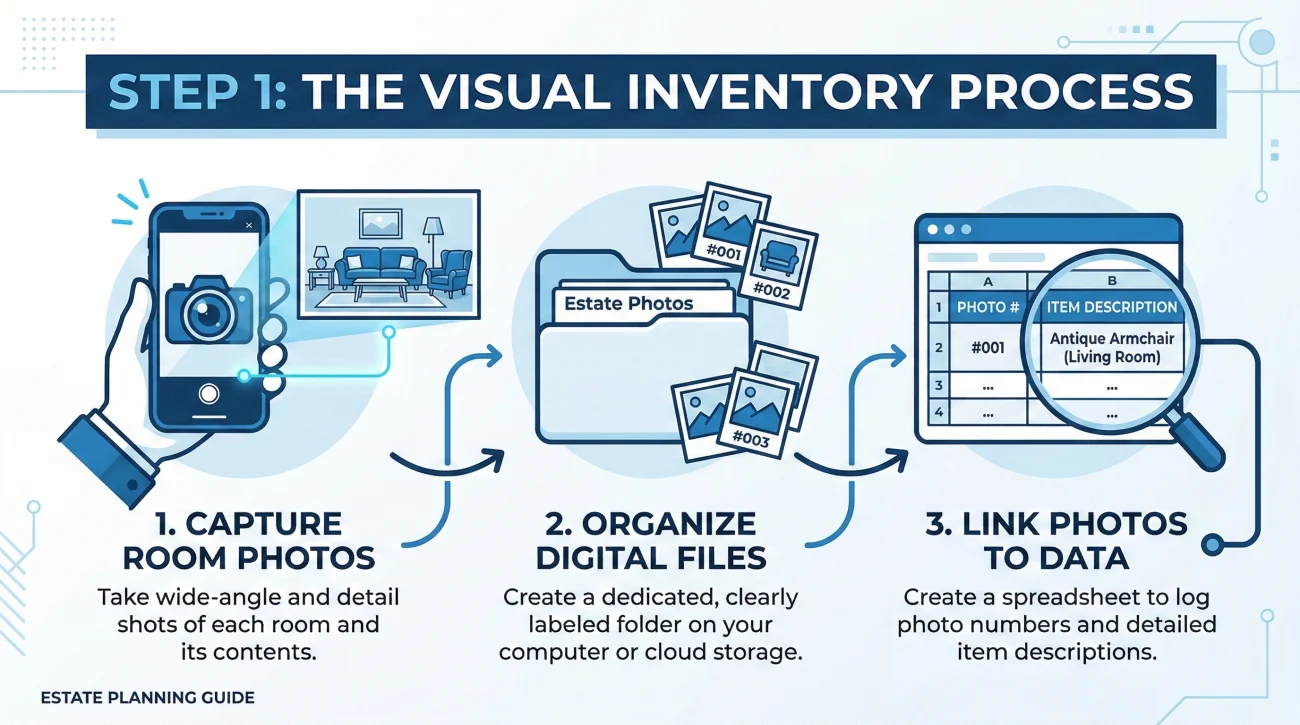
Before any beneficiary dispute over personal property can even begin, you need to know exactly what is actually in the house. The biggest mistake I see early on is an executor walking through a property with a notepad, writing down vague descriptions like “box of old plates” or “living room furniture.”
When you send a vague text list to beneficiaries, they fill in the blanks with their own memories. One person reads “old plates” and assumes it means the everyday dishes; another assumes it means the rare antique china.
The operational solution is a photo-based inventory. You do not need professional software. A simple digital folder or a shared spreadsheet with image links works perfectly. Walk through every room and take clear photos. You also do not need to photograph every single spoon or old paperback book. I typically advise executors to group common household goods together in “lots” for efficiency (e.g., photographing an entire bookshelf and labeling it “Lot 14: Assorted paperback novels”). Number the photos, and tie those numbers to your master list.
Field Note: In my daily workflow, I consistently see that when families look at current, unedited photos of an item, the intense desire to fight over it often evaporates. Photos ground everyone in reality, showing the actual condition of the items today, not the idealized version remembered from twenty years ago.
Once the visual inventory is complete and ready to share, the clock should start ticking. This leads directly into managing everyone’s expectations.
Setting Timeline Expectations
One of the most common questions I get from stressed executors is, “How long should this phase take?” Without a timeline, the distribution of household goods can drag on for a year, with beneficiaries endlessly debating over small items while the house sits empty, racking up property taxes and utility bills.
I always tell the people I work with to set firm, written deadlines. For example, give yourself 30 days to build the visual inventory. Give the beneficiaries 14 days to review the photos and make their selections. If an agreement cannot be reached within that window, default to your documented disposition pathways. Setting a schedule prevents the estate from being held hostage by indecision.
Documented Pathways for Personal Effects Distribution
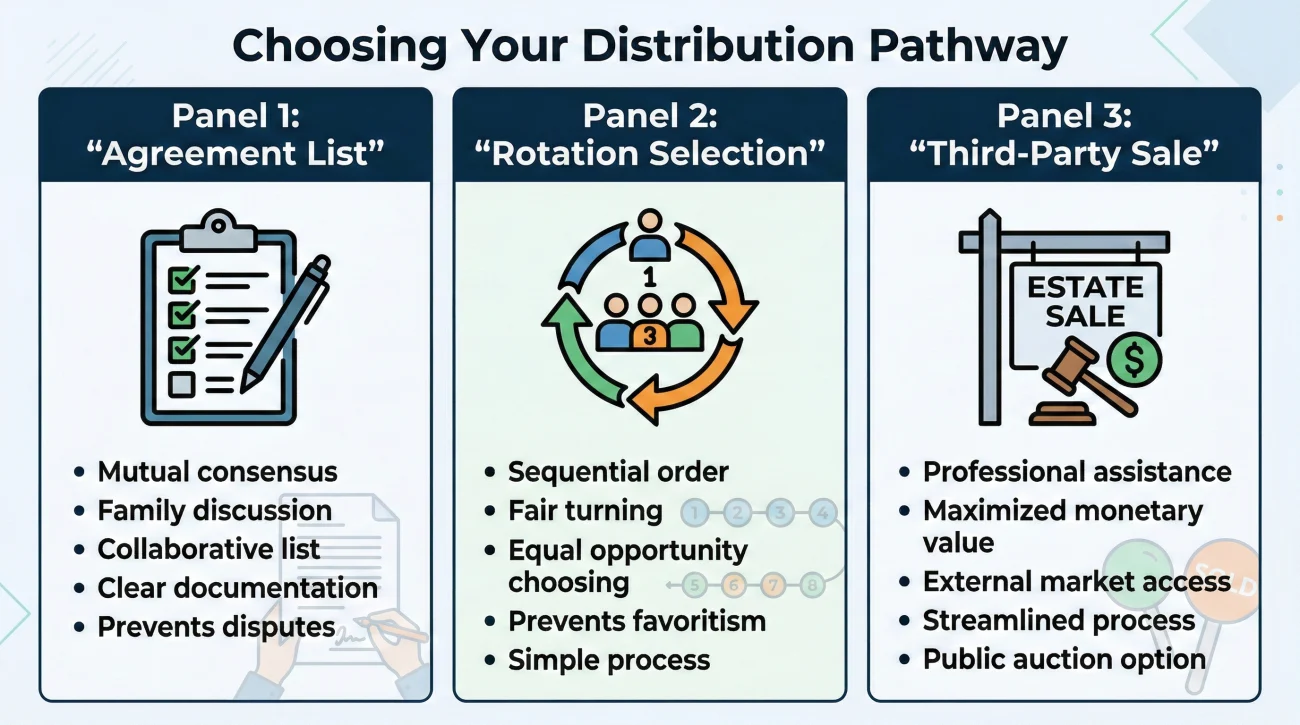
Once the visual inventory is shared, the next step is assigning the items. Because every family dynamic is different, there is no single right way to do this. However, there are three common disposition pathways that experienced executors use to keep things fair and documented.
Pathway 1: The Agreement List
If the family is generally cooperative, the easiest method is a shared agreement list. You circulate the visual inventory and ask everyone to claim the items they want by a specific date. For the items where there is no overlap, you simply document the agreement and move those items into that person’s column. For items where multiple people express interest, you isolate those specific items for further discussion, rather than halting the entire distribution process.
Pathway 2: Rotation-Style Selection
When multiple beneficiaries want the same high-value or highly sentimental items, a rotation-style selection (sometimes called a round-robin) is often the cleanest approach. You draw straws or use a random number generator to pick an order (e.g., Person C, then Person A, then Person B). Person C picks one item from the disputed list. Then Person A picks one. Then the order reverses or repeats until all items are claimed.
Hello everyone,
Thank you for reviewing the inventory photos. We have a few items that multiple people have requested (the mantel clock, the cedar chest, and the patio set).
To keep this fair and transparent, I propose we use a rotation selection process for these specific items this coming Saturday. We will randomly draw an order, and take turns selecting one item at a time.
Please let me know by Thursday if you agree to use this method so we can keep the estate moving forward.
Best regards,
[Your Name]
Do not proceed with the selection until you have written confirmation from all parties agreeing to this exact process.
Pathway 3: Third-Party Facilitated Disposition
Sometimes, communication has broken down completely, and any suggestion you make will be viewed with suspicion. In these cases, executors commonly step back and utilize a third party, such as hiring an estate liquidator to manage an estate sale. When I suggest this route to my clients, I remind them to frame it as a necessary administrative step to close the estate, not as a punishment for the family’s inability to agree.
This pathway completely removes the executor from the crossfire of family politics and ensures a clear monetary value is assigned to the estate. Beneficiaries are still welcome to buy the items at fair market value just like the general public.
Hello everyone,
Since we have not been able to reach a consensus on the remaining household items, my administrative duty requires me to move the estate forward and assign a clear value to these assets.
I have contracted [Liquidator Name] to manage an estate sale on [Date]. The proceeds will be deposited into the estate account and divided equally among everyone as part of the final distribution. You are, of course, welcome to attend the sale and purchase any items at fair market value.
Best regards,
[Your Name]
Handling Out-of-State Beneficiaries
In modern estates, it is rare for all siblings to live in the same town. When dealing with remote beneficiaries, the physical distribution of items becomes a logistical hurdle. I frequently see executors burn out because they take on the role of a free packing and shipping service.
To handle this, utilize video calls to do live inventory walkthroughs so remote family members feel included. Once items are selected, establish a clear rule: the cost of packing and shipping personal items is paid directly by the beneficiary receiving the item, or it is deducted from their specific share of the estate. It is rarely fair to charge the general estate for shipping a heavy piece of furniture to just one person. Always get shipping costs approved in writing before dropping anything off at the post office.
What to Document to Prove Fairness Later
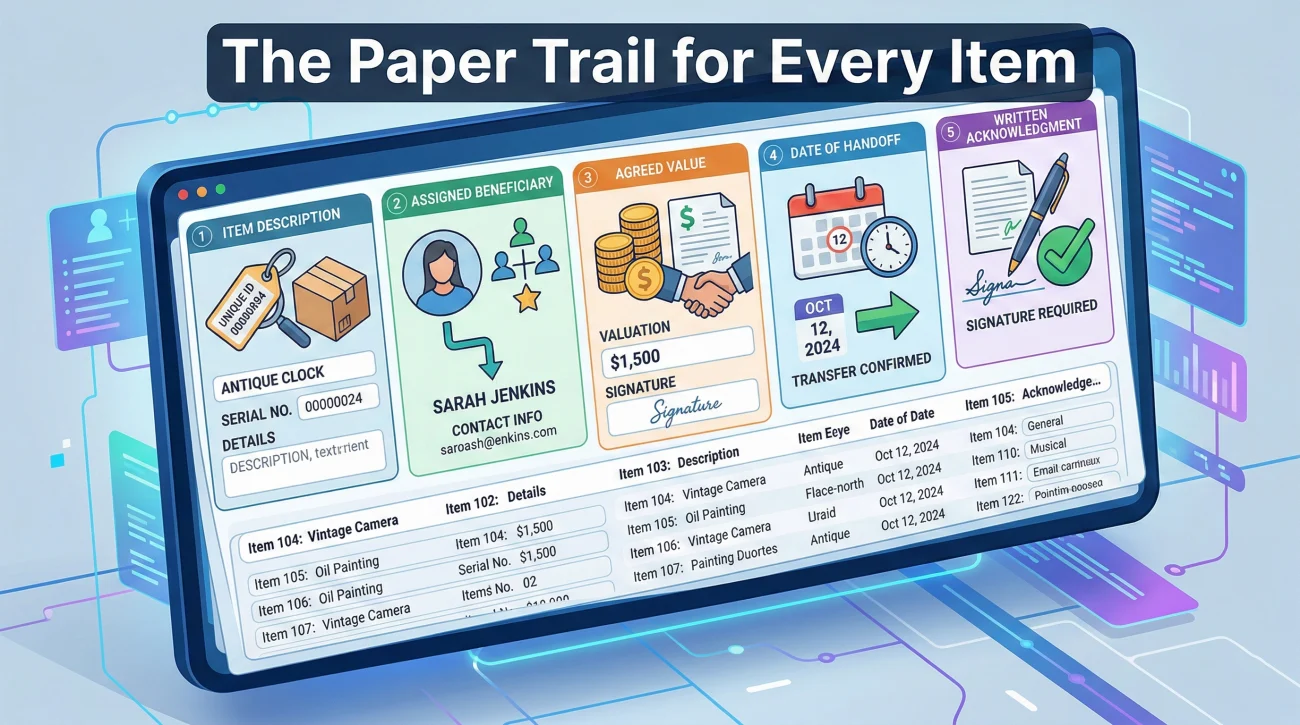
As you navigate personal effects distribution, your primary administrative duty is to build a record that can withstand scrutiny. Six months from now, if a beneficiary claims they never received their share of the household goods, you need a paper trail to prove otherwise.
To learn more about how these records fit into the big picture of closing an estate, you should review our comprehensive estate distribution checklist. For personal property specifically, here are the fields you must track for every significant item:
| Data Point | Why It Matters for the Record |
|---|---|
| Item ID & Description | Ties directly back to your original visual inventory (e.g., “Item 14, blue chair”). |
| Assigned Beneficiary | Clearly states who the group agreed would take the item. |
| Agreed Value Note | If the item has monetary value that counts against their total inheritance share, this must be noted and agreed upon before they take it. |
| Date of Handoff | The exact date the item left the estate’s control. |
| Written Acknowledgment | A signature or confirmed email from the beneficiary stating: “I have received Item 14.” |
You do not need a complex legal form for everyday household goods. A printed spreadsheet with a column for signatures, or a clear email chain confirming receipt, is often perfectly sufficient. The goal is simply to close the loop.
The Trap of Jointly Owned Property and Unclear Ownership
A unique friction point I often have to walk executors through is the blurred line of jointly owned property. If the deceased shared a home with a surviving spouse or a long-term partner, the beneficiaries from a previous marriage might demand items that the surviving partner considers their own everyday furniture. It is critical to carefully review estate documents to determine what constitutes “estate property” versus “survivor’s property” before putting items on your inventory list.
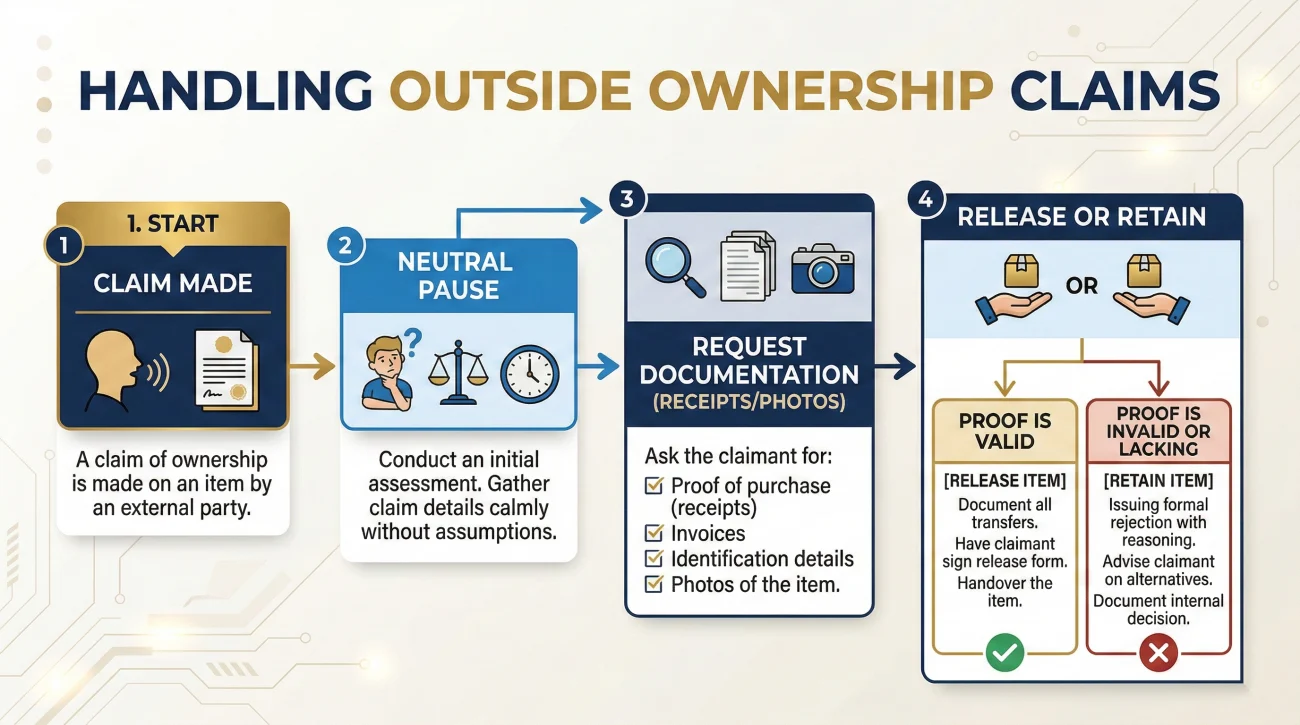
This ambiguity does not just happen with spouses; it frequently extends to neighbors and friends. You might be sorting through the garage when a neighbor steps in and says, “Actually, that lawnmower is mine, I just loaned it to him last year.”
If you give the item away and it belonged to the estate, the beneficiaries will hold you accountable. If you keep it and it genuinely belonged to the neighbor, you are holding someone else’s property. The standard operational response here is neutral pausing. Do not argue, and do not immediately hand the item over. Secure the item and ask for documentation.
I usually suggest a script like this: “I completely understand, and I want to make sure this gets back to the rightful owner. Because I am legally bound to account for everything on the property, could you please send me a quick email with any receipt, photo, or old text message showing the item is yours? Once I have that for my file, I can release it.”
Final Thoughts on Keeping the Peace
You will likely spend more time answering emails about old coffee mugs and holiday decorations than you will dealing with complex tax filings. I see this happen in almost every estate I consult on. Those coffee mugs represent a tangible connection to the person who passed away, while a tax return is just numbers on a page.
Your job is to validate their feelings, but do not let those feelings derail your operational process. By implementing a highly visible, step-by-step framework, starting with a photographic inventory and moving through documented selection pathways, you remove the secrecy. When everyone can see exactly what is available and understands the rules for claiming items, the temperature in the room drops significantly. Enforce your deadlines, stick to the visual inventory, and collect your receipts one item at a time.
❓ FAQ
🛑 How do I stop beneficiaries from taking items before the inventory is done?
You must secure the property immediately. Change the locks on the house if necessary, and send a polite but firm email stating that for legal accounting purposes, absolutely no items can be removed until the formal inventory is completed and shared with everyone.
🔫 How do I handle firearms or restricted items found in the house?
Do not distribute firearms or restricted items (like certain chemicals) using normal pathways. Firearms often require background checks, specific state transfer paperwork, or processing through a licensed dealer. Secure them immediately and consult your local estate professional.
🛋️ What happens if nobody wants the old household furniture?
If all beneficiaries decline the items in writing, the executor typically has the authority to sell the items (through an estate sale or buyout company) and add the cash to the estate account, or donate them and keep the donation receipt for the final accounting.
⚖️ How do we divide things fairly if the will just says “share equally”?
Equal share usually refers to the total financial value. Families often use a rotation selection for sentimental items, and then adjust the final cash distributions to ensure the overall monetary value received by each person balances out to equal shares.
🔄 Can beneficiaries swap items after the agreement is signed?
Once you distribute items and collect receipts, what beneficiaries do with their property is up to them. If they want to trade items privately after the fact, they can. However, as the executor, your official paperwork should reflect the original documented agreement and handoff.
📝 What if a beneficiary refuses to sign the receipt when taking an item?
Never allow an item to leave the property without a signature. If they refuse to sign a physical receipt, do not hand over the item. Alternatively, you can have them send an email stating “I have taken possession of [Item]” from their phone before they put it in their car.
😠 How do I handle someone who secretly took an item without asking?
You document it immediately. Send a written message confirming that you note they have taken possession of [Item X], and that its estimated value will be accounted for against their final share of the estate. If it is a high-value item, you should consult an estate professional on how to proceed.
☁️ Do digital photos and online accounts count as personal property?
Yes, digital assets are increasingly treated as personal property. However, accessing them often requires specific legal authorization (like letters testamentary) sent directly to the tech companies. You should not use the deceased person’s passwords to log in and distribute digital files yourself.
💰 Do personal items count against a beneficiary’s inheritance?
Yes, if the items have monetary value. Taking a $5,000 car or a valuable antique is an advance on their inheritance. This is why getting a written value note and a signed receipt is critical; it allows you to adjust the final cash distribution so the overall math remains fair.
🗑️ Can I just throw away the junk without asking?
It is best to clearly define “junk.” Used cleaning supplies or expired pantry food can usually be discarded safely. However, old papers, photos, or worn-out items might hold sentimental value. It is always safer to offer beneficiaries a final walkthrough or review of remaining items before ordering a dumpster.
⚠️ Disclosure: I'm not an attorney and nothing on this site is legal or tax advice. The content covers process, organization, and workflow—the operational side of estate administration. For legal interpretation, jurisdiction-specific deadlines, contested situations, or tax matters, please work with a licensed professional in your state.