- The core objective: You must create a permanent paper trail connecting the final estate accounting to the physical transfer of assets, protecting yourself from future claims.
- Two distinct functions: A receipt proves exactly what was delivered, while a release acts as a formal agreement that the beneficiary accepts the math and waives the right to dispute your administrative actions later.
- Court involvement matters: How you handle these documents changes significantly depending on whether you are operating under supervised or unsupervised administration.
- Handling pushback: Beneficiaries often hesitate at the legal phrasing. Having calm, clear scripts ready to explain the paperwork is just as important as the forms themselves.
The Finish Line Vulnerability
If you are nearing the end of your executor journey, you are likely exhausted. The house is handled, the debts are sorted, and the bank accounts are finally consolidated. You just want to write the final checks, hand over the family heirlooms, and be done with the responsibility. In my time helping executors organize their administrative workflows, this exact moment is where I see the most critical, unforced errors happen.
I frequently talk to executors who sent inheritance checks to family members, assuming everyone was on the same page, only to face demands for more information months later. Because they did not collect formal documentation when the money changed hands, they had no easy way to prove that the distribution was final and accepted.
This is exactly why the concepts of receipts and releases probate administration are so vital. As an executor, your liability does not magically evaporate just because you mailed a check. Think of closing an estate like returning a rental car. You do not just toss the keys on the counter and walk away. You wait for the attendant to walk around the car, check the gas gauge, and hand you a printed receipt showing a zero balance. That piece of paper is your proof that the transaction is finished and the company cannot charge you for a scratched bumper three months later.
We are going to walk through what these documents practically do, how the process shifts based on your court structure, and how to build a clean record. Keep in mind, this is an organizational map, not legal advice. The exact formatting of these documents can vary heavily by jurisdiction, but the administrative goal is universal: prove the delivery, and close the loop.
The Fiduciary Duty to Document
When you handle an estate, you are operating under a strict legal standard. According to the basic principles of a fiduciary, you are managing someone else’s money and are accountable for every penny. When it comes time to hand that money over, you need airtight proof that the transaction occurred perfectly.
Without this documentation, you leave a massive gap in your records. I have seen situations where an executor distributed cash based on a verbal agreement at a family dinner, only for the beneficiary to later claim they were shortchanged by several thousand dollars. Without a signed acknowledgement, the executor was forced to scramble through old bank statements and personal emails trying to piece together a defense.
This documentation step is a core part of the broader estate distribution checklist. You organize the assets, you summarize the math, and then you secure the signatures that prove the job was done correctly.
Supervised vs. Unsupervised Administration
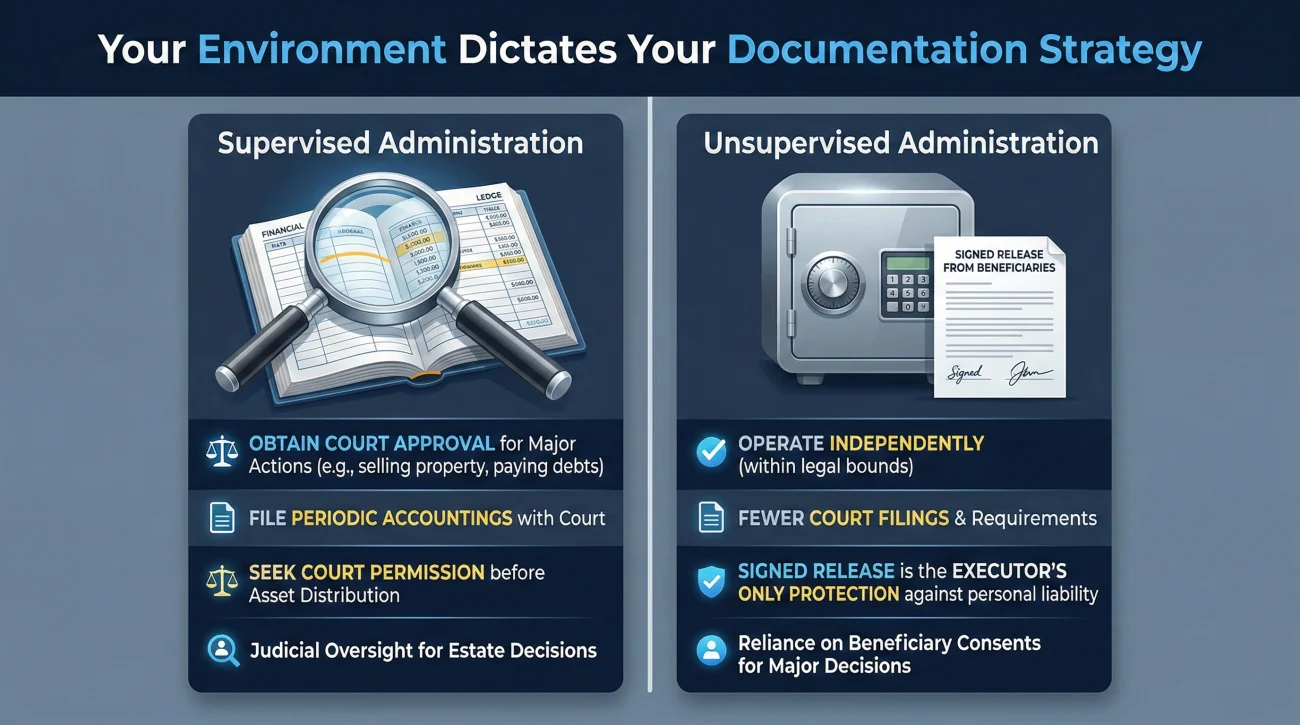
Before you draft any paperwork, you have to understand the environment you are operating in. One of the most common points of confusion I see is executors copying advice from the internet without realizing their specific court process dictates how receipts and releases are handled.
Your documentation strategy will heavily depend on whether the court is actively watching your every move or letting you handle things independently.
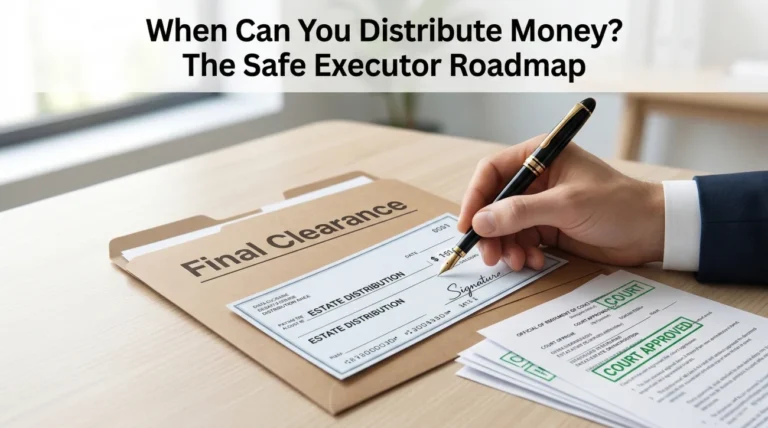
The court must approve your final accounting before you can distribute a single dollar. In this scenario, the court order itself provides a layer of protection. The receipts you collect afterward are primarily to prove to the judge that you followed their order.
You do not need court approval to distribute funds. Because the judge is not checking your math, the release document signed by the beneficiary is your only real protection against future lawsuits.
In independent administration, getting a robust release is non-negotiable. If you skip it, you are leaving the door wide open for beneficiaries to question your expenses years down the line.
The Pre-Send Checklist: What to Verify First
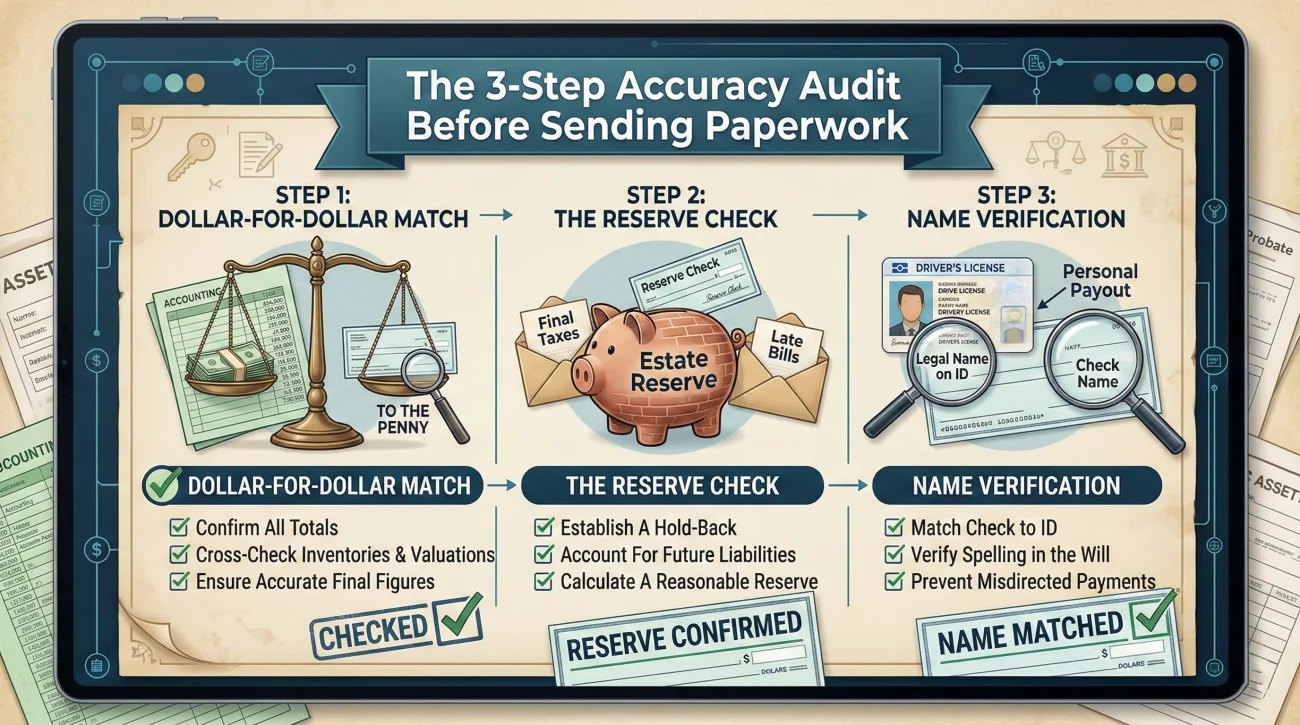
Before you even attach a receipt form to an email, your underlying numbers must be flawless. A release is only valid if the beneficiary is making an informed decision based on accurate data. If you send a release based on a sloppy accounting, the release can often be invalidated later.
In my workflow practice, I always recommend executors run through a specific checklist before drafting the final distribution packet.
- ✅ The Dollar-for-Dollar Match: Does the final distribution amount on the receipt exactly match the bottom line of the final accounting? Even a one-cent discrepancy will cause the bank or the court to reject the filing.
- ✅ The Reserve Check: Have you explicitly noted any funds you are holding back (a reserve) for final tax preparation or unexpected late bills? Beneficiaries need to know if this is a partial or absolute final distribution.
- ✅ Name Verification: Are you using the exact legal names of the beneficiaries? If a beneficiary got married and changed their name during the probate process, the receipt needs to reflect their current legal identity to match the bank check.
The Receipt Component and In-Kind Assets
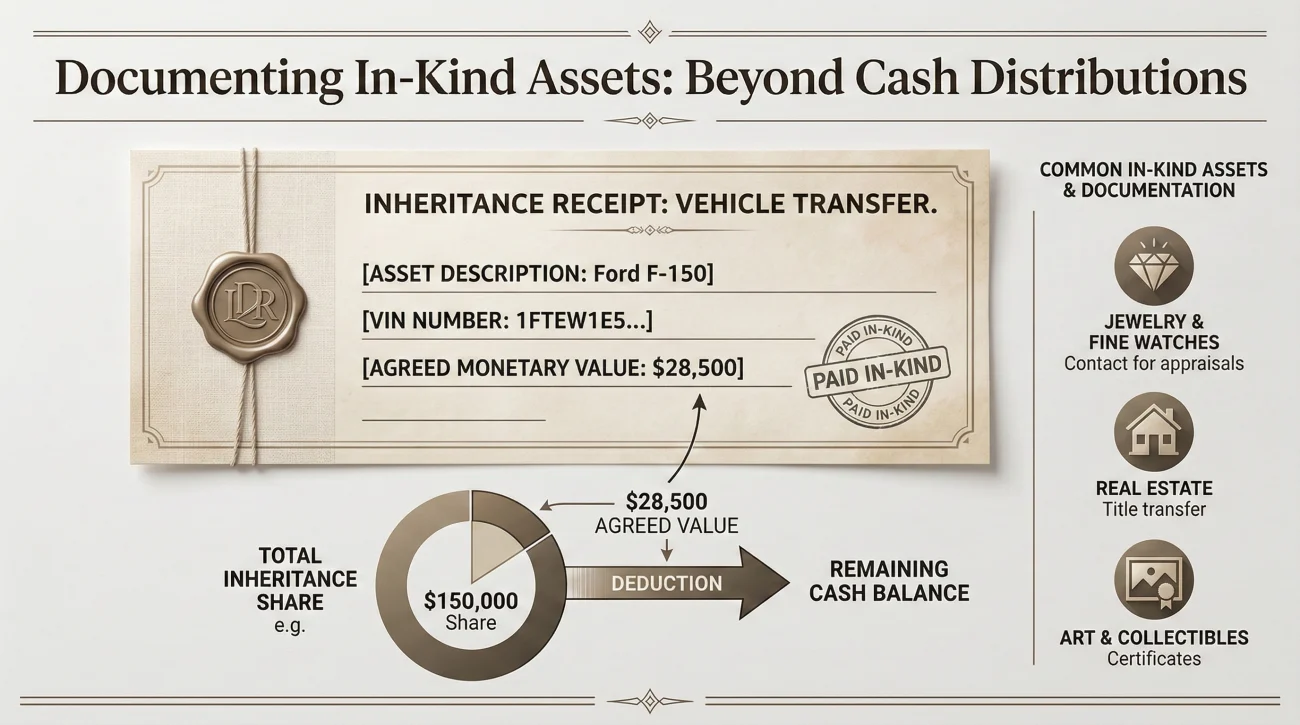
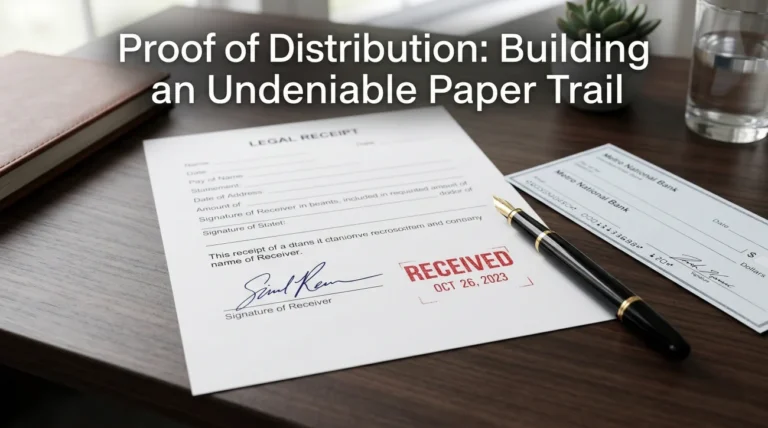
Let us break down the first half of the paperwork: the receipt. A receipt is a factual record. It is not an opinion, and it is not a negotiation. It simply states that a specific person received a specific asset.
Cash distributions are straightforward. You state the dollar amount. However, many executors stumble when distributing “in-kind” assets, such as furniture, a vehicle, or jewelry. When a beneficiary takes a physical item instead of cash, the receipt must clearly document the agreed-upon value of that item against their total inheritance share.
If a beneficiary takes a $10,000 vehicle, their receipt cannot just say “Received one Ford F-150.” It must establish the math.
Key Point: For physical items, the receipt must include the description, the VIN or serial number if applicable, and the explicitly agreed monetary value being deducted from their share of the estate.
To give you a practical idea of what this looks like operationally, here is a simplified organizational template. Please note this is for conceptual workflow purposes, not a substitute for state-required legal forms.
ESTATE DISTRIBUTION RECEIPT (Sample for Organizational Reference)
Estate of: [Deceased Name]
Beneficiary: [Full Legal Name]
I, the undersigned Beneficiary, acknowledge receipt of the following from the Executor of the above-named Estate:
[ ] The sum of $___________ via [Check Number / Wire Transfer].
[ ] The following specific property: _________________________________, with an agreed-upon distribution value of $___________.
I acknowledge that this distribution represents [my full and final share / a partial share] of the estate as detailed in the Final Accounting dated [Date].
Signature: ______________________ Date: ___________
The Release Component: Translating Legal Jargon
While the receipt confirms delivery, the “release” is what truly protects you. It generally serves as an acknowledgment from the beneficiary that they have reviewed your accounting, they agree with your expenses, and they waive their right to take you to court later.
Going back to our analogy, if the receipt proves you returned the rental car, the release is the rental company’s binding agreement that the transaction is fully settled.
Because releases contain heavy legal phrasing like “discharge,” “waive,” “indemnify,” or “hold harmless,” beneficiaries frequently panic. They read these words and feel like they are being tricked into giving up hidden rights. In my experience, executors who just email a dense PDF without explanation almost always face delays and suspicion.
You have to translate the intent of the document into plain English before they read it.
Subject: Final Estate Summary and Distribution Paperwork
Hello [Name],
We are finally at the stage where we can distribute the estate funds. Attached is the final accounting that summarizes all the bills paid and the remaining balance.
Also attached is a standard receipt and release document. The legal language can look intimidating, but it simply confirms two things: first, that you agree with the math in the accounting, and second, that you acknowledge my administrative duties for this portion of the estate are complete so I can officially close the file.
Please review the summary. Once you are comfortable, please sign the document and return it to me. Once I have the signed copies back from everyone, I will immediately issue the final checks.
Handling Beneficiary Pushback: Three Common Scenarios
Even with a great cover email, you will likely encounter friction. Over the years, I have noticed that beneficiary pushback usually falls into one of three predictable categories. How you respond determines whether the estate closes smoothly or stalls in conflict.
Reaction 1: “I need my lawyer to read this first.”
Executors often take this personally, feeling like they are being accused of theft. Do not get defensive. A beneficiary seeking counsel is actually a good thing; a lawyer will usually tell them the form is standard and advise them to sign it.
“Absolutely, take your time. I want you to be completely comfortable with the numbers before we finalize anything. Let me know if your attorney needs any supporting bank statements to verify the accounting.”
Reaction 2: “I do not understand what I am signing away.”
This happens when the release includes broad indemnification clauses. They worry they are taking on the estate’s debt.
“I understand the wording is heavy. From an administrative side, this document just protects me from being personally sued later regarding the expenses listed on the spreadsheet we both reviewed. It confirms we agree on the math.”
Reaction 3: “I am not signing because I disagree with the accounting.”
This is a hard stop. You cannot force a release if there is a genuine dispute.
“Let us pause the distribution process. I want to make sure this is entirely transparent. Can you point out exactly which line item or expense on the accounting you are concerned about so I can provide the original invoice or context?”
When to Pause: Red Flags for DIY Documents
While many executors use standard templates for a receipt and release beneficiary acknowledgment, there are specific moments where a simple downloaded form is not enough to protect you.
If you have an estate where everyone gets along and the assets were just a single bank account, standard paperwork often works fine. But if the estate has any existing friction, relying on generic forms is a massive risk.
⚠️ Warning: Do not attempt to use DIY release forms if you are distributing assets to a minor, distributing to a trust, or if a beneficiary has actively threatened legal action during the probate process.
In those situations, the phrasing of a release needs to be precise and locally compliant. If a beneficiary is hostile, they may sign a generic receipt just to get the check, and then immediately hire counsel to argue the release portion was legally invalid due to formatting errors. When family dynamics are tense, always have a local professional supply the exact closing documents.
Documenting Delivery Without Complex Forms
Sometimes, despite your best efforts, a beneficiary simply refuses to sign a release. They want their money, but they are stubborn about signing paperwork. Or perhaps you are in a situation where a formal release is not strictly required by your local process, but you still need an ironclad paper trail.
In complex cases where trust is completely broken, professionals often use escrow accounts. The executor transfers the beneficiary’s share to an attorney’s escrow account. The attorney then notifies the beneficiary: “The funds are sitting here, ready to be wired, the moment you provide the signed release.” This removes the executor from the direct conflict.
If you are handling this yourself and cannot get a formal release, you must over-document the receipt side of things:
- 📄 The Cover Letter: Send the check with a very clear, printed letter stating: “Enclosed is check #123 for $X, representing your final distributive share of the Estate. By cashing this check, you acknowledge receipt of these funds based on the provided accounting.”
- 📄 The Delivery Proof: Send the check via certified mail with a return receipt requested. Save that tracking PDF in your executor folder.
- 📄 The Bank Trace: Once the check clears, download the image of the canceled check from the estate bank account showing the beneficiary’s endorsement signature on the back.
💡 Pro Tip: Create a digital folder named “Distribution_Proof”. For every beneficiary, save their final accounting copy, their tracking number PDF, and the image of their cashed check. Name the files systematically, like 2024-11-01_Smith_TrackingReceipt.pdf.
The Operational Rule: Paper First, Money Second
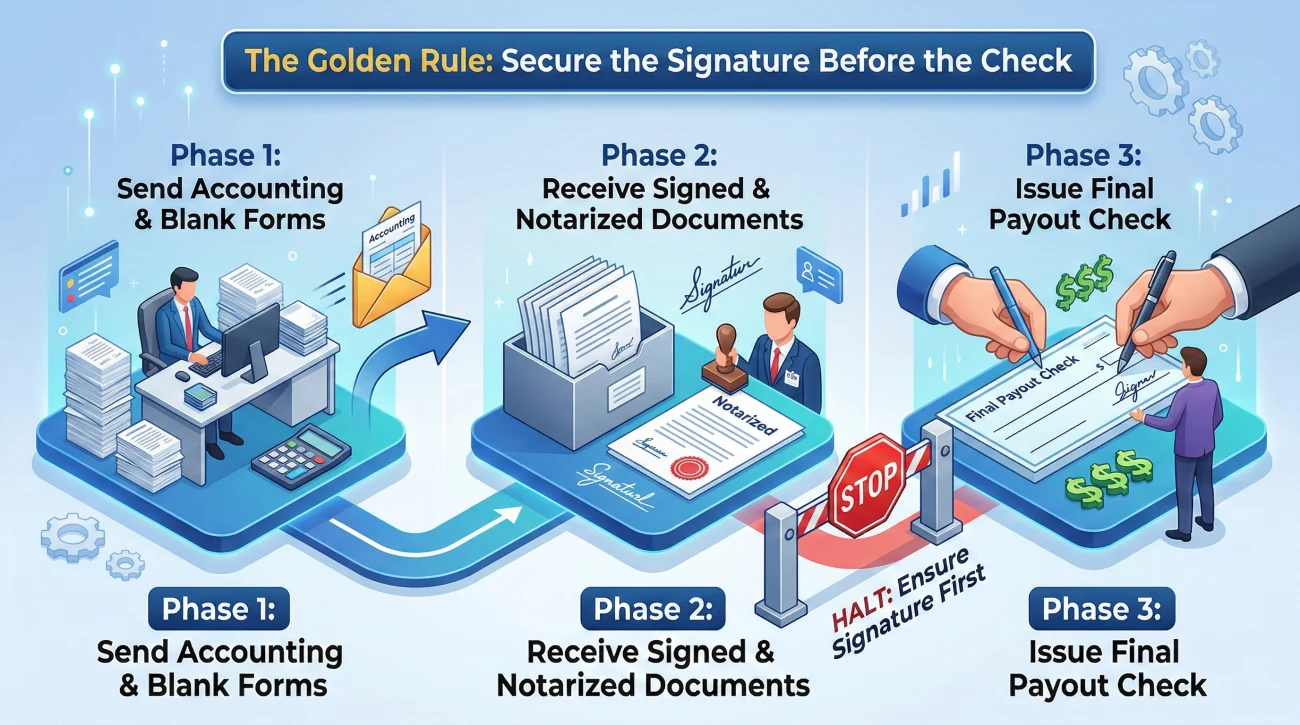
I want to state one of the most practical operational rules of estate administration very clearly. You must always try to get the signature before you send the funds.
Executors often feel bad about this, feeling like they are holding the inheritance hostage. But human nature is highly predictable. Once a beneficiary has their money in their bank account, their motivation to print, sign, scan, and email a document back to you drops to near zero. They are not acting maliciously; the urgency is simply gone.
If you send the check first, you will likely spend the next three months chasing them with polite reminder emails. Stick to the sequence. Send the accounting and the blank paperwork. Wait for the signed PDF to arrive in your inbox. Only then do you initiate the wire or mail the check.
Final
The end of an estate administration is rarely a moment of grand celebration. It is usually a quiet sense of relief achieved through diligent organization. Collecting your final receipts and releases is the ultimate step in that process. It is the definitive boundary line where you transition from actively managing someone’s legacy to simply holding a historical record that you did the job correctly.
Do not let administrative fatigue cause you to skip this final layer of armor. The peace of mind that comes from having a neat, secure folder of signed beneficiary acknowledgments is worth the minor friction of asking for signatures. Translate the legal jargon for your family, verify your numbers twice, follow the paper-first operational rule, and build the clear trail that allows you to finally put the executor binder on a shelf and step away with confidence.
❓ FAQ
🖨️ Can beneficiaries sign the release electronically?
This depends entirely on local court rules. While many independent administrations allow standard e-signatures (like DocuSign) for internal records, formal probate courts often still require physical “wet ink” signatures on official closing documents. Always verify the acceptable format before sending.
🏦 Do banks require a signed release to close the estate account?
Generally, banks do not care about beneficiary releases. The bank only requires an instruction from the authorized executor to close the account and transfer the remaining balance. The release is for your personal protection and court requirements, not a banking prerequisite.
🧑🤝🧑 What if one sibling signs immediately but another delays?
Executors typically hold all distributions until every beneficiary has returned their signed paperwork. Distributing to one person while waiting on another can create leverage imbalances or complicate the final accounting if the delaying sibling suddenly demands an adjustment.
📈 How do fluctuating stock values affect the final receipt?
If you are distributing shares of stock directly (in-kind) rather than cashing them out, the receipt should state the exact number of shares transferred and note the specific date of transfer, as the dollar value will change daily based on market conditions.
🏠 Does a property deed transfer replace a distribution receipt?
No. While the recorded deed proves the real estate changed hands legally, a standard distribution receipt should still be included in your final estate packet to tie the value of the house back to the beneficiary’s overall share of the final accounting.
💼 Can I deduct my executor fee before sending the release?
Yes, any approved executor compensation should already be listed as a paid administrative expense on the final accounting. By the time the beneficiary receives the release document, your fee should be clearly documented and subtracted from the total remaining estate balance.
🔍 Will the IRS ask to see these distribution documents?
The IRS is primarily concerned with tax returns (like the 1041 or 706) and the K-1 forms issued to beneficiaries showing taxable income. They rarely ask for standard probate distribution receipts, but keeping them is crucial in case questions arise about exactly who received what assets.
📬 How should I mail the final physical packet?
If you are mailing physical checks along with the paperwork, always use a service with a tracking number and signature confirmation, such as USPS Certified Mail. Never send final inheritance checks via standard untracked mail.
📝 What if I find another asset after everyone already signed?
If a new asset (like an old bond) is discovered after closure, you will usually need to reopen the estate or utilize a “subsequent administration” process. You will calculate the new shares, distribute the newly found funds, and collect a separate, supplemental receipt for just that specific distribution.
🗑️ When is it safe to permanently shred these signed documents?
You should keep the master file containing all signed receipts, releases, and accounting documents for several years after closing. While specific retention guidelines vary, many professionals recommend keeping physical or secure digital copies for at least three to seven years to ensure all statutory liability periods have expired.
⚠️ Disclosure: I'm not an attorney and nothing on this site is legal or tax advice. The content covers process, organization, and workflow—the operational side of estate administration. For legal interpretation, jurisdiction-specific deadlines, contested situations, or tax matters, please work with a licensed professional in your state.