- Unclaimed property is rarely about “forgetting” money. It is usually the direct result of paperwork drift, such as un-updated addresses, corporate mergers, or minor name variations.
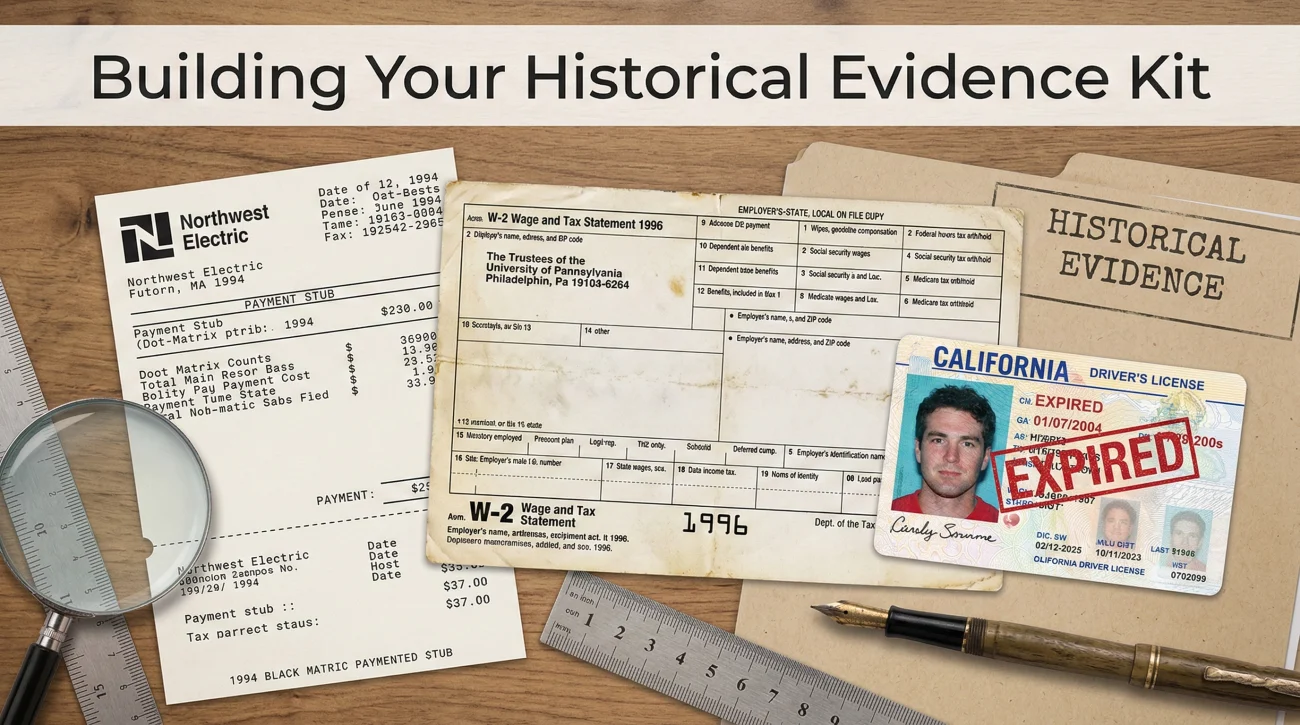
- Proving ownership requires historical documentation. You will need to build an “evidence kit” using old utility bills, expired IDs, or tax records to show the deceased person’s past addresses.
- Do not guess where to look. Follow a logical multi-state search strategy starting with the state of death, followed by their longest state of residence and employment.
- Once funds are recovered, they must flow directly into the official estate account to be recorded for final accounting before any distribution happens.
The State Is Holding Money, and It Usually Looks Like a Scam
In my years of helping executors build their documentation packets and untangle administrative knots, the reaction to an unclaimed property letter is almost always identical. The executor will look at a notice claiming the state is holding thousands of dollars for the deceased person, narrow their eyes, and ask me if it is a scam.
It is a completely logical reaction. We are conditioned to ignore unexpected promises of money. But in the context of estate administration, discovering unclaimed funds is incredibly common. The initial instinct is to treat it as a strange, suspicious side project that distracts from the standard work of settling the estate.
I always advise executors to shift their perspective. Unclaimed property is not a lottery ticket. When a bank, utility company, or insurance provider loses contact with an account holder, the law requires them to turn those funds over to the state treasury. The state then holds the money safely until the rightful owner, or their appointed executor, comes looking for it.
According to the National Association of Unclaimed Property Administrators (NAUPA), roughly 1 in 7 people have unclaimed property sitting in government vaults. Furthermore, economic research published in ScienceDirect estimates that there is approximately $70 billion in unclaimed wealth in the United States alone. When you are managing an estate, there is a very high statistical probability that you will need to process at least one of these claims.
How Paperwork Drift Creates Missing Assets
The biggest misconception families have is that the deceased person must have been forgetful or financially irresponsible to leave money behind. I frequently hear beneficiaries say, “How could they just forget a $5,000 account?”
They did not forget. What usually happens is what I call paperwork drift. Drift occurs when life moves forward but a specific administrative record does not catch up. As an executor, understanding drift helps you figure out exactly what kinds of historical documents you will need to dig up to prove ownership.
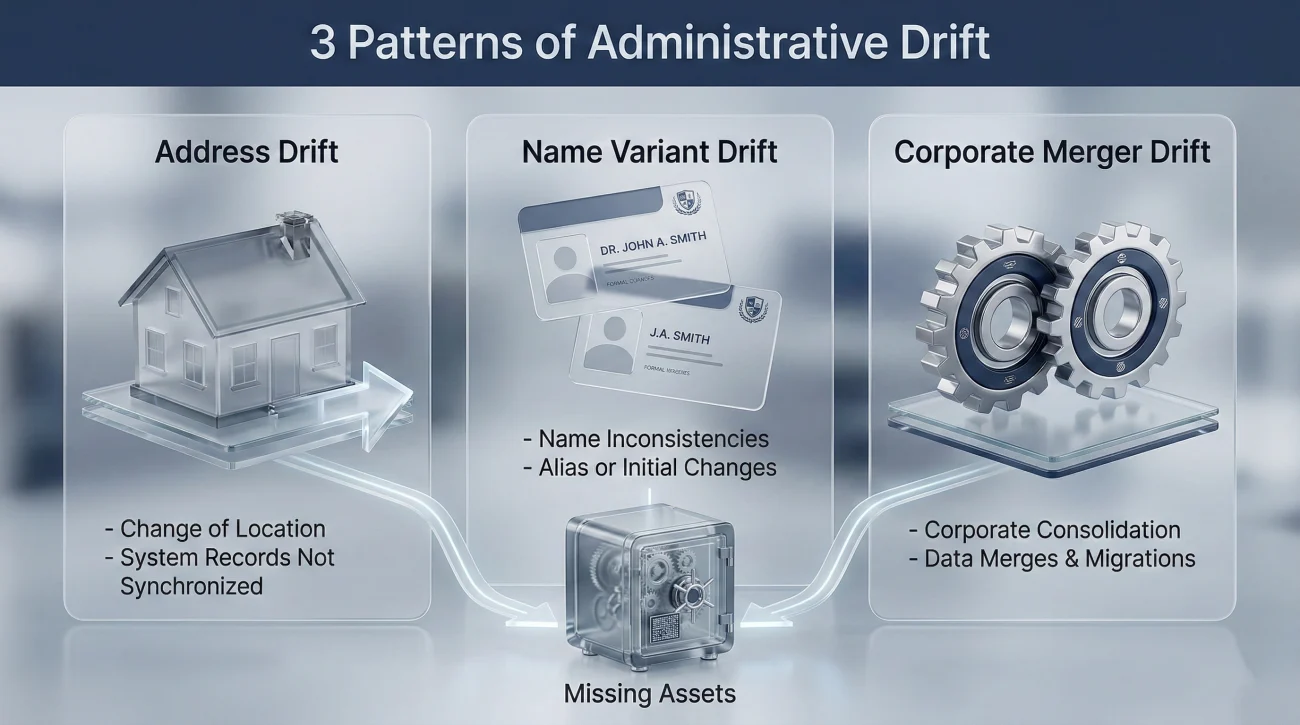
The Three Patterns of Administrative Drift
In my daily operational work tracking down missing document loops, I see three specific patterns that generate these funds:
First is the address drift. This happens when someone moves but forgets to update their mailing address with a minor service provider. A classic example is a utility deposit. When the person moved out of an apartment twenty years ago, the electric company mailed the $150 deposit refund to the old address. It bounced back, sat on the company ledger, and was eventually sent to the state.
Second is the name variant drift. If an account was opened under “Robert J. Miller” but the person’s later life and death certificate reflect “Robert James Miller”, the institution may flag the account during an audit. If they fail to verify the identity through their automated systems, they escheat the funds to the state.
Third is the corporate merger drift. This is the most complex to untangle and often involves the largest amounts of money.
Case Study in Merger Drift: Imagine the deceased person bought a life insurance policy in 1985 from a regional company called First National Fidelity. Over thirty years, that company is bought out, merged, and rebranded three separate times. Today, the holding company is named Apex Insurance Group. The original policyholder loses track of the name changes, mailings stop, and the policy eventually drifts into the state’s unclaimed property division under a corporate name the family does not even recognize.
Assuming the deceased person hid money, leading to a frantic search for secret bank statements.
Recognizing that missing money is usually the result of old addresses or corporate name changes, shifting the focus to finding historical proof.
The Multi-State Search Strategy
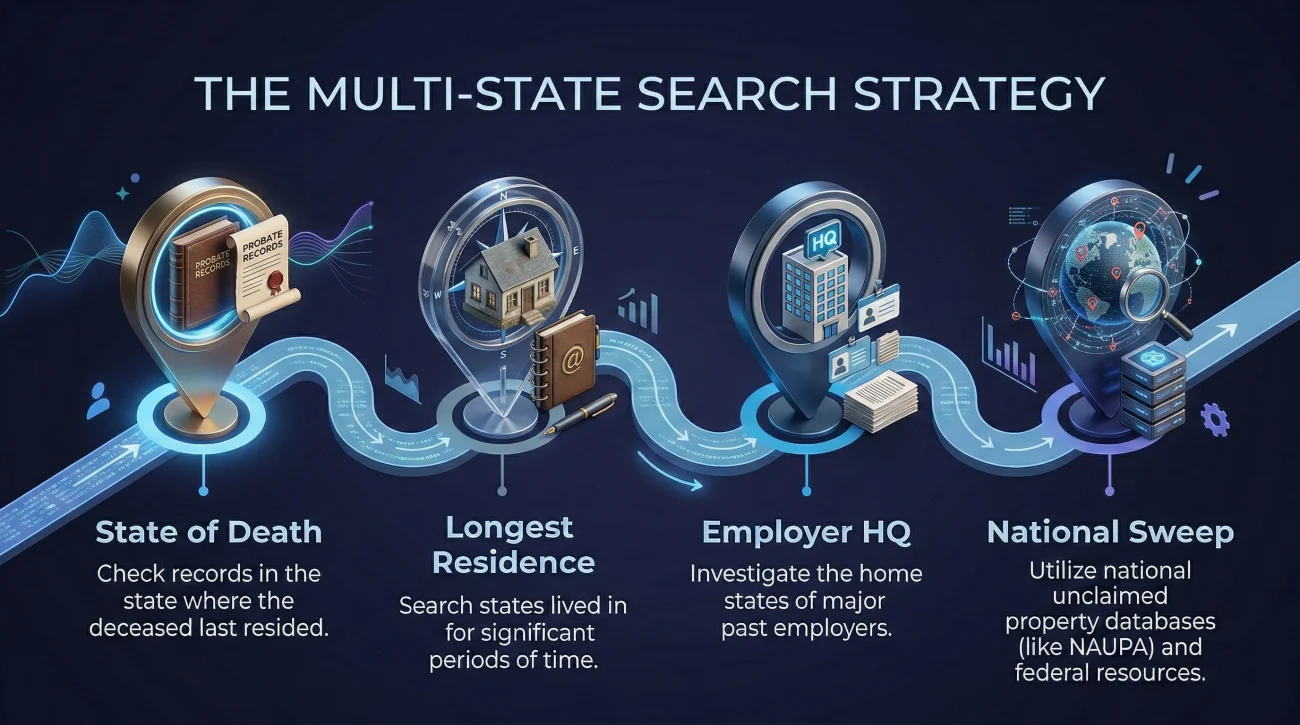
Executors often get stuck wondering exactly where to look, especially if the deceased person traveled or moved frequently. You cannot just search their final state of residence and assume the job is done.
I recommend a structured, multi-state search strategy. Start with the state where they passed away. Next, search the state where they lived the longest or spent their childhood. Then, check the state where their primary long-term employer was headquartered, as corporate payroll errors or old pensions often end up there. Finally, use the NAUPA-endorsed MissingMoney.com portal to run a broad national sweep.
Integrating Claims into Your Workflow
Once you locate a claim, you must integrate it directly into your primary workflow. Log these funds in your estate asset inventory checklist exactly as you would a savings account at a local credit union. Treat the state treasury as the holding institution.
| Institution (Holder) | Account / Claim ID | Reported Value | Current Status |
|---|---|---|---|
| State Treasury (Dept of Revenue) | Claim #998-AZ-442 | Over $100 (Exact unknown) | Claim packet mailed Oct 12 |
| State Controller’s Office | Claim #112-TX-889 | $45.50 (Utility refund) | Waiting on old address proof |
| Dept of Commerce (Unclaimed Div) | Claim #554-NY-101 | Unknown (Insurance shares) | Reviewing corporate merger history |
Building Your Historical Evidence Kit
State claims departments process thousands of files daily. They are notoriously strict. When an executor claims funds, the reviewer has to verify three distinct things: the deceased person’s identity, the fact that they owned the specific asset, and your legal authority to collect it.
The most common roadblock is proving an old address. If the state is holding a refund from 1994, they will demand proof that the deceased person actually lived at that specific street address in 1994. The modern death certificate will not help you.
Where to Look for Proof
You need to build a historical evidence kit. As you sort through the house, do not throw away outdated paperwork. I tell executors to follow a specific physical path through the home to gather these bridging documents:
- 📄 The primary filing cabinet: Look for vintage tax returns (W-2s are excellent for showing old addresses) and old property deeds.
- 📄 Shoeboxes and closet bins: Look for bundles of old utility bills, cancelled checks, or vintage bank statements from decades ago.
- 📄 Desk drawers and old wallets: Look for expired driver’s licenses or old voter registration cards.
⚠️ Warning: Never mail original, irreplaceable documents to a claims department unless they explicitly demand originals in writing. Always send clean, highly legible copies and keep the originals safe.
Getting the Requirements on Record
State treasury websites can be confusing, and generated claim forms do not always list exactly what an executor needs. Instead of guessing and risking a rejection, I always send a direct, written request to get their requirements on the record. If the state offers an email contact or a messaging portal, use this framework:
Subject: Request for executor document requirements – Claim ID [Insert Claim Number]
To the Unclaimed Property Division,
I am the appointed executor for the estate of [Name], who is the listed owner of Claim ID [Number].
Before I mail the claim packet, could you please provide a written list of the specific documents your department requires to process an estate claim?
Specifically, please confirm what is required for proof of historical address, and whether you require a court-certified copy of my appointment letters or if a standard photocopy is acceptable.
Thank you for your guidance.
When they reply, print that checklist out and make it the cover page of your mailed packet. This proves to the reviewer that you are following their instructions precisely.
Navigating Third-Party Tracers and Finders
Shortly after an estate is opened in probate court, you may receive official-looking letters from companies offering to recover “lost estate funds” for a fee, usually ranging from 10% to 30% of the recovered amount. These companies are called asset tracers.
They monitor public probate filings, cross-reference the deceased person’s name with public databases, and then pitch their services to you. Are they scams? Usually, no. They are operating legally. However, for the vast majority of standard estates, their service is entirely unnecessary. They are charging a steep percentage to do a public database search you can do yourself for free.
💡 Pro Tip: There is a rare exception where a tracer might be reasonable. If you are managing a massive, highly complex estate with assets scattered across a dozen states, and you simply have zero time to process the paperwork, paying a finder’s fee might be a calculated operational trade-off. But for most executors, it is best to bypass the tracers and file the paperwork directly.
What Happens After the Claim Is Approved?
Once the state approves your packet, it typically takes several weeks for them to issue the funds. It is vital to handle this money correctly once it arrives.
The check will usually be made payable to the estate, not to you personally. You must deposit these funds directly into the official estate bank account. Do not immediately transfer this money to beneficiaries. The recovered funds are part of the general estate pool, meaning they are subject to the standard probate process. They must be recorded in your final accounting and may need to be held to pay outstanding creditor claims before any final distributions can occur.
Final Thoughts
Discovering missing money can feel like a strange detour during a very stressful time. But when you look at it through the lens of paperwork drift, it makes perfect sense. Life is messy, addresses change, companies merge, and records get left behind.
Your role as an executor is simply to restore order to that paperwork. Run the searches systematically, build your historical evidence kit, and communicate cleanly with the claims departments. By treating this process with the same calm discipline you apply to the rest of the estate, you will successfully recover what rightfully belongs to the family.
Data Sources and References
- 📄 NAUPA Unclaimed Property Statistics: Information regarding the 1-in-7 statistic and the definition of unclaimed assets is sourced from the official National Association of Unclaimed Property Administrators.
- 📄 Economic Estimates: The estimate of approximately $70 billion in unclaimed wealth is referenced from economic literature published via ScienceDirect.
- 📄 Official Search Portal: Executors can perform free, multi-state searches using the NAUPA-endorsed platform at MissingMoney.com.
❓ FAQ
🎙️ How do I find out if the deceased had unclaimed money?
You can search national databases like MissingMoney, which is endorsed by state governments, or search individual state treasury websites directly. Always search the state where they died, plus any states where they previously lived or worked.
🤔 Does unclaimed property belong to the executor or the estate?
It belongs entirely to the estate. The executor only acts as the administrative manager to collect the funds. Once the state releases the money, it must be deposited into the official estate bank account.
📱 Can I claim missing money before getting court letters?
In most cases, no. State claims departments require strict proof of your authority. Unless the amount is extremely small and qualifies for a specific state affidavit, they will typically demand a court-certified copy of your appointment letters.
🛑 What documents do I need to prove I am the executor for unclaimed funds?
Generally, you will need a certified copy of the death certificate, your court-issued letters of authority, your personal photo ID, and historical proof of the deceased person’s connection to the original address.
⏳ Is there a time limit for an estate to claim abandoned property?
Unclaimed property is generally held by the state in perpetuity, meaning there is no strict deadline. However, you should claim it while the estate is actively open so you do not have to reopen the estate accounts later.
💸 Do I have to pay a fee to search for missing estate money?
No. Official state treasury websites and portals like MissingMoney are completely free to use. You never have to pay a processing fee to the government to claim what rightfully belongs to the estate.
📬 Why did I get a letter from a tracer about estate funds?
Third-party companies monitor probate filings and unclaimed property databases. They send letters offering to locate the funds for a percentage fee. You can usually ignore these letters and perform the free search yourself on official state websites.
🏦 Will the state automatically mail a check to the estate?
No. The state does not know an estate has been opened until you tell them. You must proactively search the database, initiate the claim, and provide the required legal documentation before they will release any funds.
📑 Do I include unclaimed property on the final estate inventory?
Yes. Once you have identified the property and know the value, it should be listed on your estate asset inventory just like any other cash account or financial holding.
🤷♀️ What happens if I find unclaimed property after the estate is closed?
This is a common issue. In many cases, you may have to petition the probate court to officially reopen the estate to gain the authority to claim the newly discovered funds, which takes additional time and effort.
⚠️ Disclosure: I'm not an attorney and nothing on this site is legal or tax advice. The content covers process, organization, and workflow—the operational side of estate administration. For legal interpretation, jurisdiction-specific deadlines, contested situations, or tax matters, please work with a licensed professional in your state.