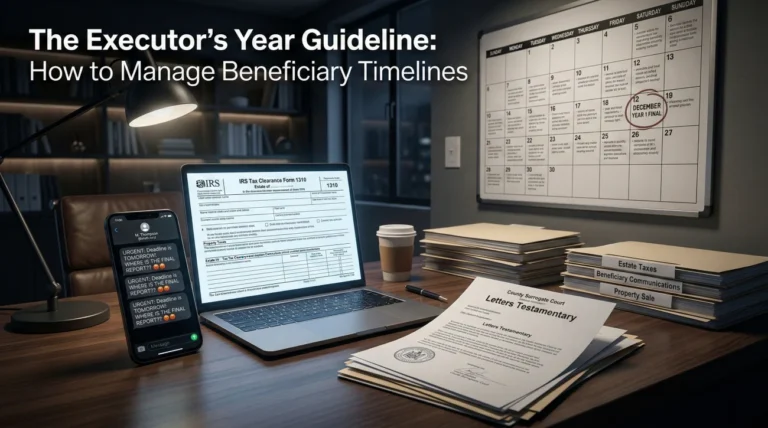

- The tension between an executor and beneficiaries is rarely about greed; it is almost always a collision of two different ways of processing grief.
- For the executor, grief often manifests as “brain fog,” making administrative tasks feel overwhelmingly heavy and leading to long periods of silence.
- For beneficiaries, grief often looks for a tangible task or target, turning logistical questions into emotional outlets.
- Without a clear communication system, the executor’s silence is misinterpreted as negligence, while the family’s questions are misinterpreted as pressure.
- Setting up a predictable update schedule and a centralized document log is the best way to protect both the estate’s progress and the family’s relationships.
The Phone Call Where Everything Shifted
I still remember a specific phone call I had a few years ago that completely changed how I look at estate administration. The executor on the line was exhausted. It was month four of settling her father’s estate, and she was crying, not because the bank forms were difficult, but because her brother had just sent a text accusing her of deliberately stalling the inheritance.
“I’m trying to get the tax clearance,” she told me, her voice shaking. “I haven’t even had time to properly miss my dad because I’m on hold with call centers every lunch break. And my own brother thinks I’m trying to steal from him.”
In my time helping people navigate the paperwork side of estates, I hear a version of this story almost every week. Around the three to six-month mark, a dangerous dynamic takes hold. The executor feels crushed by the weight of the tasks and the lack of appreciation. Meanwhile, the family members start asking harder questions, wondering why everything is taking so long. Soon, they stop talking to each other as family and start talking to each other like hostile business partners.
It is easy to look at this and label it as classic executor family conflict grief. But the reality is much deeper than a fight over money. What I have learned from watching hundreds of families walk through this fire is that this conflict is rarely a communication failure. Instead, it is a profound mismatch in how grief looks and behaves depending on which side of the estate you are sitting on.
What the Executor is Actually Living: The Fog of Administration
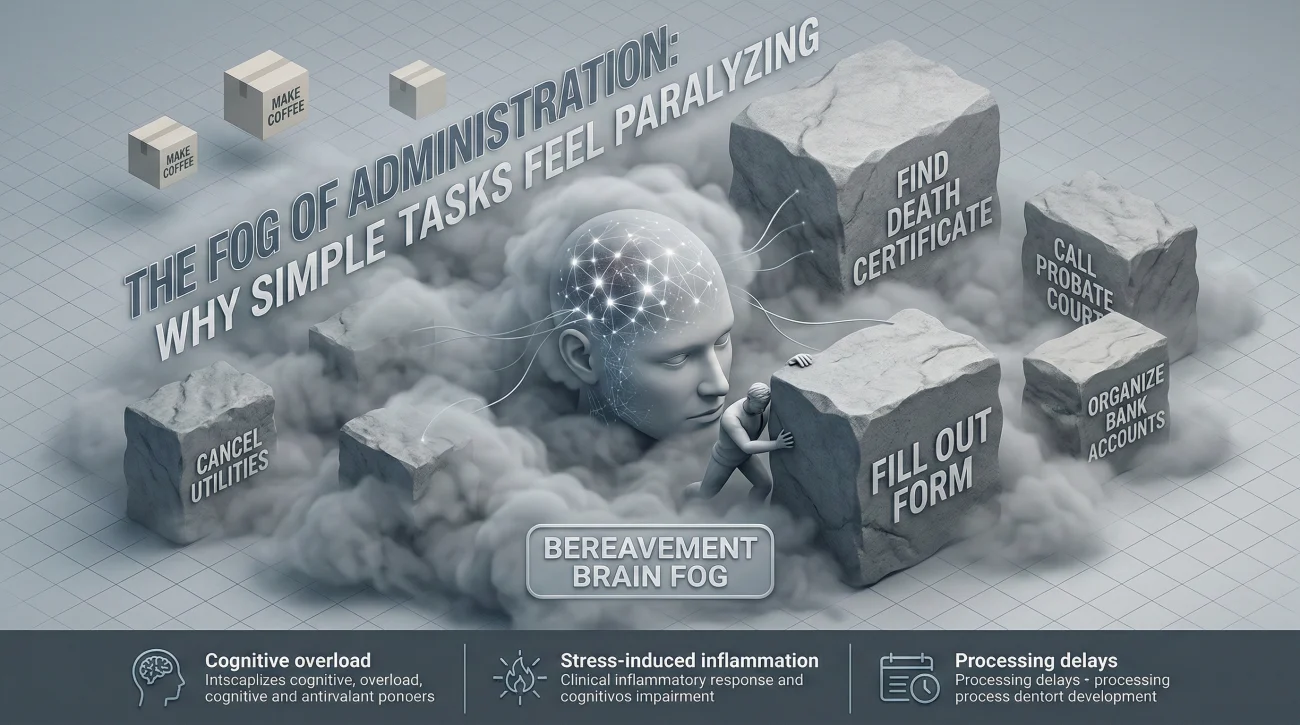
When you are named the executor, the world expects you to instantly transform into a highly efficient project manager. The reality is that you are a grieving human being who has suddenly been handed a part-time job with zero training and massive legal liability.
Grief does not just make you sad; it physically and mentally alters your capacity to function. Clinical research shows that bereavement significantly impairs cognitive function. According to a detailed report by Harvard Health on grief and the brain, the trauma of loss triggers an inflammatory response that can lead to severe issues with memory, attention span, and everyday decision-making.
I see this cognitive fatigue every day. Staring at a simple two-page account closure form can feel paralyzing. Tasks that would normally take fifteen minutes suddenly stretch across three weeks because the mental energy required to locate a death certificate and find an account number simply does not exist on some days.
Key Point: For the executor, grief manifests as a desperate need for quiet. Retreating and delaying updates is rarely a strategy to hide information; it is a survival mechanism when the brain is overloaded.
From the executor’s perspective, they are working as hard as they can behind the scenes and just want a little grace from their family. They put off sending updates because they feel they do not have any final “good news” to share yet.
What the Family is Actually Living: Grief Looking for a Task

Now, flip the perspective. The beneficiaries (siblings, children, close relatives) are experiencing the exact same loss, but they have not been given a job to do. They do not have the distraction of calling institutions or sorting through files. They are left alone with their thoughts and a profound sense of helplessness.
When people feel helpless in grief, they instinctively look for something they can control. Experts note that it is incredibly common for grieving individuals to fixate on practical matters. As highlighted in a piece by Psychology Today on why grieving people focus on logistics, focusing on tangible items, timelines, or financial details offers a temporary distraction from the overwhelming pain of the loss.
There is a core truth I try to share with executors: When a sibling asks, “Have you cleared out the house yet?” or “When do you think the bank will release the funds?”, it helps to recognize what is actually driving the question. Often, they are asking because the estate is the only remaining connection they have to the person who passed away. The logistics become a proxy for the relationship.
They want reassurance that things are moving forward, which in their minds means the memory of their loved one is being handled with respect. But because they do not see the invisible hours the executor is spending on hold with call centers, the timeline feels completely unreasonable to them.
The Dangerous Translation: Silence vs. Pressure
This is the moment where the friction ignites. We have an executor who needs space and silence to function through their brain fog, paired with beneficiaries who need constant information and movement to cope with their helplessness. They are speaking two entirely different languages of grief.
In the absence of a structured communication plan, human nature fills the void with the worst possible assumptions. The American Psychological Association notes that complex grief often exacerbates underlying family dynamics, making everyone hyper-reactive to perceived slights. This translation error destroys families.
“Why are they asking me about the car title the week after the funeral? All they care about is the money. They have no idea how hard I am working for them.”
“It has been three months and I have not heard a single word. Why are they being so secretive? They must be mismanaging things or trying to hide something.”
I have seen this specific misunderstanding result in permanent estrangements. Neither side is actually doing anything wrong, but because they do not understand the other’s operational reality, the trust completely evaporates.
The Invisible Timeline: What Happens During the Silence
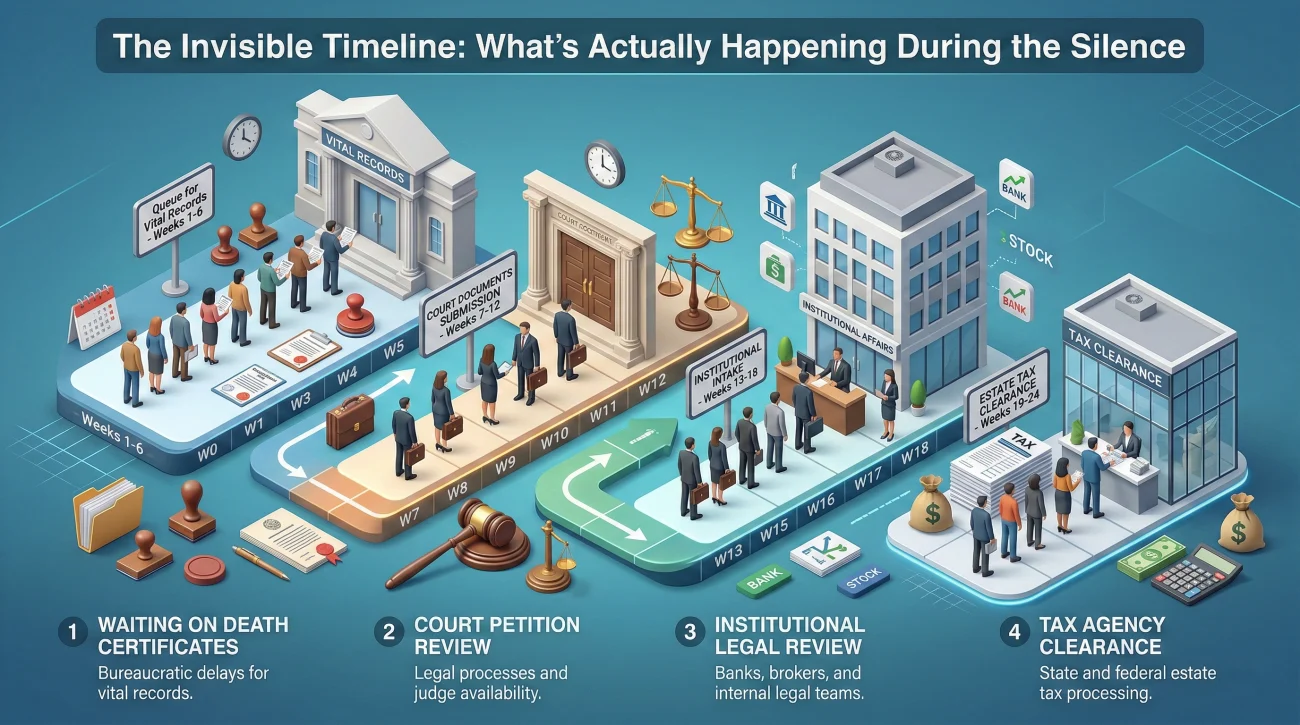
One of the fastest ways to reduce resentment from beneficiaries is to normalize the timeline. People outside the process assume that transferring an account takes a few days. They do not realize that the bulk of estate administration is simply waiting in line.
If you are an executor, sharing a realistic map of the “hidden work” can immediately lower the temperature. A typical six-month silence often looks like this behind the scenes:
- 📄 Weeks 1 to 4: Waiting on the official death certificates to arrive in the mail, which are required before any bank will even speak to you.
- 🏛️ Weeks 4 to 8: Submitting court petitions and waiting for the judge to issue the official Letters Testamentary.
- 🏦 Weeks 8 to 12: Mailing the court documents to individual banks, waiting for their internal legal departments to review the files, and fielding requests for “one more signature.”
- 🏢 Weeks 12 to 24: Waiting on state and federal tax agencies for clearances, or waiting for a real estate title process to clear.
How Writing Things Down Protects Both Sides
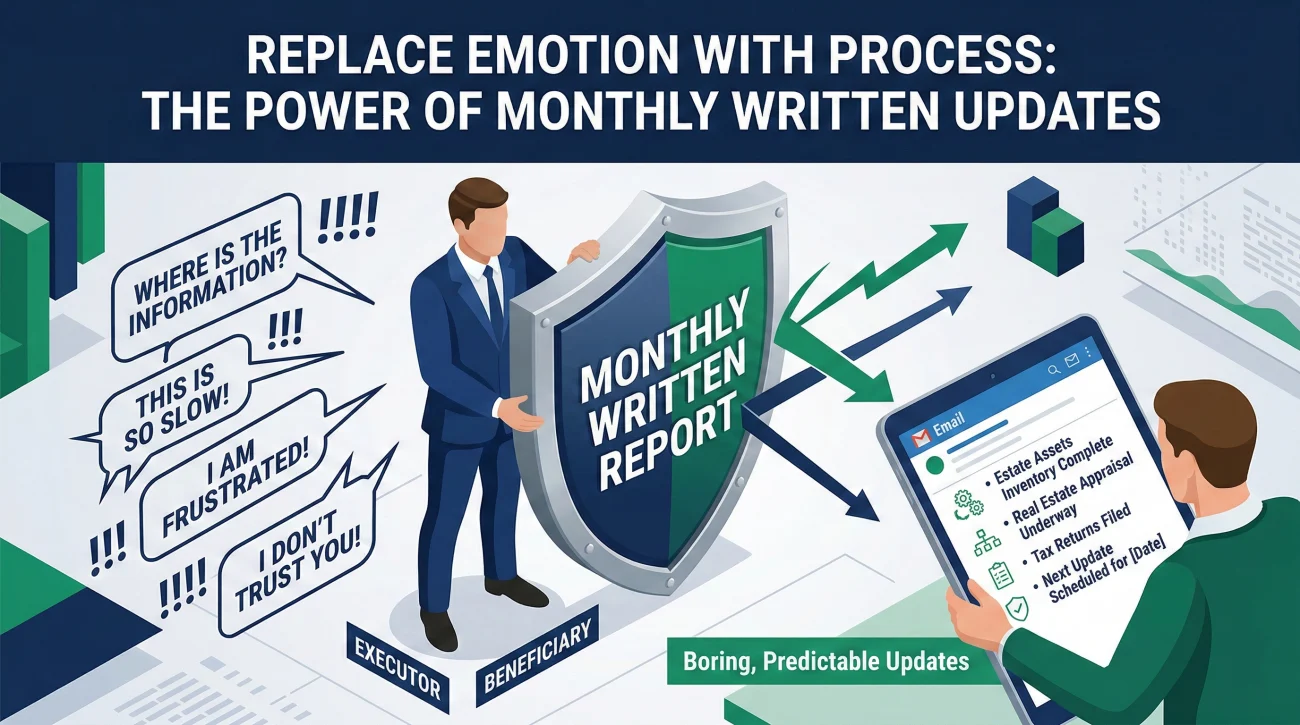
Once you understand that the tension is born from a grief mismatch, the solution becomes clear. You cannot fix the grief, but you can build a system that prevents the grief from turning into suspicion. In my experience, the absolute best way to bridge this gap is to replace emotional, ad-hoc text messages with boring, predictable, written updates.
Why does writing work better than a phone call? Verbal updates leave too much room for tone policing, and people easily forget what was said. Written communication strips out the emotion, creates a shared, objective record, and takes the relationship out of the line of fire by making the “process” the bad guy.
Here is a common pattern I recommend to executors: Set a specific day of the month, for example, the 15th, to send a brief, factual status email. Here is a neutral, professional script you can use to establish this boundary early on:
Subject: Estate Update Schedule & Current Status
Hello everyone,
I want to thank you all for your patience as I navigate the paperwork for [Name]’s estate. I am learning that the administrative side of this process involves a lot of waiting on institutions and reviewing documents, which takes more time than I initially expected.
To ensure we are all on the same page and to help me manage the day-to-day work, I will be sending out a brief status email on the [15th] of every month. This email will outline what was completed, what is currently pending with banks or agencies, and what our next steps are.
In the meantime, if you have specific questions, please reply to this email thread so I can keep all estate-related matters organized in one folder.
Thank you for understanding and for giving me the space to get these details right.
Once you have set the boundary, stick to the schedule. When the 15th rolls around, your monthly update should look like a simple business report. Do not over-explain. Use this format:
Subject: Estate Monthly Update – [Month] 15th
Hello everyone,
Here is the current status of the estate as of today:
Completed this month:
– Closed the checking account at [Bank]
– Paid the final utility bills for the house
Currently pending:
– Waiting on the IRS for the tax clearance letter (they quoted a 6-week processing time)
– Waiting on the title company for the house appraisal
Next steps:
– Once the tax clearance arrives, I can begin the final accounting.
I will send the next update on the 15th of next month.
💡 Pro Tip: Stick strictly to facts in these updates. Use phrases like “Waiting on institution review” or “Documents submitted on Tuesday.” Do not use emotional language, and do not make promises about timelines you do not control.
Final: The Estate Will Close. Will Your Family Stay Intact?
Serving as an executor is a heavy, largely thankless job. Being a beneficiary waiting in the dark is an anxious, isolating experience. When tensions rise, try to step back and remember that the person across from you is acting out of their own pain, not malice. They are navigating the exact same loss, just from a completely different seat at the table.
By recognizing how grief alters our behavior, and by building simple, written communication habits, you can stop the cycle of suspicion before it takes root. The ultimate goal is not just to close the estate successfully. The paperwork will eventually be filed, and the accounts will eventually settle. The true goal is to ensure that when the final check clears, you can still sit across from each other at Thanksgiving.
Sources Cited
- 🔗 Harvard Health Publishing: “How grief can affect your health and brain” – Detailing the cognitive impairments and “brain fog” associated with bereavement.
- 🔗 Psychology Today: “Why Grieving People Focus on the Practical” – Explaining the psychological need for control and the shift toward logistical tasks during the grieving process.
- 🔗 American Psychological Association (APA): Exploring how complicated grief and pandemic-era stressors exacerbate existing family dynamics and conflicts.
❓ FAQ
🛑 Why do my siblings constantly ask for updates on the estate?
Often, beneficiaries ask for constant updates because they feel helpless in their grief. Having a logistical task or a timeline to focus on gives them a false sense of control during a highly uncertain and painful time.
🗣️ What should I say to a family member who thinks I am hiding things?
Keep your response neutral and process-focused. Reassure them by moving communication to a written format. You can say: “I understand the wait is frustrating. To keep everything transparent, I will start sending a monthly email with a log of all completed steps and pending documents.”
⏱️ Is it normal for an executor to go weeks without talking to beneficiaries?
Yes, in many cases, executors experience periods of silence because they are waiting on institutions for document reviews, or they are dealing with the cognitive fatigue (brain fog) that accompanies grief.
🧠 Why is it so hard for me to focus on the probate paperwork?
Grief physically affects the brain, specifically the areas controlling memory, focus, and decision-making. The mental exhaustion you feel when looking at forms is a documented physiological response to loss, not a personal failure.
✉️ How often should an executor realistically update the family?
A scheduled, brief update once a month is usually the best approach. Even if the update is simply “still waiting on the IRS,” the predictability of the message reduces anxiety and stops the family from making negative assumptions.
⚖️ Can the stress of estate settlement permanently ruin family relationships?
Yes, if left unmanaged, the combination of grief, lack of communication, and assumptions about money can lead to permanent estrangement. Treating the estate as an administrative project with clear boundaries helps protect personal relationships.
📝 What is the safest way to communicate with difficult beneficiaries?
Always communicate in writing. Shift away from phone calls and text messages. Use a dedicated email thread for all estate matters so there is a clear, unemotional paper trail of what was shared and when.
😠 Why is the executor ignoring my texts about the house?
The executor is likely overwhelmed by administrative tasks and emotional exhaustion. Random text messages can feel like sudden demands. It is usually better to ask for a structured, written update schedule rather than sending individual questions.
📁 Should I just send all the bank statements to my family to prove I am working?
Do not dump raw documents without context. Instead, maintain a simple tracking log of assets and their current status (e.g., “Account closing pending”). Share the summary log on a schedule, rather than reacting to pressure with disorganized files.
🤝 How do we reset communication if we have already had a big argument?
Acknowledge the stress without taking the blame for the system. Send a message stating: “I know tensions are high because this process is frustrating and slow. Moving forward, I am setting up a monthly email update so we don’t have to stress over ad-hoc check-ins.”
⚠️ Disclosure: I'm not an attorney and nothing on this site is legal or tax advice. The content covers process, organization, and workflow—the operational side of estate administration. For legal interpretation, jurisdiction-specific deadlines, contested situations, or tax matters, please work with a licensed professional in your state.