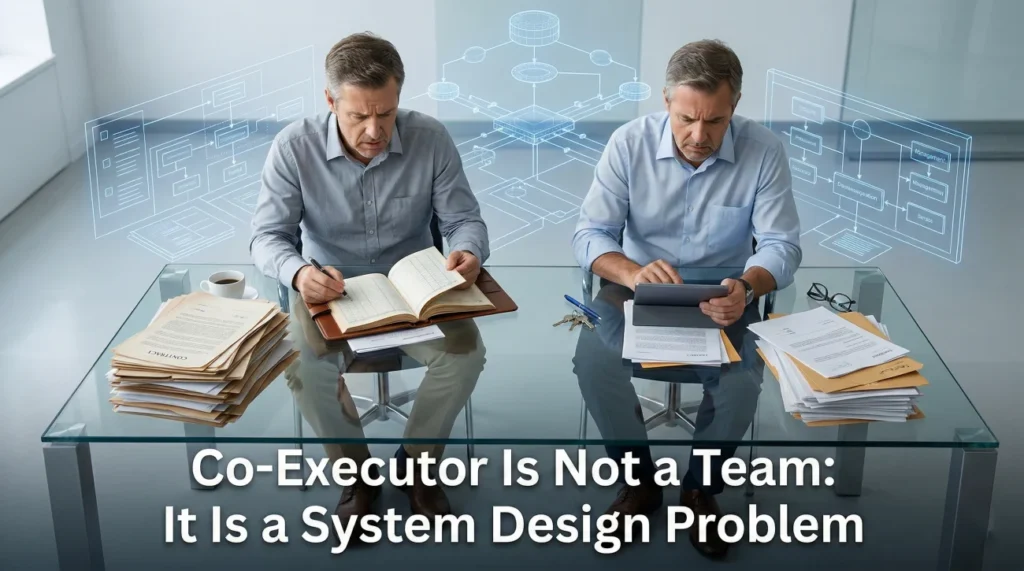
- Treating a co-executor arrangement like a collaborative team project usually leads to duplicated work and flagged accounts at financial institutions.
- Institutions view multiple voices as a liability risk; the solution is an operating system with one designated caller and one shared document record.
- Separate your internal alignment (decision logs) from your external actions (call logs) to keep the estate moving without micromanaging each other.
The Two-Call Trap: When Helping Each Other Actually Hurts the Estate
In my experience supporting estate administration workflows, one of the most common friction points happens right around week three. Two siblings, both named as co-executors, decide to “divide and conquer.” One calls the bank on Tuesday to ask about the required documents. The other calls the same bank on Thursday to check on the status of an account.
To the family, this feels like teamwork. They are both trying to be helpful and proactive. But to the bank’s backend review department, this looks entirely different. They see two separate individuals calling in, asking slightly different questions, and leaving slightly different notes in the system.
I often see this result in a flagged file. The institution pauses the process, requests a new round of written authorizations, or forces both executors to physically visit a branch together. What started as an attempt to speed things up ends up stalling the estate for weeks.
Key Point: Having a co-executor is not inherently bad, but treating the role like a team sport is. It is a system design problem. You need a structured operating system, not just good intentions.
When I look at files where co-executor first steps go smoothly, it is never because the two people agreed on everything. It is because they built a system where only one person spoke to the outside world, while both people shared complete visibility internally.
Why Institutions See Two Executors as a Liability
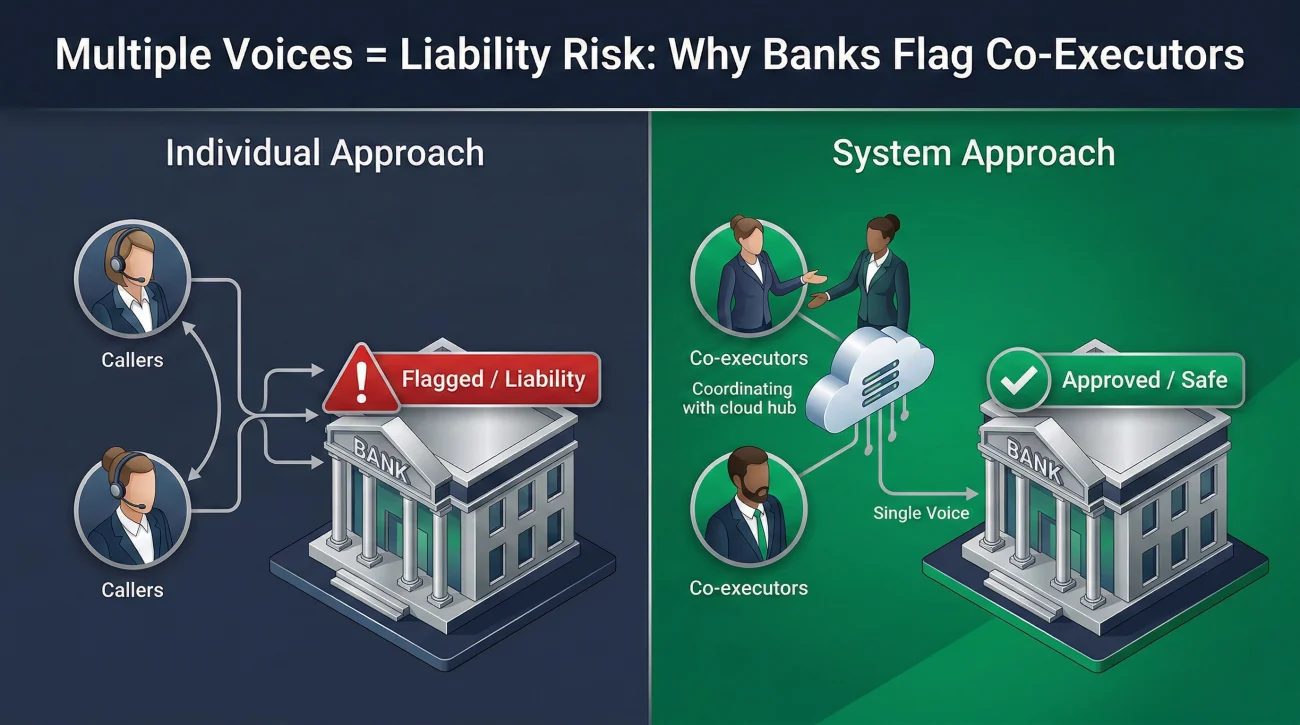
To understand why co-executor problems happen, we have to look at the process through the eyes of an institutional reviewer. Their primary job is not customer service; their primary job is risk management.
When an estate is opened, the institution is holding assets that belong to someone who has passed away. If they release those funds to the wrong person, or if they act on conflicting instructions, the institution absorbs the legal and financial liability.
The American Bar Association guidelines for executors emphasize the strict fiduciary duty to keep accurate, unified records. When you lack a unified system, you invite risk. Research into estate administration disputes further shows that co-executor friction usually stems from unclear communication and misaligned process expectations. In my daily work, I see this operational cost manifest as duplicated calls, mismatched document submissions, and conflicting notes in the bank’s system.
Both executors keep their own notes, send emails from their personal accounts, and take turns calling institutions to “share the load.”
One executor is the designated external communicator. The other executor is the internal auditor who reviews the shared log.
Reviewers want a clean, singular narrative. They want one point of contact, one set of organized documents, and a predictable trail of communication. When two people are sending in pieces of the puzzle at different times, the reviewer will simply stop processing the file until they can guarantee both executors are aligned. This is a primary driver of estate administration delays.
The Three Rules of a Workable Co-Executor System
If you want to avoid the manual review traps and constant callbacks, you have to transition from a partnership mindset to an operational mindset. I always recommend establishing three strict rules before anyone picks up a phone or mails a letter.
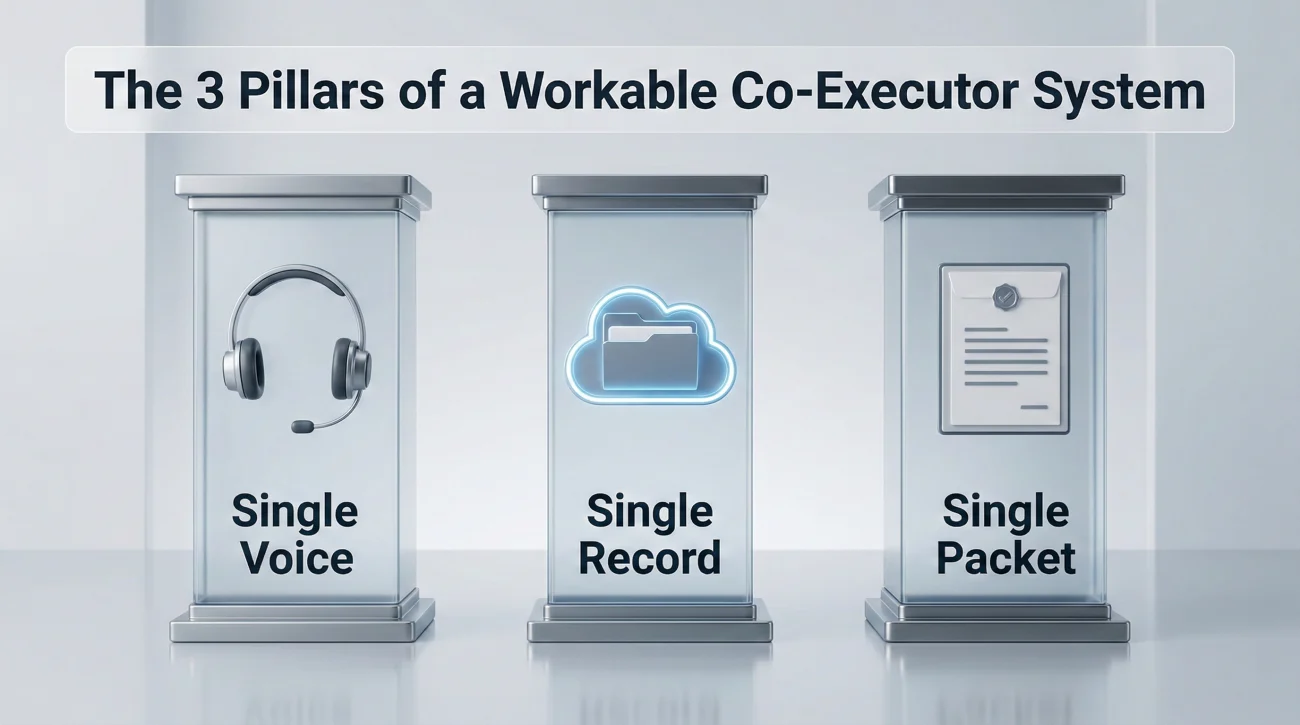
Rule 1: Single Voice
You must designate one person to handle all external communications. This person makes the phone calls, sends the emails, and mails the physical packets. Even if both of you are legally required to sign a form, the “Single Voice” is the one who puts it in the envelope and tracks the delivery.
❌ Note: Never surprise an institution. If the designated caller changes, you must notify the institution in writing, or they will flag the account for suspicious activity.
Rule 2: Single Record
Information cannot live in two different email inboxes or on two different dining room tables. You need one central hub. I strongly suggest using a shared cloud folder (like Google Drive or Dropbox) where every scanned document, every PDF, and every receipt is uploaded immediately.
When you rely on forwarding emails to each other, things get lost. A single record ensures that if Executor A is the designated caller, Executor B can log into the shared folder at 2:00 AM and see exactly what was accomplished that day without having to ask.
Rule 3: Single Packet
When submitting documents to a bank or a government agency, you must submit a unified packet. If the institution needs four documents, do not have one executor mail two of them from New York and the other executor mail the remaining two from Texas. Compile everything into one physical or digital package, include a clear cover letter, and send it from the designated “Single Voice.”
Decision Logs vs. Call Logs: Keeping the Peace
The biggest fear a co-executor has is losing control or being left out of the loop. To solve this without creating a bottleneck, you need to separate how you track your internal agreements from how you track your external tasks. You need two distinct logs.
A fundamental part of a good executor first steps checklist is establishing these tracking habits early. If you do not write it down, it did not happen. And with two people involved, memory is your worst enemy.
| The Decision Log (Internal) | The Call Log (External) |
|---|---|
| Records what the two executors agreed to do. | Records what the designated caller actually did. |
| Example: “We agreed to sell the car to CarMax for the appraised value.” | Example: “Called CarMax at 10 AM, spoke to Sarah, scheduled pickup for Tuesday.” |
| Protects the executors from future disagreements with each other. | Protects the estate from institutional errors and lost paperwork. |
| Updated weekly or as major choices arise. | Updated immediately after every single phone call or email. |
The Decision Log is also your best tool for navigating real financial disagreements. If you disagree on whether to hire an attorney or accept a specific offer on a house, writing the options down in the log forces both of you to state clear, objective reasons rather than arguing emotionally.
By using a dedicated executor call log for institutional interactions, the “silent” executor never has to wonder if progress is being made. They can simply check the log. This drastically reduces the number of tense text messages between co-executors.
The Minimum Alignment Meeting (And What to Say)
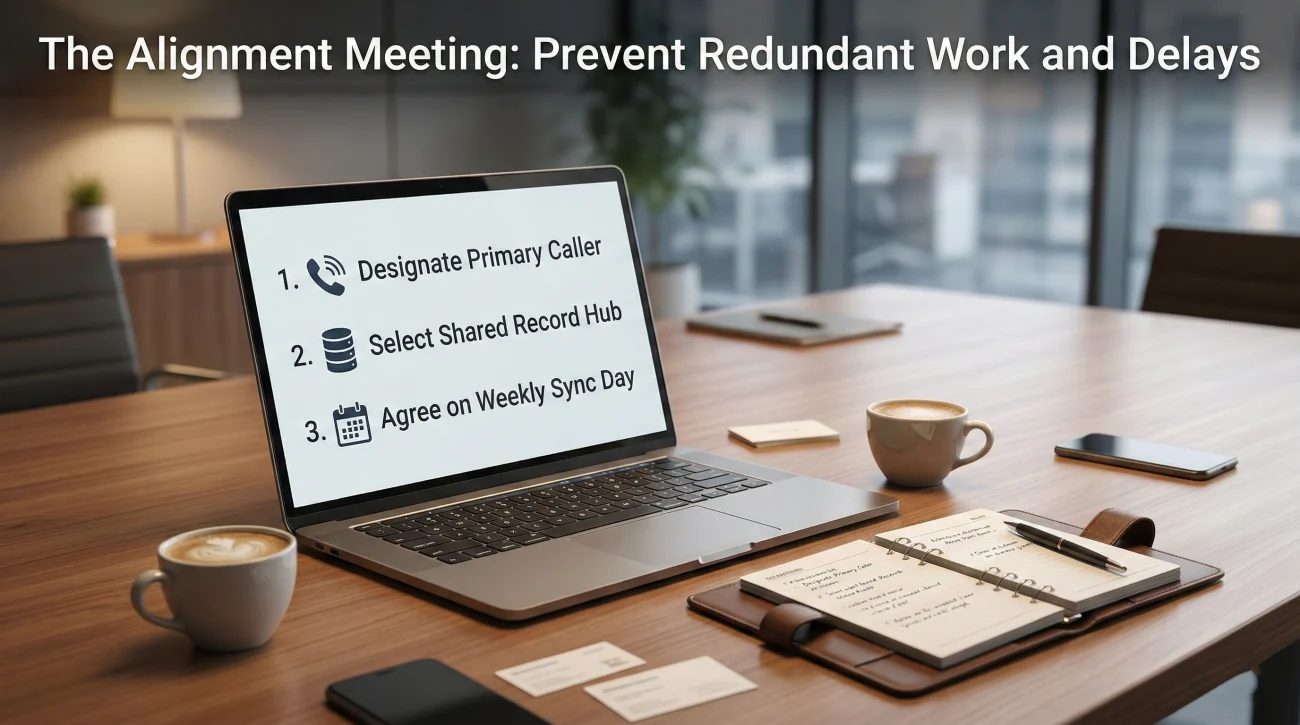
You cannot build this system via text message. You need a dedicated, structured conversation to lay the ground rules. I call this the Minimum Alignment Meeting. It is not about making financial decisions; it is purely about deciding how you will work together.
Timing is critical: you should hold this meeting within the first two weeks of being appointed, and absolutely before either of you begins calling financial institutions. A basic agenda should cover three things: identifying who will be the external caller, choosing the cloud service for your shared record, and agreeing on a specific day of the week for status updates.
If you are struggling with how to propose this to your co-executor without sounding bossy, frame it around the institutions, not around trust. Here is a practical script you can adapt to start this conversation:
Subject: Setting up our workflow for the estate
Hello [Name],
As we get started on this process, I want to make sure we don’t end up duplicating work or confusing the banks. I have read that institutions often freeze accounts if they get calls from two different people on different days, as it triggers their fraud alerts.
To keep things moving smoothly, I suggest we designate one of us as the primary caller for banks and agencies. We can set up a shared Google Drive so we both have 24/7 access to all documents, notes, and call logs.
Would you prefer to be the primary caller, or would you like me to take on that role while you review the logs and handle the physical mailings? Let me know what you think is best.
Notice the structure of this message. It identifies the common enemy (bank bureaucracy and delays), proposes a clear system (shared drive), and offers a choice of roles rather than dictating orders. This approach is rooted in solid executor week one communication hygiene.
How to Reduce Noise Without Hiding Information
Once the system is running, the goal is transparency without micromanagement. One of the patterns I see that quickly burns out co-executors is the “daily update” habit. Calling your co-executor every afternoon to summarize your tasks is exhausting and emotionally draining.
💡 Pro Tip: Replace daily check-ins with a disciplined executor document tracker. The tracker becomes the update.
Instead of constant chatter, rely on asynchronous communication. Decide on a specific day of the week, for example, Sunday evening, where you send a brief, bulleted summary of the week’s progress and the goals for the upcoming week. This creates a predictable rhythm.
If a major decision requires both signatures, bundle those requests. Do not send three separate emails on three different days asking for signatures. Gather the documents, outline exactly what they are for in a single message, and request the signatures at once. This respects both people’s time and directly prevents the institutional review delays that can push an estate settlement into its second year.
Final Thoughts
Being a co-executor does not mean doing everything together. It means building a system where the workload is divided logically, records are shared transparently, and the institutions only ever hear one consistent voice.
If you find yourselves tripping over each other, getting frustrated by redundant tasks, or receiving letters from banks asking for clarification, pause the work. Step back, implement the single voice rule, set up your shared logs, and reset your approach. The estate will settle much faster when you operate as a unified system rather than two well-meaning individuals acting independently.
Referenced Data Sources
To provide accurate operational context, this article references the following data points regarding estate administration workflows and co-executor dynamics:
- 📄 American Bar Association (ABA): Guidelines for individual executors emphasizing fiduciary duties, accurate record-keeping, and the necessity of unified administration to prevent liability. (View Source)
- 📄 Sterling Counsel (Oct 2024): Research on common sources of disputes between co-executors, noting that conflicts frequently cluster around communication styles, process expectations, and decision-making approaches. (View Source)
- 📄 Vogel Lawyers: General operational explainer regarding the structural friction and administrative delays that occur when co-executors disagree or provide conflicting instructions to institutions. (View Source)
❓ FAQ
🛑 Can two executors act independently?
Institutions usually require both executors to sign major authorizations. While day-to-day administrative tasks (like gathering information) can be done independently, acting without a unified system often causes banks to flag the account for conflicting actions.
📞 What happens if co-executors disagree on an asset sale?
If institutions receive conflicting instructions, they will freeze the asset. Operationally, you should use your Decision Log to force both parties to write down objective reasons for their stance. If a stalemate persists, court intervention is required.
🌍 How do we submit documents if we live in different states?
Maintain the “Single Packet” rule. One executor signs and mails the original document to the other, who countersigns and mails the final packet to the institution. For urgent items, ask the institution if they accept Remote Online Notarization (RON).
🏦 How do banks handle two executors calling at different times?
Banks log every interaction. If their system shows two different people calling with varying questions about the same estate, their risk management protocols often flag the file, leading to frustrating delays and manual reviews.
🤝 How should co-executors split the work fairly?
The fairest way is a division of roles, not identical tasks. One person acts as the external communicator (calling banks, mailing packets), while the other acts as the internal auditor (reviewing logs, tracking documents in the shared folder).
⚠️ What if one co-executor is also a beneficiary of the estate?
This creates a potential conflict of interest. Institutions may scrutinize distributions more closely or require a written conflict waiver. To protect both parties, ensure every decision is heavily documented in the shared log.
📝 Can one executor step back if they are overwhelmed?
Informally, one executor can let the other handle all daily admin while still reviewing logs. However, to step back entirely and relinquish liability, they cannot just stop answering emails; they must file a formal renunciation with the court.
⚖️ Does having two executors slow down the probate process?
It frequently does. The requirement to coordinate schedules, mail documents across states for dual signatures, and align on decisions adds an administrative layer that naturally extends the timeline compared to a single-executor estate.
📂 What is the best way for co-executors to share files?
Set up a secure, shared cloud storage folder (like Google Drive or Dropbox). Scan all incoming mail and immediately upload it. This creates a single source of truth that both executors can access at any time, eliminating forwarded email chains.
🔇 What do I do if my co-executor becomes completely uncooperative?
Start an escalation path: send a polite written reminder, followed by a formal written request outlining the delayed tasks. If they still refuse to act or communicate, you may need to petition the court to have them formally removed.
⚠️ Disclosure: I'm not an attorney and nothing on this site is legal or tax advice. The content covers process, organization, and workflow—the operational side of estate administration. For legal interpretation, jurisdiction-specific deadlines, contested situations, or tax matters, please work with a licensed professional in your state.