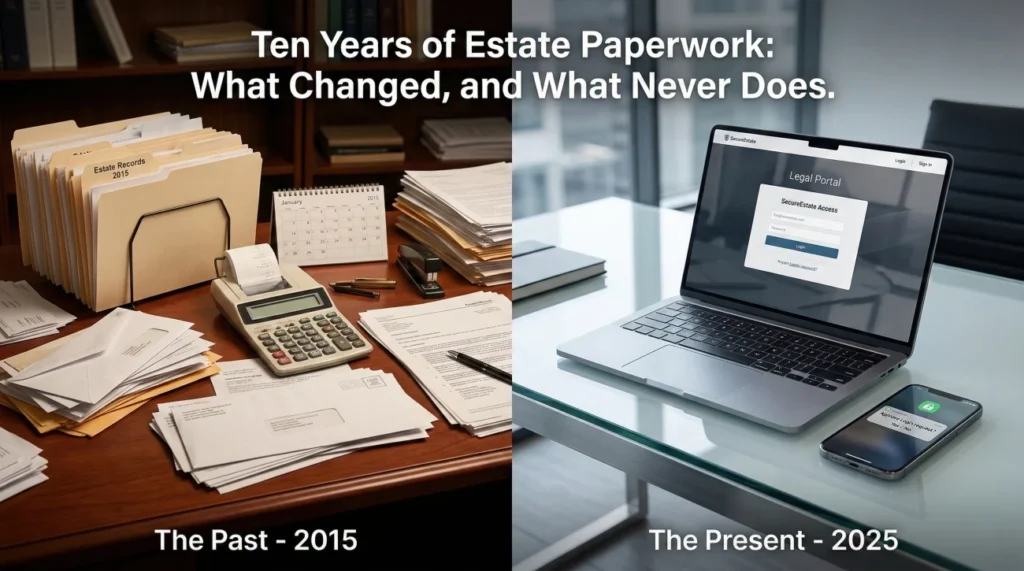
- The landscape of estate paperwork has shifted dramatically in three distinct eras over the last decade, moving from paper mailboxes to remote notarization and locked digital apps.
- Because the environment changed, my own operational workflow had to change. I no longer tell executors to wait 30 days for the mail to arrive; proactive digital mapping is now the mandatory first step.
- Despite all the technological upgrades, the human beings reviewing your documents have not changed. Institutions still reject packets in 2025 for the exact same formatting reasons I saw back in 2015.
The Rejection Letter That Looked Like a Time Capsule
Not long ago, I was helping a family review a status letter they had received from a major financial institution. The estate representative was incredibly frustrated. They had been trying to gain access to a seemingly simple account for weeks, only to receive a generic letter stating that the documents provided were “insufficient to establish authority.”
Looking at that letter, I had a distinct sense of déjà vu. Except for the digital letterhead and the current year printed at the top, it was completely identical to a rejection letter I held in my hands back in 2015. It had the exact same phrasing, the exact same ambiguity, and it created the exact same roadblock.
If you are stepping into an executor role right now, you probably feel overwhelmed by the sheer volume of modern requirements. You might assume there is some new secret system, a fresh digital workaround, or a hidden rule that makes estate administration easier today than it was in the past. After a decade of tracking executor workflows and watching where document packets go missing, I can tell you the reality is vastly different.
The tools we use have completely transformed. But the foundational layer, meaning how institutions process your paperwork and why they reject it, has not changed one bit. Understanding this difference is the only way to keep your sanity and move the process forward without getting trapped in endless paperwork loops.
A Decade of Estate Administration in Three Eras
To understand why the process feels so broken today, it helps to look at how we got here. In my day-to-day admin support work, I have watched the “standard” estate settlement process mutate across three very distinct periods.
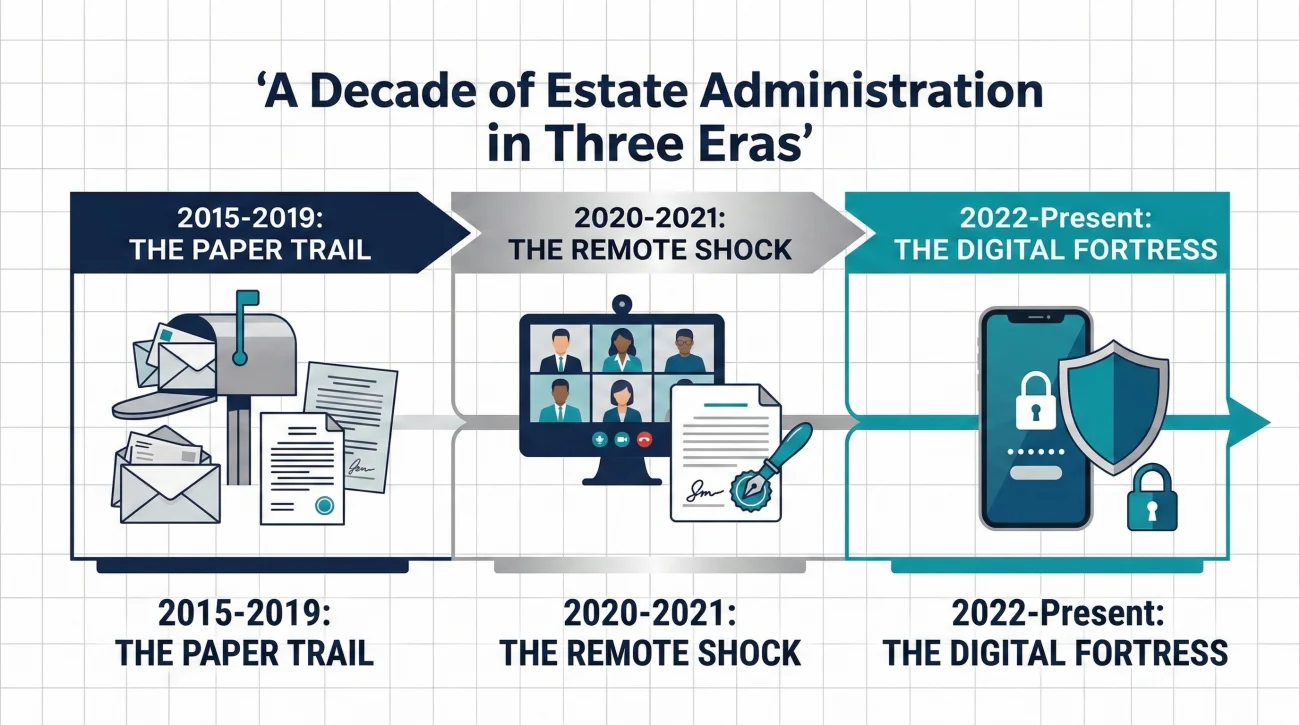
Era 1: The Paper Trail (2015 to 2019)
When I first started helping families organize estate documents, the hardest part was simply managing the physical volume of paper. We dealt with massive accordion folders. I remember sitting at a kitchen table in 2016 with a shoebox of envelopes, and within forty minutes we had mapped out eleven accounts just from the return addresses. The system had a built-in advantage. If you were patient, the estate basically revealed itself to you. Statements, bills, and tax documents naturally arrived in the physical mailbox. We could build an accurate asset map just by collecting the mail for a month.
Era 2: The Remote Shock (2020 to 2021)
Then the pandemic forced an archaic legal system online overnight. This era was pure chaos for executors. Probate courts that had relied on physical ink signatures for two hundred years suddenly had to adopt remote online notarization standards to keep the system moving. Call center wait times stretched into hours. But this was also the era where institutions realized they could enforce paperless operations permanently. The physical paper trail began to evaporate rapidly.
Era 3: The Digital Fortress (2022 to Present)
Today, we live in the digital fortress era. The primary hurdle is no longer gathering paper; it is piercing the veil of privacy and security. Almost every interaction is locked behind a two-factor authentication text message sent to a phone that may be locked, disconnected, or lost. The mailbox is empty, and the financial roadmap is hidden behind biometric app logins.
This massive shift is why modern administration is primarily an inventory problem. You cannot manage what you cannot see. If you are struggling to build this initial map without physical mail, relying on a structured approach to categorize these modern, invisible assets is essential.
How My Own Executor Playbook Had to Change
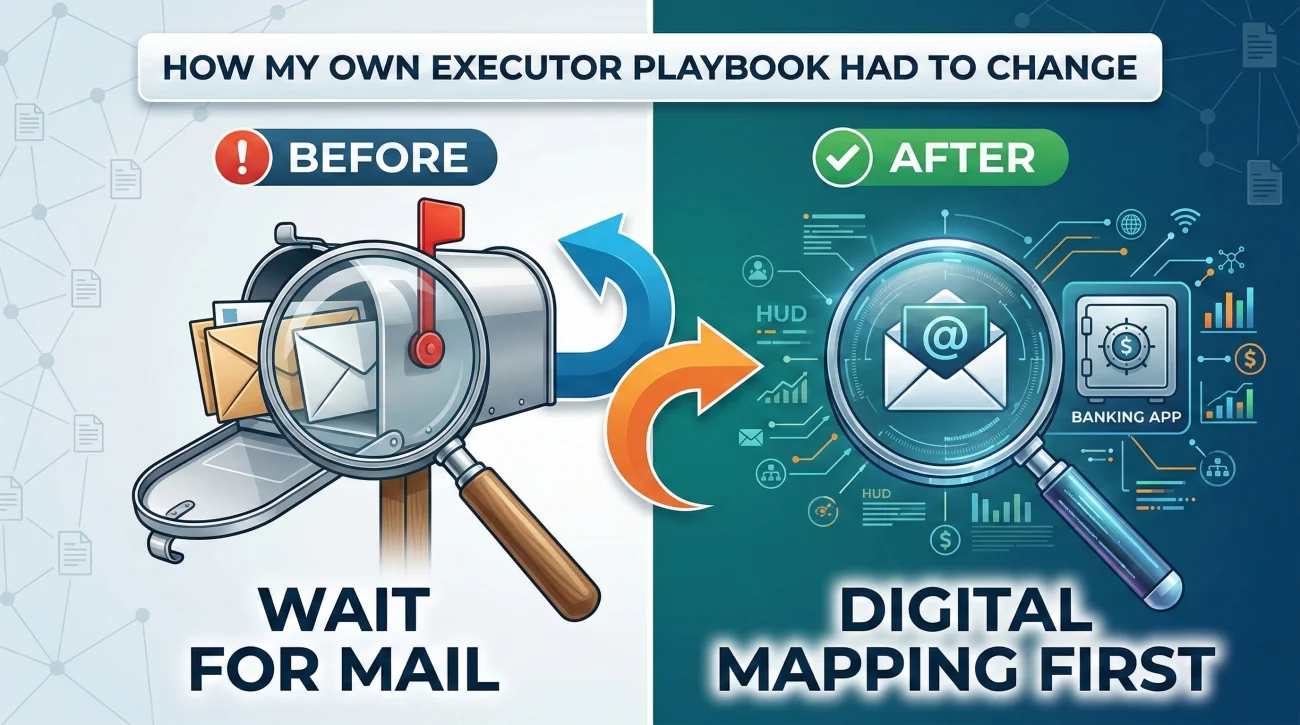
Because the landscape shifted so aggressively, my own advice to families had to evolve. Things I confidently told executors to do in 2016 will actively harm their progress if they try them today.
“Wait 30 to 45 days. Check the physical mailbox daily. The bills and bank statements will eventually tell you exactly what the person owned.”
“Assume the mailbox will be empty. Your very first task is securing the primary email account and mapping auto-pay deductions from the main checking account.”
I completely stopped relying on the mail. Today, I tell families that if they do not proactively hunt for digital footprints, entire accounts will slip through the cracks and end up in state unclaimed property vaults years later. Getting the sequence of these initial tasks right is more critical now than ever, which is why we map out the exact process in our executor first steps checklist.
The Human Bottlenecks That Survived the Decade
Here is the greatest irony of my job. We have e-signatures, secure portals, and instant digital transfers. Every few years, a new tool promises to fix this. And every time, the number stays the same. Industry data still shows the average time to settle an estate hovers around 16 months. Why?
Because the person reviewing your documents on the other end is still a human being managing corporate risk. And over the last ten years, I have watched those human reviewers reject packets for the exact same reasons, year after year.
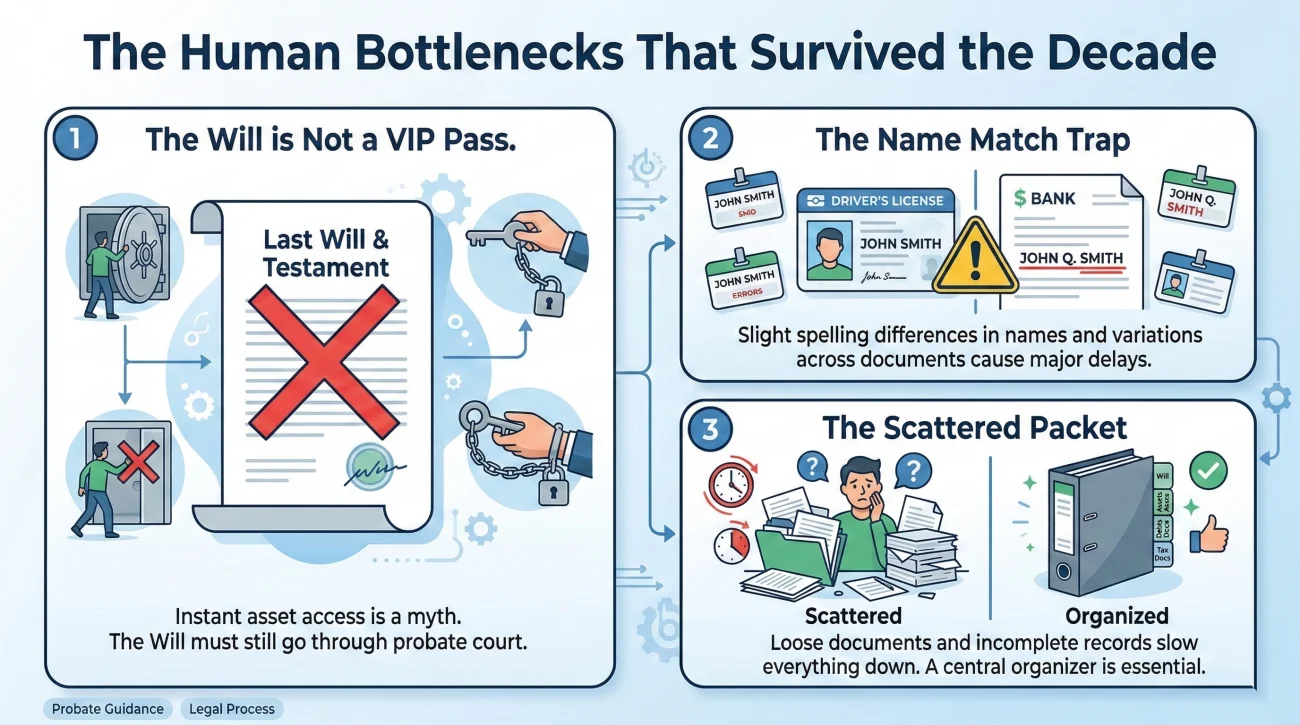
The Illusion of the Magic Document
Every single year since 2015, I have seen families mail a copy of the Will to a bank, assuming it acts like a VIP pass to access funds. And every single year, the bank sends it back. Technology did not change the fact that institutions only respond to court-issued authority, not personal wishes written in a Will. The confusion between being named in a document and being legally appointed by a judge remains the number one source of early frustration.
The Unforgiving Name Match
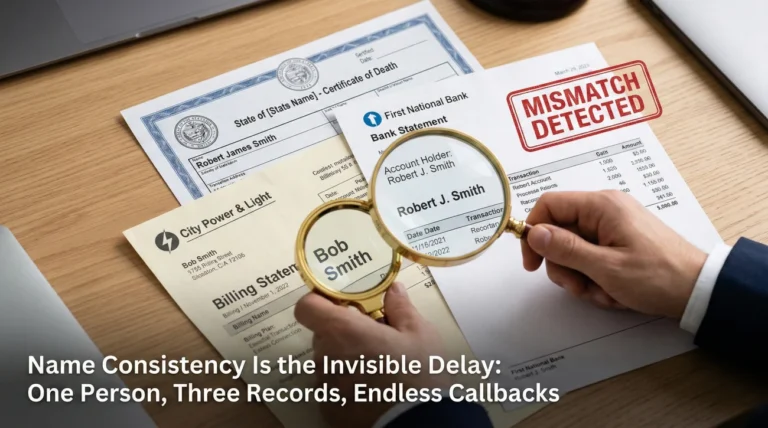
In 2016, I helped an executor whose file stalled for three months because the deceased’s middle initial was on the bank account but missing from the death certificate. Just last month, I saw the exact same scenario play out at a different institution. Digital systems have actually made this worse. Reviewers cannot use common sense; their software requires an exact character match. If you do not proactively map out name variations for them in your cover letter, they will simply reject the file.
The Scattered Packet Problem
Reviewers are evaluated on speed and accuracy. When they open a digital upload portal and find thirty misnamed PDF files with no cover letter, they do not try to piece the puzzle together. They flag the file as incomplete. I have seen this exact scenario play out dozens of times — the family assumes that sending something is better than sending nothing. It is not. The single most valuable skill an executor can learn is how to compile a readable, single-narrative packet.
💡 Pro Tip: Never upload or mail documents piecemeal. If an institution asks for three things, wait until you have all three, and submit them together with a clear index.
The One Tool That Never Expires
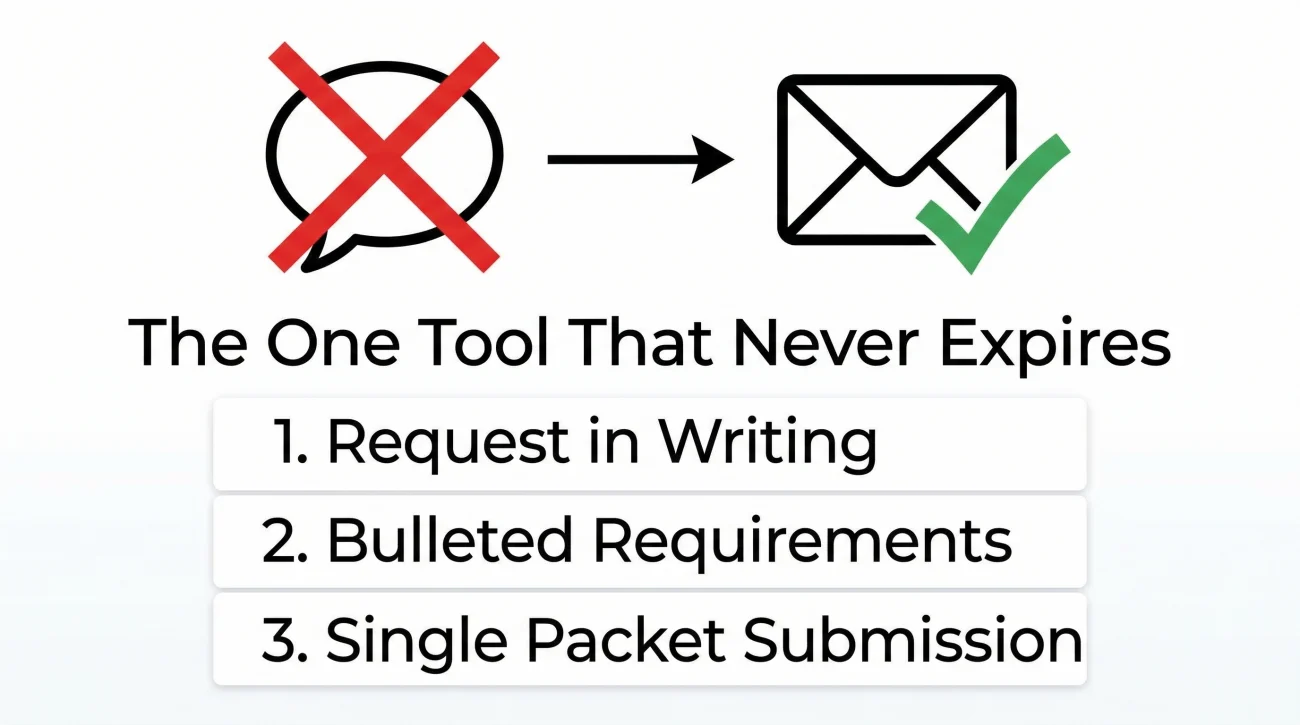
If there is one lesson that has proven true across this entire decade, it is that relying on phone calls to resolve paperwork issues is a trap. Call center notes are fragmented, and different representatives will confidently give you conflicting advice.
To cut through the noise, you must force the communication into a written format. This exact email template has lived in my drafts folder for almost ten years, and it works just as well today as it did when I first wrote it.
Hello [Representative Name / Department],
Thank you for reviewing the file for the Estate of [Name]. I understand your team needs additional information to proceed with this claim.
To ensure I provide exactly what your review team needs without creating further delays, please reply with a bulleted list of the specific missing documents or forms required.
Once received, I will compile these into a single submission for your team.
Thank you for your guidance,
[Your Name]
Representative for the Estate
This simple habit of demanding a written checklist has saved more hours of administration time over the last ten years than any digital dashboard ever could.
The Estate Closes, But Your Sanity Matters
Looking back over a decade of estate paperwork, the most important thing I want new executors to realize is that the friction you feel is not your fault. You are not failing because you are slow; you are navigating a corporate verification system that was fundamentally built to be slow, cautious, and suspicious.
The tools have modernized, but the underlying anxiety of the reviewer has not. By recognizing that delays are usually a matter of formatting, consistency, and clear communication rather than insurmountable legal walls, you can take a tremendous amount of stress off your own shoulders. Stay calm, document everything in writing, and remember that a highly readable, organized packet is your absolute best defense against a system that hasn’t truly changed its mind in ten years.
Sources
- Estate Settlement Statistics: Data regarding the 16-month average duration for estate settlement is sourced from EstateExec’s general statistics and research data.
- Remote Notarization Standards: Historical context and guidelines regarding the adoption of remote online notarization are provided by the National Association of Secretaries of State (NASS).
❓ FAQ
📱 Why won’t the company accept the death certificate online?
Many institutions require physical proof to check for raised seals or specific watermarks to prevent fraud. In my day-to-day work, I still see risk departments mandate original or certified physical copies even when they offer a secure upload portal.
📧 How do I find paperless accounts if I cannot log in?
Look for secondary footprints. Whenever I help a family that is completely locked out, we start by reviewing the main checking account statements for auto-pay deductions and monitoring the deceased’s email inbox if we have legal access to it.
🕰️ Is it normal for estate paperwork to take over a year?
Yes. Industry data commonly shows average settlement times around 16 months. In my experience, the families who move fastest are not the ones with simpler estates — they are the ones with more organized packets.
🪪 What happens if my name is spelled differently on the court document?
Name mismatches cause immediate delays. You will often need to provide an “Also Known As” affidavit. I always tell executors to proactively map these variations out in their very first cover letter so the reviewer doesn’t have to guess.
📤 Should I mail original documents or upload scans?
Always ask for the institution’s specific policy in writing first. I strongly advise never mailing your only original copy of any document unless explicitly required to do so, and always using tracked shipping if you do.
🗣️ Why do I have to keep explaining the same thing to different reps?
Call center systems often fragment notes, and different representatives may interpret your file differently. This is exactly why my number one rule is moving the conversation to written email or formal letters as quickly as possible.
📑 Can I just send the will to prove I am in charge?
No. A will is just a document expressing wishes until a local process validates it. I watch families make this mistake constantly. Institutions generally require official appointment documents to grant account access.
💻 How does remote notarization work for out-of-state executors?
In states that allow it, you connect with a certified notary via a secure video call, present your ID to the camera, and electronically sign the document. It is a huge relief for out-of-state executors I work with, though the technology can sometimes feel intimidating at first.
🛑 What should I say when an account is locked due to two-factor authentication?
Do not try to guess passwords. I always warn executors that too many failed attempts can trigger fraud lockouts. Inform the customer service team that the account holder is deceased and you need to initiate their formal deceased account workflow.
📝 How do I keep track of all these different portal logins safely?
Use a single, secure offline notebook or a dedicated password manager specifically created for your executor duties. I have seen the chaos that happens when estate portal logins get mixed up with an executor’s personal digital accounts.
⚠️ Disclosure: I'm not an attorney and nothing on this site is legal or tax advice. The content covers process, organization, and workflow—the operational side of estate administration. For legal interpretation, jurisdiction-specific deadlines, contested situations, or tax matters, please work with a licensed professional in your state.