
- Most estate administration delays happen because institutional reviewers cannot easily understand the document packet, not because the estate is legally complex.
- Institutions process thousands of cases at scale. If your IDs, forms, and letters do not perfectly align, your file gets pushed to the back of the manual review line.
- Creating a “reviewer-friendly” packet — using consistent names, clear file labels, and a single cover sheet — is the fastest way to stop the endless loop of document requests.
The “One More Document” Loop
When I review rejected packets for folks, the most common panicked email I get usually arrives around week three or four of the process. The executor has just walked out of a bank branch or gotten off a long phone call with a customer service agent. They are frustrated, exhausted, and convinced they have hit a massive legal wall.
They tell me, “I sent them everything. The death certificate, the court document, my ID. Now they are saying they need more documents, or they cannot verify the account. Do I need to hire a litigation lawyer?”
When we sit down and actually look at the paper trail, the truth almost always reveals itself. The bank is not disputing the legal right of the executor. They are just confused by the paperwork. Estate administration delays are incredibly stressful, but in many cases, they are simply paperwork problems dressed up as legal problems.
If you are stuck in a loop where institutions keep asking for items you feel you have already provided, you likely do not have a complicated legal battle on your hands. You have a document readability issue. Let’s look at how to fix it.
What Happens When Your Packet Reaches the Review Desk
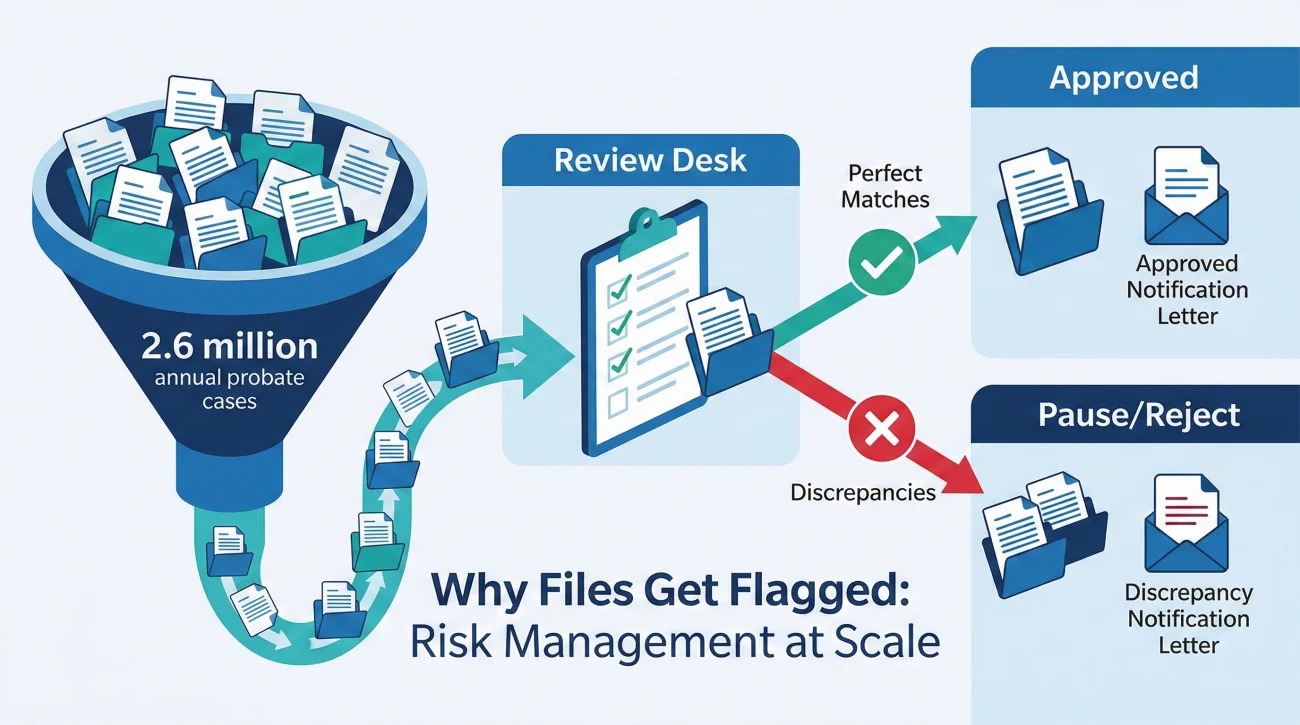
To understand why your documents keep getting rejected or flagged, I always ask executors to put themselves in the shoes of the person working in the back office of a major financial institution. They are not looking at your family’s unique story; they are looking at risk management at a massive scale.
There are approximately 2.6 million probate cases filed annually in U.S. state courts. Institutions are processing thousands of death notifications and executor requests every single week. Because the volume is so high, their frontline staff rely on strict checklists.
Key Point: A reviewer’s job is not to figure out what you meant to send. Their job is to protect the institution from liability by ensuring every document exactly matches their internal requirements. If there is a discrepancy, they pause the file.
According to national statistics from EstateExec, the average estate settlement takes almost 16 months, with about 80 percent settling within 18 months. A massive chunk of that timeline is eaten up by the friction of back-and-forth mailings, manual reviews, and mismatched information.
When a reviewer opens your file and sees scattered pages, missing signatures, or names that do not perfectly align, they do not call you to chat about it. They trigger an automated “incomplete file” letter and move to the next case. Your goal is to make sure your file never triggers that pause.
Always Get the Requirements in Writing First
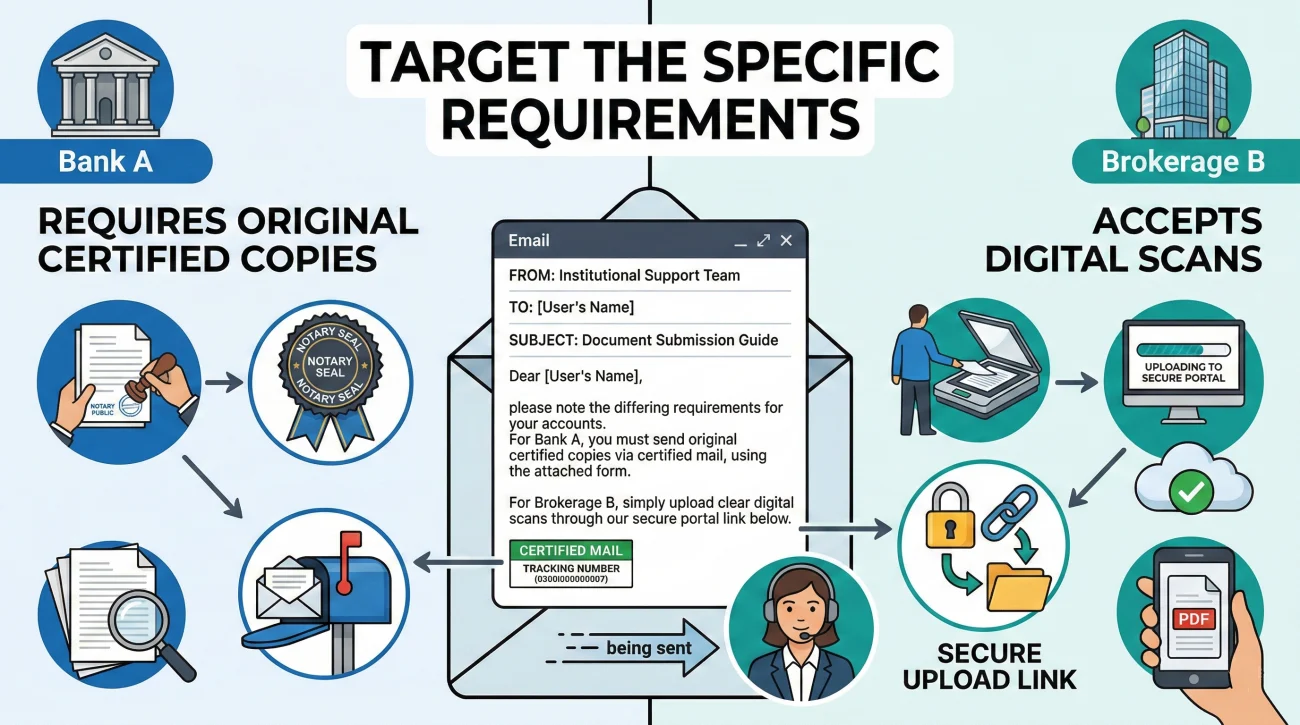
One of the biggest mistakes I see is an executor assuming that every bank wants the exact same packet. In reality, while the core documents are similar, the formatting requirements vary wildly. Before you put a single piece of paper in an envelope, you need the institution’s specific requirements in writing.
If you are tracking five to eight different institutions at once, relying on verbal instructions from customer service reps is a recipe for crossed wires and missing reference numbers. Use this script to force the institution to give you a clear target.
Hello,
I am the executor for the estate of [Deceased Name]. Before I submit the formal paperwork to access or close this account, please provide a complete, written list of all documents your legal department requires.
Specifically, please confirm:
1. If you require original certified copies or if clear photocopies/scans are acceptable.
2. If any specific forms must be notarized.
3. The direct mailing address or secure upload link for the estate settlement department.
Thank you,
[Your Name]
The 5 Rules of a Reviewer-Friendly Packet
I tell people to look at their document stack like a story. If a stranger cannot follow the plot in sixty seconds, the packet will get rejected. You have to do the translating for them. Here are the five principles I share with families to build a packet that gets approved the first time.
| Principle | How to Apply It | What Goes Wrong If Ignored |
|---|---|---|
| Consistency | Match names across all documents. If the ID says “Robert J.” but the bill says “Bob”, provide the connecting proof (AKA). | The file is immediately paused for “identity verification mismatch.” |
| Mapping | Always include a typed cover sheet that lists exactly what is attached and why you are sending it. | The reviewer has to guess what your attachments mean and often misses a crucial page. |
| Versioning | Date every cover letter. If sending an updated document, clearly label it as “Revised” or “Update.” | Old and new documents get mixed up in their system, triggering redundant requests. |
| References | Put the estate name, executor name, and institution reference/case number on every single page. | Your packet gets separated from the main case file in the mailroom. |
| Single Narrative | Only one executor communicates with the institution, acting as the sole point of contact. | Multiple callers create conflicting back-office notes, often flagging the account for fraud review. |
Where Most Document Packets Fall Apart
In day-to-day admin work, I see the same recurring failure modes. These are the specific friction points that cause a file to sit on a desk for an extra month.
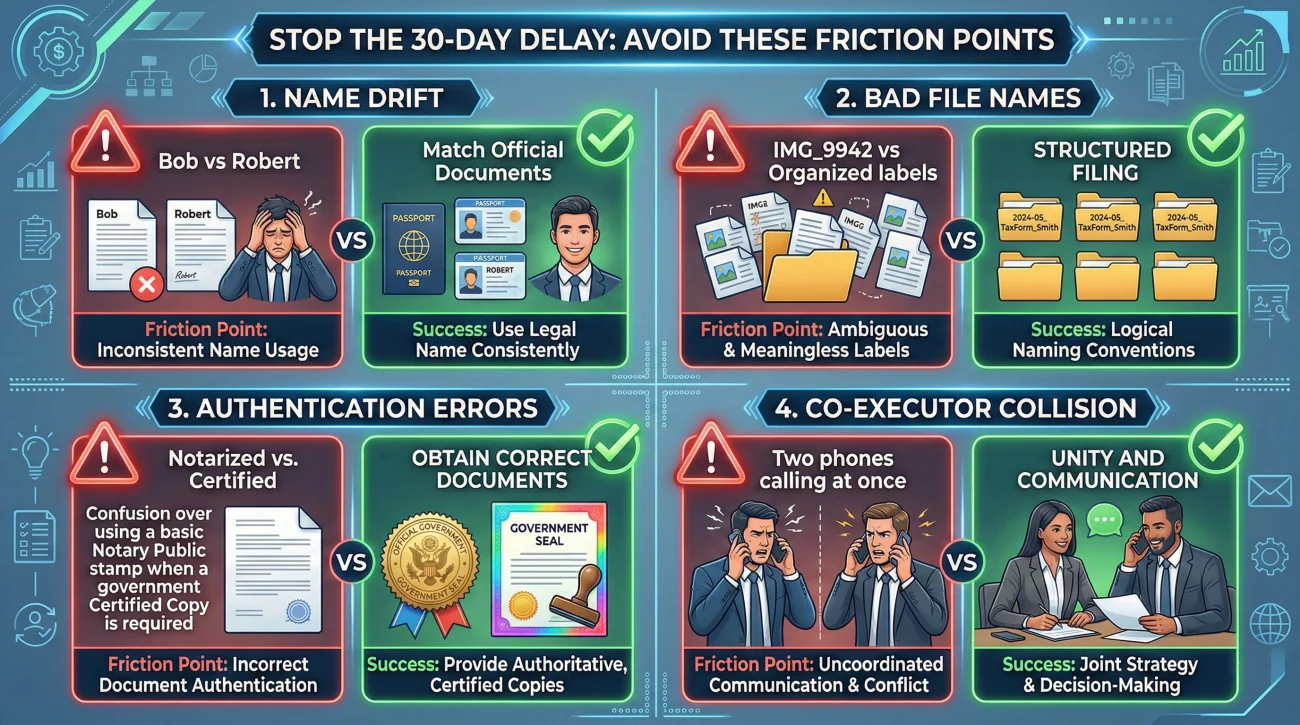
The Name Drift Problem
This is the most common culprit. Let’s say your father’s name was Robert James Smith. His bank account says “Robert J. Smith.” His driver’s license said “Robert James Smith.” But the utility bill you are trying to close just says “Bob Smith.”
To you, it is obvious that this is the same person. To a compliance reviewer, “Bob” and “Robert” are two different legal entities until proven otherwise. When you submit documents with name drift, you must address it upfront, often by ensuring court documents list “also known as” (AKA) variations.
Scattered Proof and Bad File Names
If you are uploading digital files to a portal, the way you name your files dictates how the reviewer feels about your case. If you upload five pictures from your phone with default camera names, the reviewer has to open each one, guess what it is, and mentally organize your file. Do not make them think. Name your files exactly what they are.
IMG_9942.jpg, scan_doc_new.pdf, untitled.pdf
1_Death_Certificate_Smith.pdf, 2_Court_Appointment_Smith.pdf, 3_Executor_ID_Smith.pdf
Notarized vs. Certified Copies
Many executors lose weeks because they misunderstand document authentication. A bank might ask for a “certified copy of the death certificate.” An executor takes a photocopy to a local notary, gets it stamped, and mails it in. It gets rejected.
A notary can only verify that a living person signed a piece of paper in front of them. A certified copy is issued directly by the vital records office or the court, bearing an official raised seal or watermark. Knowing which one the institution actually requires stops this loop before it starts.
Digital Assets with No Paper Trail
When dealing with PayPal, brokerage apps, or crypto exchanges, there is rarely a physical statement to mail back. Executors often try to take screenshots of the deceased’s phone, which institutions routinely reject for security reasons. For digital assets, the documentation must shift from physical statements to official account numbers, registered email addresses, and written requests submitted through the platform’s specific bereavement portal.
The Co-Executor Collision
If two people are named as co-executors, they often try to split the work: “You call the bank today, I’ll send the email tomorrow.” This is an operational disaster. When two different people submit documents or call in at different times, the institution’s system logs conflicting updates. Establish a strict protocol: one person is the sender and caller, while the other reviews and approves behind the scenes.
The Pre-Flight Checklist Before You Send
Before you seal an envelope or click upload on an institutional portal, take five minutes to run your packet through this pre-flight checklist. It is the best defense against a 30-day delay.
- ✅ Is the cover letter dated and signed?
- ✅ Is the institution’s reference number visible on the cover sheet?
- ✅ Are all pages of the court document included (even the blank back pages if they have a stamp)?
- ✅ Does the name on the death certificate perfectly match the account holder’s name?
- ✅ If the names do not match, is the linking proof (like an AKA on a court order) attached?
- ✅ Is your return address clearly printed and current?
- ✅ If mailing physically, are you using certified mail with a tracking receipt?
- ✅ Have you scanned and saved a complete copy of the exact packet you are sending?
Soft Signals That You Actually Need Legal Help
If you have followed every documentation rule, named your files perfectly, and provided certified copies, but the institution still stalls, the issue might finally be shifting from administrative to legal. As an executor, you need to know the difference between a desk clerk asking for a clearer photocopy and a compliance department raising a red flag.
⚠️ Warning: If an institution uses phrases like “competing claims,” “we require court clarification,” or “this account has a designated beneficiary that conflicts with your request,” you are no longer dealing with a paperwork issue.
When multiple people are claiming the same funds, or when the institution is genuinely unsure who has the legal right to the asset, no amount of neat file organization will solve it. That is the moment to step back and consult with the estate’s legal counsel.
Final Thoughts on Breaking the Bottleneck
Being an executor is an endurance event, and the paperwork can feel deeply unfair when you are already managing grief. But the moment you stop looking at institutional requests as personal rejections and start seeing them as system requirements, the process gets easier.
If you are currently stuck, stop calling and arguing with the frontline representatives. Take a breath. Pull your packet back out. Check it for consistency, map it clearly with a cover letter, and resubmit it as a single, clean narrative. Good executor first steps always start with organizing the paper trail before you make the phone calls. Treat your files like a professional project, and you will find that the “legal walls” suddenly turn into open doors.
Sources & Data
The operational patterns and statistics mentioned in this guide are informed by real-world estate administration tracking and the following industry data:
- EstateExec: General Statistics on Estate Settlement (reporting average settlement timelines of 16 months and 80% completion within 18 months).
- National Center for State Courts (NCSC) / ProbateCourtBond: Annual caseload reports indicating approximately 2.6 million probate cases are filed annually in U.S. state courts, highlighting the massive scale institutions must manage.
❓ FAQ
⏳ Why does the estate settlement process take so long overall?
The timeline accounts for mandatory creditor waiting periods, tax filings, and the slow back-and-forth of verifying documents with multiple financial institutions.
🏦 Why does the bank keep asking for the same death certificate?
They often lose track of separate mailings, or the copy provided was not a certified original. Always send documents as a complete packet with a cover letter reference number.
📋 How do I organize estate documents for the bank?
Group them logically: proof of death, proof of your authority from the court, and proof of your identity. Always include a typed cover sheet listing what is attached.
📞 What do I say when customer service cannot find my file?
Ask for the estate settlement department directly. Provide the reference number from your previous correspondence, and ask for an email address to send a consolidated, tracked packet.
📬 How should I handle documents that arrive from the court at different times?
Hold them in your main executor folder until you have the complete set required by the institution. Sending pieces individually guarantees a delay.
🛑 Can a bank refuse my executor documents?
Yes, they will refuse to process them if the names do not match perfectly, if the documents are expired, or if you do not provide the specific court-issued authority they require.
📝 What happens if the name on the will does not match the bank account?
You will likely face a delay. The institution may require court documents that explicitly list the deceased person’s “also known as” (AKA) names to bridge the gap.
📧 Is it better to mail or email estate documents?
If the institution offers a secure digital upload portal, that is usually fastest. If mailing, always use certified mail with a tracking number so you have a written receipt.
🕵️♂️ How do I know if an estate delay is my fault?
If you are sending loose documents without cover letters, changing your contact methods, or uploading poorly named files, you are likely contributing to the manual review delays.
📅 How often should I follow up on an estate account review?
Ask the institution for their standard review timeline (often 10 to 14 business days). Follow up in writing on the exact day that timeline expires if you have not heard back.
⚠️ Disclosure: I'm not an attorney and nothing on this site is legal or tax advice. The content covers process, organization, and workflow—the operational side of estate administration. For legal interpretation, jurisdiction-specific deadlines, contested situations, or tax matters, please work with a licensed professional in your state.