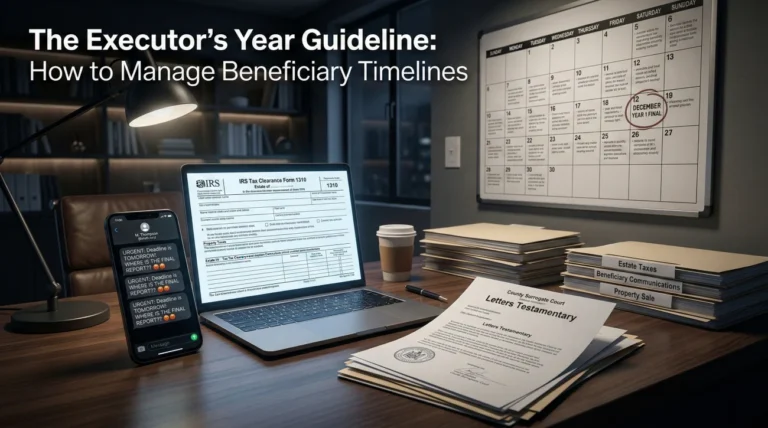

- The average estate takes roughly 570 hours of administrative work to settle, and it is rarely because the estate is legally complex.
- Most of your time as an executor is not spent on official court duties, but on reactive tasks like callbacks, waiting on hold, and re-submitting rejected documents.
- You can drastically reduce your hours by creating a single documentation packet and strictly tracking your communications.
- Beneficiary pressure usually spikes when they do not understand that the bulk of your 570 hours is spent navigating institutional bureaucracy.
The Guilt of the ‘Simple’ Estate
Around the third or fourth month of estate administration, I often hear from executors who are completely exhausted and feeling a heavy sense of guilt. Just last week, I spoke with an executor named Sarah. She was four months into managing an estate that only had three bank accounts and a clear will. Yet, she had already logged over 180 hours, mostly because a single bank rejected her paperwork three times over a medallion signature guarantee requirement nobody explained to her from the start. She asked me if she was moving too slow or doing something wrong.
If you are in Sarah’s position, I want to give you a clear reality check. A major national study revealed that the average executor spends roughly 570 hours settling an estate. Let that number sink in. The executor 570 hours reality is not a reflection of your efficiency. It is a reflection of a system that requires you to prove your authority over and over again to institutions that are built to manage risk, not to make your life easy.
⚠️ Note: While the administrative burden is universal, keep in mind that mandatory waiting periods for creditors and specific probate timelines will always vary by state.
In my experience helping executors streamline their workflows, I see families ramp up the pressure precisely because they do not understand where this time goes. They assume a simple will means a fast process. Today, I am going to break down exactly where those hours vanish, how to map your work buckets, and how you can stop losing time to the hidden trap of administrative rework.
What the 570-Hour Average Actually Means
When you hear that a job takes hundreds of hours, it is easy to imagine weeks of non-stop, focused labor. But estate administration does not work like that. It is a fragmented, start-and-stop process spread over many months.
The EstateExec statistics on executor effort show that while the average is around 570 hours, about 80 percent of estates are settled with under 800 hours of work. These hours are rarely spent doing high-level legal maneuvers. Instead, they are spent sitting on a 45-minute hold with a utility company, driving to a branch office to get a medallion signature guarantee, or searching through a basement for a 12-year-old life insurance policy.
Key Point: You are not spending 570 hours managing money. You are spending 570 hours managing institutional verification processes.
I frequently remind executors that this time is a marathon of small, frustrating tasks. If you try to sprint through it, you will only burn out. Understanding the categories of work helps you pace yourself and set boundaries with beneficiaries who might be wondering why things are taking so long.
The 6 Core Work Buckets
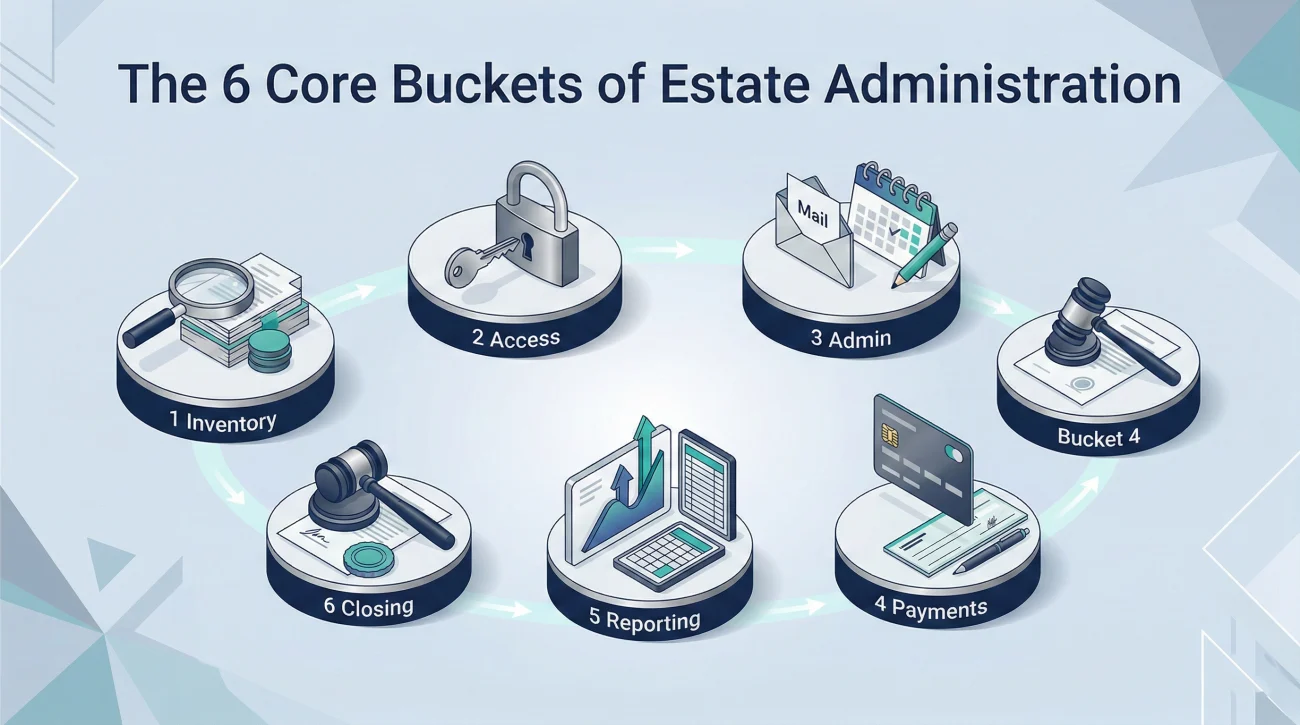
To make sense of where your time is going, you have to look at the work in categories. When I help executors build their systems, we usually break the process down into six distinct buckets. Each of these requires a different type of energy and documentation.
| Work Bucket | What You Are Actually Doing |
|---|---|
| 1. Inventory | Searching for assets, hunting down account numbers, and building a complete estate asset inventory to understand what you are managing. |
| 2. Access | Submitting death certificates and court letters to unfreeze accounts, transfer ownership, and gain online or phone access. |
| 3. Admin | Canceling subscriptions, forwarding mail, securing physical property, and managing the day-to-day carrying costs of the estate. |
| 4. Payments | Identifying valid creditors, paying final medical bills, filing tax returns, and ensuring debts are settled before distribution. |
| 5. Reporting | Logging every penny that enters or leaves the estate account and providing status updates to the court and beneficiaries. |
| 6. Closing | Executing final distributions, obtaining receipts from heirs, and formally closing the estate with the probate court. |
The problem is that you do not get to do these one at a time. You might be in the Access phase for a brokerage account while simultaneously handling the Admin phase for a vacant house. This context switching is mentally exhausting and eats up a massive portion of your overall timeline.
What Reduces Hours vs What Increases Hours
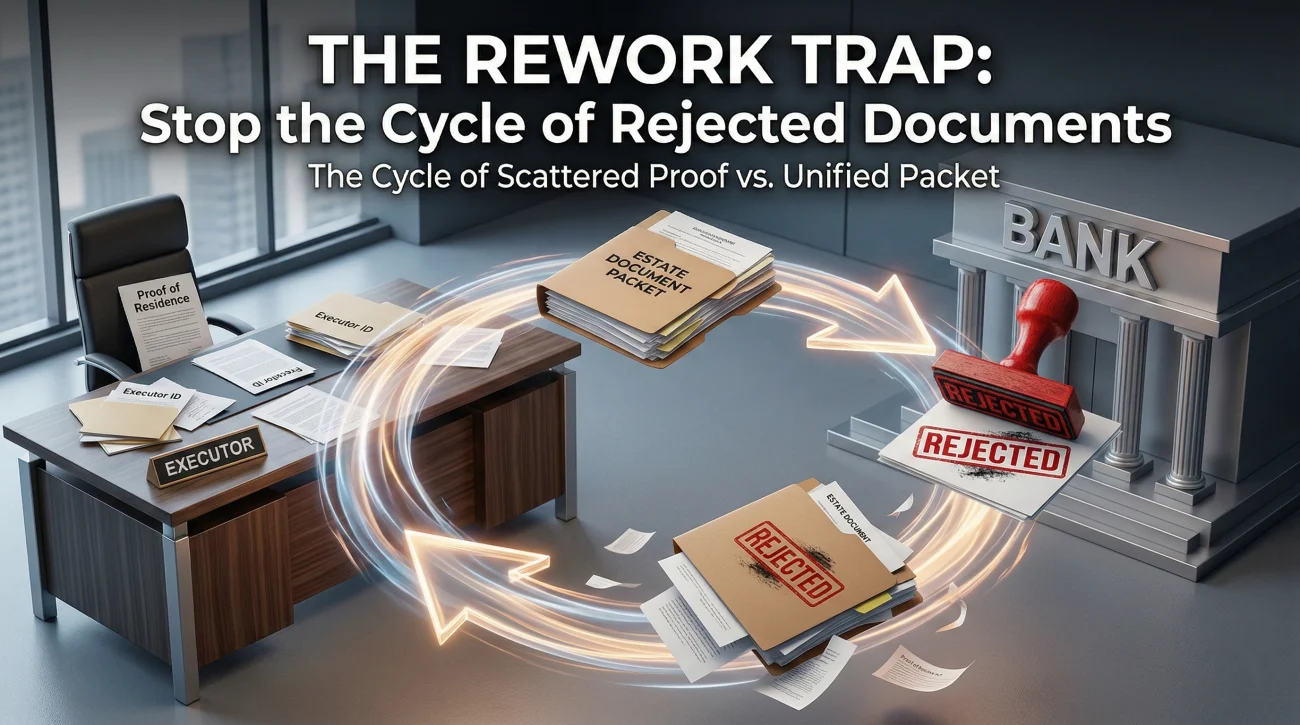
You cannot control how fast a bank reviews a file, but you can control how you submit it. The fastest wins usually come from stopping the cycle of rejected documents and repeated phone calls.
Calling an institution, writing down half the instructions on a sticky note, sending whatever documents you think they need, and waiting weeks for a reply.
Asking the institution for a written list of requirements, compiling a single organized packet, sending it with a tracking number, and logging a reminder to follow up in five days.
Getting Requirements in Writing
To protect your time, you must stop relying on verbal instructions from customer service reps. When you are told you need to submit documents, use this script to force clarity.
Hello,
I am the executor for the estate of [Deceased Name]. Before I submit my documentation packet, I want to ensure I provide exactly what your review team needs on the first attempt.
Could you please reply with a complete, written list of every document required to process this request? If there are specific forms or signature guarantee requirements, please include those details as well.
Thank you for your guidance,
[Your Name]
Executor
When you have their requirements in writing, you eliminate the risk of a representative telling you later that you missed a step. You are building a paper trail that holds them accountable and protects your timeline.
Protecting Your Time From Beneficiary Pressure

Beneficiary pressure usually spikes around month three or four. Because family members do not see the 45-minute hold times, the rejected forms, or the constant context switching, your silence looks like negligence to them. Their grief and impatience often turn into texts asking, “Why is this taking so long?”
The best way to stop this pressure is proactive, boundary-setting communication. Do not wait for them to ask. Instead, send a standardized monthly update that clearly shows the bureaucracy you are navigating.
Hello everyone,
I want to provide a quick update on the estate administration. This month, I completed [Task 1] and submitted the official paperwork for [Task 2].
Right now, we are in a mandatory waiting period for [Institution/Creditor review], which typically takes [X to Y weeks]. I cannot speed up their internal review process, but I will follow up with them directly on [Date].
I will send the next routine status update on [Date]. Thank you for your patience as we navigate this process.
Best,
[Your Name]
By telling them exactly when you will follow up with the bank, and exactly when you will update the family next, you close the communication loop. They no longer feel the need to check in constantly, which protects your mental space.
The Co-Executor Time Trap
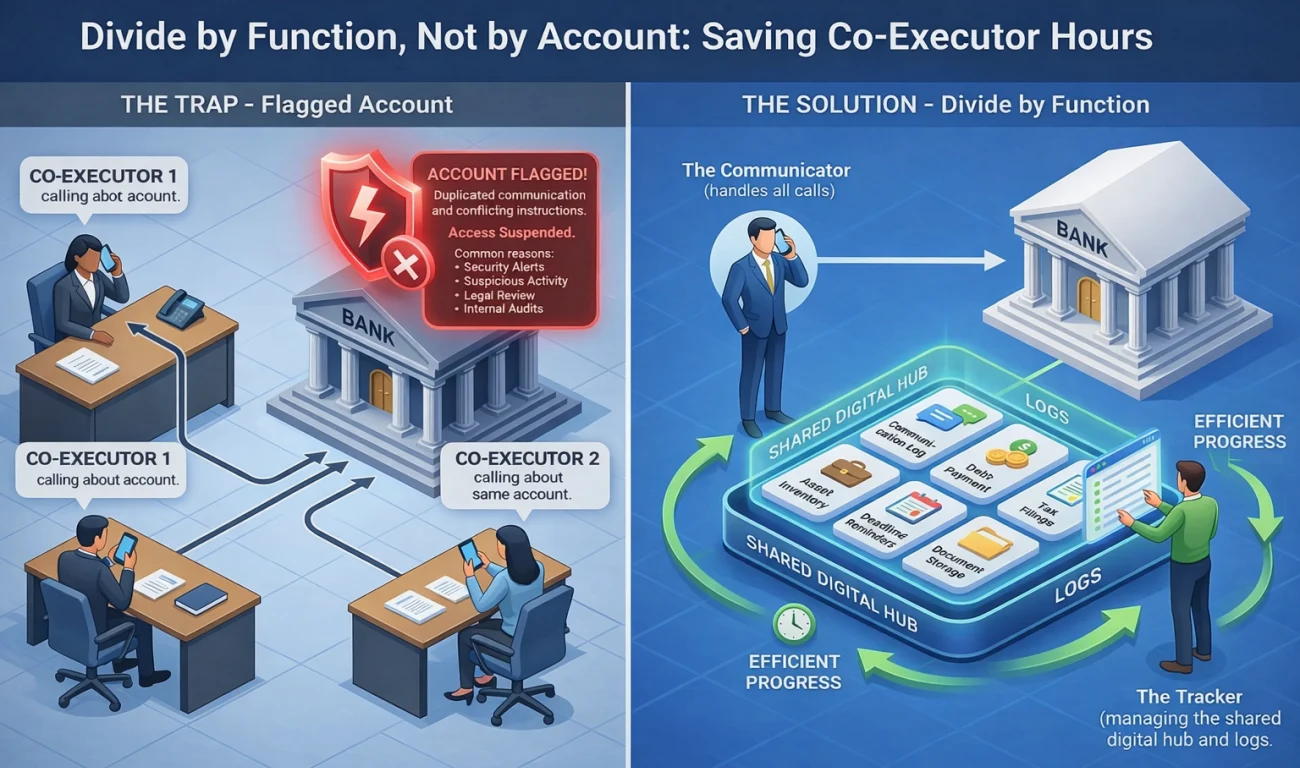
If you have a co-executor, you might assume the work will be split in half, reducing your hours. In practical terms, this is rarely true. In fact, poor coordination between co-executors is one of the fastest ways to increase the total hours spent.
When two people call the same institution separately, the bank’s security system often flags the account for conflicting instructions. Now, instead of moving forward, both of you have to jump through extra identity verification hoops. To prevent this, you must divide your labor by function, not by account.
| Co-Executor Role | Primary Responsibilities |
|---|---|
| The Communicator | Makes all phone calls to institutions, acts as the single point of contact for bank departments, and signs standard requests. |
| The Tracker | Maintains the call log, organizes the digital file packet, manages the physical mail, and drafts the status updates for the family. |
💡 Pro Tip: Never duplicate your phone calls. Let the Communicator handle the friction with the bank, while the Tracker ensures the paper trail is flawless. This system alone can save dozens of hours.
Final: Keeping Your Sanity Through the 570 Hours
The guilt Sarah felt in her fourth month is something almost every executor experiences. Feeling overwhelmed by the sheer volume of hours you are pouring into an estate is a normal part of the process, especially when you are grieving and trying to manage your own life at the same time.
Stop judging yourself for not moving faster. Instead, focus on moving systematically. Build your single packet of authority documents, keep a strict log of every call you make, and always demand requirements in writing. You cannot change how slow the bureaucracy is, but by building a reliable system, you can protect your own time, stop the rework trap, and finally get your weekends back.
Sources
- 📄 EstateExec: General Statistics on Executor Effort and Timelines
- 📄 PRNewswire: First Nationwide Statistics on After-Death Practices
❓ FAQ
⏱️ How many hours does an executor actually work?
National statistics show the average executor spends roughly 570 hours settling an estate, though smaller estates often resolve with fewer hours. Much of this time is spent on administrative tasks and following up with institutions.
📅 Why does probate take so many months to complete?
Beyond your active working hours, estates are subject to mandatory state-level waiting periods for creditors (often 3 to 6 months) and tax filing timelines. The legal calendar moves independently of your personal effort.
🏃♂️ Am I moving too slow if the bank keeps asking for more proof?
Not necessarily. Institutions often process requests piecemeal. If you are actively tracking your submissions and calling for updates, you are doing your job. The delay is usually on their review desk, not yours.
📞 What specific tasks cause the biggest delays?
Missing tiny details causes the longest delays. For example, failing to get a Medallion Signature Guarantee on a transfer form can force an institution to reject your file, making you restart a 30-day review cycle.
⏳ Do I have to work on the estate every single day?
No. Estate administration is a marathon, not a sprint. It is healthier to dedicate specific blocks of time each week to handle calls and paperwork rather than letting it interrupt your daily life.
👨👩👧👦 How do I stop beneficiaries from constantly asking for updates?
Take control of the communication cadence. Send a proactive, brief email once a month detailing what you completed and what waiting period you are currently in. When they know an update is coming, they stop asking.
📝 Can a document packet really prevent callbacks?
Yes. Sending documents one by one confuses fraud and review departments. A single, comprehensive packet with a cover letter creates a clear narrative, reducing the chance that a reviewer will reject it out of confusion.
🏦 Why do banks claim they never received my forms?
Banks operate in silos. The local branch might not communicate with the back-office estate settlement team. Always keep copies ready to send again, and insist on written confirmation when they receive your file.
🤝 How should co-executors split the work to save time?
Divide by function, not by account. Have one person act as the sole communicator who calls institutions, while the other acts as the tracker who manages the digital files and logs the notes.
🛑 Is there a legal deadline to finish all 570 hours?
While courts have specific filing deadlines, the overall process is guided by the “executor’s year” — a general rule of thumb that an estate should ideally be settled within a year, though complex cases often take longer.
⚠️ Disclosure: I'm not an attorney and nothing on this site is legal or tax advice. The content covers process, organization, and workflow—the operational side of estate administration. For legal interpretation, jurisdiction-specific deadlines, contested situations, or tax matters, please work with a licensed professional in your state.