- The hidden layer: An unclaimed property search catches the stray assets (like old utility deposits or uncashed checks) that never made it into the deceased’s main filing cabinet.
- Timing matters: Do not rush this on day one. Wait until you have gathered the core assets, but always run a search before you finalize and close the estate.
- Data is key: To run an effective search, you need a master list of the deceased’s past addresses, maiden names, and common misspellings of their name.
- Log your zero results: Documenting where you searched and finding nothing is just as important as finding an asset. It proves to beneficiaries that you did your due diligence.
The Forgotten Financial Trails We Leave Behind
When you step into the role of an executor, your immediate attention is naturally drawn to the massive, obvious tasks. You secure the house, you locate the primary checking account, and you try to track down the main life insurance policies. But in my time helping families organize estate paperwork, I have noticed a very common pattern: it is rarely the big assets that cause lingering confusion. It is the small, forgotten accounts.
People leave financial breadcrumbs behind throughout their lives. A $150 security deposit from an apartment rented two decades ago. A final paycheck from a brief job that was mailed to the wrong address. A small dividend check from a forgotten stock split. When these items are returned to the sender or sit dormant for a certain number of years, the law usually requires the holding institution to turn those funds over to a state agency. This is what becomes “unclaimed property.”
Working through an unclaimed property search checklist is one of those simple, highly effective steps that many executors simply forget to do. It is not about finding a hidden treasure chest; it is about thoroughness. It ensures that every loose end is tied up before the estate is closed. More importantly, it gives you a clear paper trail to show beneficiaries that you turned over every stone.
In this guide, I will walk you through a practical, systematic approach to finding missing money, how to organize your search without getting overwhelmed, and exactly how to log your efforts so your records are bulletproof.
What Actually Ends Up as Unclaimed Property?
It is easy to assume that if someone was generally organized, they wouldn’t have any missing funds. But unclaimed property often has nothing to do with being disorganized. It is usually the result of a simple life transition, such as a move, a marriage, or an administrative error at a company.
Before you start searching, it helps to know what you are actually looking for. When I look at the logs of recovered property in routine estate administration, a few common categories appear repeatedly.
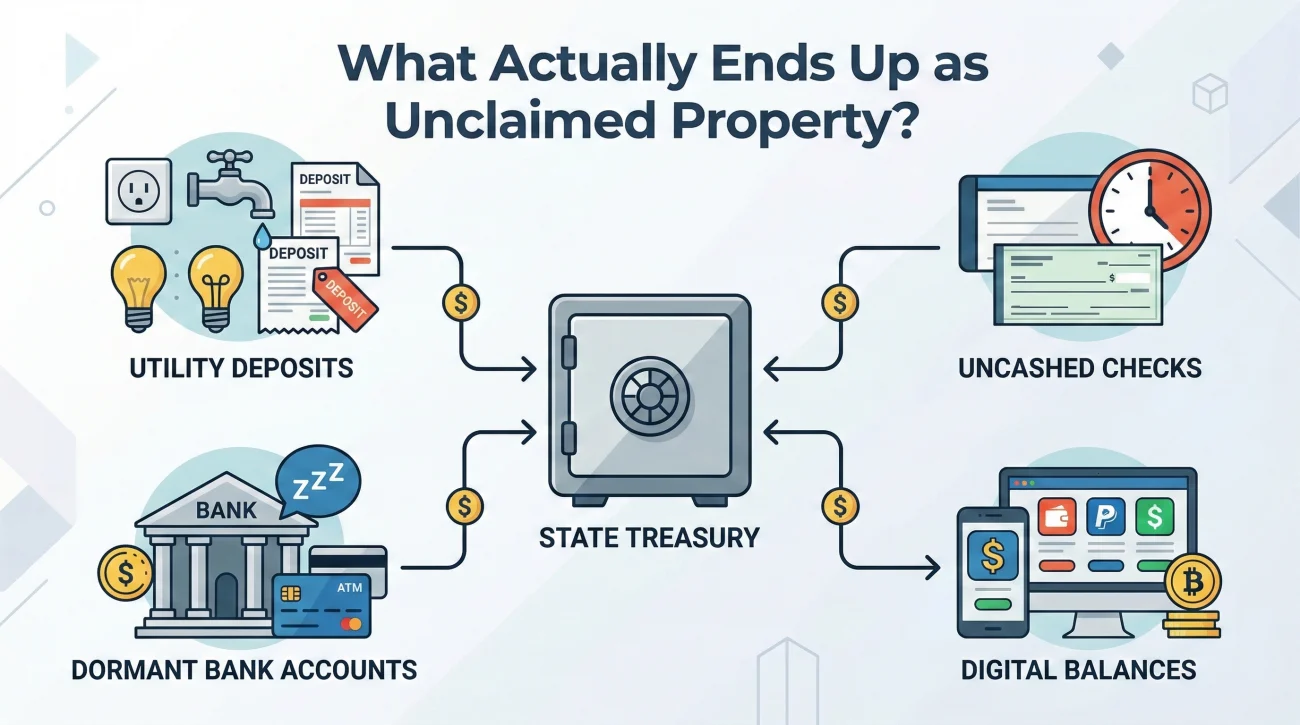
The Most Common “Lost” Assets
- 📄 Utility and Security Deposits: When people move, they often forget to provide a forwarding address to the electric company, water company, or their previous landlord. The final refund check bounces back and eventually goes to the state.
- 📄 Uncashed Checks: This includes final paychecks, vendor refunds, insurance premium overpayment refunds, and even small dividend checks.
- 📄 Dormant Bank Accounts: Sometimes, people open a savings account for a specific goal, fund it with a small amount, and completely forget about it. If there is no activity for several years, the bank turns it over.
- 📄 Digital and Modern Balances: Abandoned PayPal balances, unused prepaid Visa gift cards, and dormant accounts on cryptocurrency exchanges are increasingly swept into state custody after a few years of inactivity.
- 📄 Insurance Payouts: If a life insurance company knows a policyholder has passed but cannot locate the beneficiaries, the payout will eventually be remitted to the state’s unclaimed property division.
- 📄 Escrow Balances: After a mortgage is paid off or a property is sold, there is sometimes a small balance left in the escrow account for taxes or insurance.
⚠️ Warning on Safe Deposit Boxes: Never assume that a small account is not worth tracking down. I have seen situations where a “small” dormant checking account actually held the key to identifying a much larger, forgotten safe deposit box at the same branch. If you notice a tiny, recurring deduction for “box fees” on an old statement, immediately ask that specific bank branch to check for an undeclared safe deposit box under the deceased’s profile.
“Mom lived in the same house for 30 years and kept all her bank statements in one drawer. We don’t need to do a missing money search after death.”
“Even highly organized people have utility refunds or old escrow checks that get lost in the mail. Running a search takes 30 minutes and provides documented peace of mind.”
When to Run Your Unclaimed Property Search
Timing your search is an operational detail that can save you a lot of duplicated effort. Many new executors try to search for unclaimed funds on the very first day they receive their appointment documents. While the enthusiasm is great, doing it too early is usually inefficient.
In practice, it takes time for institutions to realize an account is dormant or a check is uncashed, and even more time for them to legally remit those funds to a state agency. If you search the day after the person passes away, you will only see very old items. You will miss anything that is currently in the process of being flagged as dormant.
A better workflow is to integrate this search into the middle and end phases of your administration duties.
Key Point: Run your primary unclaimed property search about three to six months into the estate administration process, after the daily mail has stopped revealing new assets. Run one final, quick search just before you prepare the final accounting to close the estate.
By treating the search as a mid-stage task, you are using it to catch the outliers, rather than trying to use it as your primary discovery tool. This step fits perfectly alongside your broader efforts to build a complete picture of the estate. If you haven’t yet built your central tracker for the major assets you already know about, I highly recommend pausing here to set up your master estate asset inventory first. The unclaimed property search is simply a layer you add on top of that foundational list.
Gathering Your Search Data: The “Known Variables” List
Databases are extremely literal. If a state database has a record for “William H. Smith” and you only search for “Bill Smith,” you will likely get zero results. Before you ever open a search portal, you need to compile a list of data variations to test.
In my experience, the families who successfully locate missing funds are the ones who build a simple grid of search terms first. You want to think like an investigator looking at a timeline of the deceased person’s life.
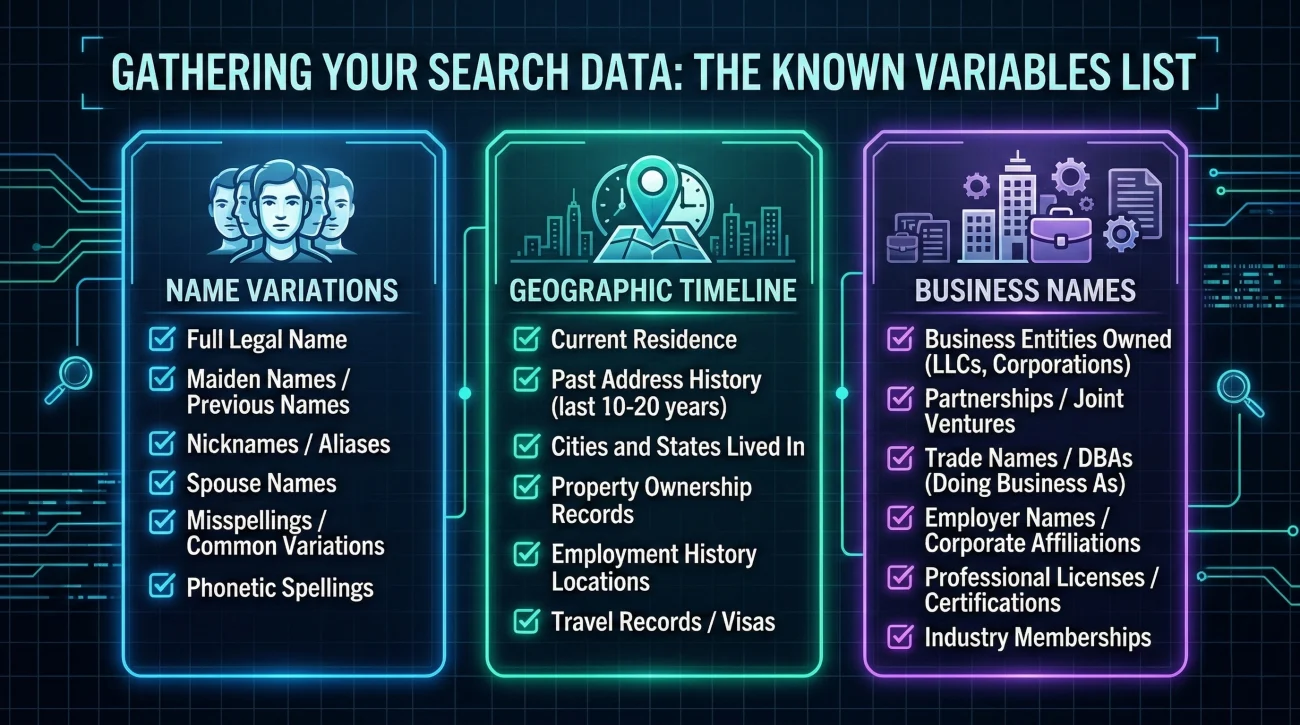
Data Points to Collect
Sit down with a piece of paper or a digital note and write out the following:
- ✅ Every name variation: First, middle, last. Maiden names. Names from previous marriages. Common nicknames that might have been used on informal accounts.
- ✅ Initials: First initial and last name (e.g., “J. Doe”).
- ✅ Common typos: If their last name was “MacDonald,” also write down “McDonald.” If it was “Jon,” write down “John.”
- ✅ The geographic timeline: List every state the deceased person ever lived in. Do not just focus on where they passed away. Include childhood states, college states, and states where they may have owned a vacation property or worked a temporary job.
- ✅ Business names: If the deceased ran a small sole proprietorship or a consulting side-business, write down the exact DBA (Doing Business As) names. Vendors often issue refunds to the business name, not the personal name.
💡 Pro Tip: Look closely at old tax returns if you have them. The address history and the names of former employers listed on W-2s are goldmines for figuring out which states you need to include in your search.
Executing the Search: A Systematic Approach
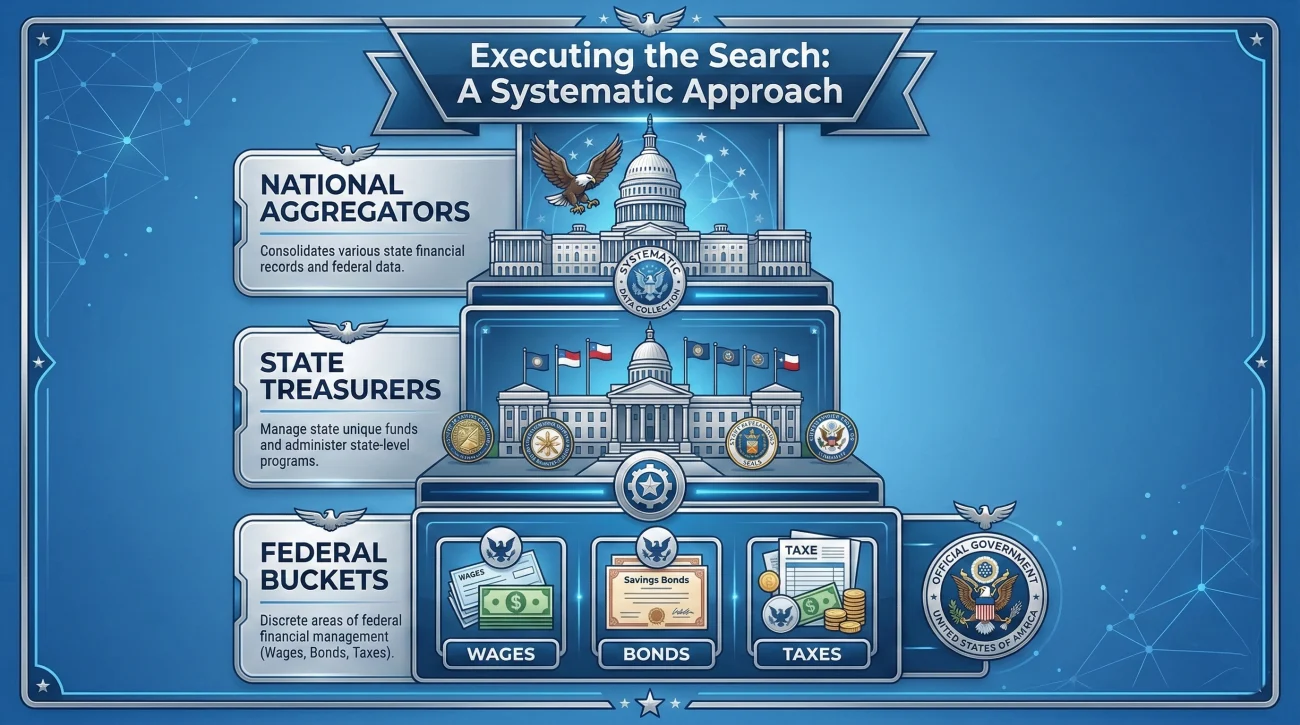
Once you have your list of name variations and states, it is time to do the actual searching. The key here is to stick to official, free government channels. You do not need to pay a third-party service to run these searches for you.
“I received a letter offering to locate missing estate funds for a 15% finder’s fee. Should I sign it?”
The operational answer is almost always no. Those companies are generally just querying the exact same free public databases that you have access to from your laptop. You can do this yourself safely and for free.
Tier 1: The National Aggregators
Start with the broad, multi-state search tools, often run by national associations of state treasurers. These databases let you run a name and see potential hits across many participating states at once. It is the fastest way to check off the states you weren’t even thinking about.
Tier 2: Individual State Treasurers
Not every single state feeds its data perfectly or instantly into the national aggregators. For the states where you absolutely know the deceased person lived, worked, or owned property, go directly to that specific state’s official treasury or comptroller website. Search their dedicated unclaimed property portal using all your name variations.
Tier 3: The Federal Buckets
This is where many executors stop, which is a major mistake. State treasurers do not hold federal funds. You must check these distinct federal portals separately:
- Unpaid Wages: The Department of Labor’s Wage and Hour Division holds back wages recovered from labor enforcement actions. You can search their Workers Owed Wages (WOW) portal.
- Savings Bonds: Uncashed Series EE or I bonds do not go to state agencies. You must use the TreasuryHunt.gov database provided directly by the U.S. Department of the Treasury to see if there are matured, uncashed bonds.
- Tax Refunds: Undelivered federal tax refunds remain with the IRS. You will need to use the IRS “Where’s My Refund” tool or contact the agency directly with the deceased’s final return information.
- Pensions: If a former employer went bankrupt or closed, their pension obligations might be guaranteed by the Pension Benefit Guaranty Corporation. You can search the PBGC’s Unclaimed Pensions database to verify.
What Happens When You Find a Match (And What If It Stalls)
Finding a match in Tier 1, 2, or 3 is just the beginning. Once you identify potential funds, you transition from discovery mode to recovery mode.
The database will usually generate a claim form. The agency will require proof of your authority (your court-stamped executor appointment documents), proof of the deceased’s identity (the death certificate), and often proof that the deceased lived at the address associated with the funds. This is exactly why keeping old tax returns or utility bills is critical.
Handling Denials and Escalations
Not every claim sails through smoothly. Sometimes, a state agency will deny a claim or put it in a “pending documentation” status indefinitely because the name variation is too broad or the address proof is deemed insufficient. If this happens, do not immediately give up.
First, ask the agency for their specific escalation path. Most state treasurers have an administrative appeal process where a supervisor reviews the rejected claim. For smaller amounts, providing a supplementary affidavit explaining the name or address discrepancy is often enough to clear the hurdle.
However, if the asset is exceptionally large (such as a six-figure uncashed life insurance payout) and the state refuses to release it due to complex legal naming issues, this is the exact moment to step back and hand the file to the estate’s attorney. Do not risk losing significant estate value trying to navigate legal roadblocks alone.
For the vast majority of standard claims, however, your biggest hurdle won’t be a legal denial. It will simply be the months-long processing queue. Managing that extended waiting period effectively is what keeps the estate moving forward.
Communication Hygiene: Following Up on Claims
Whether your claim is moving smoothly or requires a minor appeal, once it is officially filed, your job shifts entirely to monitoring. Submitting a claim for unclaimed property is rarely a fast process. State agencies handle thousands of these files, and the review queues can stretch for months. If you simply submit a form into an online portal and wait passively, you will likely lose track of it.
In estate administration, silence is not your friend. You need a structured way to follow up. If a claim has been pending beyond the stated processing time, use a calm, neutral communication script to request a status update. Avoid getting angry or expressing frustration about estate deadlines; just stick to the facts.
Subject: Status Inquiry – Claim ID #98765432 – Estate of [Deceased Name]
Hello,
I am writing to request a status update on Unclaimed Property Claim #[Insert Claim ID].
This claim was submitted on [Date] for the Estate of [Deceased Name]. The required supporting documents, including the death certificate and my appointment as executor, were uploaded on the same day.
Could you please confirm if this file is currently under review, or if there is any additional documentation your office requires from me to proceed?
Thank you for your time and assistance,
[Your Name]
Executor, Estate of [Deceased Name]
Direct Outreach to Former Employers
Sometimes your search doesn’t start at a state database. If you suspect a specific final paycheck or retirement balance exists but hasn’t yet been turned over to the state, you may need to contact a former employer’s human resources department directly.
When reaching out to corporate HR, you need to cut through the noise immediately. These departments handle hundreds of emails daily. To keep your request focused and highly actionable, I recommend relying on this simple communication framework:
[Action: State your role] + [What you need to know] + [Confirmation request]
By organizing your message this way, you ensure the HR representative knows exactly who you are and what steps they need to take next. Here is how that formula translates into a practical email:
Subject: Estate Inquiry – Final Compensation – [Deceased Name]
Hello HR Team,
I am the executor for the estate of [Deceased Name], who was formerly employed at your company. I am currently auditing the estate’s financial records.
Could you please review your records to determine if there are any uncashed payroll checks, unremitted expense reimbursements, or pending benefits under their name?
Please let me know what forms you require from me to verify my authorization and process any remaining items.
Thank you,
[Your Name]
Why You Must Log Every Search (Even the Empty Ones)
This is perhaps the most critical piece of advice I can offer regarding asset discovery: you must keep a log of where you looked, not just what you found.
❌ Note: A major mistake is keeping claims in your head. When an executor submits five different claims to three different states and relies on memory to track them, months will pass, claim emails will get buried in spam folders, and the funds will stall indefinitely.
Every search should generate a line item in a dedicated tracker. If a claim is initiated, the Claim ID number must be recorded immediately. If the search yields nothing, the word “Negative” must be recorded.
Handling the “Phantom Asset” Beneficiary
A common operational challenge is the “phantom asset” rumor. A family member might insist, “I know Dad had a secret account in Texas, you need to find it.”
If you run a search in Texas and find nothing, simply saying “I checked, there is nothing there” over a phone call is never enough to satisfy a suspicious beneficiary. This is where your log becomes your shield.
When you execute a search to chase down a rumor, take a screenshot of the “No Results Found” page showing the exact name variation you searched, the state database used, and the date timestamp. Log this action formally. If the beneficiary continues to press the issue, you can present this documentation in writing: “Per your request, a comprehensive search of the Texas Comptroller’s database was conducted on [Date] for [Name]. Attached is the negative result confirmation. Unless specific account numbers or statements are provided, this inquiry is considered closed.” This professionalizes the boundary and protects you from future claims of negligence.
Template: The Unclaimed Property Search Log
You do not need complicated software for this. A simple spreadsheet or a written log in a notebook works perfectly, as long as you are consistent. Here are the core columns you should maintain for your unclaimed funds estate search.
| Date Searched | Database / State | Name Variation Used | Result Status | Claim ID (if applicable) | Next Follow-Up Date |
|---|---|---|---|---|---|
| Oct 12, 2024 | National Database | John A. Smith | Negative | N/A | N/A |
| Oct 12, 2024 | Ohio State Treasurer | Jonathan Smith | 1 Match Found (Utility) | OH-998877 | Nov 15, 2024 |
| Oct 15, 2024 | Florida Comptroller | Jon Smith | Negative | N/A | N/A |
| Oct 18, 2024 | Dept of Labor (WOW) | John A. Smith | Pending HR Review | DL-443322 | Dec 01, 2024 |
When you integrate this table into your broader estate tracking system, it completely removes the mental burden of remembering what you have and haven’t checked. When it is time to distribute the estate, you simply look at the “Result Status” column. If everything says “Negative” or “Claim Paid,” you are clear to proceed. If something says “Pending,” you know exactly what is holding you up.
The Quick-Reference Search Checklist
Use this quick-reference summary to ensure no steps are skipped during your discovery process:
- ✅ Phase 1: Prep. Map out all name variations, maiden names, DBAs, and historical addresses.
- ✅ Phase 2: National Search. Query the multi-state aggregator portals.
- ✅ Phase 3: State Search. Check the individual treasury sites for every state the deceased lived or worked in.
- ✅ Phase 4: Federal Search. Query PBGC (pensions), TreasuryHunt (bonds), and DOL (wages).
- ✅ Phase 5: Document. Screenshot zero-result pages and formally log every Claim ID.
- ✅ Phase 6: Escalate. Follow up on stalled claims every 30 to 45 days in writing.
Final Thoughts: The Legacy of a Clean Estate
Stepping into the executor role is often an exercise in managing chaos. While tracking down dormant utility deposits or forgotten payroll checks might seem like tedious administrative work, it serves a much higher purpose.
By executing and documenting a rigorous unclaimed property search, you are doing more than just recovering stray dollars. You are actively building trust. You are proving to the family, the court, and yourself that every stone was turned, every rumor was investigated, and the estate was handled with absolute integrity. In the end, a clean, transparent record is the most valuable asset you can deliver to the beneficiaries.
❓ FAQ
🔍 How do I find unclaimed money for a deceased relative?
Start by compiling a list of all names and addresses the deceased used. Then, search the official state treasurer or comptroller websites for every state they lived in, as well as national aggregator databases. Always use official, free government portals.
🌐 Is there a national database for missing estate money?
There are national aggregator sites sponsored by state treasurers that allow you to run a multi-state search at once. However, not all states participate fully, so it is best practice to also check individual state treasury sites directly.
📑 What proof do I need to claim deceased money?
State agencies generally require the deceased’s death certificate, your official court appointment document proving you are the executor or administrator, your own photo ID, and sometimes proof connecting the deceased to the address associated with the funds.
⏳ How long does it take to get unclaimed property from an estate?
Processing times vary wildly by state and the complexity of the claim. It can take anywhere from a few weeks for simple, automated claims to several months if the claim requires manual review by an auditor.
⚖️ Do executors have to search for unclaimed funds?
While local rules vary, an executor generally has a fiduciary duty to identify and collect all assets of the estate. Running a standard search for missing funds is a practical way to fulfill that duty and ensure nothing is left behind.
🏢 Why does money go to the unclaimed property office?
By law, if a company (like a bank or utility) holds funds for an individual and loses contact with them for a specific period (the dormancy period), they cannot keep the money. They must surrender it to the state for safekeeping.
🛑 Are unclaimed property search websites a scam?
While some are legitimate data-mining services, many will charge you a heavy percentage fee just to query the exact same public databases you can search for free. Stick strictly to portals ending in .gov to avoid unnecessary fees.
📅 What happens if I find money after the estate is closed?
Discovering assets after formally closing an estate usually requires petitioning the court to reopen the estate so you can legally claim and distribute the funds, which involves more time, paperwork, and filing fees.
🏥 Does life insurance go to unclaimed property?
Yes. If a life insurance company becomes aware that a policyholder has passed away but cannot locate the beneficiaries after a certain period of time, the payout is typically turned over to the state as unclaimed property.
🗺️ How do I search multiple states at once?
You can use free national unclaimed property portals endorsed by state governments. These sites query participating states’ databases simultaneously. Just remember to run separate searches for states that do not participate in the joint network.
⚠️ Disclosure: I'm not an attorney and nothing on this site is legal or tax advice. The content covers process, organization, and workflow—the operational side of estate administration. For legal interpretation, jurisdiction-specific deadlines, contested situations, or tax matters, please work with a licensed professional in your state.