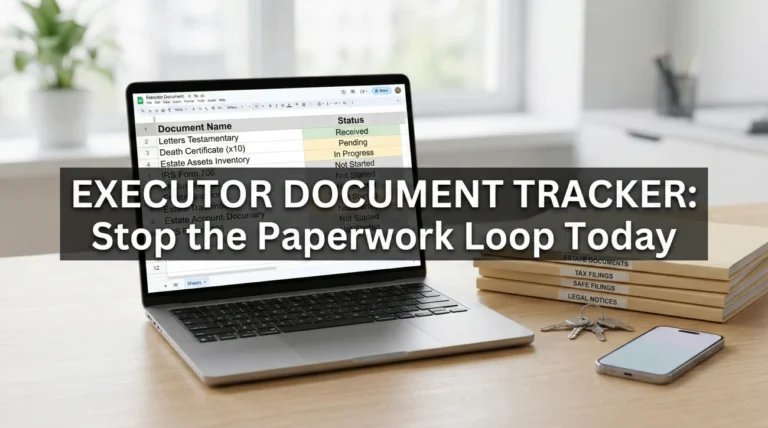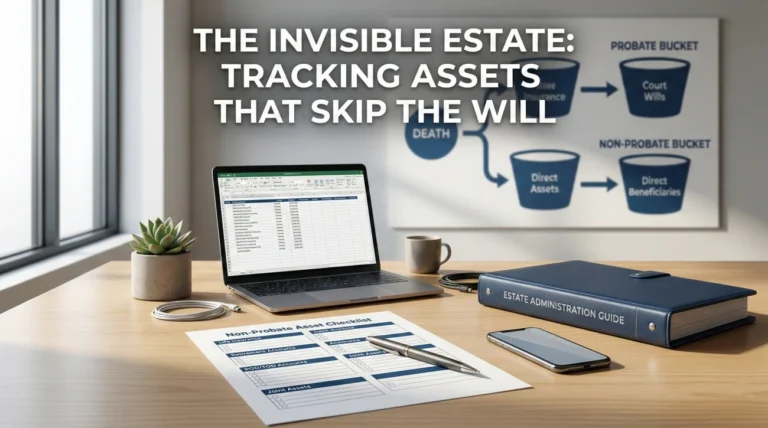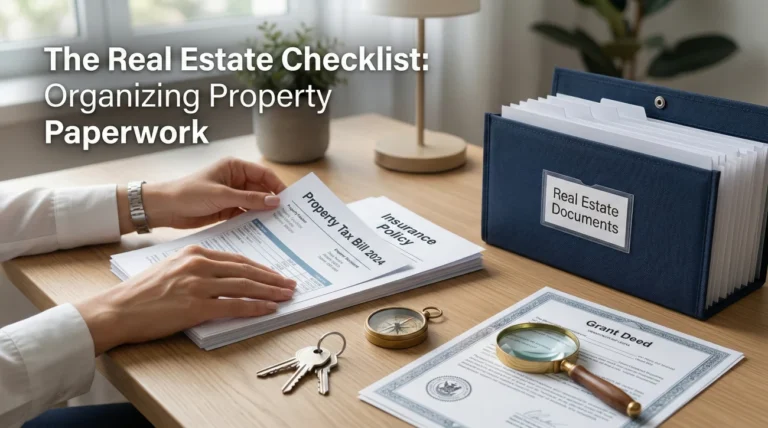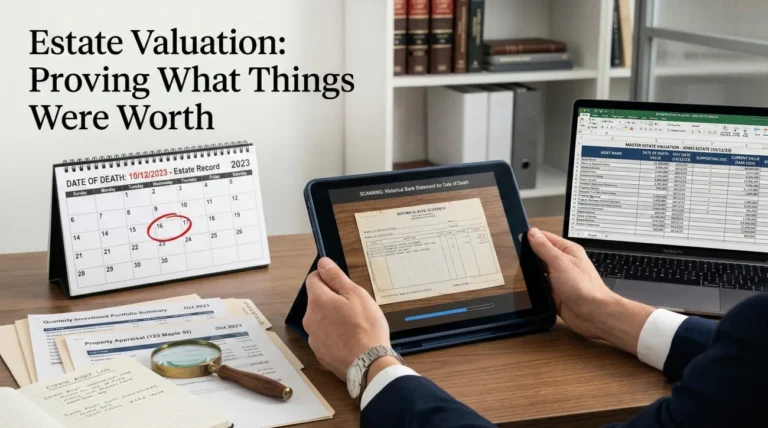
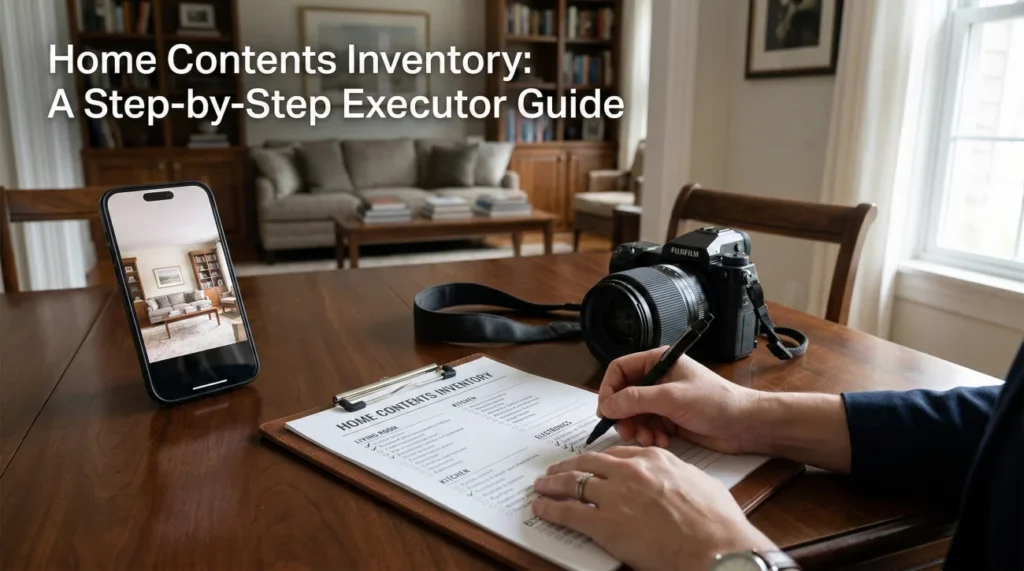
- Establish the baseline: Always take wide-angle and detail photos of every room, garage, and storage space before a single item is moved, boxed, or thrown away.
- Group the ordinary: Do not list every spoon and towel individually; categorize everyday items into logical groups to save hours of administrative time.
- Map the proof: For high-value items, locate and link appraisals and receipts to your tracking sheet. If no proof exists, log it as unverified rather than guessing its value.
- Secure the grey areas: Never open locked safes alone. Use neutral scripts to secure the physical property immediately and communicate clear boundaries with family.
The Weight of an Empty House
I often hear from executors who have just finished dealing with the immediate aftermath of a loss, only to stand in the doorway of the deceased’s home and feel completely overwhelmed. A house holds a lifetime of memories, and translating a home full of furniture, heirlooms, clothes, and everyday clutter into a neat, organized administrative record can feel like an impossible task.
If you are feeling this way, you are not alone. Building a reliable home contents inventory checklist is rarely about evaluating million-dollar art collections. More often, it is about methodically documenting the reality of the physical space so that you have a clear, unshakeable record of what was there.
In my experience supporting executors through this workflow, the most stressful moments rarely come from the complex bank accounts. They come from the missing family watch, the disputed dining room table, or the sudden realization that a sibling came by and “cleaned up” before anything was logged. My goal here is to help you build a shared experience of calm organization. I will walk you through a practical system to categorize, photograph, and document household contents in a way that protects you and keeps the estate administration moving smoothly.
Why Personal Property Gets Messy Fast
It is a common pattern I see: an executor will meticulously track down every digital account and financial statement, but they leave the house contents for “whenever the family gets together.” This is a recipe for administrative friction.
Physical items blend sentimental value with assumed financial value. Someone might remember a specific painting being “worth a fortune,” while an appraisal might reveal it is a mass-produced print. If you do not have a documented baseline of the property, you cannot easily resolve these discrepancies later.
Key Point: Once an item leaves the house undocumented, it stops being a physical asset and becomes a highly emotional memory. Your immediate priority is to freeze the scene and capture the baseline reality.
When you focus purely on the personal property inventory for estate purposes as a documentation exercise, you remove the emotion from the initial step. You are just taking inventory. However, doing this without a structured plan leads to lost time. Trying to write down every book, every plate, and every hand tool will exhaust you. We need a system.
The Baseline Walkthrough (Before Moving Anything)
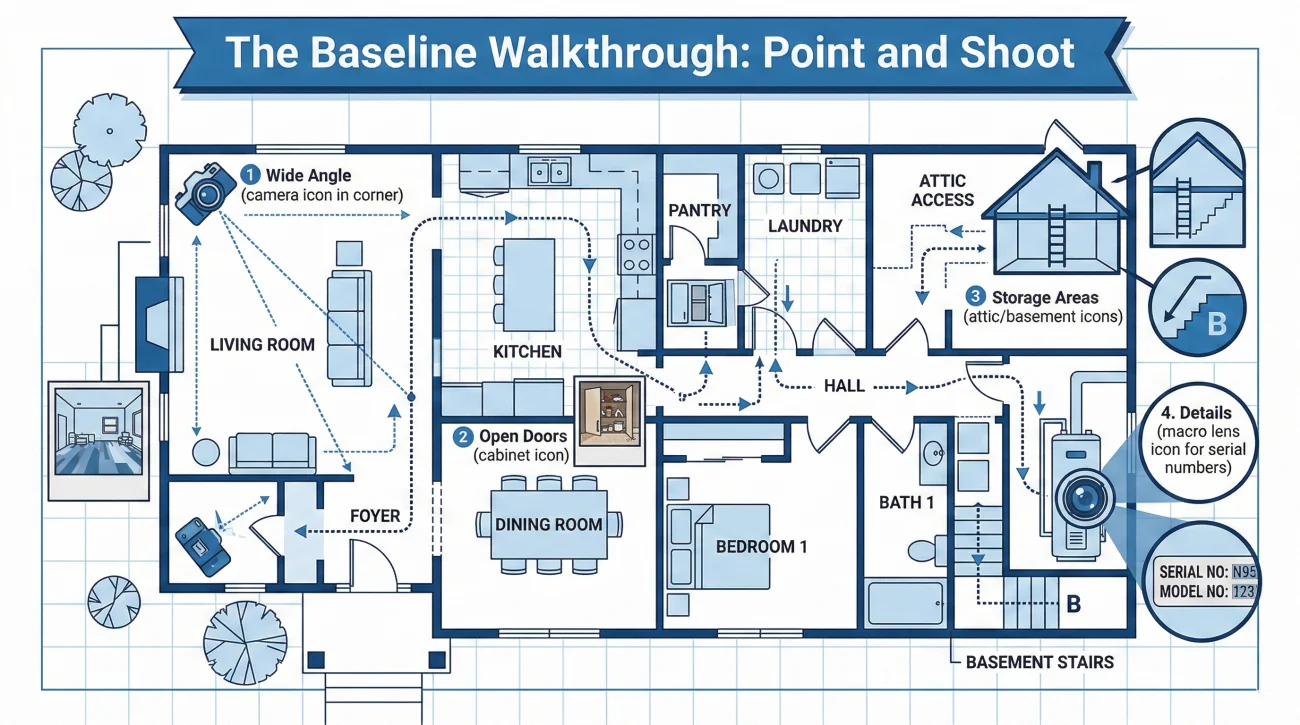
Before you bring in boxes, before you let relatives look around, and before you throw away a single piece of junk mail on the counter, you must capture the baseline. A visual record is the absolute best defense against the phrase, “I thought there was a second set of golf clubs.” If it is not in the baseline photos, you have objective proof of the home’s state on the day you began your administration work.
The most effective executors I work with are the ones who pace themselves. They do not try to empty the house in a weekend. They grab their camera, lock the doors, and do a systematic sweep.
How to Execute the Walkthrough
Start at the front door and work your way clockwise through the home. Do not organize yet. Just point and shoot.
- 📸 The Wide Angles: Stand in the corners of each room and take wide shots capturing the floor, walls, and ceiling. Show how the furniture is arranged.
- 📸 The Open Doors: Open every closet, cabinet, and drawer. Take a clear, well-lit photo of the contents as they sit.
- 📸 The Garages and Outbuildings: These are notorious for holding hidden value. Photograph workbenches, tool chests, riding mowers, and vehicle license plates.
- 📸 The Grey Areas: Do not skip the attic, the basement, or seasonal storage bins. These areas often contain items belonging to adult children or ex-spouses, which can trigger disputes later.
⚠️ Warning: Ensure your phone or camera has a solid charge and plenty of storage. A typical 3-bedroom home might require 200 to 400 photos to capture adequately. Do not delete blurry background photos immediately; sometimes that blur in the background is the only proof that a specific rug was in the room.
Once you have taken the photos, back them up. Create a dedicated folder on your computer or cloud storage named something like Estate_Photos_Initial_Walkthrough and organize them by room (e.g., 01_Living_Room, 02_Master_Bedroom). This simple naming convention will save you hours of hunting later.
Handling Safes, Lockboxes, and Hidden Caches
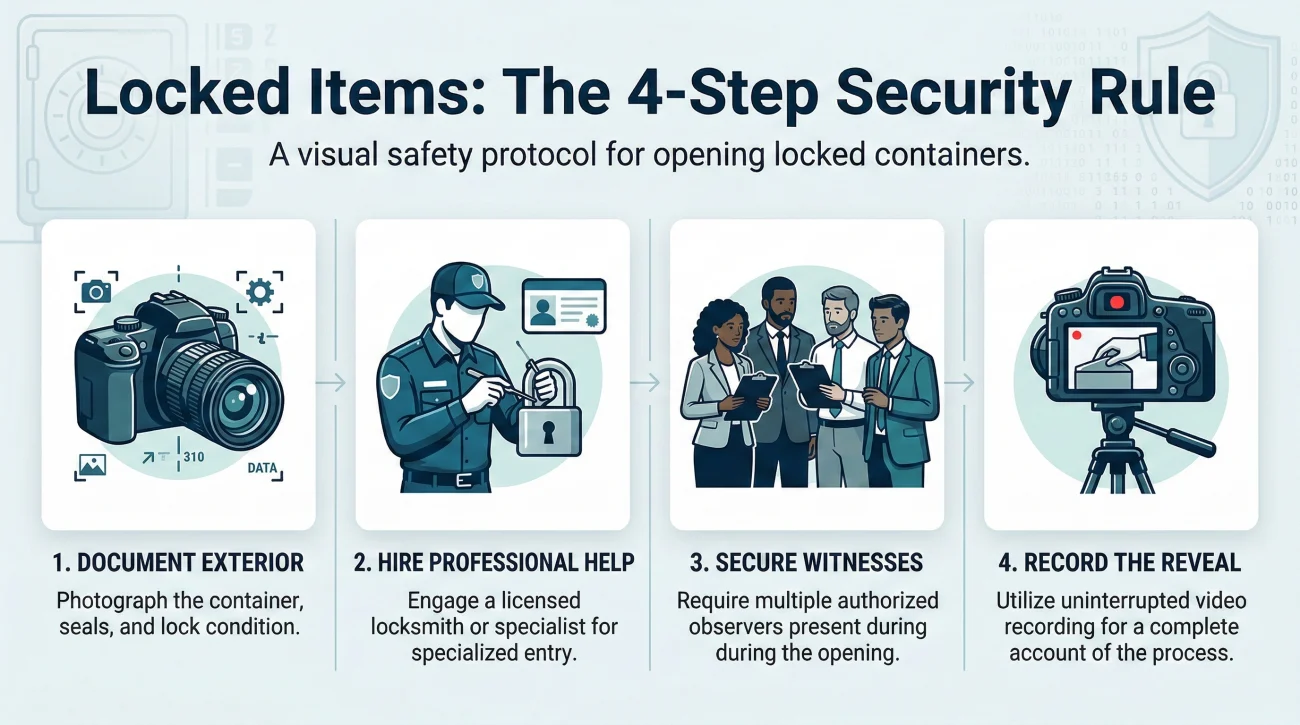
During your walkthrough, you will likely encounter locked filing cabinets, a floor safe, or a locked toolbox. This is a critical operational moment. A common mistake is for an executor to pry open a safe alone, find a small amount of cash, and deposit it. Even if handled perfectly legally, doing this without a witness opens the door for someone to accuse you of hiding assets.
If you find a locked container where you do not have the key or combination:
- 🔒 Document the exterior: Take a photo of the locked safe in its original location. Note it on your inventory as “Locked Safe – Pending Access.”
- 🔒 Hire a professional: Do not attempt to drill it yourself. Hire a bonded locksmith.
- 🔒 Bring a witness: Have a co-executor, an attorney, or a neutral third-party present when the safe is finally opened.
- 🔒 Video the reveal: Record a continuous video from the moment the door opens until every item inside is pulled out and cataloged.
Categorizing Items to Save Your Sanity
Once the house is documented visually, the next step in creating an estate household contents inventory is categorization. In my early days helping executors, I saw people burn themselves out trying to count every individual hand towel and coffee mug. You simply do not have the time for that level of micro-tracking.
Instead, group items into functional categories. This approach allows you to catalog an entire room in minutes rather than days.
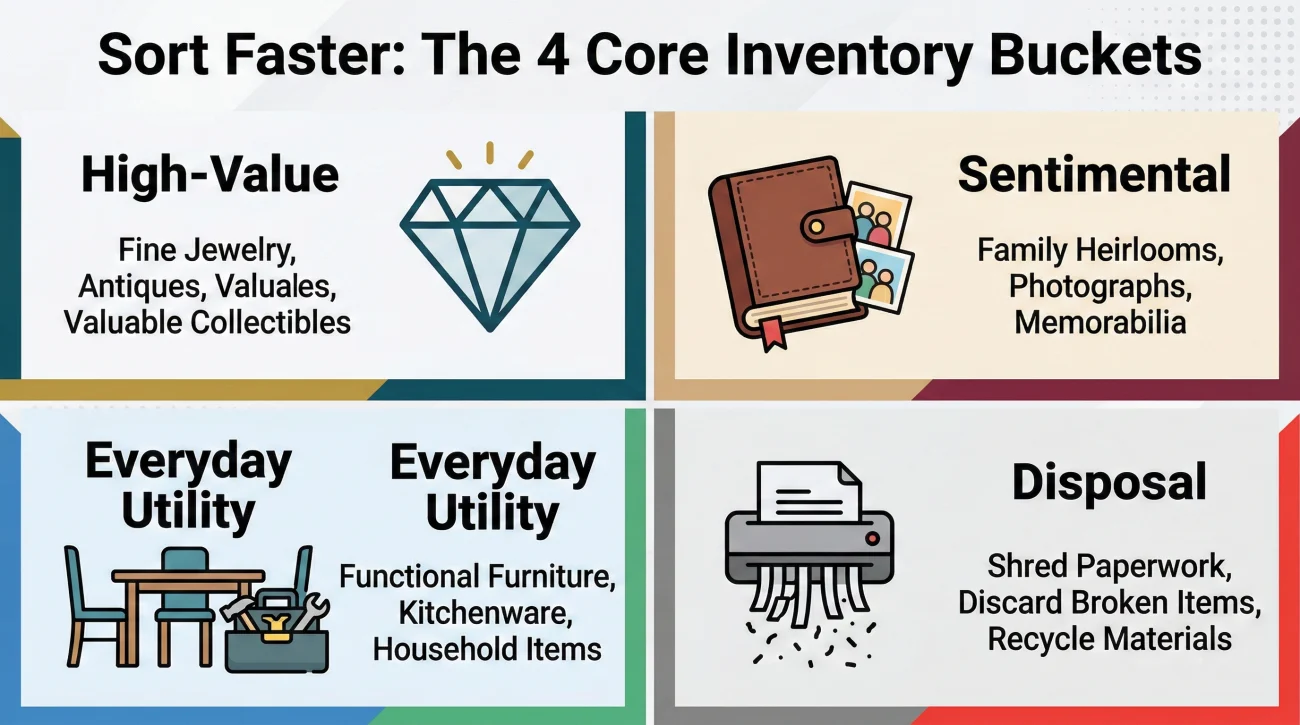
The Four Core Categories
In day-to-day admin work, I find that sorting the physical environment into these four buckets simplifies everything:
| Category | Description | Inventory Approach |
|---|---|---|
| High-Value / Scheduled | Vehicles, fine jewelry, fine art, antiques, large electronics, safes, firearms. | Itemize individually. Note location, condition, and any visible identifying marks or serial numbers. |
| Sentimental / Specific Bequests | Photo albums, military medals, family bibles, specific items mentioned in a will. | Itemize individually or by specific collection (e.g., “Box of family photos from 1980s”). |
| Everyday Utility | Standard furniture, clothing, kitchenware, linens, basic tools, books. | Group by type and room. (e.g., “Living room soft furniture,” “Master bedroom closet – everyday clothing”). |
| Disposal / Shred / Hazardous | Expired pantry food, old cleaning supplies, broken items, old junk mail. | Do not inventory. Photograph the pile if needed, then securely dispose, shred, or donate. |
Writing down “6 dinner plates, 4 coffee mugs, 1 toaster, 1 coffee maker, 8 forks, 1 blender.”
Recording “Kitchen countertop appliances and daily-use dishware (See photos KITCHEN_05 through KITCHEN_08).”
Proof Mapping: Linking Items to Documents

For everyday utility items, the photograph is usually enough proof of existence. However, for high-value items, you need to map the physical asset to documentary evidence. This is where a lot of physical inventories fail—the executor lists a “Rolex watch” but never tracks down the original receipt or insurance appraisal.
When learning how to inventory personal property after death, you must understand that an item is only as valuable as the proof backing it up. As you go through the home office or filing cabinets, actively look for a paper trail. Start with the homeowner’s insurance policy first—it is the most likely place to find high-value items already listed by name and appraised value.
- 📄 Insurance Schedules: Check the deceased’s homeowner’s insurance policy. Is there a “scheduled personal property” rider for jewelry, art, or tech?
- 📄 Appraisals: Look in filing cabinets for past professional appraisals, especially for antiques or coin collections.
- 📄 Receipts and Certificates: Check for certificates of authenticity tucked behind framed artwork or receipts inside jewelry boxes.
When you find these documents, scan them and name the file clearly (e.g., Appraisal_GoldWatch_2019.pdf). Note the existence of this document on your inventory sheet, and store the digital file in a dedicated Estate_Assets_Proof folder.
When the Paper Trail Goes Cold
What do you do when you find a seemingly valuable piece of art or jewelry, but there is absolutely no paperwork in the house? Do not guess. Log it on your sheet with the note Unverified – Pending Professional Appraisal. This protects you from liability if the item turns out to be costume jewelry, and it clearly communicates to stakeholders that a professional valuation will be required later.
💡 Pro Tip: Your physical home contents list is just one layer of your overall administrative duties. To see how this physical list integrates with bank accounts and financial records, you should review our comprehensive Executor Asset Inventory Guide, which teaches the full master tracking system.
Even with perfect documentation, physical items remain uniquely vulnerable to disappearing. To protect the baseline you just captured, you must establish strict rules about who can enter the physical space.
Setting Boundaries and Communication Hygiene
One of the most challenging field notes I have gathered over the years involves the phrase, “I just want to come over and help clean.” Family members often have the best intentions, but letting multiple people into the home before the inventory is complete is an administrative disaster.
Items get moved. Paperwork gets thrown away. Things “disappear.” You must secure the property and set clear expectations with stakeholders immediately. This requires polite, firm, written communication.
Script: Securing the Property
If family members are asking for access to the house, you need to establish that the space is locked down until your official documentation pass is complete. You can adapt this email template:
Subject: Update on [Deceased’s Name]’s home and upcoming inventory
Hello everyone,
I am currently in the process of beginning the administrative work for the estate. My first major task is to complete a full, formal inventory and photographic record of everything in the house.
To make sure I capture everything accurately and keep the records pristine, I am keeping the house secured and closed to visitors right now. Please do not drop by the house or attempt to remove any items, even if it is something you loaned to [Deceased’s Name] or something they promised you.
Once I have finished the complete inventory and all items are properly documented, I will share the next steps regarding how we will handle the household contents.
I appreciate your patience and understanding as I work through this necessary process.
Best regards,
[Your Name]
Script: Requesting Prior Records from a Vendor
If you find a high-value item but cannot find the paperwork, you may need to reach out to the original dealer or an appraiser whose card you found in the home. Remember our communication formula:
Subject: Request for historical appraisal records – Estate of [Deceased’s Name]
Hello [Vendor Name],
I am handling the estate administration for [Deceased’s Name]. We located a [Item Description, e.g., 1920s Steinway Piano] in the home, along with your business card in their files.
I am trying to locate the most recent appraisal or purchase receipt for our estate inventory records. Could you please check your records and provide a copy of any documentation you have on file for this item?
Please let me know if you are able to locate this, or what specific information you need from me to release the records.
Thank you,
[Your Name]
Template: The House Contents Inventory Sheet
You do not need complex software to create a highly functional house contents inventory template. A standard spreadsheet is usually the best tool. I recommend setting up a sheet with the following columns to keep your data structured and easy to read.
| Room / Location | Item or Category Description | Type | Photo File Names | Proof / Notes (Appraisals, Receipts) | Current Status |
|---|---|---|---|---|---|
| Master Bedroom | Everyday clothing and shoes | Utility | MBED_01 to MBED_04 | None required. | Pending sorting/donation |
| Living Room | Grandfather clock (Howard Miller) | High-Value | LIV_Clock_01, LIV_Clock_Detail | Receipt found in desk (Receipt_Clock.pdf) | In place, documented |
| Home Office | Filing cabinet (Locked) | Utility/Docs | OFFICE_09 | Key missing. Need locksmith. | Pending access |
| Garage | Hand tools and gardening equipment | Utility | GARAGE_10 to GARAGE_15 | None required. | In place, documented |
By keeping the “Type” column, you can quickly filter your spreadsheet later to just see the “High-Value” items if you need to share a specific list with an appraiser or an estate sale company.
Final Thoughts on Physical Asset Documentation
Tackling the physical contents of a home goes beyond mere accounting. An unorganized home is fertile ground for family arguments—a vague memory about a missing painting can spiral into years of resentment. By creating a rigorous, photo-backed executor personal property checklist, you are doing more than protecting the estate’s financial value.
You are protecting relationships. A clear, objective inventory removes suspicion, provides transparency, and allows the family to focus on grieving rather than arguing over who took the dining room chairs. Trust your process, document the baseline, and the rest of the physical administration will fall into place.
❓ FAQ
Executors often run into highly specific roadblocks when dealing with a deceased person’s physical property. Here is how I typically advise handling these common, real-world scenarios.
🎥 Should I video the house before cleaning it out?
Yes, a continuous video walkthrough is an excellent backup to still photos. It provides context for how rooms connect and can capture audio notes you make as you walk. Still photos, however, are often better for capturing specific details like serial numbers or hallmarks.
📚 How do I inventory massive collections, like hundreds of books or records?
Unless the collection contains known, rare first editions, treat it as a bulk utility item. Photograph the shelves to capture the volume, and log it as “Library Collection – Approx. 400 mixed hardcover and paperback books.” If family members believe specific items in the collection are valuable, ask them to provide documentation or hire a specialist appraiser for that specific section.
🖼️ What should I do with family photos when clearing an estate?
Treat physical photos as “Sentimental” assets. Do not throw them away, even if there are duplicates. Box them carefully, label the boxes clearly, and document their existence on your inventory sheet. Later, you can discuss with family members about digitizing or distributing them.
🧾 How do I prove who owns personal property in an estate?
Ownership of physical items is often proven through paper trails. Look for original purchase receipts, scheduled homeowner’s insurance riders, certificates of authenticity, or professional appraisals. Note any documents found in your inventory tracking sheet.
📋 How detailed does an estate inventory of household goods need to be?
It needs to be detailed enough to prevent reasonable disputes. High-value items need specific descriptions, serial numbers, and photos. Utility items just need a categorical description and a photograph of the pile or room area.
🚗 What happens if family members take items before the inventory?
If items are removed before documentation, it creates gaps that can lead to conflict. If you know this has happened, document it immediately. Note who took what (if known) and when, and send a written communication asking that no further items be removed until the formal process is finished.
🗝️ What if there is a safe in the house but I cannot find the key?
Do not attempt to break it open yourself. Document its location, log it on your inventory as “Locked – Pending Access,” and hire a bonded locksmith. When the safe is opened, ensure you have a neutral witness present and record a video of the contents being removed.
🐕 What do I do with the deceased’s pets during the inventory?
Legally, pets are considered personal property of the estate, but they require immediate care. Secure temporary housing for them with family, friends, or a shelter. Keep a detailed log of any veterinary, food, or boarding expenses, as these can often be reimbursed by the estate.
📦 How do I handle items left behind by an ex-spouse or adult children?
If someone claims property in the house belongs to them, do not release it immediately. Segregate the items, document them, and ask the claimant to provide proof of ownership (like a receipt or written agreement). Once verified, document the handover in writing.
🏷️ Should I hire an estate sale company right away to empty the house?
No. You must build your baseline inventory first. An estate sale company needs to know exactly what is available to sell and what specific items (like sentimental pieces or specific bequests) are off-limits. Handing over the keys without an inventory puts you at administrative risk.
⚠️ Disclosure: I'm not an attorney and nothing on this site is legal or tax advice. The content covers process, organization, and workflow—the operational side of estate administration. For legal interpretation, jurisdiction-specific deadlines, contested situations, or tax matters, please work with a licensed professional in your state.